
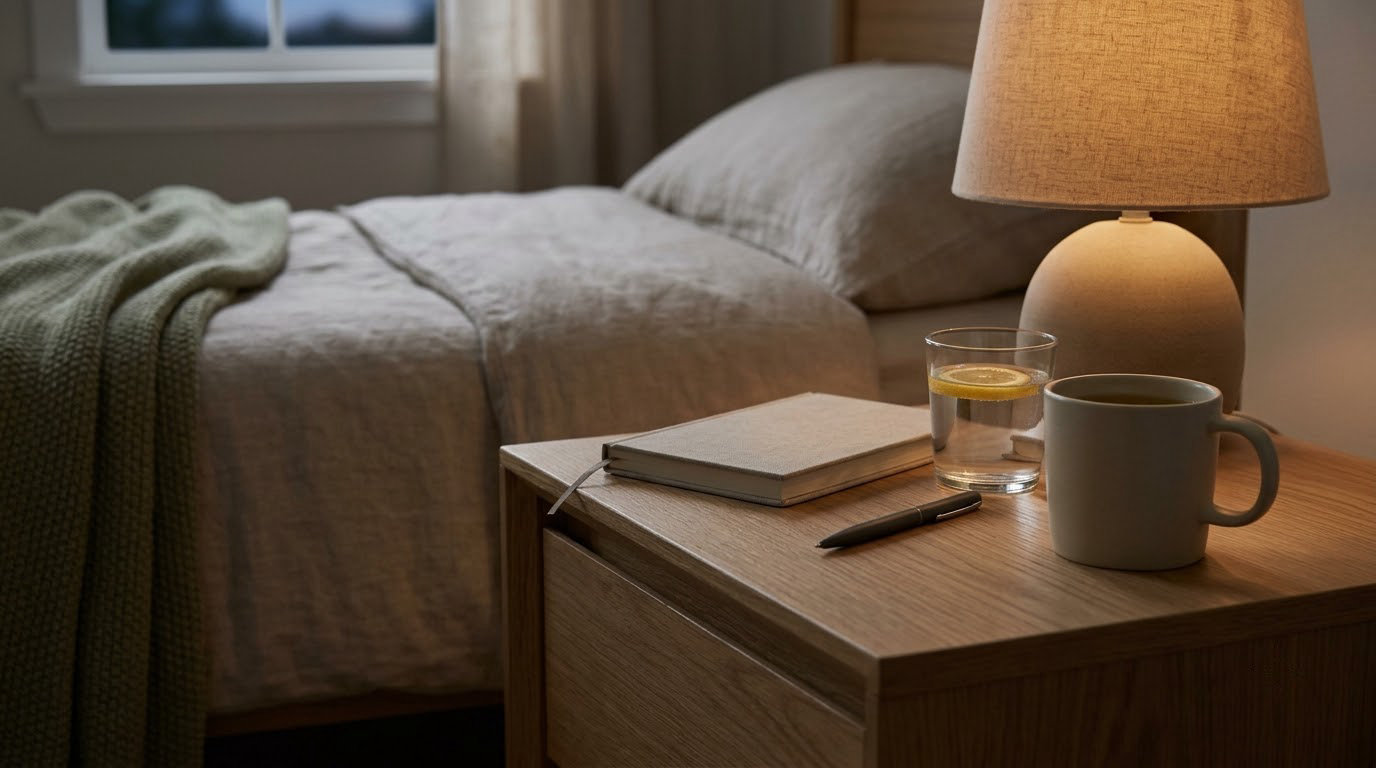
To stop emotional eating at night, you break the pattern in three places: eat a meal that actually satisfies you in the evening, pause before the fridge so you can name what you are feeling, and swap the food for something that soothes you the same way. Most people need a week or two of practice, and a rough night here and there is normal. You are retraining a habit that took years to build, so treat it like that.
I have talked to a lot of people who describe the same evening: a normal day of eating, a hard afternoon at work, and then a standing position at the fridge at 9 pm feeling like a bottomless pit. Nothing changed in their hunger. Something changed in their mood, and food was the fastest thing available to soothe it.
The trouble is that food works. For about an hour, the ache softens. Then comes the second wave, guilt about what you just ate, and a promise to behave tomorrow, which sets up tomorrow’s restriction and tomorrow’s rebound hunger. That loop is the whole problem, and the way out is not willpower. It is a different set of evening habits.
This guide is general information, not medical advice. If nighttime eating is affecting your sleep, your weight, or your mental health, talk to a doctor or a registered dietitian about it.
Table of Contents
- What You Need
- Step-by-Step
- Common Mistakes
- Frequently Asked Questions
- What can I eat at night when I am hungry and upset?
- How can I stop eating late at night when I am not physically hungry?
- Do calming teas or nighttime drinks help with emotional eating?
- How long does it take to change a nighttime eating habit?
- When should I seek help for emotional eating at night?
- What should I do after I overeat at night?
- Take the First Step Tonight
What You Need
You do not need a program, an app subscription, or a new kitchen. You need six things, and most of them are already in your house.
A dinner you would call filling
Most evening eating starts with an underwhelming dinner. If your last real meal was lunch at your desk, your body arrives at 9 pm asking for everything at once. Have a plate that includes protein, a fiber-rich carbohydrate, some fat, and enough volume to take up space. See step 2 for what that looks like.
A hunger scale, or just your own words
Something to rate yourself against between one and ten, or simply the words “actually hungry” versus “not hungry, upset.” A note in your phone works. The point is to catch the difference before you open the fridge, not to grade yourself.
A large glass and a slow way to drink it
Thirst often wears the same coat as hunger in the evening. People in eating-disorder and self-control communities report that drinking a big glass of cold water slowly is one of the fastest ways to buy ten minutes. It works because it occupies your hands and your pace.
One calming activity that is not screens
A book, a stretch, a short walk around the block, a shower, or ten minutes of a guided audio. It has to be something you can do standing up in your kitchen at 9 pm without getting dressed first.
A notebook or tracking app kept near the kitchen
This is the single most useful tool in this whole plan, and it costs nothing. When the journal is the thing within arm’s reach, the urge turns into a writing prompt instead of a fridge-opening reflex. People who keep one nearby often report that the act of writing alone blunts the craving, sometimes within a few lines.
One distraction with a fixed length
The Harvard Health advice people borrow most often is simple: distract yourself with something that takes about five minutes. Five minutes is short enough that you will actually start it, and long enough that a passing urge often loses its edge on the other side.
Step-by-Step
Here is the six-step sequence for learning how to stop emotional eating at night. Work through it in order and give each step a week or two before judging it. You are looking for one small change at a time, not a new personality by Friday.
Step 1: Identify What Happened Before the Craving
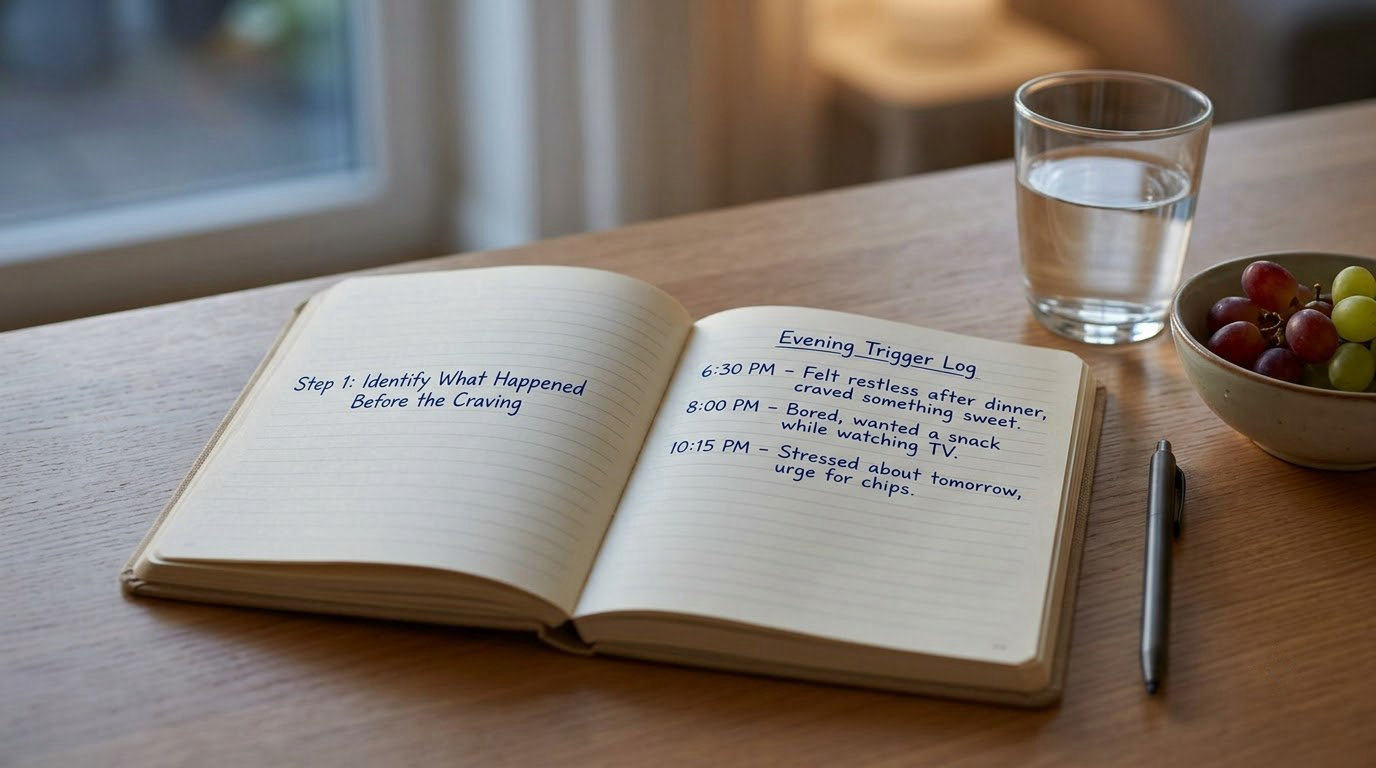
Start with data, not judgment. When an evening episode happens, write down five things: the time, your hunger level from one to ten, the emotion you were feeling, what happened in the few hours before, and what you were doing and where you were.
The point of the log is not to catch yourself doing something wrong. It is to separate four different experiences that all feel identical from the inside.
- Physical hunger builds gradually, shows up as a hollow feeling, and any reasonable meal satisfies it.
- Boredom arrives when nothing is happening and food looks more interesting than the alternative.
- Stress usually shows up with tension in the shoulders, an unfinished task, or a message you did not want to open.
- Loneliness or low mood often looks like restlessness and a wish to be comforted.
Do not judge one bad evening. Look for repetition across ten or fourteen days. A pattern that shows up three times is data. A pattern that shows up once is just Tuesday.
How you will know it worked: after two weeks you can name your top three evening triggers and the time of day they show up, which is more useful than a generic list of healthy eating advice.
Step 2: Build a Balanced Evening Meal
Dinner is the foundation of this entire plan, and this is where most restrictive plans go wrong. If you undereat during the day, you arrive at night physically hungry, and no amount of willpower survives that.
Build dinner from four parts.
- Protein: lentils, beans, tofu, eggs, fish, chicken, or Greek yogurt.
- Fiber-rich carbohydrate: brown rice, whole grain bread, sweet potato, or a bowl of oats.
- Healthy fat: avocado, olive oil, or a spoonful of nut butter.
- Volume: roasted or steamed vegetables in whatever quantity actually fills your plate.
Two combinations that work well: lentils with roasted vegetables and brown rice, or Greek yogurt with berries and a spoon of nut butter when dinner needs to be fast. A baked sweet potato with black beans and avocado takes about twenty-five minutes and covers all four parts.
For more ideas on the vegetable side, how to eat more vegetables without cooking every night keeps the volume problem cheap to solve.
No single food fixes emotional eating. Sleep, stress, and routine do most of the work. Food just stops you arriving at the evening already behind.
How you will know it worked: by 9 pm you feel satisfied rather than restless, and your log shows fewer late-night fridge visits.
Step 3: Slow Down and Check Your Hunger
The pause is the whole technique. Most people open the fridge and decide inside three seconds, which is faster than thought. Give yourself ten minutes before you decide anything.
During those ten minutes, rate your hunger from one to ten and answer four questions. Are you physically hungry, or is this boredom, stress, or loneliness? What would genuinely satisfy the feeling, not the stomach? Do you want food, rest, movement, or company? What did you eat yesterday at this time?
If you do eat, eat sitting down and slowly. Notice fullness as it arrives rather than eating past it out of habit. Stopping when satisfied is a skill, and it is a learned one. It does not require eating perfectly.
People on anti-restriction forums push back hard on any advice that sounds like eat less during the day, and they are right to. The goal here is satisfaction, not restriction.
How you will know it worked: some episodes end without eating, and the ones that do not are ones you actually chose rather than ones that happened to you.
Step 4: Create a 20-Minute Evening Wind-Down

The urge rarely appears out of nowhere. It fills a gap. When you leave a wide empty hour between dinner and sleep, food walks into it. A short, repeatable routine closes that gap.
- Ten minutes before bed, start closing the kitchen. Put away leftovers, wipe the counter, run the dishwasher. It is a physical signal that the eating part of the day is done.
- Brush your teeth. Do it earlier than you used to. It is a surprisingly strong cue that stops the fridge raid.
- Ten minutes of something gentle. Stretch, read, journal three lines, or listen to calm audio.
- Dim the lights and put the phone in another room. Late scrolling is the most common bridge between a neutral evening and a 10 pm fridge visit.
Keep it short enough to survive a bad day. On the nights you are exhausted, the version that still happens is two minutes: brush teeth, dim lights, phone in the hallway.
How you will know it worked: evening episodes cluster later or shrink in size, and falling asleep takes less effort.
Step 5: Replace the Automatic Food Response
Stopping a behavior is harder than it sounds, because you leave the empty space it filled. Replacing it is easier, and this is the technique people in r/loseit and r/getdisciplined identify most often as the thing that actually worked for them: what did you swap it with?
Match the swap to the specific emotion. Stress wants movement or breath. Boredom wants engagement. Loneliness wants contact. Fatigue wants rest, not stimulation.
- Stress: a ten-minute walk, slow breathing, or a short stretch. Movement burns the arousal instead of adding sugar to it.
- Boredom: anything with a next chapter, a next move, or a next answer.
- Sadness: write the sentence “this does not fix anything” and keep writing. Naming the feeling reduces its grip more reliably than most people expect.
- Loneliness: call or text one person, or put on a show where someone talks to you.
- Anxiety: a shower, a tidy task, or slow breathing with a longer exhale than inhale.
- Fatigue: go to bed early. Nothing improves tomorrow like eight hours of sleep.
Whatever the swap, it should be something you can start within sixty seconds of noticing the urge. If it takes twenty minutes to plan, the food wins.
How you will know it worked: you start reaching for the swap instead of the fridge, and the urge still fades even when you do eat something eventually.
Step 6: Review Patterns and Adjust the Plan
Once a week, ideally Sunday evening, read your notes. What time was the urge? What was the emotion? What did you do instead? Did you eat dinner with protein?
Change one thing per week. If you fix dinner, do not also overhaul your entire evening. Small single changes are what actually stick.
Setbacks are part of this, not proof it failed. Mayo Clinic’s guidance on emotional eating leans hard on learning from setbacks rather than treating them as failure, and that is the right read. A single big evening does not reset a routine. It is one data point.
Two habits tend to pay off fastest. Keeping your phone out of the bedroom removes the single most common trigger, and keeping the notebook next to whatever you eat from gives the urge somewhere else to go.
Watch for all-or-nothing thinking, which is the belief that anything other than perfect means you have failed. That belief is the engine of the guilt loop and it is worth challenging every time it shows up.
How you will know it worked: episodes become less frequent, less large, or less secret, and losing sleep to it stops being normal.
Common Mistakes
Restricting all day to control the evening
This is the most common mistake and the one that backfires hardest. Under-eating during the day produces rebound hunger after dark, and rebound hunger feels exactly like emotional eating even when it started as biology. Eat a real dinner instead.
Skipping meals because the day was busy
People describe skipping meals all day and then a total loss of control in the evening as their single most repeated pattern. If you know a day will run late, plan a backup dinner that takes fifteen minutes, like eggs on toast or yogurt with fruit.
Eating standing up over the sink
Standing removes the settling-in part of eating, so you finish before you register fullness, then feel unsatisfied and go back. Sit down, even at the counter, and give it ten minutes.
Relying on willpower alone
Willpower at 9 pm after a hard day is a low-quality resource. Do the environment work earlier: close the kitchen, brush your teeth early, keep trigger food out of sight. Changing the setup beats winning the same argument every night.
Shame-based journaling
A log full of what a disaster you are does not change behavior, it just adds stress, and stress is one of the triggers. Record time, hunger, emotion, and context. Behavior only. Save the self-attack for nothing.
Trying to eliminate every craving
Full abstinence tends to fail and it usually ends in the exact behavior you were trying to avoid. Aim to change the response, not to abolish the urge. The urge is a signal. It is not an instruction.
Skipping sleep and caffeine timing
Short sleep raises hunger the next day and lowers self-control. A tired brain at 9 pm is the most predictable setup for a raid. Aim for a consistent bedtime, keep caffeine out of the afternoon, and get bright light in the morning, since morning light is one of the strongest anchors for your body clock.
People who have had success with cutting back added sugar during the day report that late-night cravings calm down as a side effect, not as the main goal. Our guide to stopping sugar cravings in the afternoon covers that side of things.
Frequently Asked Questions
What can I eat at night when I am hungry and upset?
Eat something small, protein-forward and warm if you like: Greek yogurt with berries, a boiled egg with a few nuts, or a small bowl of soup. The aim is to give your body something real, not to find a perfect food. Add a piece of fruit if you want sweetness. Sitting down and eating slowly matters more than what you choose, because eating over the sink leads to eating past fullness without noticing it.
How can I stop eating late at night when I am not physically hungry?
Delay the decision by ten minutes and name the feeling before you open the fridge. Drink a large glass of water slowly while you wait, then do something fixed in length: a ten-minute walk, a shower, or three lines in a notebook by the kitchen. If the urge passes, you were thirsty, bored or uncomfortable rather than hungry. The goal is a replacement behaviour, not a test of willpower.
Do calming teas or nighttime drinks help with emotional eating?
They help more than they cure. A warm herbal tea takes a few minutes to make and drink, which creates the ten-minute delay that works, and the ritual of preparing it is soothing on its own. Caffeine-free options such as chamomile or peppermint are the better choice after mid-afternoon, since caffeine late in the day makes your sleep lighter and next night’s cravings easier. Water and decaf coffee are common substitutes people find useful.
How long does it take to change a nighttime eating habit?
Most people notice the first difference within one to two weeks, and a meaningful change usually takes six to eight weeks of steady effort. You will see progress before you feel confident: fewer episodes first, then smaller ones, then more nights where you simply sleep through it. Consistency matters more than intensity, so keep dinner and the wind-down routine stable even during a busy stretch.
When should I seek help for emotional eating at night?
Seek help if you eat large amounts in a short period, feel unable to stop, eat in secret, or wake at night unable to sleep without eating. Those patterns may point to binge eating disorder or night eating syndrome, which are diagnosed by a clinician and treated with approaches such as cognitive behavioral therapy. A registered dietitian can also help if daytime eating is driving your evening hunger. Nothing here is a substitute for that assessment.
What should I do after I overeat at night?
Do not restrict the next day and do not skip meals to make up for it. That approach is the main fuel behind repeated episodes. Go back to your normal meals at your normal times the following day, note what triggered it in your log, and adjust one small thing for the next evening. A single episode is an unpleasant data point, not a reset, and treating it as failure is what keeps the cycle going.
Take the First Step Tonight
You do not need to overhaul your life to start. Tonight, do three things: name the trigger that showed up in your evening, build one balanced plate with protein and fiber, and choose your replacement before bed so it is waiting when the urge arrives.
Keep the notebook close, close the kitchen early, and brush your teeth before you are tired enough to negotiate with yourself. Progress over perfection. One handled evening is a better result than a perfect week you convinced yourself was impossible.
If you want the plant-based version of those evening meals, soaking nuts and seeds before eating is a simple prep habit worth adding to your routine, since nut butter and seeds carry a lot of the staying power you want at night.
This article is for general education and is not medical advice or a treatment plan. If nighttime eating is regularly causing distress, disrupted sleep, or weight changes, a doctor or registered dietitian can assess what is going on and what support fits. Anything beyond a habit you can change at home belongs with a professional, and asking is a strength, not a failure.