
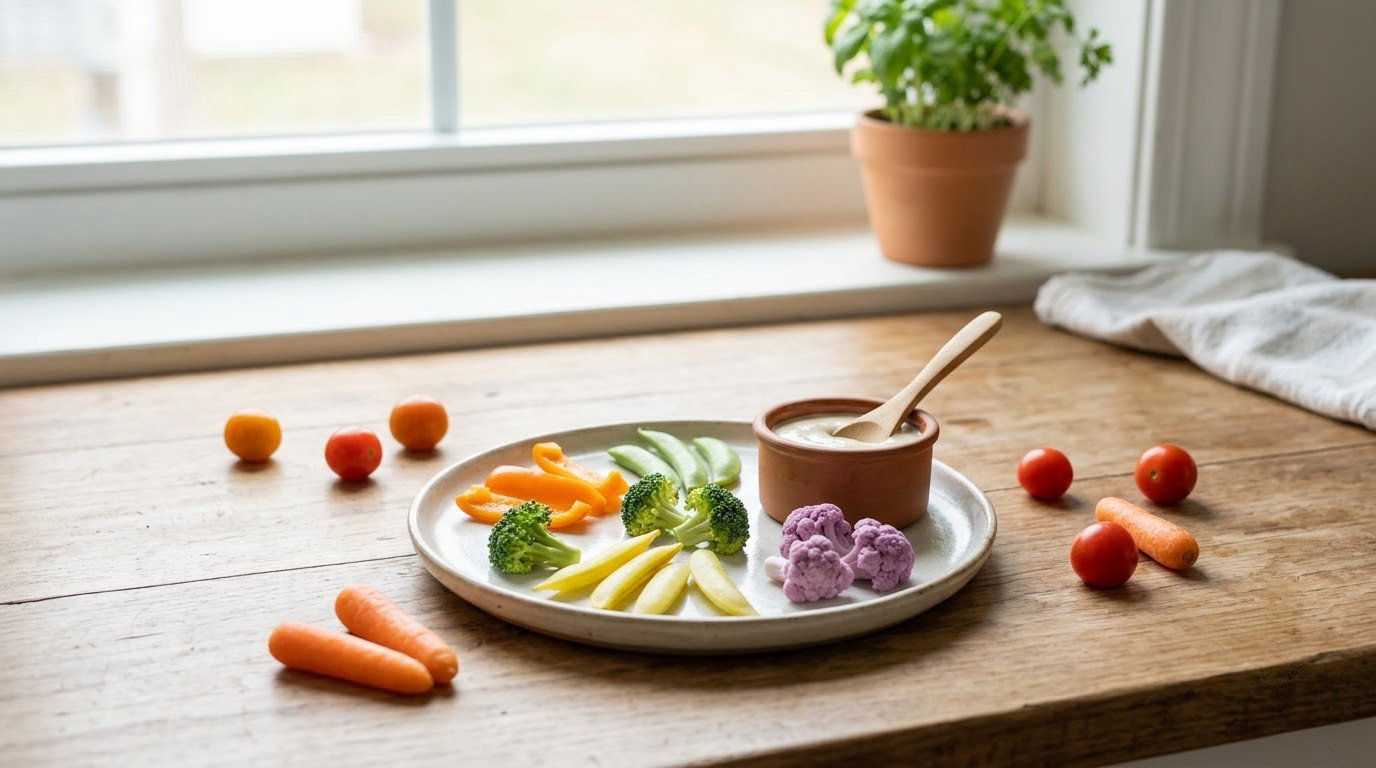
To get kids to try new vegetables, keep the vegetable on the menu and take the pressure off. Offer a small portion alongside two foods your child already eats, say nothing about whether they take a bite, and repeat the same food 10 to 15 times over two or three weeks before you judge it. Most refusals clear with repetition, not persuasion.
The reason this works is that refusal is rarely about taste. Children are born with food neophobia, an instinct to avoid unfamiliar plants, because some unfamiliar plants really are toxic. A new vegetable also looks unfamiliar, smells unfamiliar, and has a texture they have never handled.
That instinct fades with exposure. Each uneventful encounter moves a food one step closer to the child’s personal list of safe things, and children eat what has become familiar. Your job is to make the encounters uneventful.
Most of the work is prep, not willpower. Batch-cook two or three vegetables on Sunday, following how to eat more vegetables without cooking every night, so a Tuesday dinner is never the moment a new vegetable gets decided against.
Table of Contents
- What You Need
- Step-by-Step: A Low-Pressure Plan for New Vegetables
- Common Mistakes and Better Alternatives
- Tips for Different Ages and Preferences
- How to Keep the Meal Peaceful
- Frequently Asked Questions
- How many times should I offer a new vegetable before giving up?
- What is the 5-2-1-0 rule for feeding kids?
- Does the three bite rule actually work?
- Should I hide vegetables in food my child already likes?
- Should I cook a separate meal for my child who refuses vegetables?
- Do I need to worry if my child will not eat vegetables?
- Conclusion
What You Need
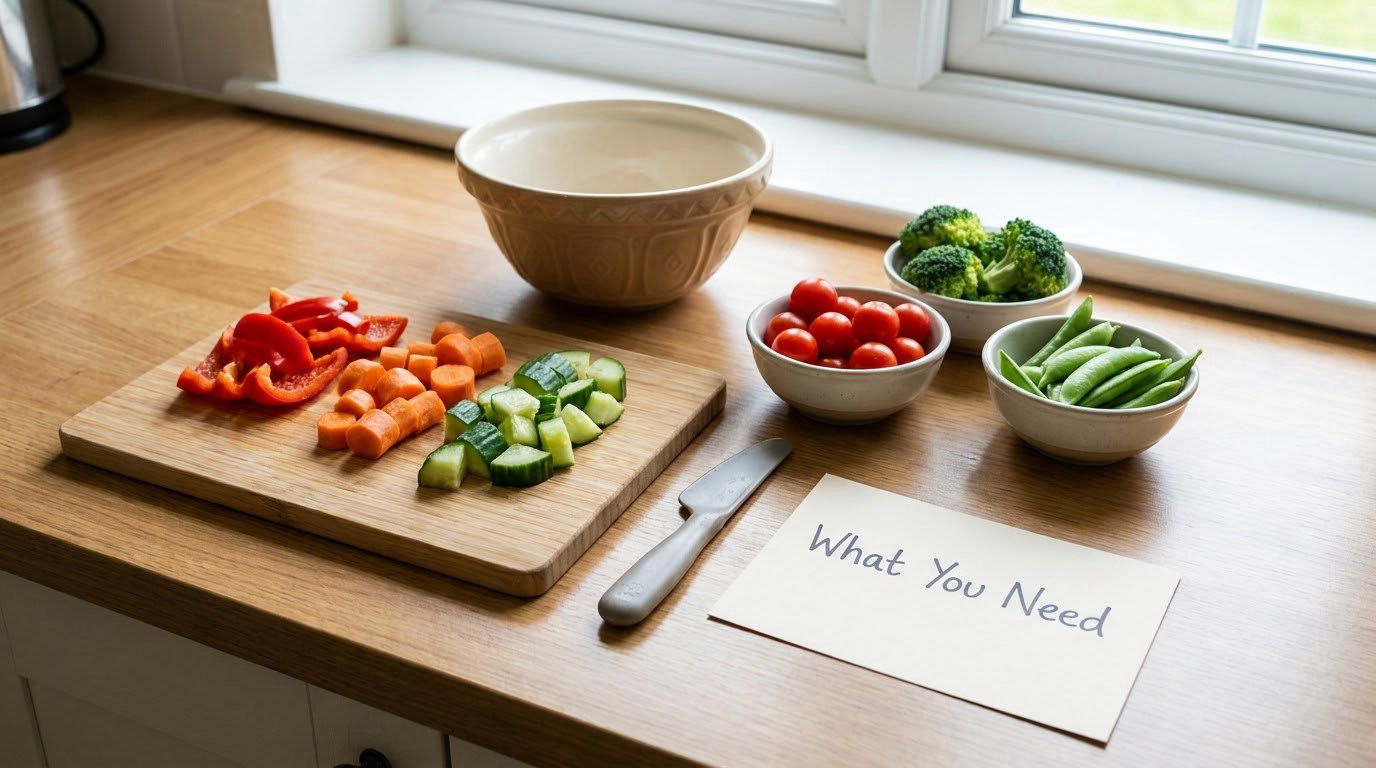
You do not need a special cookbook. You need a few familiar flavors within reach, small portions, child-safe tools, and a decision about how you will handle the first refusal before it happens.
A few flavors your child already accepts
Butter, olive oil, grated cheese, garlic, salt, a splash of cream, cinnamon, smoked paprika, or the sauce your family already uses. These are the vehicles, and they are doing most of the work in early exposures.
Small bowls and small portions
A teaspoon, three pieces the size of a fingertip, or a quarter of a mini muffin tin. A full serving on the plate reads as a demand before the food is even tasted.
Child-safe tools
A kid’s knife, a small peeler, a low drawer they can reach, and a stool at the counter. Let them handle the vegetable with you and the game changes.
One familiar dish you already make
Pasta, rice, scrambled eggs, oatmeal, a cheese sandwich, soup. You will be adding the new vegetable to something that already works, not replacing a meal.
A plan for the first no
Decide now that you will not bargain, comment, or serve a substitute. Having that settled in advance is what stops the negotiation spiral at 6pm.
Step-by-Step: A Low-Pressure Plan for New Vegetables
1. Choose One Familiar Vegetable as a Base
Combine the unfamiliar vegetable with a food the child already accepts. The new vegetable stays visible and recognizable, which is what makes the exposure count.
This structure comes from the Division of Responsibility, a feeding framework from Ellyn Satter that splits the meal into what the adult decides and what the child decides. You decide what is offered, when, and where. The child decides whether to eat it and how much.
The popular shorthand is the 5-2-1-0 approach.
| Number | Meaning | What it looks like at dinner |
|---|---|---|
| 5 | Exposures to the new food | Five separate unpressured chances to see, smell and touch it |
| 2 | Familiar foods | Two accepted foods on the plate, like pasta and cheese |
| 1 | New food | One new vegetable, in a small portion, clearly visible |
| 0 | Pressure | No requests to eat it, no comments, no deals |
So: roasted carrot sticks next to buttered pasta and grated parmesan, with a spoonful of the carrot offered and nothing said about it.
2. Offer a Small, Manageable Portion
Start with a teaspoon, a small forkful, or four or five bite-size pieces. The portion needs to be easy to sample and impossible to feel like a test.
Some families use the three bite rule, where the child is invited to taste, lick and smell the food across a meal, with no expectation of swallowing. Treat it as permission, never as a quota.
Small portions also let you keep offering. A refused teaspoon leaves room for a second one, and a second refusal is data, not failure.
3. Use a Familiar Flavor and Texture
Preparation changes the vegetable more than any parenting trick does. The same carrot is a different food raw, steamed, roasted and blended into sauce.
Roasting with oil and salt caramelizes the sugars and softens the edges, which is why it changes acceptance more than boiling or steaming does. Steaming keeps a vegetable mild and soft enough for small hands, and sticks work well as finger food for toddlers.
Blending into a thick sauce hides color and texture entirely. Parents on forums report that thick tomato or cheese sauce works far better than a smoothie, which most children detect within one sip.
For texture-sensitive children, match the preparation to the vegetable. Mushrooms stay unappealing raw and turn unremarkable roasted. Leafy greens are usually accepted only when cooked down soft rather than wilted into a salad.
4. Let Your Child Choose How to Explore It
Offer options about interaction rather than about eating. They can taste it, touch it, smell it, play with it, put it in their mouth and take it out, mix it into the sauce, or leave it alone.
Free play with food often comes first. A child who has handled a pepper twenty times has already moved it from unknown to familiar.
Make clear that eating is not required during any single exposure. The goal of a serving is to notice the food, not to finish it.
5. Model Enjoyment Without Forcing
Eat the vegetable yourself, at the same table, and describe it in specific terms. “This is sweet” or “the edges are crispy” is honest and useful.
Skip the praise. Saying “look at you, you’re a good eater” makes the food a performance, and children spot the fake cheer fast.
Never compare. “Your sister loves this” puts a sibling in the middle of a fight that the vegetable did not start.
Children copy what they see rather than what they hear. A parent quietly eating the same vegetable, several nights a week, does more than a week of convincing.
6. Keep Offering It Without Pressure
Repeated neutral exposure over separate meals is the engine here. The most common question parents ask is how many times a food has to be offered before you know it is genuinely disliked, and the honest answer is that 10 to 15 unpressured exposures is a reasonable benchmark.
Spread them out. Three exposures in one meal is not three exposures, it is one serving you described three times.
Keep a simple tally. A note on the fridge with a row of ten squares is enough. Mark a square each time the vegetable was served, and do not read anything into a single response.
Regressions are normal. Plenty of children eat vegetables happily and then go off them at around age one, or in the year when they start asserting independence. That is a new phase, not a lost cause.
7. Celebrate Small Wins and Build Variety
Notice progress in the order it actually happens: touching it, smelling it, putting it in the mouth, keeping it in the mouth, swallowing, and eventually asking for it again.
Each stage counts. Parents who tracked a toddler’s first contact with green beans often report a swallow several weeks after the first spit-out, with no dramatic moment in between.
Once one vegetable is accepted, move sideways before you move forward. A child who accepts roasted broccoli usually gets to cauliflower faster than a child who has never accepted a green vegetable at all.
Common Mistakes and Better Alternatives
Most dinner-table battles over vegetables come from tactics that feel reasonable in the moment and then work against you.
Hiding the vegetable completely
Blending spinach into a smoothie or sauce with no visible change feels clever, and it works right up until the day your child spots the colour. Parents report three-year-olds finding grated zucchini in muffins, and once that happens, every hidden vegetable in the house is suspect.
A better alternative is a visible vegetable in a familiar dish. If the point is the vegetable, let it be seen.
Bargaining for bites
One more bite for a piece of toast, or dessert once the vegetables are gone, teaches that vegetables are a price to be paid rather than food to eat. Parents who stopped trading dessert for vegetables report noticeably calmer dinners.
Serve dessert the same way you serve the vegetables, unconnected to performance. The whole menu stays neutral.
Rewarding every bite
A sticker for every forkful turns eating into a job. It also signals that the vegetable is not worth eating on its own, which is the opposite of the message you want.
Let the reward be the continuation of the meal itself, the conversation, and the family’s approval, not a token.
Serving a large portion of the new thing
A whole plate of something unfamiliar is a threat. Full servings belong to familiar foods, at least at first.
Cooking a separate meal for the picky eater
Short-order cooking confirms that the family menu is the problem, and the child learns that refusing works. It also costs you the modelling that makes the family table useful.
Cook one meal, serve the components separately, and let your child assemble their own plate from the parts they accept.
Forcing, or holding the spoon
Physically forcing food tends to produce resistance, distress and a worse relationship with eating. The American Academy of Pediatrics advises against it, and responsive feeding guidance treats the child as the one who decides how much to eat.
Not eating is always an option your child already has. You do not need to take it away to win.
Treating one rejection as a permanent verdict
Your three-year-old’s opinion this week is data about this week. Preferences shift with mood, tiredness, and whatever else is on the plate.
Tips for Different Ages and Preferences
The same principles apply at every age, but the tactics that work change a lot.
| Stage | What works now | What to watch |
|---|---|---|
| 6 to 12 months | Soft finger foods the child can grip: steamed carrot sticks, banana, soft pear | No whole grapes, nuts or raw hard chunks; sit down and supervise |
| 1 to 3 years | Roasted sticks, mashed mixes, veg in sauce, small portions on the family plate | Going off vegetables around age one is common; keep serving without comment |
| 3 to 5 years | They help wash, peel and chop; you name the vegetable and its colour | Autonomy is growing, so give them a real choice between two vegetables |
| 6 to 12 years | They join the menu planning, shop one item, and cook one dish | Peer comments about food carry real weight at this age |
Texture matters more than taste
For a lot of children, the objection is not flavour but mouthfeel. Raw cucumber is watery, raw broccoli is squeaky, and soft cooked onion is slippery. When a child rejects a vegetable in every form, try the opposite texture before you try a new vegetable.
Sensory sensitivities and autism
Children with sensory processing differences or autism often need a slower, more literal plan, and the standard advice to just keep offering can set up a fight rather than progress. Predictability helps more than novelty here, which is the opposite of the usual advice.
Work in one change at a time, keep the routine stable around meals, and let the child set the pace on textures. Free play and a gradual sensory build-up are often the gentler route in.
A pediatric feeding specialist or occupational therapist is the right person for a plan if the same foods are refused for months, if eating leads to distress, or if the child seems to lose skills they once had.
When to contact a pediatrician
Occasional vegetable refusal in a growing child is normal. Contact your child’s doctor if the restriction covers most foods rather than vegetables alone, if there is weight loss or a slowing growth pattern, if eating causes vomiting, gagging or pain, or if you are worried about a specific food allergy.
Strict eating that narrows over time can point to ARFID, avoidant or restrictive food intake disorder, and that deserves a professional assessment. Ask about a referral to a feeding team and about a children’s multivitamin as a short-term safety net while a fuller diet takes shape. A multivitamin does not replace vegetables, and it is a conversation to have with your doctor rather than a workaround to buy on your own.
How to Keep the Meal Peaceful
Wording matters more than most parents expect. A calm sentence, said the same way every time, ends the interrogation faster than any negotiation strategy.
Scripts that work
When your child says they do not like it: “That is fine. It is on the table. You can have some of the pasta.”
When they push: “You do not have to eat the carrots. You do have to sit with us for dinner.”
When they ask for seconds of something else: “Sure. The carrots are there whenever you want them.”
When you catch yourself negotiating, stop. One short answer repeated calmly beats a long explanation every night.
Separate the components on the plate
Instead of a mixed dish, serve the pasta, the vegetable and the protein side by side in their own small bowls. Children eat more of what they can identify and control, and a deconstructed plate stops the vegetable from contaminating the whole meal.
Keep the table out of the argument
Meals in most homes should stay under about 20 to 30 minutes. Serve what is ready, let the child leave when they are done, and put leftovers away without comment. A skipped vegetable is not a wasted meal.
Parents who involve children in shopping, washing and cooking report that willingness shifts more from that involvement than from any trick at the table. It also gives the vegetable a memory outside dinner, which is useful when the food itself is still a hard sell, and it costs less than another pan on the stove if you already know how to eat more vegetables without cooking every night.
Frequently Asked Questions
How many times should I offer a new vegetable before giving up?
Ten to 15 unpressured exposures is a reasonable benchmark, spread across separate meals and weeks. If the food was hidden, altered beyond recognition, or only offered when everyone was hungry, that does not count as a full exposure. If a child shows distress around food, stops eating foods they used to accept, or loses weight, talk to your pediatrician instead of counting further.
What is the 5-2-1-0 rule for feeding kids?
It is a simple structure for offering a new food: 5 exposures to the new food, 2 familiar foods your child already eats, 1 new food on the plate, and 0 pressure to eat it. The familiar foods carry the meal so the new one is not a demand. The zero is the part most parents skip, and it is the part that makes the rest work.
Does the three bite rule actually work?
It works when it is framed as permission rather than a target. A child is invited to taste, lick, smell and touch the food across a meal, with no expectation about swallowing. Treating it as a quota to complete turns it into another demand. Some families use it as the minimum they offer, never the maximum they expect.
Should I hide vegetables in food my child already likes?
It can work in the short term, and thick tomato or cheese sauce tends to be more effective than smoothies, which children usually detect. The downside is that it teaches kids to distrust food once they spot it, and many children find grated zucchini in muffins by age three. If you use it, use it alongside visible servings so the vegetable is still being learned as itself.
Should I cook a separate meal for my child who refuses vegetables?
Usually not. Separate meals confirm to the child that the family food is the problem, and the same pattern tends to spread to more foods over time. Cook one meal and serve the parts separately, so your child builds their own plate from what they already accept. Short-order cooking also removes you as a model, which is one of the more reliable influences at the table.
Do I need to worry if my child will not eat vegetables?
If they eat a reasonable range of other foods, are growing normally, and are not distressed, vegetable refusal on its own is usually a phase rather than a nutritional emergency. Fruit and other foods cover many of the same vitamins and minerals, and a pediatric multivitamin can be a short-term safety net. Contact your doctor if the restriction spreads to most foods, or if there is weight loss, pain or gagging.
Conclusion
Pick one vegetable tonight. Roast it with a little oil and salt, put a small portion on the plate next to two foods your child already eats, eat it yourself, say nothing about whether they take a bite, and serve it again in three days. Ten calm repetitions will do more than a month of convincing.