
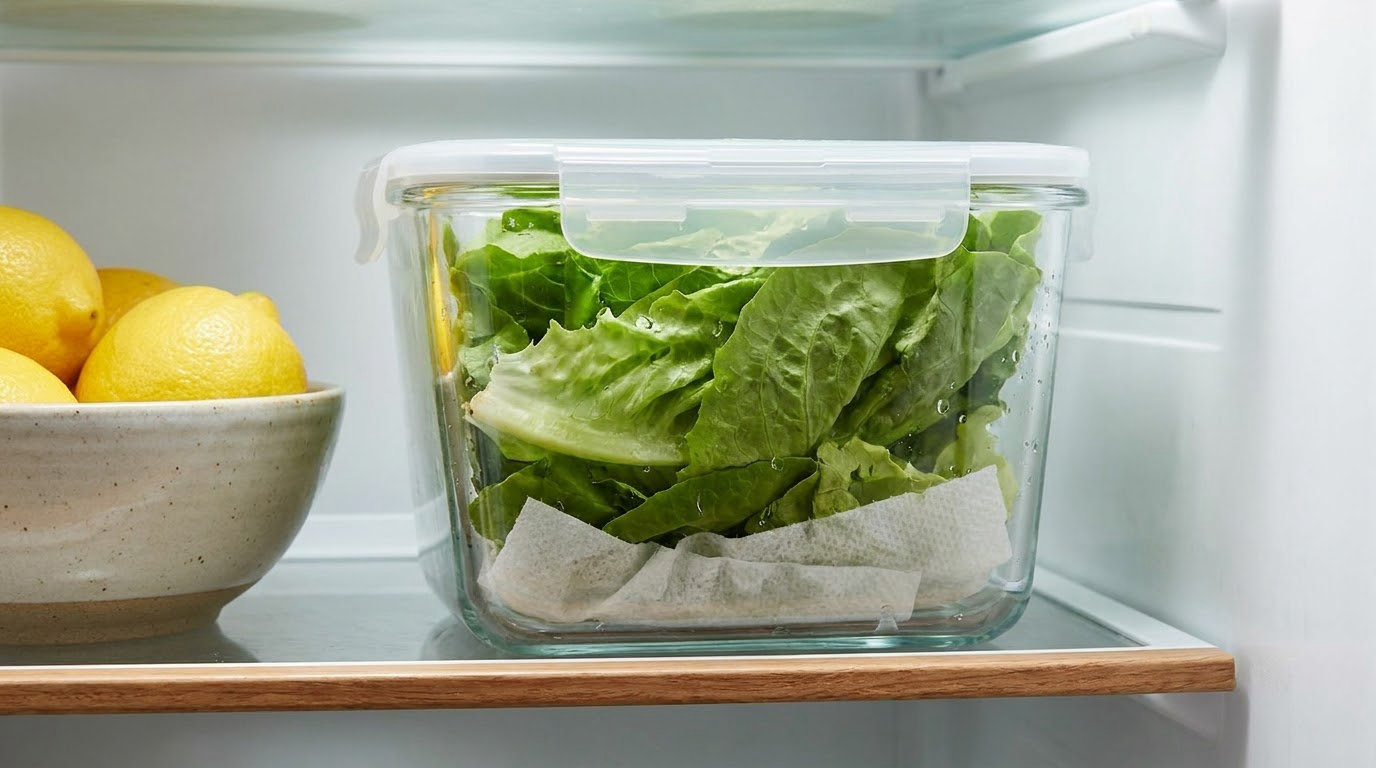
To store leafy greens so they stay crisp, dry them completely, wrap them loosely in a clean paper towel, and refrigerate in a container or bag where air can still move. Skip the airtight seal if the leaves are even slightly damp, and keep fruit like apples and bananas away from the greens. That is the whole method, and it buys you most of a week instead of three days.
It takes about five minutes of prep and no special equipment. The reason it matters: cut greens left wet in a closed box will go slimy in a day or two, while the same greens dried and wrapped reliably stay usable for five to ten days depending on the variety.
Table of Contents
- What You Need
- How to Store Leafy Greens So They Stay Crisp: Step-by-Step
- 1. Inspect and separate the greens before storing
- 2. Dry the leaves thoroughly: how to store leafy greens so they stay crisp
- 3. Wrap or loosely contain the greens
- 4. Refrigerate in the coldest practical area
- 5. Revive slightly wilted leaves before using them
- 6. Freezing greens for longer storage
- 7. How to store herbs alongside greens
- How long leafy greens last in the fridge
- Common mistakes to avoid
- Frequently Asked Questions
- Conclusion
What You Need
You do not need a produce-obsession setup. A short list of ordinary kitchen items covers it.
- A container with a lid that is roomy enough that the greens are not compressed, ideally one you can stand upright on the counter so air circulates while it chills.
- Paper towels or a clean cotton cloth, the disposable kind you can swap out every few days without thinking about it.
- A perforated produce bag or a vented clamshell for hardy greens that need a little more airflow than a sealed box gives.
- A salad spinner or a clean towel for removing surface water. A salad spinner is faster, a towel works fine, and a single sheet of paper towel in a flat layer also does the job.
- A produce bag for herbs and a small jar or glass if you buy cilantro and parsley on the same trip as your greens.
The one thing I would add if your crisper drawer is small is a second lidded container. Stacking greens on top of each other crushes them, and crushed edges brown within a day.
How to Store Leafy Greens So They Stay Crisp: Step-by-Step
Work through these in order. Skipping ahead to the container is the mistake most people make, because dryness is what decides how long the batch lasts.
1. Inspect and separate the greens before storing
Pick out anything damaged before the greens go anywhere near a container. A single bruised, wet leaf can turn the whole batch to mush, and that is usually what you are seeing when a bag of spring mix collapses in three days.
Tear or cut the greens away from the thick stems, which hold more water than the leaf blade and bruise easily. Romaine hearts, kale ribs, and chard stalks all come off. Broccoli florets hiding in a bag of spring mix go in the compost, not the salad box.
Wilted outer leaves go in the compost too. Storing them does not slow the spoilage, it just spreads it to the good leaves around them.
2. Dry the leaves thoroughly: how to store leafy greens so they stay crisp
Trapped moisture is the main cause of slimy greens. Washing and storing without drying is the single habit that costs people the most produce.
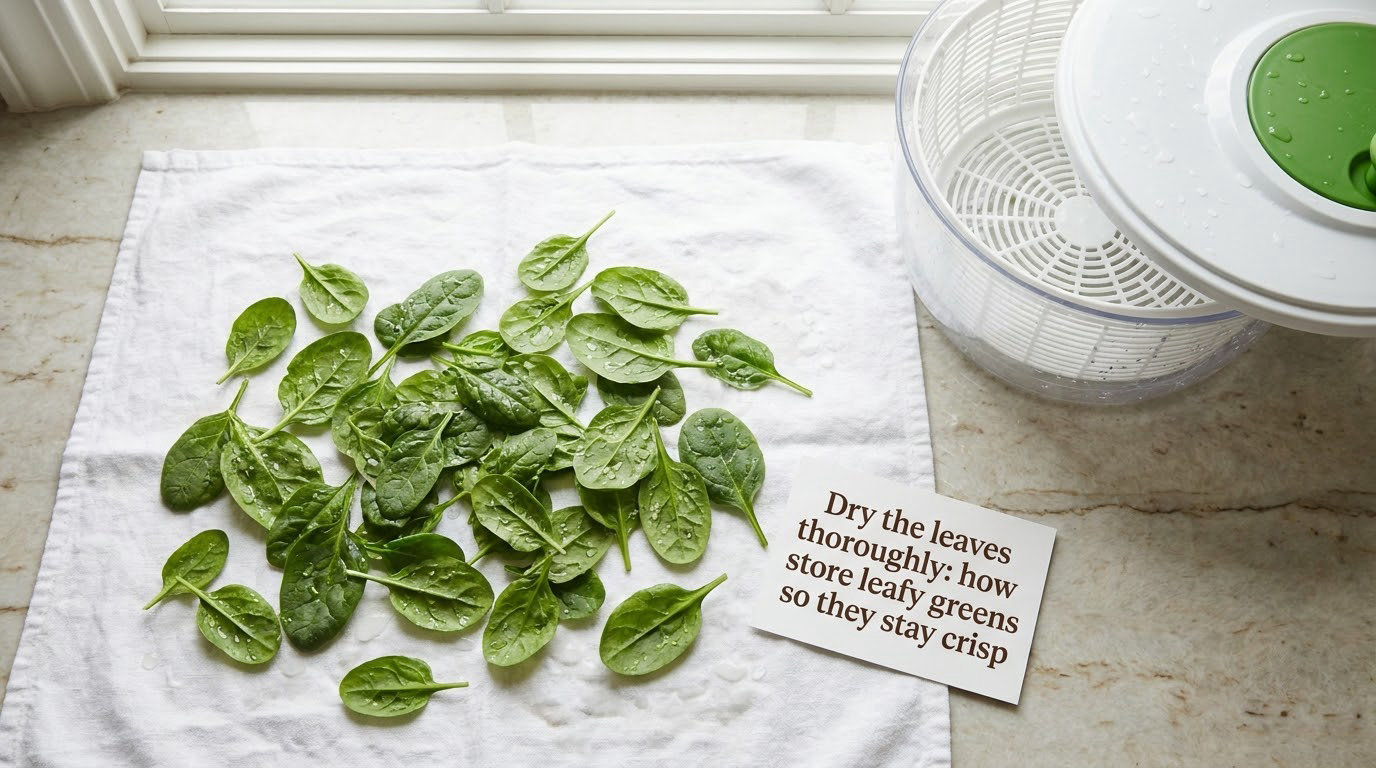
Spin the leaves in a salad spinner for two or three cycles, stopping to shake out the basket between each one, because water hides in the ribs. Then lay them in a single layer on a clean towel and pat or roll gently until you cannot feel any cool dampness on the underside of a leaf.
Air-drying also works. Spread the leaves over a rack or a towel for 20 to 30 minutes, and they will lose most of their surface water while you are making coffee. A clean cotton cloth, rubbed between your hands, moves water faster than paper towel alone.
If you plan to eat the greens within a day, many cooks skip drying entirely and store them unwashed with a dry paper towel. That approach works well. It is the combination of washed, wet leaves and a sealed lid that produces the slime.
3. Wrap or loosely contain the greens
Delicate leaves like butter lettuce, arugula, and spring mix want the paper towel method. Lay one dry sheet in the bottom of the container, add the greens loosely, and lay another sheet on top.
The towel catches the condensation that forms as warm leaves cool in the fridge, so the moisture sits in the paper instead of on the leaf. Swap in a fresh towel every three or four days, or whenever yours feels damp. Dry greens put away this way have held up for a couple of weeks in my kitchen, though the safer planning assumption is five to seven days.
Sturdy greens such as kale, collards, bok choy, and chard tolerate a perforated produce bag or an open-top box in the crisper. Their thicker leaf structure needs more airflow than a sealed container allows, and their tough fibers survive handling that would destroy a butter lettuce leaf.
Whatever you use, do not seal damp greens in an airtight box. That is how a bagged salad becomes a bag of soup. Air needs a path out, and the greens need the towel to handle what comes with it.
4. Refrigerate in the coldest practical area
Put the greens in the crisper drawer, toward the back of the refrigerator where the air is coldest and the temperature changes least. Set your fridge to 34 to 36 degrees Fahrenheit, and keep it at or below 40 degrees for food safety.
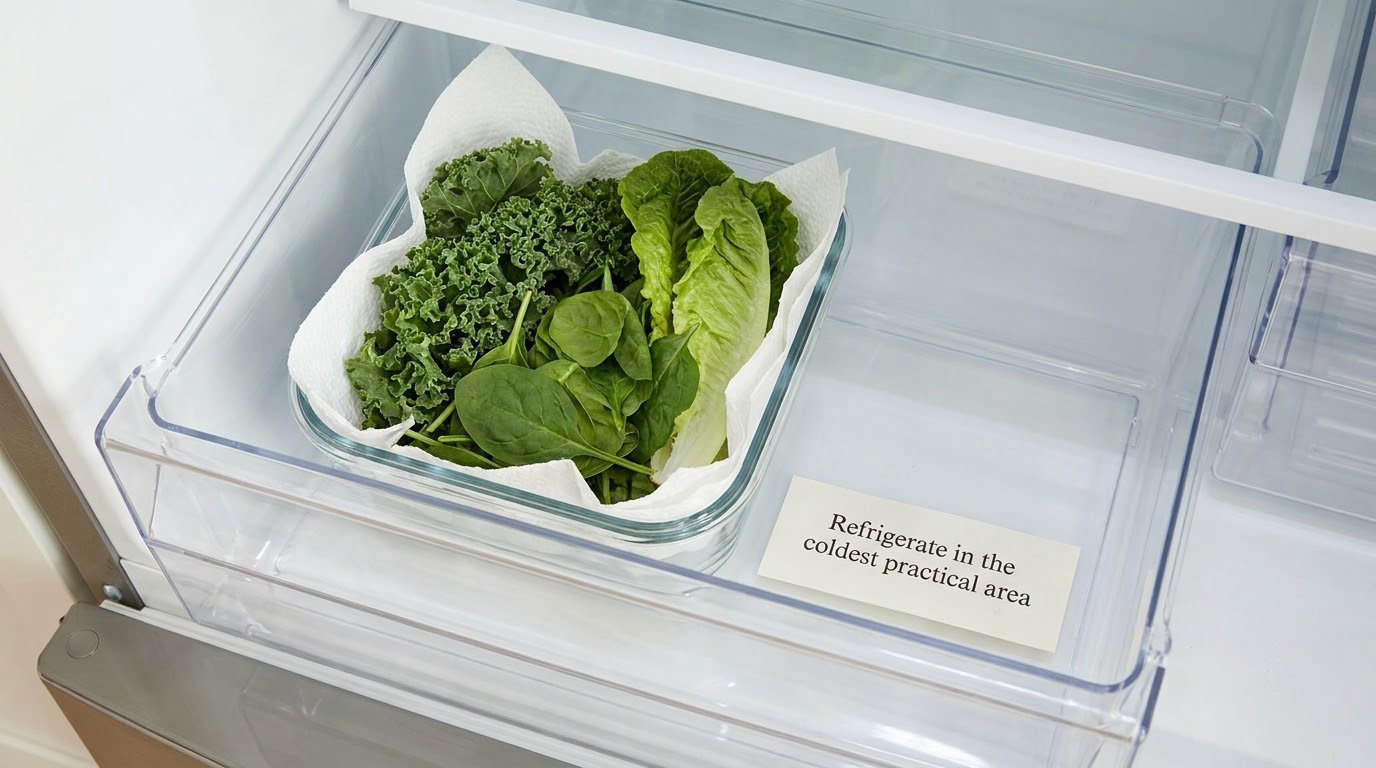
Crispers work because they hold humidity steady and cut the temperature swings that push water out of the cells. If the drawer is too shallow for a container, standing the container upright on a shelf toward the back works nearly as well. Keep the container out of the door, where the temperature rises every time someone grabs a bottle of ketchup.
Watch for ethylene-producing fruit in the same drawer. Apples, bananas, pears, avocados, and ripe tomatoes release ethylene gas, and leafy greens are sensitive to it. That is why bunches of kale left next to the fruit bowl go yellow and limp within days, while a similar bunch in a separate drawer looks fine. Move the fruit to a bowl on the counter if you keep the greens in the crisper.
5. Revive slightly wilted leaves before using them
Leaves that are limp but still smooth, green, and clean-tasting usually come back. Fill a bowl with cold water, drop the leaves in, and add a small pinch of salt. Wait 10 to 15 minutes, then lift the leaves out and dry them thoroughly in a towel or spinner before you use them.
An ice water bath works even better in a pinch, because the temperature difference pulls the water back into the leaves faster. The effect is strongest on romaine hearts, kale, and cabbage. Baby spinach recovers less reliably, so check it after ten minutes rather than assuming it worked.
Discard leaves that stay slimy after the soak, that are yellowing, or that smell sour. A wilted leaf is a water problem. A slimy or sour-smelling leaf is a bacterial one, and no amount of soaking brings it back.
6. Freezing greens for longer storage
Freezing changes the texture, so greens that go in the freezer are for cooked dishes and smoothies rather than salads. Spinach, kale, chard, and collards all freeze well after blanching: drop the leaves into boiling water for 30 seconds to a minute, plunge them into ice water, squeeze out the water, and pack them in freezer bags in single portions.
For smoothie-only use, many cooks skip the blanching and freeze raw spinach straight from the box. The texture does not matter once it is blended, and the nutrient loss from blanching is small enough that most people do not bother. Use a bag and press out the air so the leaves do not clump into one solid brick.
7. How to store herbs alongside greens
Herbs follow different rules because they are more delicate than the leaves. Cilantro and parsley store like a bunch of flowers: trim the stems, stand them in a jar of water, cover loosely with a produce bag, and refrigerate. Change the water every few days and pull off any leaves that sit in it.
Basil is the exception. It blackens in a cold fridge, so keep the stems in water at room temperature out of direct sun, change the water daily, and pull off the lowest leaves that touch the water.
How long leafy greens last in the fridge
These are realistic windows for properly dried, wrapped greens in a refrigerator at 34 to 36 degrees. Treat them as guidance rather than a promise, since humidity, how fresh they were at purchase, and how often you open the container all move the numbers.
| Green | Type | Best storage | Typical shelf life |
|---|---|---|---|
| Romaine | Sturdy leaf | Paper towel, container, upright | 7 to 10 days |
| Kale | Sturdy leaf | Perforated bag, crisper | 7 to 10 days |
| Collard greens | Sturdy leaf | Perforated bag, crisper | 7 to 10 days |
| Cabbage | Sturdy leaf | Whole head or loosely wrapped | 2 to 3 weeks |
| Green cabbage, cut | Cut sturdy leaf | Paper towel, sealed container | 5 to 7 days |
| Spinach | Delicate | Paper towel, container, very dry | 5 to 7 days |
| Spring mix | Delicate | Paper towel in original box or container | 5 to 7 days |
| Bok choy | Semi-sturdy | Paper towel, container | 7 to 10 days |
| Swiss chard | Sturdy leaf | Perforated bag, crisper | 5 to 7 days |
| Butter lettuce | Very delicate | Paper towel, container, upright | 4 to 6 days |
| Arugula | Very delicate | Paper towel, shallow container | 3 to 5 days |
| Chives, scallions | Herb, hardy | Sealed bag or container | 7 to 10 days |
Common mistakes to avoid
Almost every spoiled batch traces back to one of these.
- Storing wet greens in a sealed container. The fix is a full dry-off before the greens go in, and a paper towel on both sides of the pile.
- Sealing everything airtight. Only truly dry, sturdy greens survive a vacuum seal. Delicate leaves need a vented bag or a container that is not clamped shut.
- Washing a week ahead. Prewashed bagged greens arrive damp enough. If you buy loose greens and want to wash them, wait until the night before you plan to use them.
- Crowding the container. A mound of leaves compresses the ones underneath, and the crushed ones brown quickly. Two shallow containers beat one deep one every time.
- Storing greens with apples, bananas, or avocados. Ethylene from ripening fruit accelerates yellowing and softening. Keep the two groups apart.
- Leaving a damp towel in place. The towel works only while it is dry. Replace it every three or four days.
- Keeping greens until they look tired. Plan meals backwards from purchase day. Greens eaten on day four taste better than greens rescued on day seven.
- Using a cloth you do not wash often. A towel that has been used for raw meat carries bacteria onto leaves you eat raw. Use paper towels for anything unwashed.
One more that gets overlooked: buying the biggest box you can carry. A large bag of spring mix almost never gets finished before the bottom layer turns, unless you are feeding a crowd or prepping salads for the week. Half the bag plus a jar of herbs is usually the better buy.
Frequently Asked Questions
Should leafy greens be washed before storing?
Not usually. Greens you plan to eat within a day or two can go in the fridge unwashed, which keeps them drier and longer-lasting. Wash only when you are ready to use them, and dry them thoroughly first, because water left on the leaves is what turns them slimy. Exception: prewashed bagged greens are already rinsed, so just remove the dry paper towel and store them as they came.
How long do leafy greens stay fresh in the refrigerator?
It depends on the variety. Sturdy greens such as romaine, kale, collards, and cabbage usually last 7 to 10 days, sometimes two weeks for a whole cabbage head. Delicate greens like arugula, butter lettuce, and spring mix last 3 to 6 days. These figures assume the leaves were dried properly, wrapped in a paper towel, and kept in a refrigerator set to 34 to 36 degrees Fahrenheit.
What is the best way to keep lettuce crisp?
A paper towel inside a container that is not sealed airtight does the most reliable work. Lay a dry sheet on the bottom of the container, add the lettuce loosely, and put another sheet on top, then stand the container upright in the back of the fridge. Replace the towel every three or four days. Keep the fridge at 34 to 36 degrees and keep lettuce away from apples and bananas.
Should I store leafy greens in an airtight container?
Only when the greens are completely dry and on the sturdy side. Airtight containers trap humidity, and humidity on leaves means rot, especially in a week-old kale or romaine heart. Delicate greens like arugula and spring mix need some airflow, so a perforated bag or a vented clamshell suits them better. Spinach that is bone dry can go in a sealed container safely.
Can I freeze leafy greens for later use?
Yes, and freezing is the best way to stop a large batch from spoiling. Blanch spinach, kale, collards, or chard in boiling water for 30 to 60 seconds, cool them in ice water, squeeze out the water, and freeze in single portions. Frozen greens lose their crispness, so use them in cooked dishes, soups, and sauces. For smoothies you can skip blanching and freeze raw spinach.
How do I revive wilted greens?
Submerge the leaves in a bowl of cold water with a small pinch of salt and wait 10 to 15 minutes, then dry them completely before using. An ice water bath works faster because the temperature gap pulls water back into the leaves. Romaine, kale, and cabbage recover well; baby spinach often does not. Throw away leaves that stay slimy, turn yellow, or smell sour after the soak.
Conclusion
Start with the leaves, not the container. Get the moisture off, wrap the greens loosely in a dry paper towel, refrigerate them in the coldest part of the drawer away from ripening fruit, and use them while they still look, smell, and feel fresh.
Everything else in this guide is a variation on that one habit. Do it consistently and your greens last a week instead of three days, and you stop finding a bag of greens liquefied at the back of the fridge.