
Unfortified plant foods carry no reliable vitamin B12, so anyone eating a plant-based diet needs a deliberate source, whether that is fortified foods, a fortified plant milk, or a supplement. This guide explains what B12 does, which plant sources to trust, and how to work out your next step.
Table of Contents
- Why Vitamin B12 Matters on a Plant-Based Diet
- Where Can Vegans Get Vitamin B12 on a Plant-Based Diet?
- Are Spirulina, Tempeh, and Other Plant Foods Reliable B12 Sources?
- What Are the Signs of Low Vitamin B12?
- Do You Need a Vitamin B12 Test?
- How to Choose a B12 Supplement
- What Should Plant-Based Readers Do First?
- Frequently Asked Questions
- Can vegans get enough vitamin B12 from plant-based foods?
- Is vitamin B12 necessary if I eat fortified plant milks and cereal?
- Which vitamin B12 supplement form should I look for?
- Can spirulina, seaweed, tempeh, or nutritional yeast provide reliable B12?
- What symptoms can vitamin B12 deficiency cause?
- Should I get tested for vitamin B12 on a plant-based diet?
- Conclusion: Make B12 a Planned Part of Your Diet
Why Vitamin B12 Matters on a Plant-Based Diet
Vitamin B12, also called cobalamin, is a water-soluble vitamin with a cobalt atom at its centre. Your body uses it for red blood cell formation, DNA synthesis, and the maintenance of the myelin sheath that insulates nerve fibres.
Here is the part that surprises people. B12 is made by certain bacteria and archaea, not by plants and not by animals. Animals get it second-hand, from food or from gut bacteria. A plant has no mechanism for producing or storing it, which is why lentils, spinach, broccoli and quinoa are not B12 sources no matter how carefully you prepare them.
That matters because deficiency does two kinds of damage at once. You can end up with megaloblastic anemia, where red blood cells form too slowly, and with nerve problems that may not fully reverse even after your levels recover. Persistent fatigue, trouble concentrating and a sore tongue often show up first, but they are common enough that nobody should self-diagnose from a symptom list.
One extra wrinkle for plant-based eaters: diets rich in leafy greens tend to be high in folate, and plenty of fortified plant milks are fortified with folic acid. Folate can correct the anemia part of a B12 deficiency while the nerve side keeps progressing quietly. Many long-term vegans on forums like r/vegan and r/PlantBasedDiet treat B12 as the one nutrient they refuse to be casual about, largely for that reason.
The NIH Office of Dietary Supplements, The Vegan Society, VeganHealth.org and the Vegetarian Nutrition Dietetic Practice Group all state the same thing in slightly different words: plant-based diets need a planned B12 source. The Vegetarian Resource Group publishes similar guidance for vegetarians.
Where Can Vegans Get Vitamin B12 on a Plant-Based Diet?
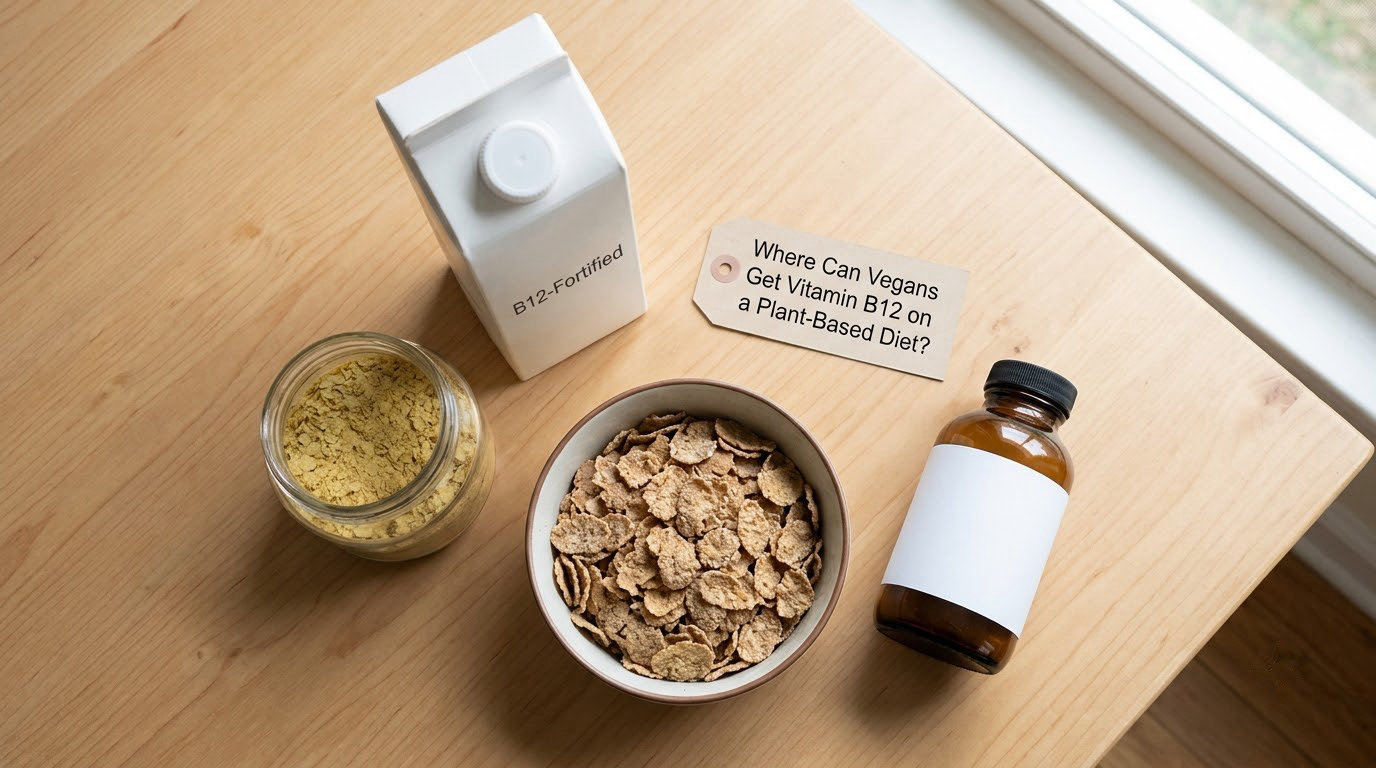
Reliable sources fall into two groups: products with B12 added on purpose, and supplements. Fortified plant milks, fortified nutritional yeast, fortified breakfast cereals, plant-based meat analogues and some protein bars sit in the first group, and their B12 content varies widely by brand and by serving size.
- Fortified plant milks. Soy, almond, oat and rice versions are all available in fortified form. Check that the specific carton in your hand carries B12, because the same brand often comes in both fortified and unfortified versions.
- Fortified nutritional yeast. This is the savory mushroom-like seasoning sold in jars, and only the fortified kind supplies B12. The golden flakes and the unfortified bulk tubs are different products.
- Fortified breakfast cereals. Often the highest amount per serving in the grocery aisle, and easy to miss because it is not on the front of the box.
- Plant-based meat analogues. Many burgers, sausages and mince products are fortified, though the amounts differ from product to product.
- Fortified nutrition bars. Useful on paper, and one more thing to check on the label rather than assume.
- Supplements. Tablets, capsules, liquids and sprays. Most dietitians who work with vegans treat a supplement as the dependable option and fortified food as helpful extra.
Two things catch people out. First, the word vegan on the front of a product tells you nothing about B12, since certification is about ingredients, not nutrient content. Second, a serving is whatever the manufacturer says it is, so a cereal listing a large amount per 40 gram serving is a very different thing once you measure the bowl.
How to Read Vitamin B12 Labels on a Plant-Based Diet
Turn the carton around and look for the nutrient panel. You want the specific number of micrograms per serving, not a vague claim on the front of the package.
A few habits make this much faster. Look for the B12 name on the ingredient side too, because B12 may be listed as cobalamin, cyanocobalamin, methylcobalamin, hydroxocobalamin or adenosylcobalamin, and any of those means the product supplies active B12. Then check whether the serving size matches what you actually eat. Add up the servings you have in a normal week rather than judging a single meal.
On supplements, ignore front-of-pack language and read the Supplement Facts panel, where active B12 appears with a microgram amount. A very large number is normal and not a sign of a better product, because absorption from a large tablet is limited. This is also where pseudovitamin B12 gets caught, since the inactive lookalike found in spirulina and some seaweeds can show up on a label or in a greens powder blend while contributing nothing your body can use.
Follow the label directions rather than any dose described in an article, including this one, and check the expiration date before you buy. For personal dosing, a registered dietitian or your pharmacist is the right person to ask.
Are Spirulina, Tempeh, and Other Plant Foods Reliable B12 Sources?
No. These foods come up constantly in vegan communities for good reason, but the picture is more complicated than the enthusiasm suggests.
Spirulina and blue-green algae do contain corrinoid compounds, but they are largely inactive analogues rather than cobalamin. The same goes for the Aphanizomenon algae sold in some older supplements, which is why this category disappeared from most reputable guidance. Worse, those analogues can register on a blood test and make a deficient result look better than it is.
Seaweed and nori show B12-like activity in laboratory assays, much of it from inactive forms, and the human data is thin. Shiitake mushrooms contain a B12 analogue too, and the amounts are inconsistent enough that no dietitian recommends them as a source.
Tempeh, fermented foods and kombucha are often listed as sources because bacteria make B12, but the concentration is small, unpredictable, and sometimes purely inactive. Fermented foods also bring up salt, which is a separate reason not to lean on them heavily.
Unwashed vegetables, spring water and unwashed produce get cited as the historical route, and the logic holds. B12 arrives on soil and on insects, so people who ate unwashed food and drank untreated water got some. That route disappeared with modern sanitation, which is a good argument for planning B12 rather than an argument against the diet.
Nutritional yeast is the one to keep, and only if the jar says fortified. Unfortified nutritional yeast is a lovely food with no B12 contribution at all, so the label is the whole answer to this question.
What Are the Signs of Low Vitamin B12?
Short answer: fatigue, weakness, numbness, tingling, balance trouble, brain fog and mood changes, and often nothing obvious at all for years. Most people have three to five years of stored B12 in the liver, so a diet change today may not show up on a blood test for quite a while.
Nerve-related signs tend to be the ones people notice first, and they are the ones worth acting on quickly. That includes tingling in the hands or feet, a feeling of pins and needles, unsteadiness, and slower mental processing. Fatigue and shortness of breath on stairs point to the blood side, where red cell production has been affected, and a smooth or sore tongue is another commonly reported sign.
Here is the problem with this list. Every item on it has dozens of other explanations, from iron deficiency and thyroid problems to stress, poor sleep and depression. That is exactly why deficiency on a plant-based diet is not something to self-diagnose. If any of these show up and stay around, book an appointment and say that you eat a plant-based diet, because that one sentence changes how your clinician approaches the blood work.
One point worth repeating, because the fear behind it is genuine: the neurological changes can become permanent if they are allowed to progress. That is an argument for getting a reliable source sorted out, not an argument for panic.
Do You Need a Vitamin B12 Test?
Ask your doctor or registered dietitian about testing if you have been on a plant-based diet long term without a planned source, if you have symptoms, or if you have conditions or medicines that affect absorption. That list includes pernicious anemia and other intrinsic factor problems, Crohn’s disease, celiac disease, small intestinal bacterial overgrowth, H. pylori infection, long-term metformin use, and proton pump inhibitors. Age matters too, because stomach acid production often falls with age and B12 absorption depends on it.
Be aware that serum B12 is an imperfect test. Reference ranges vary between laboratories, and a result inside the range still does not rule out functional deficiency, particularly in people taking metformin or proton pump inhibitors. Methylmalonic acid and homocysteine often give a clearer picture because they rise when B12 is not doing its job, and holotranscobalamin measures the fraction of B12 actually being delivered to tissues. A full blood count can also show enlarged red cells, which is a clue but not a diagnosis.
Forum readers in r/B12_Deficiency often ask how long supplementation takes to move a number, and the honest answer is that it varies with dose, absorption and how long you have been low. Bring your results to a professional rather than trying to interpret them against a range you found online. For anyone who has been eating seaweed, spirulina or a greens powder, mention it, since those can distort a serum reading in the reassuring direction.
How to Choose a B12 Supplement
There are four forms you will meet, and all of them work for most people.
- Cyanocobalamin is the most common and the cheapest. It is stable, well studied, and inexpensive, which is why many dietitians recommend it without hesitation.
- Methylcobalamin is the form already circulating in your blood. Some people prefer it, and the argument that cyanocobalamin is inadequate is not well supported.
- Hydroxocobalamin is used widely in European practice and appears in some injections.
- Adenosylcobalamin is the form used in the mitochondria for energy metabolism and shows up in a few products.
What actually separates good supplements from poor ones is simpler than the chemistry. Look for third-party certification such as USP, NSF or ConsumerLab. Check the expiration date, because B12 degrades in heat and light, and a bottle that has sat in a warm cupboard for two years is not a good buy. Choose a form you can take consistently, because a daily small tablet that you actually swallow beats a perfect weekly dose that sits in a drawer.
On dose size, this is the point where you need a professional rather than an article. The published intake reference for adults is 2.4 micrograms a day, but absorption from a large tablet is limited, which is why the amounts on vegan supplement labels look enormous by comparison. Ask a registered dietitian what fits your situation, particularly if you are pregnant, breastfeeding, over 60, or managing any of the absorption conditions named earlier.
Two last questions people rarely ask. High-dose B12 is generally well tolerated and no upper limit has been set, so the fear of taking too much is largely unfounded, though acne-like breakouts are reported by some people on very high doses. And B12 is harmless for people who do not have a deficiency, so there is no reason to skip a supplement because you suspect you already have plenty.
What Should Plant-Based Readers Do First?
If you take one thing from this guide, take the action plan rather than the science.
- Audit what you already eat.Pull out two or three plant milks, cereals or meat analogues you buy regularly and check the B12 line on each. Most people discover their routine includes a mix of fortified and unfortified versions of the same product.
- Pick one reliable source.Either a supplement you take without fail, or a fortified food you genuinely eat most days. The word here is reliably. A fortified food you eat twice a year is not a source.
- Ask a professional about the amount.A registered dietitian, your pharmacist or your doctor can take your history, including any medicines and any absorption conditions, and tell you what to take.
- Consider a blood test if you have been on this diet for a while, if you have symptoms, or if you have a condition or medicine that affects absorption.
- Recheck after a few months so you know whether your routine is working, rather than assuming it is.
For anyone who just went vegan, the common mistake is treating this as a someday problem because nothing feels wrong. B12 stores last years, so feeling fine tells you almost nothing. Set up the source in the same week you change your shopping list, while it is still fresh.
Frequently Asked Questions
Can vegans get enough vitamin B12 from plant-based foods?
Only from fortified foods, not from whole plant foods. Lentils, grains, vegetables, nuts and seeds contain no reliable B12, because plants cannot make it. If your intake comes entirely from fortified plant milks, fortified nutritional yeast and fortified cereals, eaten consistently and in known amounts, you may cover your needs, which is why labels matter. Most vegan dietitians still recommend a supplement as the dependable option and fortified food as helpful extra, so you have a backup if a product changes.
Is vitamin B12 necessary if I eat fortified plant milks and cereal?
It depends on whether your fortified intake is consistent and measurable. A carton of fortified plant milk and a bowl of fortified cereal can add up to a meaningful amount across a day, but brands vary widely and a lot of people swap products without noticing one of them is unfortified. A supplement removes that uncertainty, which is why many people take one anyway. A registered dietitian can help you work out whether your current pattern is enough or whether you want a supplement as backup.
Which vitamin B12 supplement form should I look for?
Any of the four active forms works for most people. Cyanocobalamin is the cheapest and most widely studied, methylcobalamin is already the form circulating in your blood, hydroxocobalamin is common in European practice, and adenosylcobalamin is used in energy metabolism. Claims that one form is necessary are not well supported. Judge a supplement more on third-party certification, expiration date and whether you will actually take it consistently than on the form name.
Can spirulina, seaweed, tempeh, or nutritional yeast provide reliable B12?
Spirulina, seaweed, nori, shiitake and tempeh do not provide reliable B12. The corrinoids in spirulina and many seaweeds are inactive analogues that your body cannot use, and they can even distort a blood test into looking better than it is. Tempeh and fermented foods contain small and unpredictable amounts. Nutritional yeast is the exception, and only the fortified kind, clearly marked on the jar. The unfortified flakes contain no B12 at all.
What symptoms can vitamin B12 deficiency cause?
Commonly reported signs include fatigue, weakness, numbness or tingling in the hands and feet, balance trouble, brain fog, mood changes and a sore or smooth tongue. Nerve symptoms can appear before blood symptoms do, and prolonged deficiency may cause damage that does not fully reverse. None of these signs point to B12 on their own, since iron deficiency, thyroid problems and other conditions look similar. Book an appointment, mention that you follow a plant-based diet, and let a clinician work through it.
Should I get tested for vitamin B12 on a plant-based diet?
Testing is worth discussing if you have been on a plant-based diet for a long time without a planned source, if you have symptoms, or if you have a condition or medicine that reduces absorption, such as pernicious anemia, Crohn’s disease, celiac disease, metformin or long-term proton pump inhibitor use. Serum B12 alone can be misleading, and methylmalonic acid, homocysteine and holotranscobalamin often give a clearer picture. Bring your results to a doctor or registered dietitian for interpretation rather than comparing them to a range online.
Conclusion: Make B12 a Planned Part of Your Diet
Unfortified plant foods do not supply vitamin B12, so a plant-based diet works best when B12 is planned rather than hoped for. Pick one source you can rely on, read the label to confirm what is actually in it, and treat fortified food as a helpful addition rather than the whole plan.
If you have symptoms, are pregnant or breastfeeding, are over 60, or take medicines that affect absorption, talk to a doctor, pharmacist or registered dietitian about the amount that fits you and whether testing makes sense. The first step takes about five minutes in a grocery aisle: turn the carton around and read the B12 line.