
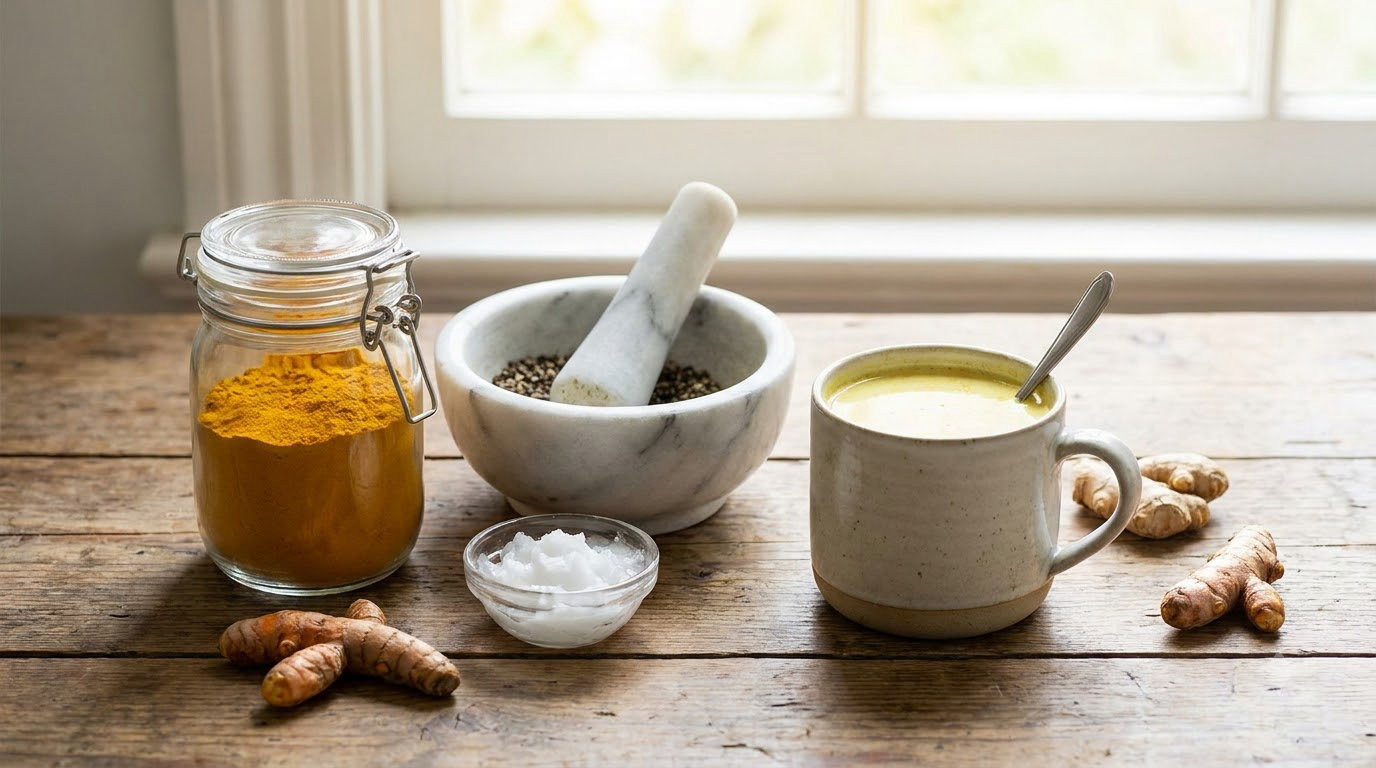
To help your body absorb turmeric, pair it with two everyday helpers: black pepper and a little cooking fat. Piperine, the compound in pepper, slows the liver enzymes that break curcumin down, and fat carries the compound through the intestinal lining into your bloodstream. Warm fat and a few minutes of cooking help too. Together those three moves do more than any single trick on its own.
That is the whole idea behind how to use turmeric so your body absorbs it. Turmeric in a curry is a fine place to start, but the powder settles at the bottom of the bowl and most of it never makes it into circulation. Adjust the format, add fat, add pepper, keep the portion steady, and the same spice does a lot more useful work.
Two honest notes before the steps. Kitchen turmeric powder is roughly 2 to 3 percent active curcumin, so a normal serving is a modest dose no matter how good your technique is. And this is general food information, not medical advice. If you take medication or have a health condition, a doctor or pharmacist is the right person to ask before you start making turmeric a daily habit. I reviewed this for 2026 against mainstream nutrition guidance, and it holds up.
Table of Contents
What You Need
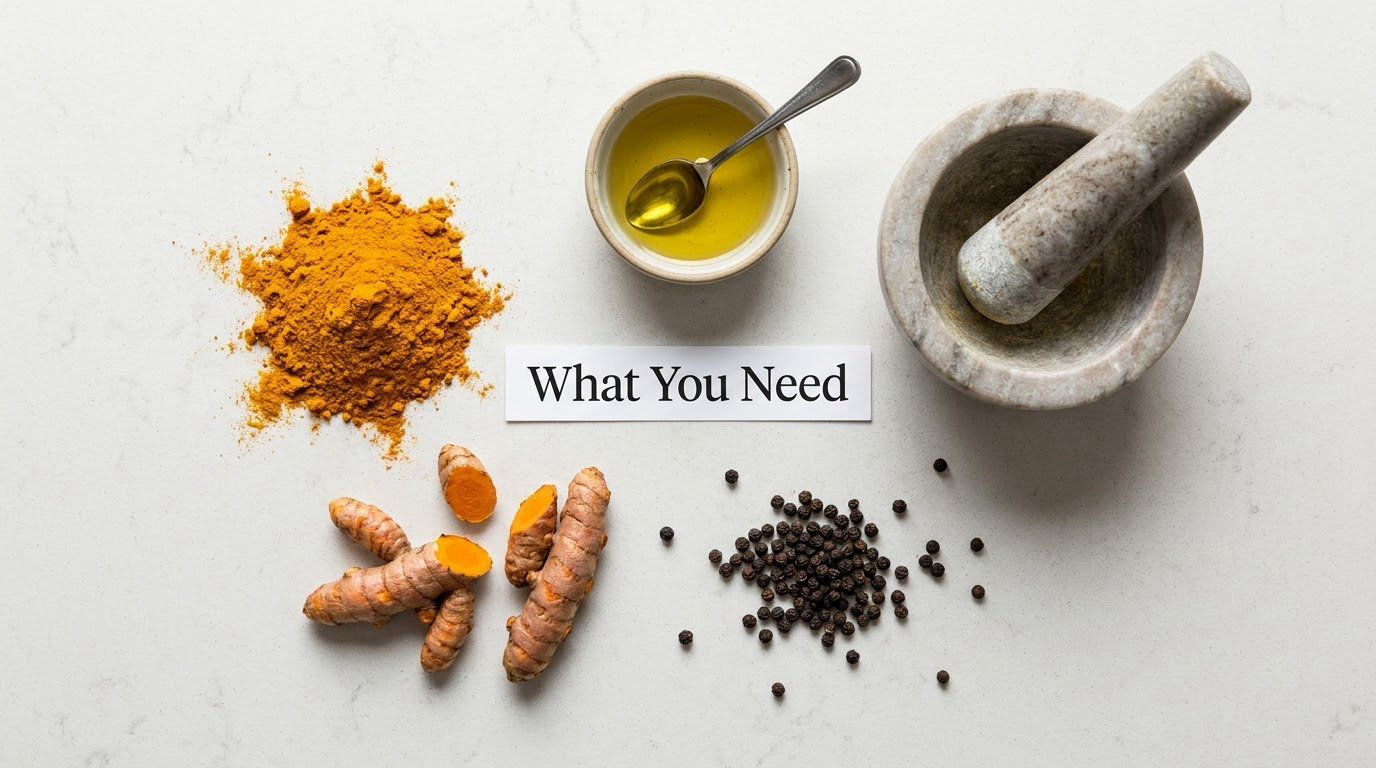
You need less than a shopping list suggests. Everything below is either already in your kitchen or costs about the same as a bag of rice.
- One turmeric format. Ground spice for cooking, fresh root for grating into dishes, or a labeled curcumin extract if you want a concentrated dose without the taste.
- A pinch of black pepper. Whole peppercorns or ground pepper. Roughly 1/20 teaspoon is the amount that appears in most kitchen recipes that pair the two.
- Some cooking fat. Olive oil, coconut oil, butter, ghee or full-fat dairy. Any of these work because curcumin is poorly soluble in water and dissolves readily in fat.
- A heat source. A stovetop, oven or microwave. Warmth loosens turmeric’s oils and helps it disperse into the fat instead of sitting as powder.
- Optional equipment. A small whisk, a mortar and pestle for cracking pepper, or a high-speed blender if you plan to drink turmeric rather than cook with it.
Pick your format first, because it changes everything downstream. Fresh root stains cloth and hardens your knives, ground spice disappears into a dish, and a supplement capsule is a different category of decision entirely.
Step-by-Step
Choose Your Turmeric Format
Fresh root, ground powder and capsules are three different tools, and only one of them is right for your week. Start by asking how you actually cook.
Fresh turmeric root is freshest-tasting and works best grated into stir-fries, rice, tea and salad dressings. It is fibrous, so it needs time in liquid or heat to soften. The staining is real and it does not wash out of fabric, so use a cutting board you do not love.
Ground turmeric is the most forgiving option and the one most homes already own. It is cheap, shelf-stable and disperses well once it hits hot fat. Its weakness is concentration: kitchen powder carries only about 2 to 3 percent curcumin, so a quarter teaspoon is a small amount of active compound even when you absorb it perfectly.
Capsules deliver a much larger, measured amount of curcumin, usually as a standardized extract. What varies widely is the delivery system. Some are plain powder in a capsule, which behaves much like the spice. Others pair curcumin with piperine, or wrap it in fat-based carriers such as phospholipid complexes, micelles or liposomes. Those engineered forms are designed to raise blood levels without food, which is convenient on travel days.
When you read a label, three things tell you the most. First, look for the percentage of piperine, because that is the enhancer doing measurable work. Second, check whether it says turmeric root powder or a curcumin extract, since a capsule of root powder is closer to cooking with the spice. Third, look for a third-party testing mark, which tells you the label contents were verified rather than estimated.
Pair Turmeric with Everyday Foods
Pairing is where most of the practical gain happens, and it takes two partners, not one. Fat does the physical work. Black pepper does the chemical work.
Curcumin is hydrophobic, which is a polite way of saying it does not dissolve in water. Bile released after a fatty meal forms tiny droplets called micelles that carry the compound across the intestinal lining, and from there it travels through the lymphatic system into the blood. Skip the fat and that whole route barely opens. A pinch of olive oil, a spoon of coconut oil, a pat of butter or a splash of whole milk is all it takes to get it moving.
Black pepper handles the next problem. Curcumin that does get absorbed is quickly tagged by liver and intestinal enzymes in a process called glucuronidation, which makes it easy to excrete. Piperine temporarily slows those enzymes, so more curcumin survives the trip. A small human study from 1998 reported roughly 2,000 percent higher curcumin bioavailability when it was given with 20 mg of piperine, and animal work showed a much smaller effect. That number is real but narrow, so treat it as a reason to add pepper to a dish rather than a promise about your results.
You do not need a separate pepper supplement. Kitchen pepper works. A quick test tells you if it is potent enough: crack a few peppercorns in a mortar until the smell hits the back of your nose. Freshly cracked pepper has noticeably more aroma than the dust in a two-year-old tin, and aroma tracks to the piperine.
Beyond pepper and fat, a few other pairings show up often in kitchen practice. Ginger, cinnamon and cardamom are traditional turmeric companions and make a drink easier to drink daily. Black pepper and turmeric also both feature in South Asian cooking, which is why the pairing looks so natural on a plate. On the supplement side, compounds like quercetin and silibinin from milk thistle show up as secondary enhancers in the research, though the kitchen version of that idea is simply a well-built meal.
Prepare It for Better Everyday Use
Heat and fat do the same job from different directions, and combining them is the single easiest upgrade to an existing recipe.
The most useful technique is blooming. Put a spoonful of oil or a knob of butter in a pan, add your turmeric, and let it cook for 30 to 60 seconds until the oil turns deep orange and smells warm rather than dusty. Stir in pepper at the end, then add your other ingredients. Those seconds of heat release the spice oils into the fat, which is the difference between turmeric that flavors food and turmeric that travels with it.
For drinks, whisk rather than stir. Put the turmeric and a pinch of pepper in the bottom of a mug, add a small amount of warm milk or a fat like coconut oil or butter, then whisk briskly. If the powder clumps, the liquid was too cold or the ratio of powder to liquid was too high. Top up and whisk again. A small amount of honey makes it drinkable, which matters more than people expect.
One caution on heat. Making turmeric more soluble is not the same as making it more absorbable, and online advice tends to run those together. Cooking raises solubility in oil, which supports absorption through the fat pathway, but turmeric left to simmer in plain water for a long time mostly disperses powder in water that your body cannot efficiently use. If you simmer, do it in a broth that already contains fat.
For dressings, whisking turmeric into an olive oil or tahini dressing is the easiest no-cook route. The fat is already there, and the pepper does its job in the same bite.
Use a Consistent Serving Approach
Absorption work is less about a single clever meal than about a pattern you repeat. The same portion, prepared the same way, most days, beats an enormous serving once a week.
Think of turmeric as a seasoning rather than a supplement dose. A quarter teaspoon in a curry, a teaspoon stirred into a pot of soup or broth, or a mug of golden milk with milk or plant milk and a small spoon of fat is a normal culinary portion. Serving needs vary from person to person based on the food, the format and everything else you eat, so if you want guidance for your own situation, ask a registered dietitian rather than copying a number from a label.
Timing matters less than people think, and it matters mostly because of the meal around it. Morning, evening or split across the day all work, provided a fat-containing meal is nearby. Turmeric in breakfast eggs with olive oil, or in a soup at dinner, both deliver. An empty stomach is the one condition to skip, since without a meal there is usually no fat to carry the compound and you may just notice stomach discomfort.
If you hate the taste, stop forcing the drink. Cook-only routes work, and capsules remove the flavor problem entirely, which is a reasonable reason to prefer them. A capsule taken with a fatty meal is a perfectly ordinary use, not a failure of commitment.
Common Mistakes
Most disappointing turmeric experiences trace back to one of five small errors. Each has a quick fix.
- Using a heavy scoop and expecting more. More powder does not mean more absorption, and large amounts of turmeric can upset the stomach. Fix: use a normal seasoning portion and keep the pairing instead of increasing the amount.
- Adding turmeric to a fat-free dish. Soup made with water, plain rice or steamed vegetables give curcumin nothing to dissolve into. Fix: add a tablespoon of oil, a spoon of nut butter or a drizzle of full-fat milk.
- Leaving out the pepper. The single most common omission. Fix: add a pinch of freshly ground black pepper to every dish, sauce or drink.
- Storing the spice badly. Turmeric loses its aromatic oils in heat, light and open air, and those oils carry flavor. Fix: keep the jar sealed in a cupboard away from the stove, and buy a smaller container you will finish quickly rather than a large one you will leave open for a year.
- Assuming a capsule is automatically better. A plain powder capsule with no enhancer can behave like the spice in your pantry. Fix: read the label for piperine or a named delivery system before paying extra.
One more worth naming: taking turmeric consistently and expecting a specific result on a specific day. Turmeric is a food, not a fast-acting product, and honest expectations protect you from buying a second bottle.
Frequently Asked Questions
Can black pepper increase turmeric absorption?
Yes. Black pepper contains piperine, which temporarily slows the liver and intestinal enzymes that break curcumin down, so more of it reaches your bloodstream intact. A small 1998 human study reported about 2,000 percent higher curcumin bioavailability when it was given with 20 mg of piperine. In a kitchen, roughly 1/20 teaspoon of ground black pepper per serving is the practical amount that researchers use in recipes.
Why is turmeric absorbed better with black pepper?
Curcumin is quickly cleared from the body once it is absorbed. Enzymes in your intestinal wall and liver add a small molecule to it in a process called glucuronidation, which makes it easy for your body to excrete. Piperine holds those enzymes back briefly, so a larger share of the curcumin you swallowed stays in its active form long enough to circulate.
Do you take turmeric in the morning or at night?
Either works, and the meal around it matters more than the clock. Morning suits eggs cooked in oil or a breakfast bowl with avocado. Evening suits soups, curries and stews. Splitting it across both meals is fine too. What consistently underperforms is taking turmeric on an empty stomach, because there is no fat available to carry the curcumin across the intestinal lining.
Is it safe to take turmeric with piperine?
For most people, yes, and it is a pairing used in food worldwide. Piperine does more than help curcumin: it can also affect how your liver processes certain medicines, which matters if you take blood thinners, diabetes medication or drugs with a narrow safe range. Check with a pharmacist before adding a concentrated piperine product alongside prescription medication.
What happens to your body when you take turmeric every day?
Daily culinary amounts are well tolerated by most people, and turmeric has a long history of use as a food. The catch is that improving absorption also increases your overall exposure, so side effects become more likely at the same time. Large amounts, concentrated extracts and high-dose piperine products carry more risk than seasoning-level use. Stop and speak to a clinician if you notice stomach upset, nausea or unusual bruising.
Does turmeric need to be taken with food?
Yes, and fat is the part that counts. Curcumin does not dissolve in water, so it needs dietary fat and bile to form micelles that carry it through the intestinal lining. A dry capsule taken on an empty stomach gives your body very little to work with. Taking it with a meal that contains oil, butter, avocado, nuts or full-fat dairy gives it a much better route into circulation.
Start with One Simple Turmeric Recipe
If you do one thing this week, make golden milk three times and skip the shopping trip. It takes five minutes, it forces the fat-and-pepper pairing to happen, and it is forgiving enough to become habit.
- Warm one cup of milk. Whole or any unsweetened plant milk works. Do not let it come to a boil.
- Add the turmeric. One teaspoon of ground turmeric per cup is a strong starting point. Half a teaspoon is plenty if you are new to the flavor.
- Add a pinch of black pepper. About 1/20 teaspoon, freshly ground if you have a mill or mortar.
- Add a small spoon of fat if needed. A teaspoon of coconut oil or a pat of butter blended in smooths the texture and gives the curcumin something to dissolve into.
- Whisk well, then add warmth. A small spoon of honey or ginger helps with taste. A pinch of cinnamon is traditional and pleasant.
Whisk for twenty seconds, not five. That is usually the difference between smooth and gritty, and gritty means the powder never dispersed into the fat.
Keep the rest simple. Use turmeric the way you already use it in the kitchen, just with two additions you did not make before: a pinch of pepper and a real source of fat. Repeat that for a few weeks before adding anything else, because the best method here is the one you will still be doing next month.