
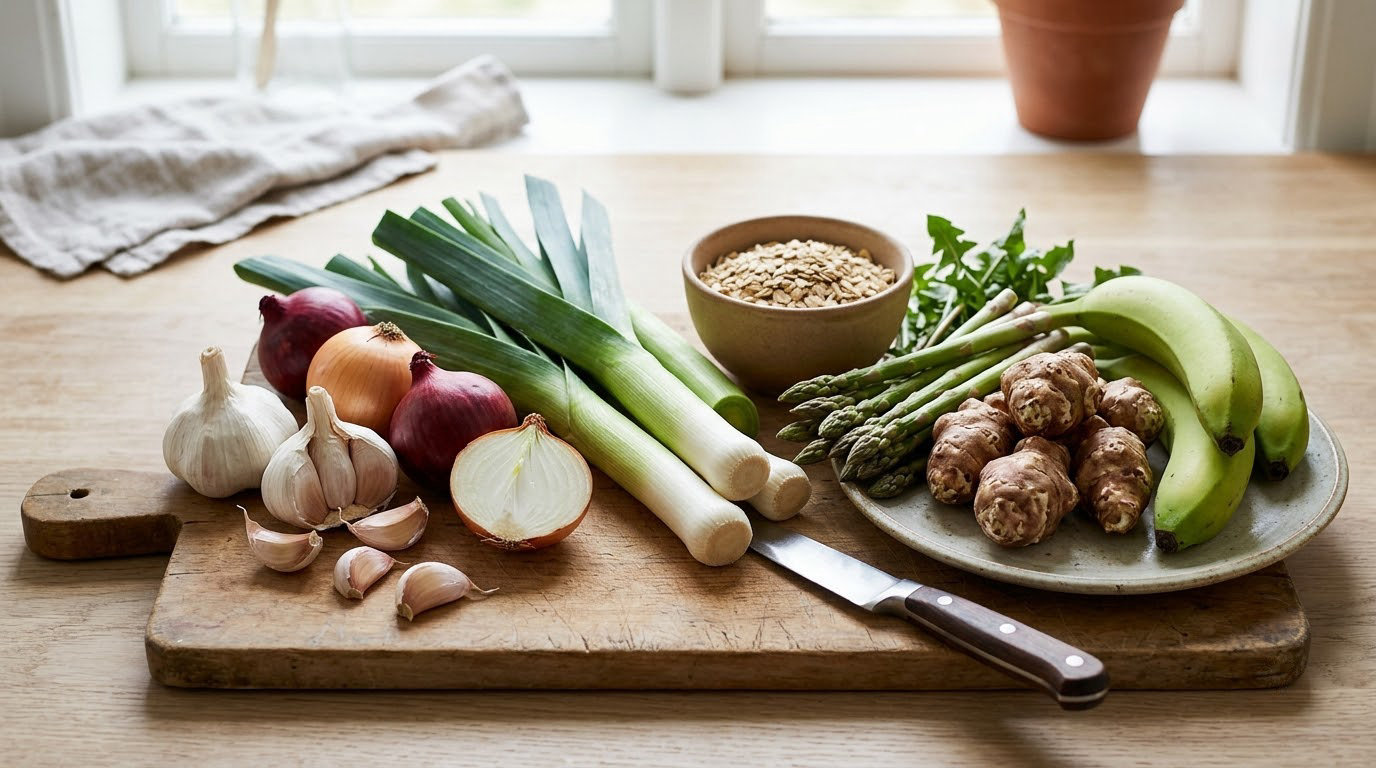
The foods high in prebiotic fiber that do the most work are garlic, onions, leeks, chicory root, Jerusalem artichokes, asparagus, green bananas, oats, lentils, chickpeas, white beans, apples, blueberries, and unsweetened cocoa. Each supplies a fermentable carbohydrate that reaches the colon mostly intact, where resident gut bacteria break it down into short-chain fatty acids.
That short answer hides a fair amount of nuance, because “high in fiber” and “high in prebiotic fiber” are not the same claim. Wheat bran is a lot of fiber and very little prebiotic action. A clove of garlic is modest in weight but dense in fructans. Sorting those two ideas apart is most of what this guide does.
Nothing here is a treatment plan, and no food list fixes a diagnosed gut condition. If you have IBS, SIBO, a recent course of antibiotics, or symptoms that worry you, talk with a doctor or a registered dietitian before changing what you eat in a big way.
Table of Contents
- Foods High in Prebiotic Fiber at a Glance
- 1. Garlic
- 2. Onions
- 3. Leeks
- 4. Chicory Root
- 5. Jerusalem Artichokes
- 6. Asparagus
- 7. Bananas
- 8. Oats
- 9. Lentils
- 10. Chickpeas
- 11. White Beans
- 12. Apples
- 13. Blueberries
- 14. Cocoa
- Frequently Asked Questions
- How much fiber should adults eat each day?
- What is the difference between prebiotic fiber and probiotics?
- Can eating prebiotic foods cause gas or bloating?
- Are supplements necessary to get enough prebiotic fiber?
- Are frozen fruits and vegetables good sources of prebiotics?
- Who should talk with a healthcare professional before increasing fiber?
- Conclusion
Foods High in Prebiotic Fiber at a Glance
Read this table as a guide rather than a lab report. Figures are approximate and move with serving size, ripeness, cooking and processing, so treat every number as a range rather than a target you have to hit.
| Food | Main prebiotic fiber | Approximate amount | Where it fits | Comfortable starting portion |
|---|---|---|---|---|
| Garlic | Fructans (FOS and inulin) | Roughly 1 to 3 g fructans per 100 g | Cooked dishes, sauces, dressings | Half a clove |
| Onions | Fructans | Roughly 3 to 6 g fructans per 100 g | Soups, sautés, salads, sauces | 1 to 2 tbsp raw |
| Leeks | Fructans | Roughly 2 to 4 g fructans per 100 g | Soups, omelets, grain bowls | 2 to 3 tbsp sliced |
| Chicory root | Inulin | About 12 to 20 g inulin per 100 g roasted root | Coffee substitutes, blends, baking | 1 to 2 g powder |
| Jerusalem artichokes | Inulin | About 8 to 12 g inulin per 100 g | Roasted, boiled, in salads | 2 to 3 slices |
| Asparagus | Inulin-type fructans | About 1 to 2 percent of carbohydrate | Grilled, roasted, steamed, blended | 3 to 4 spears |
| Bananas | Resistant starch | Often 1 to 2 g per 100 g when underripe | Smoothies, oatmeal, snacks | Half a firm banana |
| Oats | Beta-glucan | About 4 g beta-glucan per cup of dry oats | Porridge, overnight oats, baking | Quarter cup dry |
| Lentils | GOS plus resistant starch | About 1 g GOS per 100 g cooked | Soups, salads, bowls, patties | Quarter cup cooked |
| Chickpeas | GOS and stachyose | About 1 to 2 g GOS per 100 g | Salads, curries, hummus, bowls | 2 tablespoons |
| White beans | GOS and resistant starch | About 2 to 3 g GOS per 100 g | Soups, chili, salads, dips | 2 tablespoons |
| Apples | Pectin | About 1 to 1.5 g pectin per medium apple | Whole, baked, in slaw | Half a small apple |
| Blueberries | Fiber with plant polyphenols | About 3 to 4 g fiber per cup | Yogurt, oatmeal, salads, smoothies | A quarter cup |
| Cocoa | Fiber and polyphenols | About 10 to 15 g fiber per 100 g powder | Smoothies, oatmeal, yogurt, baking | 1 tablespoon |
Two things stand out. The allium vegetables sit at the top for density of fructans, while the pulses and grains carry the volume. And nothing on this list requires a supplement, which is worth remembering as you read the rest.
1. Garlic
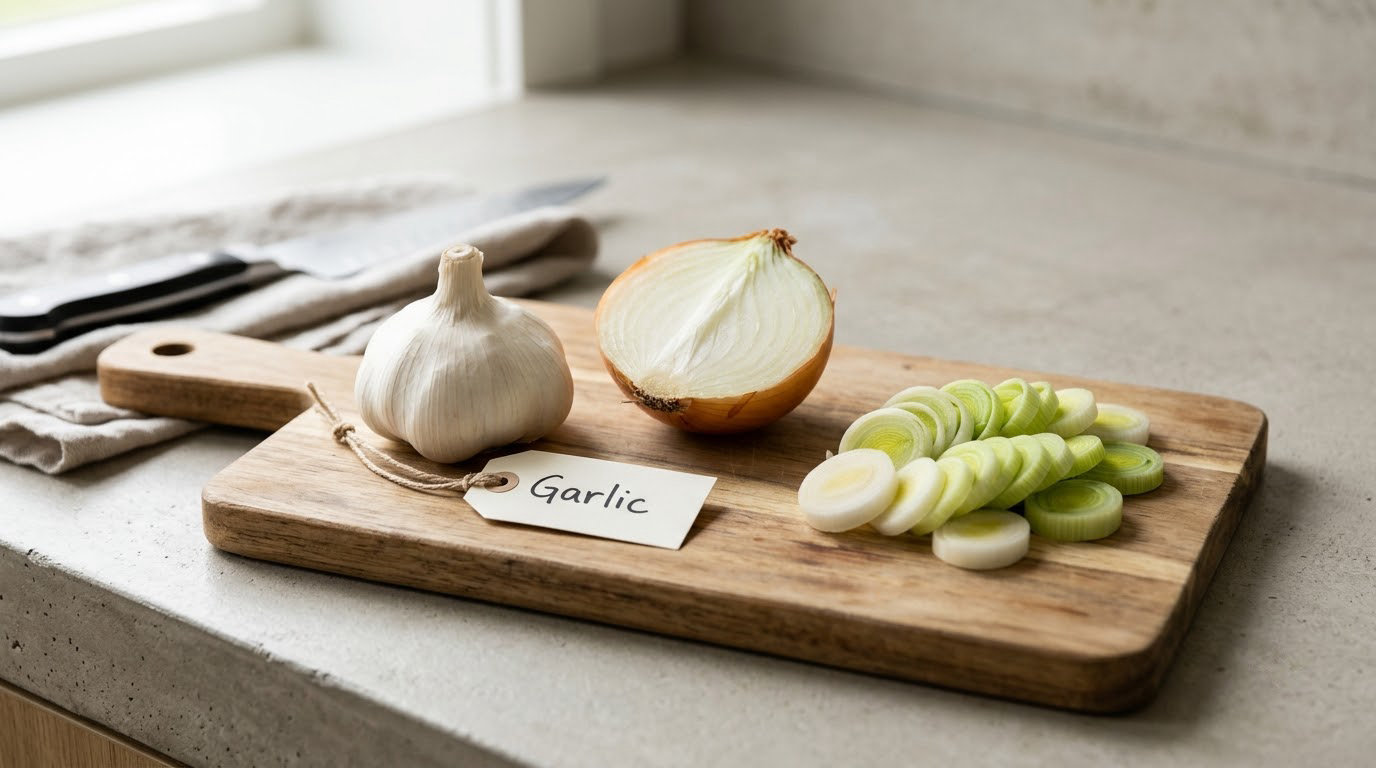
Garlic is one of the most concentrated everyday sources of fructans, the inulin-type chain of fructooligosaccharides and inulin itself that gut bacteria readily ferment. Garlic has more prebiotic fiber per gram than most of what sits in your pantry.
It is also the food people most often regret eating raw. Cooking breaks some fructans down, which is why a clove in a cooked sauce tends to land far easier than the same clove sliced into a salad. If garlic has always been the source of your worst bloating, cooked garlic is a reasonable middle ground rather than a food to write off.
Practical uses: mince a clove into tomato sauce in the last few minutes of cooking, whisk garlic into a vinaigrette with olive oil and lemon, or roast a whole head alongside other vegetables and squeeze the soft cloves out. If you are adding coconut oil for cooking at high heat, garlic is a good flavor partner for the hotter pan work.
Start with half a clove, cooked, on a day when you are not already pushing your fiber intake.
2. Onions
Onions carry the same fructan profile as garlic, in a milder and more versatile package. A 100 g serving of onion contains roughly 3 to 6 g of fructans, which puts it near the top of any ordinary food by prebiotic concentration.
That is also why onion causes so much trouble for people who are sensitive to fermentable carbohydrates. Raw onion in large amounts is a classic trigger; slow-cooked onion is usually better tolerated because heat reduces the fructan load.
Practical uses: sweat onions as the base of soups and curries, caramelize them slowly for a sauce, add raw slices to salads and slaws in modest amounts, or blend a small piece into a tomato smoothie for people who like the sweetness but not the texture. Caramelized onion is a good place to start if raw onion has been a problem.
Start with one to two tablespoons of raw onion, or a spoonful of cooked onion, and build from there.
3. Leeks
Leeks belong to the allium family and supply fructans in the same family as garlic and onion, at roughly 2 to 4 g per 100 g. They are frequently the easiest of the three to fit into a meal, because the flavor is mild and the texture works in almost anything savory.
The white and pale green parts carry the most fructan. The darker green tops are perfectly edible and a good addition to stock, but most of the prebiotic action sits lower down the stalk.
Practical uses: slice the white part into soups and sauces, fold chopped leek into an omelet or frittata, add roasted leeks to a grain bowl, or blend the tougher pieces into a green smoothie where they disappear completely. Washing sliced leeks well matters, since grit trapped between the layers is the most common complaint.
Two to three tablespoons of sliced white leek is a reasonable first serving.
4. Chicory Root
Chicory root is unusual on this list because it is the one ingredient that shows up in concentrated form in everyday products. Roasted chicory root holds roughly 12 to 20 g of inulin per 100 g, a density no fresh vegetable approaches.
It is worth separating chicory root from chicory coffee, too. Inulin survives roasting well, so the roasted root used in coffee substitutes and blends still carries its prebiotic content. The brewed drink delivers a smaller amount than the powder does, and sugar-free blends are the ones doing the most work.
Practical uses: a teaspoon of roasted chicory powder in hot water, mixed into a coffee substitute blend, folded into muffins and banana bread, or stirred into oatmeal. The taste is bitter and earthy, which is why blends pair it with something milder.
One to two grams of inulin powder a day is a common starting point. More than that on an empty stomach is a common way to learn why people describe inulin as harsh.
5. Jerusalem Artichokes
Jerusalem artichokes contain about 8 to 12 g of inulin per 100 g, more than almost any vegetable you can buy fresh. They are also the most overlooked item on this list, partly because they look strange and partly because the name suggests something from the Middle East rather than a sunflower relative.
The texture is the thing people react to. Sliced raw they are crisp and mild, cooked they turn sweet and almost creamy, and both forms carry their inulin. Cooked and cooled preparations are also where resistant starch shows up alongside the inulin.
Practical uses: roast them until the edges caramelize, boil and dress them like potatoes, shave them thinly into salads, or cook a large batch, chill the leftovers, and eat them cold over a grain bowl. Start small and increase, because larger portions are the standard route to gas and bloating.
Two or three slices, cooked, is plenty to begin.
6. Asparagus
Asparagus supplies inulin-type fructans, at around 1 to 2 percent of its carbohydrate content. That is a more modest figure than the alliums, but asparagus earns its place because it is easy to eat several times a week without noticing, and because it fits cooking methods that change how it behaves.
Preparation matters more here than in most vegetables. Raw and blanched asparagus keeps more of its fructans; heavy roasting reduces them along with the moisture. When I roast asparagus on a hot sheet pan, I use coconut oil for high heat cooking with a dry pan, since wet oil and heavy charring are a bad combination there.
Practical uses: grill or pan-sear whole spears, roast at high heat for caramelization, steam lightly and dress with lemon and oil, chop into soups, or blend the fibrous ends into soups and smoothies where they thicken rather than taste.
Three or four spears is a sensible first serving for most people.
7. Bananas
Bananas are a prebiotic food and not a probiotic one. They contain no live cultures; what they supply is resistant starch, a starch that escapes digestion in the small intestine and reaches the colon intact.
Ripeness is the whole story. An underripe green banana can hold several times more resistant starch than a yellow one, and a spotted banana has largely converted it into ordinary digestible starch. Cooling cooked starchy foods also raises their resistant starch content, so leftover cold potatoes sit in the same category.
Building a day around foods high in prebiotic fiber
One practical approach is to pick two or three of these foods and repeat them daily rather than rotating through all fourteen and giving up on day three. A firm banana in an oatmeal breakfast, a spoonful of chicory powder in a midday drink, and garlic in dinner is a workable template that covers fructans, resistant starch, and beta-glucan in a single day.
Variety still matters over a week. Different fermentable fibers favor different organisms, so rotating beans, grains, alliums, and fruit across the week gives a broader signal than any one food can.
Half a firm banana in a smoothie is an easy place to start. Ripe bananas are still good food, just less useful for this particular purpose.
8. Oats
Oats are the most accessible prebiotic food in most kitchens. A single cup of dry rolled oats delivers roughly 4 g of beta-glucan, a viscous soluble fiber that resists digestion and ferments slowly and steadily in the colon.
Because of that slow fermentation, oats are frequently better tolerated than concentrated inulin sources, even by people who bloat at garlic and onions. That makes them a useful early food when you are working up your intake from a low baseline.
Practical uses: cooked porridge with cinnamon and chopped banana, overnight oats with yogurt and berries, oats blended into smoothies for thickness, or oat flour in pancakes and baking. Steel-cut, rolled, and instant all work; heavily processed instant varieties with a long ingredient list are worth comparing before buying.
Quarter cup of dry oats is a sensible starting amount. If you buy oats in bulk, reading the label for added sugar takes ten seconds and saves a disappointing breakfast.
9. Lentils
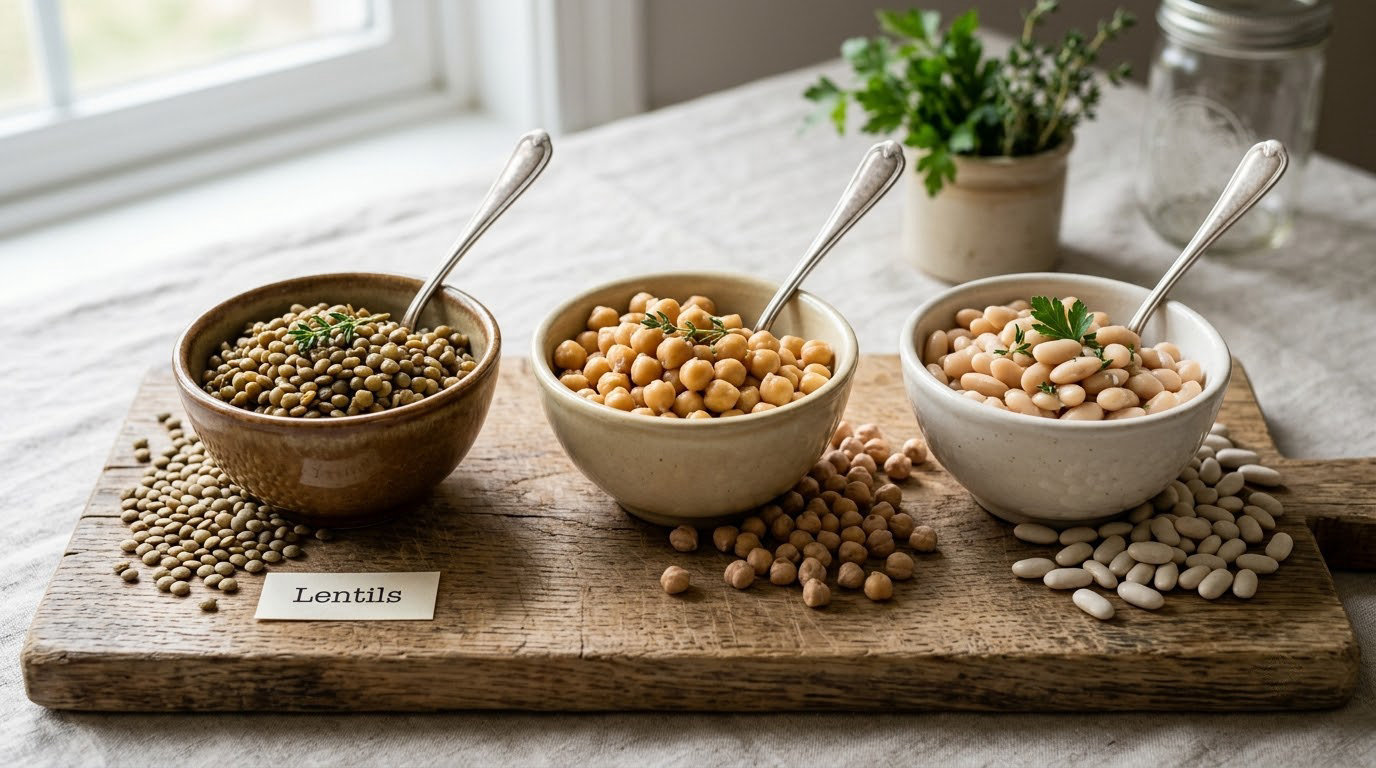
Lentils contribute two prebiotic routes at once: galacto-oligosaccharides, or GOS, which are fermentable straight away, and resistant starch, which builds when cooked lentils cool. Both belong in the GOS group that pulses are known for, along with raffinose and stachyose.
The cooling effect is easy to use practically. Cook a batch of lentil soup, refrigerate the leftovers, and eat half of them cold a day later. You get more resistant starch and a dish that is arguably better the next day anyway.
Practical uses: lentil soup, warm salads with vinaigrette, grain bowls with roasted vegetables, patties and fritters, dal, or a thick blended soup. Red and green lentils cook down faster and get softer, while firm green or black lentils hold their shape in salads.
Quarter cup of cooked lentils is a good first portion, doubled after a few days if your digestion is handling it well. Drink plenty of fluid alongside.
10. Chickpeas
Chickpeas supply about 1 to 2 g of GOS and stachyose per 100 g, alongside a generous amount of insoluble fiber. The GOS fraction is gentler in scale than the allium fructans, which makes chickpeas a reasonable middle rung while your gut adapts.
Preparation changes the picture more than people expect. Canned chickpeas are cooked and then sit in liquid, which raises their resistant starch somewhat. Roasting concentrates flavor and drives off water but reduces nothing about the prebiotic fiber, so roasting is a good choice for taste rather than for gut reasons.
Practical uses: hummus blended with tahini and lemon, chickpeas in salads, chickpea curry, grain bowls, roasted chickpeas as a snack, or a blended dip loosened with olive oil and lemon. Tahini and lemon matter here for a practical reason, since fat and acid make the fiber easier on digestion.
Two tablespoons, whether canned or homemade, is a reasonable start.
11. White Beans
White beans, also called cannellini or navy beans, sit at the higher end of the GOS range among pulses, at roughly 2 to 3 g per 100 g, with resistant starch forming as they cool. They are also among the least expensive ways to add fiber to a week of meals.
The classic mistake is going from a very low fiber intake straight to a full bowl of chili. Increase gradually, keep your fluid intake up, and give your system a few days between increases. That pacing does more for tolerance than any single food choice.
Practical uses: white bean soup, chili, salads with olive oil and lemon, a blended dip thinned with broth or olive oil, or beans folded into a grain bowl. A pot of beans cooked from dry, portioned, and frozen is the most convenient version of this and freezes well.
Two tablespoons to start, then a quarter cup once comfortable.
12. Apples
Apples are a prebiotic food in the modest sense. A medium apple carries roughly 4 g of total fiber, of which about 1 to 1.5 g is pectin, a soluble fiber that is fermented slowly and incompletely by gut bacteria.
Eating the skin is the single change that matters. Much of an apple’s pectin and a good share of its polyphenols sit right under the peel, which is also where most of the fiber lives. Peeled apples are a different food as far as prebiotic value goes.
Practical uses: whole with the skin on, baked with cinnamon, chopped into slaw with cabbage, sliced into oatmeal, or added to a yogurt bowl. An apple eaten raw and whole at the end of a meal is about as low-effort as prebiotic food gets, and it travels well.
Half a small apple is enough to start with, especially if your fiber intake is currently low.
13. Blueberries
Blueberries contribute about 3 to 4 g of fiber per cup alongside anthocyanins and other plant polyphenols. They are not a concentrated prebiotic source the way chicory root is, and it is better to describe them as a supportive addition than as the strongest item on this list.
What makes them useful is frequency and convenience. Frozen berries keep their fiber and polyphenols, which means the off-season gap that stops people buying fresh is not a real gap at all. Frozen also breaks down faster when blended, so they disappear into smoothies in a way fresh berries do not.
Practical uses: spooned over yogurt or oatmeal, folded into pancakes, tossed into salads with savory dressing, or blended with banana and oats into a smoothie. Baking and cooking reduce some of the polyphenols but leave most of the fiber intact.
A quarter cup is plenty for most days, and doubling it is unremarkable if your digestion is already settled.
14. Cocoa
Unsweetened cocoa powder carries roughly 10 to 15 g of fiber per 100 g along with a substantial share of its polyphenols, some of which reach the colon alongside fermentable fiber. It is a modest prebiotic contributor compared with the alliums, and cocoa powder is easy to mistake for chocolate.
The distinction matters. Sweetened drinking chocolate and dark chocolate bars contain far less cocoa solids per serving, and the sugar in them is a separate issue. This is the point where checking the label on packaged foods pays off: plain cocoa should list cocoa or cacao solids as the only ingredient.
Practical uses: a tablespoon stirred into oatmeal or yogurt, blended into a banana smoothie, mixed into a smoothie with greens where it covers bitterness well, folded into bran muffins, or whisked into a mug of warm milk.
One tablespoon is a reasonable daily amount. More than a few tablespoons at once is occasionally reported as uncomfortable, so it is one to watch if you are sensitive.
Frequently Asked Questions
How much fiber should adults eat each day?
General US guidance from the National Institutes of Health puts daily fiber at about 38 grams for adult men and 28 grams for adult women. Prebiotic fiber is only part of that target, since insoluble fiber and other types count too. Most people fall well short of the recommendation, and raising intake gradually with plenty of fluid makes the change far easier on digestion.
What is the difference between prebiotic fiber and probiotics?
Probiotics are living organisms, usually bacteria or yeast, added to food or supplements. Prebiotics are non-digestible carbohydrates that feed bacteria already living in your colon. Eating both together is often called a synbiotic approach: food like yogurt and fruit that supplies live cultures along with fiber those cultures can use.
Can eating prebiotic foods cause gas or bloating?
Yes, especially when you jump straight to concentrated sources such as chicory root inulin, garlic, onions, or Jerusalem artichokes. The bacteria fermenting the fiber produce gas as a byproduct, and an unfamiliar gut reacts more strongly than an adapted one. Start with a small portion of a gentler food such as oats or firm banana, increase every three or four days, and cut back if symptoms are more than mildly uncomfortable.
Are supplements necessary to get enough prebiotic fiber?
For most people, no. Everyday foods supply enough prebiotic fiber if you eat a reasonable range of vegetables, legumes, whole grains, and fruit. Supplements such as inulin powder are useful for convenience or during travel, but they are concentrated and tolerance varies widely. Whole foods also come with protein, micronutrients, and fiber types a capsule does not provide.
Are frozen fruits and vegetables good sources of prebiotics?
Yes. Freezing preserves fiber and most polyphenols, and the effect of freezing on prebiotic fiber itself is minor. Frozen produce is often picked and frozen shortly after harvest, and it costs less than fresh out of season. Frozen fruit also blends smoothly for smoothies, and blanched then frozen asparagus and green beans keep their fermentable carbohydrates.
Who should talk with a healthcare professional before increasing fiber?
Talk with a doctor or registered dietitian first if you have diagnosed IBS, IBD, SIBO, celiac disease, or a history of an eating disorder, or if you recently finished antibiotics. Anyone with persistent pain, weight loss, blood in stool, or symptoms that are getting worse should get checked rather than self-directed. For everyone else, gradual increases and adequate fluid are usually enough.
Conclusion
If you do one thing with this list, pick two foods you already like and add one of them to a meal you already eat, today. Oats at breakfast and garlic in a cooked dinner covers two of the main fermentable fiber types with almost no extra effort.
Then add a third over the next couple of weeks, keep changing the rotation, and drink enough fluid that the increase does not slow your digestion down. If you are coming off antibiotics or managing a diagnosed condition, bring the plan to a doctor or registered dietitian first, since the right pace for you may be considerably slower than it is for someone else.