
To read a nutrition facts label, start at the very top: check the serving size and how many servings are in the container, read the calories for one serving, then use the %DV column, where 5% or less is low and 20% or more is high. Finish with the ingredients list, which runs from heaviest to lightest.
That is the whole skill. Everything else on a food package, from the big glowing word on the front to the tiny footnote about daily values, exists to sell you the food. The black-and-white panel on the side is the only part a federal rule governs, and it is the only part worth trusting when you put two jars side by side.
I have spent more time than I care to admit squinting at cereal boxes in fluorescent grocery lighting, and the labels that trip people up are almost always the same ones. So this guide walks the panel top to bottom the way the FDA lays it out, then shows you how to use it for a specific goal rather than just describing the columns.
Table of Contents
What You Need
Not much, which is good news. Before you start, you need three things.
The food itself, in your hand. Most people try to read labels from a shelf, at arm’s length, in bad light. Turn the package so the panel faces you and hold it closer.
A reason for comparing. A specific question changes what you look at. Choosing between two yogurts means fiber and added sugars. Choosing a soup means sodium. Choosing a snack for a kid means calories and added sugars. Without a goal, the panel turns into a wall of numbers and you stop reading halfway down.
A measuring cup or a kitchen scale, for later. Not to read the label, but to check it. When a serving size says a quarter of a cup and you scoop out half the tub, every number on that panel is twice what the label claims.
You do not need a nutrition degree, an app, or a spreadsheet. If you want a deeper look at what sits behind the numbers, our guide to how to read an ingredient list on a food package pairs well with this one.
How to Read a Nutrition Facts Label: Step-by-Step
Read the panel in physical order, top to bottom, because the FDA designs it that way. Each step below tells you what to look for and why it matters.
Start with the serving size and number of servings
Every single number on the panel describes one serving, not the whole package. The serving size is stated in a household measure first, like a cup or a piece, with the metric weight in parentheses, and directly under it sits the servings per container.
Do the math once and you have the trap closed. A 20-ounce bottle of soda that lists 2.5 servings at 140 calories each works out to 350 calories for the bottle, not 140. A 15-ounce can with 2.5 servings means one can is 2.5 servings.
Some packages print two columns, one for a serving and one for the whole package, usually on anything small and calorie-dense like a bottle of juice or a bag of chips. Read the header of each column carefully so you do not read the per-package number and assume it is per serving.
If you eat a different amount than the label assumes, multiply. 1.5 servings means 1.5 times every number on the panel, and rounding applies to the total you end up with, not to each nutrient.
Check the calories per serving
Calories sit in their own bolded line right under the serving information, and they are the number most people look at first and least thoughtfully.
The %Daily Value figures on the same panel are calculated against a 2,000-calorie reference diet. That is a general reference point for adults and children over four, not a personal target. Your own needs shift with age, body size, activity level and goals, so treat the daily values as a measuring stick rather than a prescription.
Calories also tell you almost nothing on their own. A package can be low in calories and still be mostly sodium and added sugar. Use the number as an input, then read the rest of the panel.
Read the nutrition facts label for the nutrients you care about
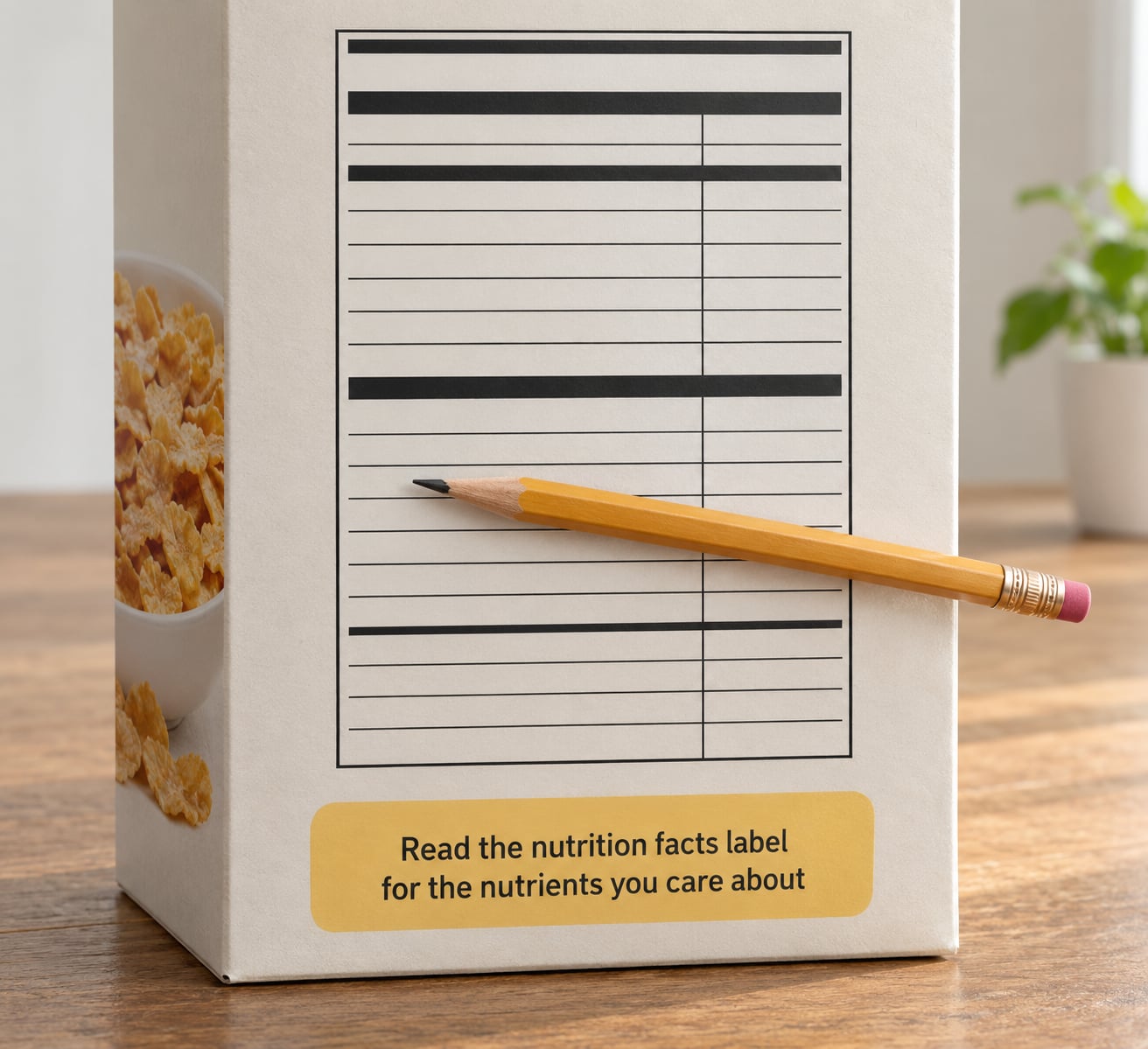
The panel splits into two families, and knowing which is which saves you a lot of scrolling. The FDA prints two bold headers to make it obvious.
Nutrients to limit are the indented sub-lines: saturated fat, trans fat, cholesterol, sodium, and added sugars. The FDA’s Daily Values for these sit at 20 g saturated fat, 300 mg cholesterol, 2,300 mg sodium and 50 g added sugars.
Nutrients to get more of are the ones with stand-out positions: dietary fiber (28 g DV), vitamin D (20 mcg), calcium (1,300 mg), iron (18 mg) and potassium (4,700 mg). Most people fall short on fiber, calcium, potassium and vitamin D without ever realizing it.
Total fat splits into saturated, trans and unsaturated, and only saturated and trans carry their own Daily Values. Total carbohydrate splits into fiber, total sugars and added sugars, and added sugars must be listed as their own indented line since 2016.
Total sugars includes sugar naturally present in the fruit or milk plus anything added. That is why a plain jar of jam can carry 24 g of total sugars with 20 g of them added, and why dried sweetened cereal can show 12 g total with all 12 g added.
Dietary fiber comes in two forms. Soluble fiber dissolves and helps with cholesterol and blood sugar; insoluble fiber does not dissolve and mostly adds bulk. Current Dietary Guidelines for Americans put the daily fiber goal at 25 to 38 grams, depending on age and sex, and almost nobody hits it without trying.
If you also read labels for carbohydrate counting, note that net carbs is not an FDA-regulated term on the panel, and neither is glycemic index. People who count carbs generally use total carbohydrate and subtract dietary fiber, and the American Diabetes Association recommends using total carbohydrates rather than relying on net carbs.
Use the Daily Value column as a guide
5% Daily Value or less is low in a nutrient. 20% Daily Value or more is high in a nutrient. Everything from 10% to 19% sits in between, and that middle band is where judgement enters.
The rule works because the Daily Values are not round marketing numbers. They come from how much of a nutrient most people need, and they apply to every product, so you can compare a granola bar against a box of crackers directly.
Apply it in the right direction. Fiber at 25% DV is worth chasing. Sodium at 45% DV in a single serving means that snack has used close to a quarter of your daily sodium before dinner.
One wrinkle worth knowing: the American Diabetes Association uses a 10% DV cut-off instead of 5% for people managing diabetes, which tightens the filter. If you are working with blood sugar or carb counting, treat 10% as your low threshold rather than 5%.
Look at the ingredient list and front-of-package claims together
The ingredients list is ordered by weight from most to least, so the first three or four ingredients are most of what you are about to eat. A long list of unrecognizable names usually means starches, fillers and emulsifiers are doing the work. A short list of recognizable foods is a good sign, though it is not a nutrition verdict on its own.
Added sugar shows up under many names: corn syrup, high fructose corn syrup, dextrose, maltose, sucrose, cane sugar, evaporated cane juice, cane syrup, honey, agave nectar, rice syrup, malt syrup and fruit juice concentrate. If several of those cluster in the first five ingredients, added sugars will be high.
Our guide to how to spot hidden sugar in packaged foods covers the full list of aliases if that is your main concern.
Now cross-check the claims on the front. Fat free means 0.5 g of fat or less per serving, not zero. Low fat means 3 g or less. Low sodium means 140 mg or less. High fiber means 5 g or more. Every one of those thresholds applies to a single serving, so a serving size that makes the number look good is fair game under the rules.
Keep an eye out for the pairing of 0 g trans fat with partially hydrogenated oil in the ingredient list. Under federal rules a product can list zero trans fat while still containing up to 0.5 g per serving, and it accumulates fast once you eat more than one serving. The American Heart Association flags this combination specifically.
Compare similar products using the same amount
Here is the practical routine. Pick two versions of the same food, name-brand against store-brand, and put them side by side.
First, normalize the serving sizes. If one lists 140 calories per cup and the other lists 90 calories per half cup, the half cup is the only honest comparison point. Scale everything to the same weight or the same household measure before you look at a single nutrient.
Then scan the %DV column for the nutrients tied to your goal, in the same order both times. Finally, check the ingredients list to explain any gap. One brand often wins on a number and loses on what is actually in the jar.
Yogurt is the best classroom for this, because the gap between a 2 g sugar variety and a 19 g one is enormous and invisible until you compare the grams. Our guide to picking a healthy yogurt at the store walks through that comparison on a real panel.
Common Mistakes
- Comparing packages with different serving sizes. The fix: convert to the same amount first, every single time. A quarter-cup serving of pasta sauce makes any sauce look reasonable, because it is roughly what goes on a plate, but a serving size chosen for the nutrition panel is not always the serving size on the box.
- Assuming a front-of-package claim describes the whole package. Low calorie, low sodium and fat free are all judged per serving. The fix: read the servings per container line before you believe any of them.
- Skipping the added sugars line. Total sugars includes natural sugar, so a dried fruit bar can look moderate until you see the added line underneath it. The fix: read the indented added sugars row every time.
- Treating organic or natural as a nutritional advantage. Organic describes how the crop was grown and natural is largely an unregulated marketing word. Neither tells you anything about sodium, sugar or fiber. The fix: read the panel for that, and use the ingredient list for quality.
- Using 5% as the only threshold. The 5/20 rule is a starting point, not a verdict. The fix: look at what each number means for your own goal, and note that the ADA uses 10% for diabetes management.
- Treating the panel as a treatment plan. A label tells you what is in the food. It cannot tell you whether you should eat it, how often, or how it interacts with a medication or condition. The fix: use it as information, and take individual questions to a doctor or a registered dietitian nutritionist.
Tips for Making a Quick Shopping Decision
When you have about thirty seconds and two products in your hands, run the scan in this order.
Serving size and servings per container. This takes two seconds and it is where most comparisons go wrong. If the numbers differ, stop and convert.
Calories per serving. Not as a quality score, just as a size check. A 90-calorie snack that comes in a 900-calorie bag is not a 90-calorie purchase.
The %DV column, top to bottom. Push the 20%-or-higher values you want more of up your list, and pull the 20%-or-higher values you want less of off the bottom. Five seconds is enough to scan for the two nutrients that matter to you.
The first three ingredients. They tell you what the product actually is, and they explain most surprises in the panel above them.
That last step is what settles close calls. When two products tie on the numbers, the shorter list of recognizable ingredients usually wins, and it takes about two seconds to decide.
Frequently Asked Questions
What is the 5/20 rule for nutrition facts?
The 5/20 rule is a shortcut for reading the % Daily Value column. A nutrient showing 5% DV or less is low in that food, and 20% DV or more is high. Values from 10% to 19% sit in the middle. Use it as a quick filter: aim high for fiber, calcium, iron, potassium and vitamin D, and keep low for saturated fat, sodium and added sugars.
How inaccurate can nutrition labels be?
Federal rules allow a product’s nutrient content to fall within roughly 20% of the value printed on the panel, and many values come from food-composition databases rather than laboratory testing. Small serving differences and rounding make up some of that gap. It is accurate enough for everyday comparisons, which is exactly what the panel is designed for.
What is the number one carb to avoid?
Added sugar is the category to watch rather than any single food. Check the % Daily Value for added sugars: 5% DV or less is low and 20% or more is high for a serving. Then scan the ingredients list for sugar under its other names, since corn syrup, dextrose, maltose, cane syrup and fruit juice concentrate all count as added sugar.
How do I read a nutrition label when the package has two columns?
Two-column labels print one set of numbers for a single serving and a second set for the entire package, and they appear on small, calorie-dense items like juice bottles and chip bags. Read the header above each column before you take any number. If you want a like-for-like comparison, use the per-serving column on both products.
Does organic or natural mean the food is healthier?
Organic describes how the crop was produced and says nothing about nutrition. Natural is not an FDA-regulated nutrient claim, so it can appear on almost anything. Neither tells you about sodium, added sugars or fiber. Judge those on the Nutrition Facts panel and check the ingredient list, then use organic or natural as a preference if you want it.
How do I read labels for a low-carb or keto diet?
Start with total carbohydrate, then subtract dietary fiber to get an estimate, and check how much of the total is added sugars. Net carbs is not an FDA-regulated term and the American Diabetes Association recommends using total carbohydrates instead. Also watch sugar alcohols such as erythritol and maltitol, which can appear without adding much to total carbohydrates.
Conclusion
Start at the top of the panel every time. Read the serving size and the servings per container, then calories, then use the %DV column with the 5/20 rule, and let the ingredients list settle anything the numbers left unclear.
That sequence works whether you are comparing two yogurts, counting carbs, or just trying to figure out why a bag of chips has 1,000 calories in it. If you have a specific condition or dietary pattern in play, bring the panel to a doctor or a registered dietitian nutritionist, since individual needs go well beyond what any label can tell you.