

To calculate calories you need per day, work out your basal metabolic rate with the Mifflin-St Jeor equation, multiply that number by your activity factor, and then adjust for your goal. That gives you an estimate of total daily energy expenditure, or TDEE.
It takes about five minutes with a calculator. The catch is that the output is a starting point, not a measurement, so you’ll want to check it against real weight and intake data after three or four weeks.
Table of Contents
What You Need
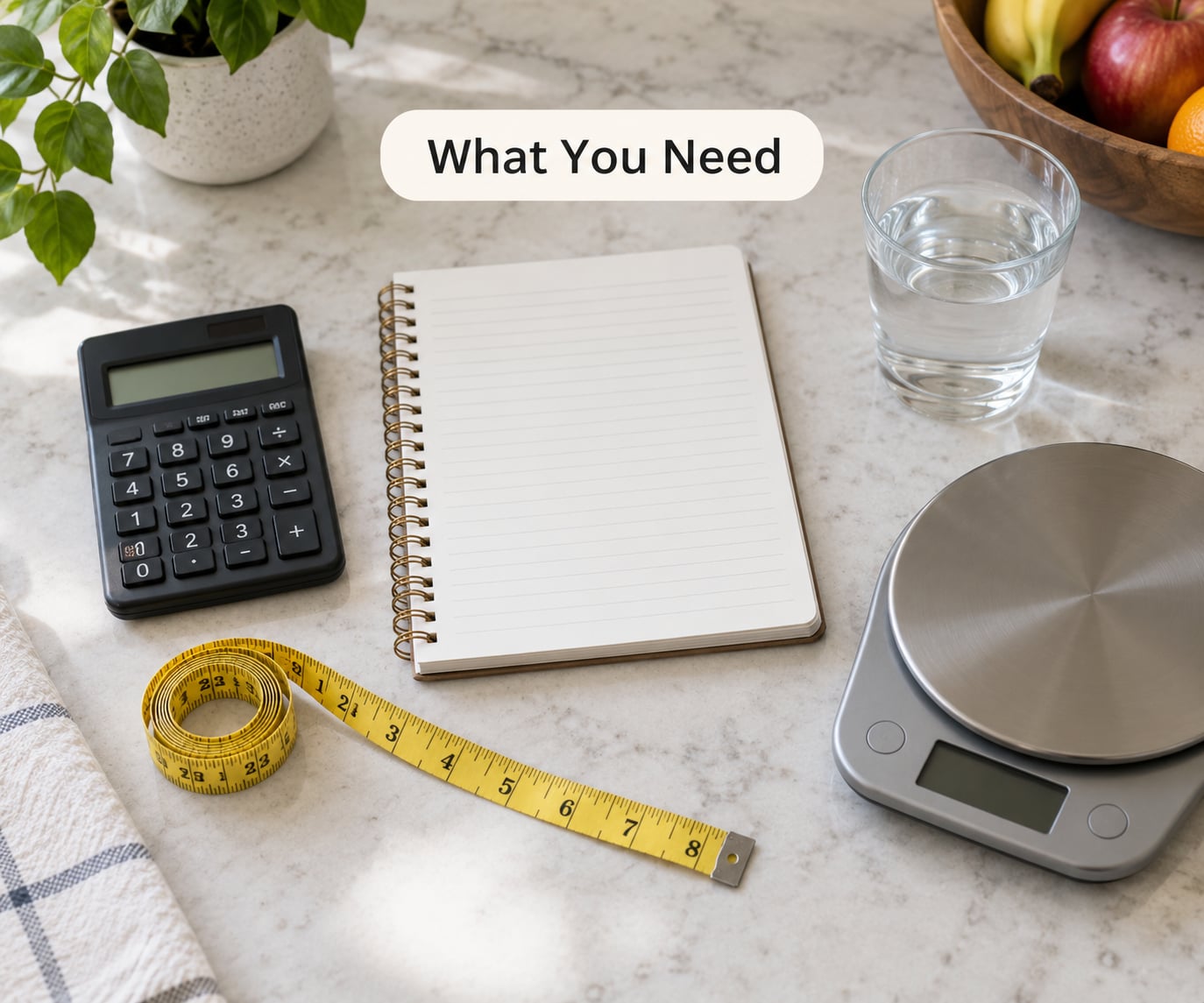
Six inputs do all the work: your age, sex, height, weight, activity level, and goal. That’s it.
- Height. Measure once, in the morning, against a flat wall. Bare feet, heels together, mark the top of your head.
- Weight. Use current numbers, not what you weighed last spring. Weigh yourself a few times across a week and take the middle reading.
- Age and sex. The formula uses a sex constant of +5 for men and -161 for women, so it has to match the sex you were assigned at birth.
- Activity level. A rough weekly picture of training, commuting, and just moving around.
- Goal. Hold steady, lose slowly, or build up. You cannot choose this until step 4.
Optional but useful: a food scale for the first fortnight, a tape measure if you can only estimate height, and a tracking app or plain notebook.
This is general information about how predictive equations work, not medical advice. If you have a medical condition, are pregnant or breastfeeding, have a history of disordered eating, or are under 18, get individual guidance from a doctor or registered dietitian rather than running the maths yourself.
Step-by-Step: How to Calculate Calories You Need Per Day
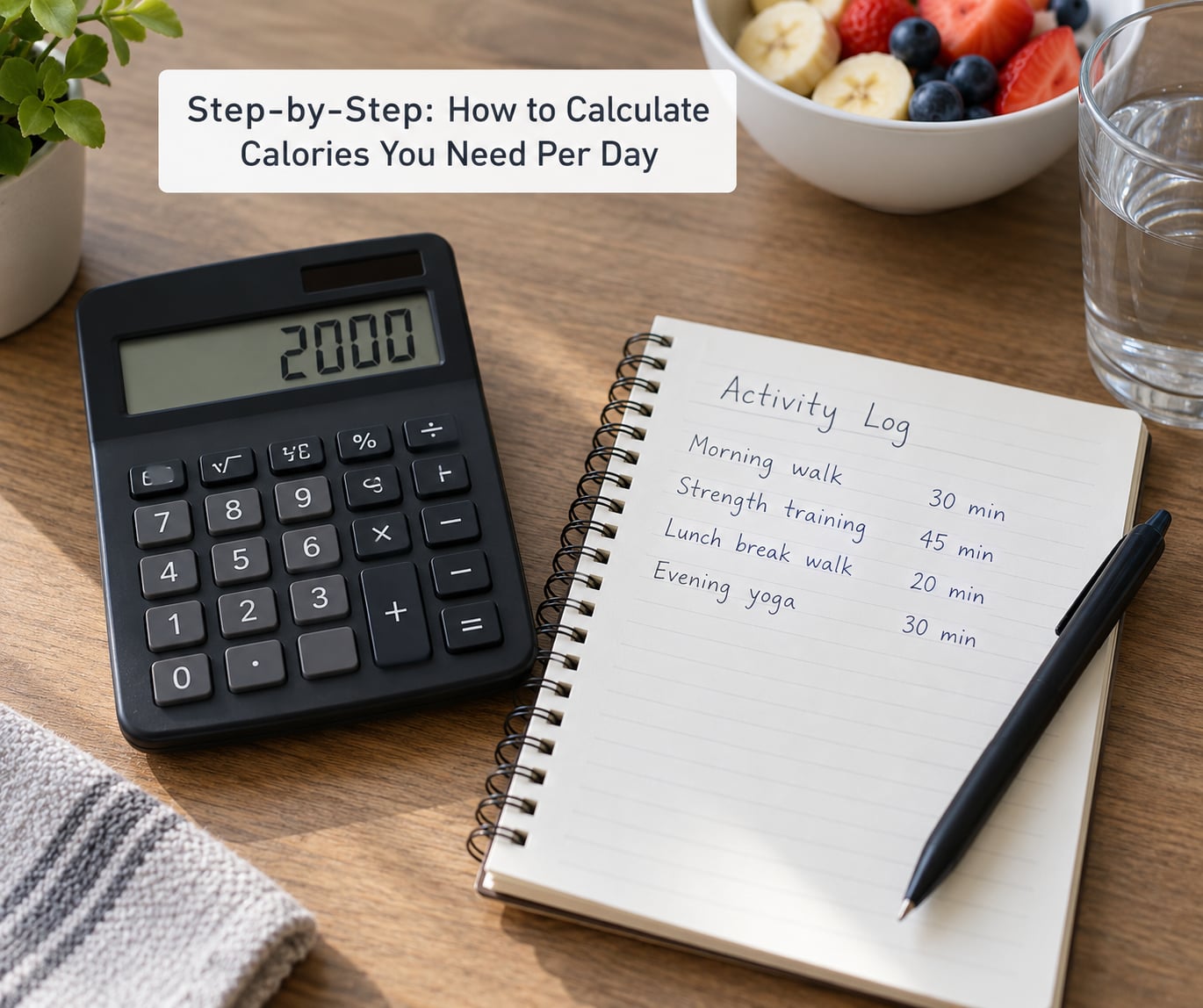
Step 1: Gather Your Current Measurements
Write down five numbers before you open a calculator: weight in kilograms, height in centimetres, age, and sex. If you have pounds and inches, convert them first, because feeding pounds into a metric equation gives you a number that looks plausible and is wrong by about 2.2 times.
Two conversions cover almost everything:
- Kilograms = pounds × 0.4536. A 165 lb reading is about 74.8 kg.
- Centimetres = inches × 2.54. A 5 ft 5 in (65 in) height is about 165.1 cm.
Use today’s measurements. The equation leans on body weight and lean mass, and a ten-pound swing moves a 165 lb person’s resting estimate by roughly 50 calories a day.
Step 2: Calculate Your Basal Metabolic Rate
Your basal metabolic rate, or BMR, is the energy your body uses at complete rest just to keep organs running. Published in 1990 and generally the best-validated of the common equations, the Mifflin-St Jeor formula reads:
Men: BMR = (10 × weight in kg) + (6.25 × height in cm) − (5 × age) + 5
Women: BMR = (10 × weight in kg) + (6.25 × height in cm) − (5 × age) − 161
Here is a full example. A 34-year-old woman, 5 ft 5 in, 165 lb:
- Weight: 165 × 0.4536 = 74.8 kg
- Height: 65 × 2.54 = 165.1 cm
- (10 × 74.8) = 748
- (6.25 × 165.1) = 1,032
- (5 × 34) = 170
- 748 + 1,032 − 170 − 161 = 1,449 kcal
Read that carefully: 1,449 is not what you eat in a day. It is what you would burn lying still, fully asleep, for 24 hours. Real days include walking, thinking, cooking and digesting.
Step 3: Adjust for Your Activity Level
Multiply your BMR by an activity factor. Pick the row that matches an ordinary week, not your best one and not your aspirational one.
| Activity level | Factor | What it describes |
|---|---|---|
| Sedentary | 1.2 | Desk job, little deliberate exercise, under 5,000 steps a day |
| Lightly active | 1.375 | Light exercise 1-3 days a week, or an active job on your feet |
| Moderately active | 1.55 | Moderate exercise 3-5 days a week |
| Very active | 1.725 | Hard exercise 6-7 days a week, or a physical job plus training |
| Extra active | 1.9 | Twice-a-day training, shift work, manual labour, or a very high step count |
Our example woman trains twice a week and walks most days, which lands on lightly active: 1,449 × 1.375 = 1,993, so roughly 1,990 kcal a day to hold her weight.
Two honest habits make this more accurate. Pick the level from an average week rather than your busiest one, and when your activity is genuinely mixed or seasonal, choose the lower of the two rows and adjust later from real weight data. Non-exercise activity thermogenesis, the calories burned in ordinary movement, swings by several hundred a day between people who look equally sedentary, and the multiplier cannot see that difference.
Step 4: Decide What the Result Means for Your Goal
Now the number becomes useful. Adjust from maintenance in the direction you want, and keep the change small enough that you can hold it.
- Hold your weight: eat near your TDEE. For our example, about 1,990 kcal.
- Lose weight gradually: subtract 300 to 500 kcal, which is roughly 0.25 to 0.5 kg (0.5 to 1 lb) a week. Our example lands near 1,500 kcal.
- Gain lean weight: add 250 to 400 kcal and add resistance training to the plan. Our example lands near 2,300 kcal.
- Support training: stay near maintenance or slightly above, and add carbs around harder sessions.
Commonly cited intake floors sit around 1,200 kcal for women and 1,500 for men, and going below them without medical supervision is a bad trade. They exist for a reason: very low intakes bring fatigue, poor sleep, hair loss, and lost training quality.
The arithmetic behind weight change is rough but handy. Around 7,700 kcal represents roughly one kilogram of body fat, so a 500 kcal daily deficit is about 0.5 kg a week in theory and usually less in practice.
Step 5: Turn Your Estimate Into an Actionable Plan
Split the daily number into three meals and one or two snacks rather than two large meals and a gap. For a 1,990 kcal day, that is roughly 600 kcal at breakfast, 250 kcal as fruit or yoghurt in the morning, 650 kcal at lunch, 200 kcal in the afternoon, and about 300 kcal at dinner, with the remainder for oils, sauces and drinks.
Protein carries more of the hunger load than the calorie count does, which is worth knowing if you want the detail on how much protein you actually need per day.
Then compare the plan with reality. Weigh your food for two weeks, log it honestly, and compare your average daily intake against the estimate. Tracking is a diagnostic tool here, not a way of life, and two solid weeks tells you plenty.
How to recalculate calories you need per day in week three
This is the step that makes the number correct, and it is where most guides stop.
- Weigh yourself every morning, after using the bathroom, and look at the weekly average rather than a single reading.
- Compare that average with where you started. Over three to four weeks, the trend is meaningful even though the day-to-day noise is not.
- If your weight held steady, your estimate was right. If it drifted by about 1 kg in either direction, move your intake by 100 to 150 kcal and repeat.
- Re-run the formula if your weight changed by more than about 5 percent, since your TDEE moves with you.
Repeat the whole cycle every two to four weeks while you are changing things. A number that was right six weeks ago is not necessarily right today.
Common Mistakes
Choosing activity by aspiration. The 1.9 row exists for people who genuinely train twice a day, not for the person who plans to. Pick the level that describes your average Tuesday.
Using an old weight. Formula inputs should be current. Recalculate after any meaningful weight change.
Treating BMR as your daily need. Eating your basal rate means cutting 25 to 40 percent of your energy without intending to, which is how people end up under-eating and blaming their metabolism.
Counting exercise calories as a budget. Movement burn estimates are routinely overstated, sometimes by two or three times. You are already counting activity through the multiplier, so adding a workout number on top double-counts it.
Dropping calories fast. Aggressive cuts drive hunger up and adherence down, and metabolic adaptation can follow. Adjust by 100 to 150 kcal at a time and give it two weeks.
Treating the estimate as exact. Prediction error runs roughly 5 to 10 percent, which on a 2,000 kcal figure is 100 to 200 kcal of genuine uncertainty. No equation measures metabolism; they estimate it from four inputs.
Mixing up units. Pounds into a metric formula is the single most common arithmetic error and it does not look wrong on the calculator. Convert first.
Two habits prevent most of this: weigh yourself on the same scale, at the same time, and write the number down even when you do not like it. And give the plan two to four weeks before judging it, because almost every formula needs one adjustment cycle to become correct for you.
Frequently Asked Questions
Does this calorie formula work for children and teenagers?
Most online calculators refuse to run for under-18s because growth makes an estimate unreliable and because the risk of an overly restrictive target is higher. The Mifflin-St Jeor equation itself works arithmetically at any age, but the activity factors and the floor numbers were not designed with growing bodies in mind. Ask a doctor or registered dietitian for guidance instead of adjusting an adult number yourself.
How large should a calorie deficit be for gradual weight loss?
Most mainstream guidance points to a daily shortfall of roughly 500 kcal for about 0.5 kg (1 lb) per week, with slower rates often working better in practice. Around 7,700 kcal represents roughly one kilogram of body fat, though real results vary. Avoid deficits that take you below commonly cited floors of 1,200 kcal for women and 1,500 kcal for men.
Do calorie needs change as you get older?
They do, slowly. The Mifflin-St Jeor equation subtracts 5 kcal for every year of age, and lean mass tends to decline while body fat rises across adulthood. Activity usually drops at the same time. The effect is real but gradual, which is why your estimate should be recalculated every two to four weeks rather than trusted forever from a single calculation.
How can I estimate calories without weighing my food?
Use label calories for packaged items and restaurant menu figures as a starting point, then adjust for the oil, butter and sauces you actually add. Portion comparison works better than recall: compare a serving to familiar objects such as a deck of cards or a fist. Expect to undercount by 10 to 20 percent at first, which is why one weighing week early on pays for itself.
When should I check with a doctor or dietitian instead?
Ask a healthcare professional before restricting intake if you are under 18, pregnant or breastfeeding, managing diabetes, kidney disease, PCOS, a thyroid condition or an eating disorder history, or if you are an athlete in heavy training. The same applies if you feel lightheaded, constantly cold, unusually tired or fixated on food after two or three weeks of tracking. An individual assessment beats any equation in those situations.
Conclusion
Calculating calories you need per day takes three pieces of arithmetic: Mifflin-St Jeor for your basal metabolic rate, an activity factor for total daily energy expenditure, then a deliberate adjustment for the goal you actually want. None of it is complicated. The part that takes patience is the calibration.
So start with the current measurements in front of you, pick the activity row that matches an ordinary week rather than a good one, and treat the result as a flexible starting estimate with a 5 to 10 percent margin. Check it against two weeks of real intake and your weekly weight average, nudge by 100 to 150 kcal when the trend disagrees, and repeat. Updated for 2026, this method is the same one the dietary reference calculators use, with the honesty step most of them leave to you.