
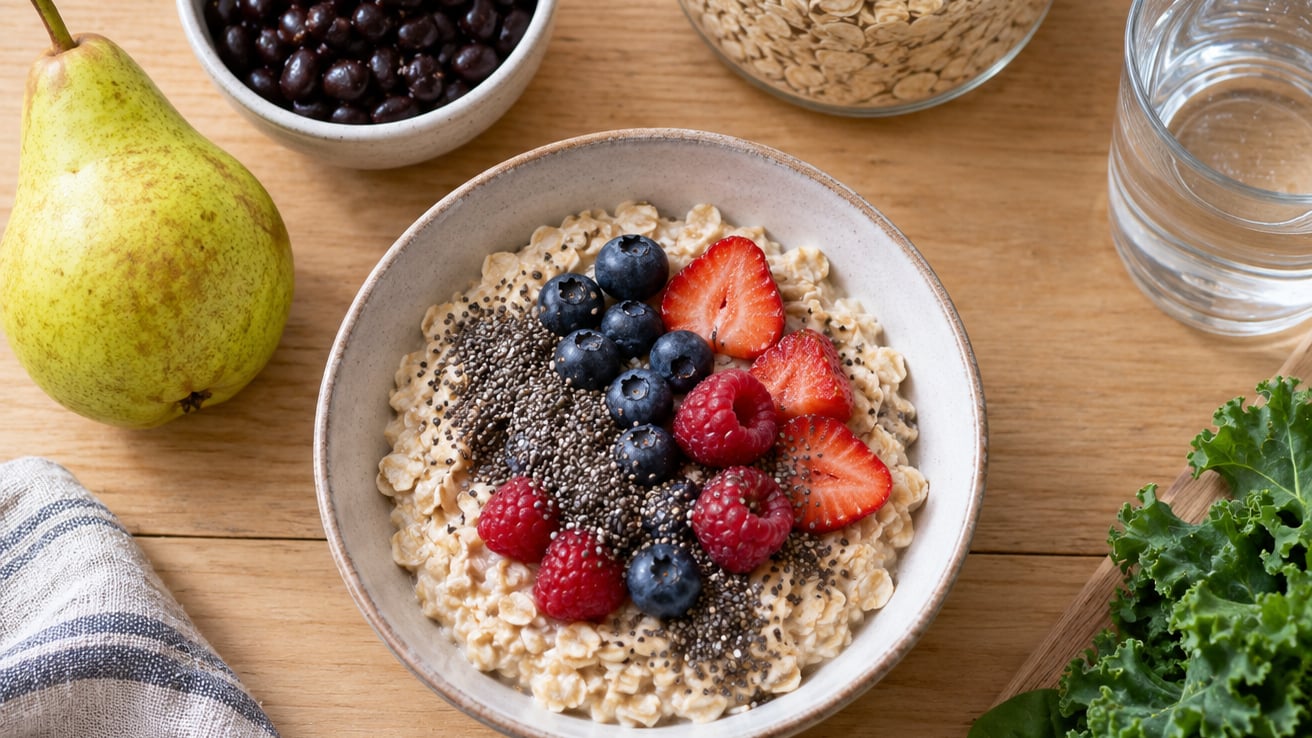
Most adults fall well short of fiber, and the fix is boring rather than dramatic: add a few grams a day from ordinary foods, spread them across meals, and drink enough fluid. Adult daily fiber targets are about 25 grams for women and 38 grams for men under age 50, dropping to 21 and 30 grams after 50, which works out to roughly 14 grams for every 1,000 calories you eat.
This guide walks through how to eat more fiber every day with no supplement, no tracking app and no meal overhaul. Nine swaps, one realistic sample day, and a way to raise your intake that your digestion can actually tolerate.
One caution up front. Fiber moves water through your gut, so when you add a lot of it at once without fluids, gas and bloating are common. Go slowly, drink water throughout the day, and talk to a doctor or registered dietitian if you have persistent pain, cramping or a diagnosed digestive condition.
Table of Contents
What You Need
Good news: you need nothing special. No blender, no specialty bread, no powders on the counter. Beans from a can, rolled oats, frozen vegetables and a handful of seeds will get most people where they need to be.
What you do need is a short list of foods that carry a lot of fiber per bite, so you are not trying to eat an impossible volume of vegetables. Beans and lentils are the single biggest lever, at roughly 15 grams in a cooked cup. Most people eat something like half that on an average day.
Here is a rough chart of common high-fiber foods and how much each standard serving delivers. Figures are approximate and vary by brand and portion, so treat them as guidance rather than exact counts.
| Food | Serving | Fiber |
|---|---|---|
| Lentils, cooked | 1 cup | 15 g |
| Black beans, cooked | 1 cup | 15 g |
| Avocado | 1 medium | 10 g |
| Chia seeds | 1 oz | 10 g |
| Edamame | 1 cup | 8 g |
| Raspberries | 1 cup | 8 g |
| Chickpeas, cooked | 1 cup | 7 g |
| Artichoke | 1 medium | 7 g |
| Whole wheat pasta, cooked | 1 cup | 6 g |
| Barley or quinoa, cooked | 1 cup | 5 g |
| Pear, with skin | 1 medium | 5 g |
| Oats, dry | 1/2 cup | 4 g |
| Ground flaxseed | 2 tbsp | 4 g |
| Broccoli, cooked | 1 cup | 4 g |
| Almonds | 1 oz | 4 g |
| Whole wheat bread | 1 slice | 3 g |
| Popcorn, air-popped | 3 cups | 3 g |
It also helps to know the two main kinds. Soluble fiber dissolves in water and forms a gel, which slows how fast sugar enters the bloodstream and binds cholesterol in the gut. Oats, barley, chia, ground flaxseed, apples, citrus and beans are the usual sources.
Insoluble fiber does not dissolve. It adds bulk and pushes things along, which is why whole grains, wheat bran, nuts, seeds, beans and most vegetables show up here. Both types are useful, and most foods that are good for you give you some of each. If you want a deeper look at prebiotic foods specifically, our guide to 14 foods high in prebiotic fiber goes into the gut bacteria side.
Step-by-Step: How to Eat More Fiber Every Day
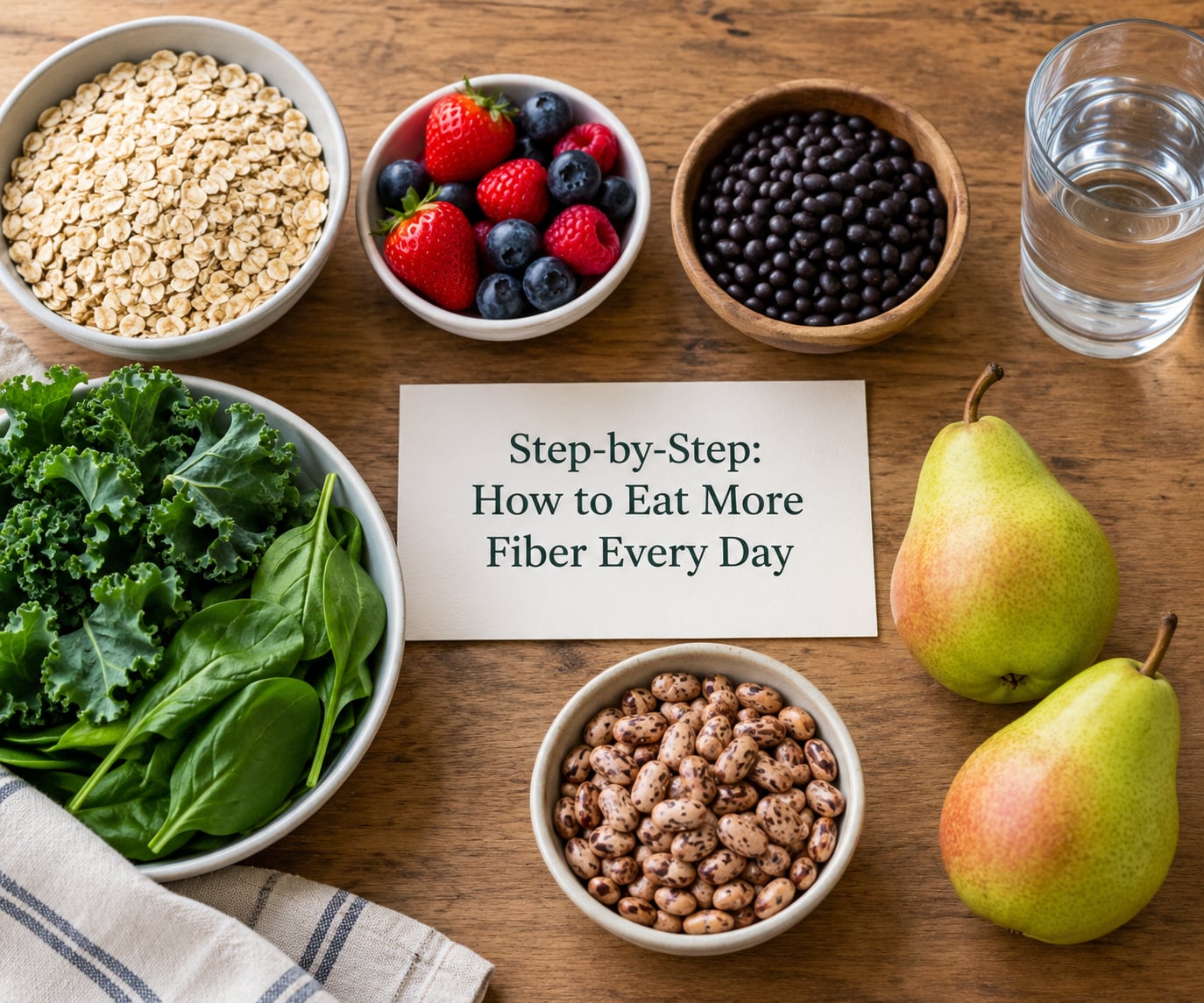
Five steps, in the order that works. Skip around if you like, but the order matters more than people expect, because the first step is the one most people get wrong.
Step 1: Set a Reasonable Daily Fiber Goal
Count roughly where you are now. Most people land somewhere between 10 and 15 grams without trying, which means you are usually 10 to 20 grams short rather than needing a revolution.
Pick a target you could plausibly hit this week. If you eat about 12 grams now, aiming for 16 grams is a real goal. Aiming for 38 grams in three weeks is how people end up bloated and quitting.
A workable pattern is to add 3 to 4 grams a day for the first week, then another 3 to 4 grams the following week. That spread lets your gut adjust while you build the habit. Drink water steadily through the day rather than chugging it at the end.
Step 2: Add Fiber at Breakfast
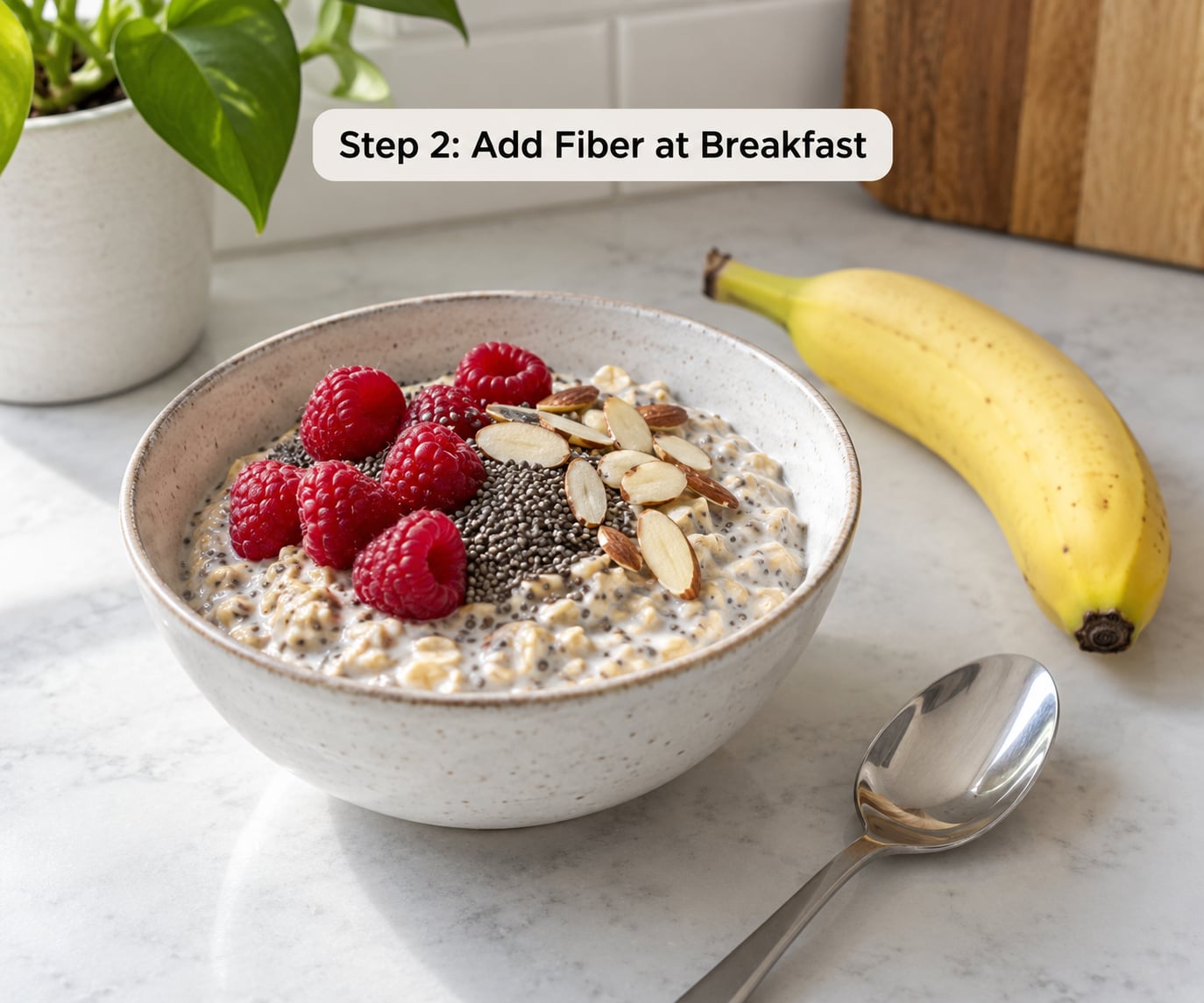
Breakfast is usually the easiest meal to fix because it is the one most people repeat daily. The typical bowl of sweetened cereal sits around 2 grams, and a slice of white toast with jam adds almost none.
Switch to rolled oats and you go from roughly 2 grams to about 4, with no extra effort. Then top it. A tablespoon of chia seeds adds roughly 3 grams, ground flaxseed another 2, and a cup of raspberries about 8. That turns a boring bowl into a 15 gram breakfast.
My default is overnight oats: half a cup of rolled oats, three-quarters of a cup of milk or oat milk, a spoonful of chia, a spoonful of peanut or almond butter, and half a cup of berries. It costs about three minutes the night before and covers breakfast for most of the week. Our daily gut health picks cover the rest of the day if you want more ideas beyond breakfast.
If you are not an oatmeal person, the swap still works: whole wheat toast instead of white, an apple or pear instead of a banana, or a handful of almonds added to whatever you already eat.
Step 3: Build Fiber Into Lunch and Dinner
This is where the biggest gains are, because beans and lentils deliver more fiber per serving than almost anything else. You do not need to become a vegetarian. You need to put half a cup of beans into dinner two or three nights a week.
Concrete moves that work:
- Swap half the pasta. Use a chickpea, lentil or black bean pasta for half your serving. You get roughly 6 to 8 grams a cup instead of 2, and the texture difference mostly disappears in sauce.
- Add beans to what you already cook. Chili, soups, tacos and curries all take a can of drained beans without changing the recipe. Chili is the classic example: it goes from about 6 grams a bowl to 12 or more.
- Use brown rice, barley or quinoa. Each cup is roughly 5 grams against about 1.5 for white rice.
- Keep the skin on potatoes and pears. A medium baked potato with skin is close to 4 grams; peeled, it is under 2.
- Replace half the flour in baking. Whole wheat flour or oat bran in muffins, pancakes and banana bread adds fiber without anyone noticing a texture problem.
- Add vegetables you will actually eat. Frozen broccoli, peas and green beans count the same as fresh and cost less. This guide to raising fiber without bloating has portion advice if a big salad sounds like too much.
The budget version of this is not a compromise. Dried and canned beans, rolled oats and frozen vegetables are the cheapest fiber per gram you can buy, and they are how a lot of people on tight budgets build their intake without noticing.
Step 4: Use Smart Snacks and Beverages
Snacks are where most people quietly lose. A handful of almonds is about 4 grams, a pear is 5, half a cup of edamame is 4. Those replace a cookie, not a meal.
For drinks, the honest answer is that very few beverages carry meaningful fiber. Water, coffee and tea have none. Juice has none either, because the fiber is left behind in the pulp, which is why a whole orange is 3 grams and its juice is zero.
A blended smoothie is the exception. Blending keeps the fruit and vegetable fiber in the glass, unlike juicing, so a smoothie with a cup of raspberries, half a banana, a tablespoon of chia and a handful of spinach delivers roughly 10 grams. The catch is that smoothies are easy to overdo on volume, so keep them meal-sized rather than liter-sized.
Two quick no-cook options if mornings are the problem: overnight oats made the night before, or a chia pudding that sets in the fridge for four hours. Both travel, both keep well, and neither needs heat.
Step 5: Keep Your Intake Comfortable
This is the step that decides whether you keep the habit. Four habits do most of the work:
- Add a new high-fiber food every three or four days, not every meal.
- Spread fiber across the day instead of front-loading dinner with a giant salad.
- Drink fluid with it. Most people carry their own water bottle; if you do not, that is the first habit to change.
- Cook vegetables rather than eating them raw in bulk. Heat breaks down some fiber and reduces the gas that raw cruciferous vegetables can cause.
Expect two to three weeks before your digestion feels settled. If it does not, or if you notice ongoing pain, blood in stool, unexplained weight loss or persistent bloating, stop pushing fiber and speak to a doctor or registered dietitian. People managing IBS, following a low-FODMAP plan, recovering from bariatric surgery or working around a smaller stomach should get individualized advice first, because the standard high-fiber lists do not fit everyone.
Common Mistakes
1. Going from 12 grams to 35 grams in a week. This is the most common mistake and the reason people quit. The gut bacteria need time to shift. Add 3 to 4 grams a day per week instead, and hold each level for a week before climbing.
2. Starting with a supplement. Psyllium, methylcellulose and inulin all work, and supplements are useful when food alone will not get you there, but they concentrate fiber into a small dose and cause more gas per gram than the same amount from food. Most people do better eating their fiber and using a supplement only for the gap. Start any supplement at half the label dose with a full glass of water, then titrate up.
3. Adding a huge raw salad at dinner. Raw vegetables carry fiber your body cannot break down efficiently, and volume plus novelty is a recipe for cramping. Steam or roast instead, start with a third of what you planned, and build up from there.
4. Raising fiber and forgetting water. Fiber holds water. If you are not drinking enough with it, you can feel worse rather than better, which is the opposite of what you wanted.
5. Assuming every high-fiber food suits every diet. Beans, wheat and certain fruits are high in FODMAPs and cause real problems for people with IBS. Low-FODMAP lists exist for a reason. If fiber is a problem for you rather than a goal, get advice from a registered dietitian before you start stacking legumes and bran onto everything.
6. Counting juice and juice-based drinks as fiber sources. A glass of orange juice is roughly zero grams. Whole fruit is 3 grams, and blended fruit keeps its fiber. That single swap is one of the easiest points available to you.
Frequently Asked Questions
How quickly can I increase fiber without bloating?
Most people do best adding about 3 to 4 grams a day and holding that level for a week before adding more. Going straight from 12 grams to 35 grams is the single biggest cause of gas and cramping. Keep fluid intake steady, spread fiber across meals, and cook vegetables instead of eating them raw in bulk. If you are still uncomfortable after two to three weeks, that is worth raising with a doctor or registered dietitian.
What is the best way to get soluble fiber?
Oats, barley, chia seeds, ground flaxseed, apples, oranges, pears, beans and psyllium husk are the most practical everyday sources. Soluble fiber dissolves in water and forms a gel, which slows digestion and binds cholesterol in the gut. Half a cup of dry rolled oats gives roughly 4 grams, and an ounce of chia seeds adds about 10 more. Most of these foods carry insoluble fiber as well, so you rarely have to separate the two.
Does fiber actually cause bloating and gas?
It can, especially when you add a large amount quickly. Gut bacteria ferment fiber, and the gas they produce is part of how that process works. Two things reduce it: increase gradually, and drink enough fluid. Cooking vegetables softens fiber that would otherwise reach your gut raw. If bloating continues at a level you have held for several weeks, or comes with pain, speak with a doctor rather than pushing through it.
How do I add more fiber to smoothies?
Use whole fruit and vegetables rather than juice, since blending keeps the pulp and fiber in the glass while juicing leaves it behind. A cup of raspberries is about 8 grams, half a banana 2 grams, a tablespoon of chia seeds 3 grams, and a handful of spinach 1 gram. That lands near 14 grams in one drink. Keep the volume meal-sized, though, since very large smoothies are hard to manage and easy to overfill.
Is one banana a day enough fiber?
A medium banana has about 3 grams, which is a useful contribution but not a plan. It is roughly a seventh of the 25 gram daily target for women and under a tenth of the 38 gram target for men under 50. A pear with skin, a cup of raspberries or half a cup of black beans each delivers more than a banana does. Keep the banana and add a bean dish somewhere in the same day.
Can I get enough fiber on a gluten-free or low-FODMAP diet?
It takes more planning but it is doable. Gluten-free options such as beans, lentils, quinoa, buckwheat, chia, ground flaxseed and avocado all carry fiber without gluten. On a low-FODMAP plan the lists shrink, because beans, wheat and certain fruits are high in FODMAPs, so portions and serving sizes matter more than adding more. A registered dietitian who works with IBS can build a plan that raises fiber without triggering symptoms.
Start With One Swap This Week
Pick the single change you can repeat without thinking: rolled oats with chia and berries at breakfast, or half a cup of beans in dinner twice a week. Do that for a fortnight and add 3 to 4 grams a day after that. Fiber targets in 2026 are not a finish line you either hit or miss; they are a number you climb toward, and most people find the gut settles long before they reach 30 grams.