
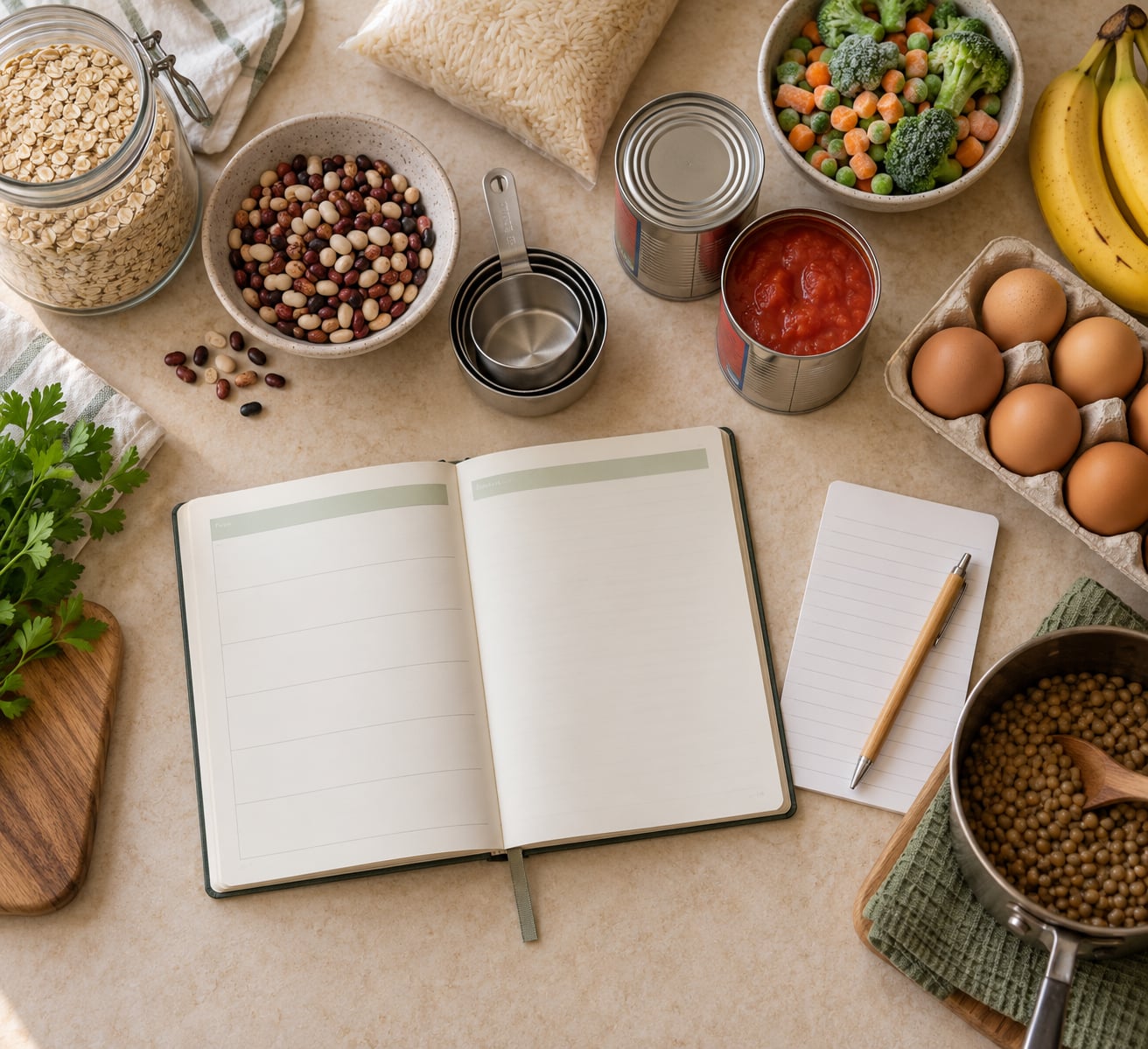
To plan healthy meals on a budget, set a weekly spending limit, list seven dinners that share ingredients, check what you already own before you shop, and cook the base ingredients in one batch. It takes about 20 minutes of planning and an hour of cooking to cover most of the week.
The reason it works is simple: you stop buying food you never cook. Spoilage is the number one complaint in every budgeting forum I have read, and unplanned shopping is what causes it. A written plan also lets you compare unit prices instead of reacting to whatever looks good at the end of the aisle.
Below is the system I actually use, with a sample week, a grocery list layout and a leftover rotation that turns one cooked batch into three different meals.
Table of Contents
- What You Need
- Step-by-Step
- Step 1: Set a Weekly Food Budget and Eating Plan
- Step 2: Check Your Pantry and Plan Around What You Already Have
- Step 3: Choose Flexible, Budget-Friendly Meals
- Step 4: Build a Balanced Meal Plan
- Step 5: Build a Grocery List by Store Section
- Step 6: Shop Smart and Cook in Batches
- Step 7: Use Leftovers and Adjust Next Week
- Common Mistakes
- Frequently Asked Questions
- Conclusion
What You Need
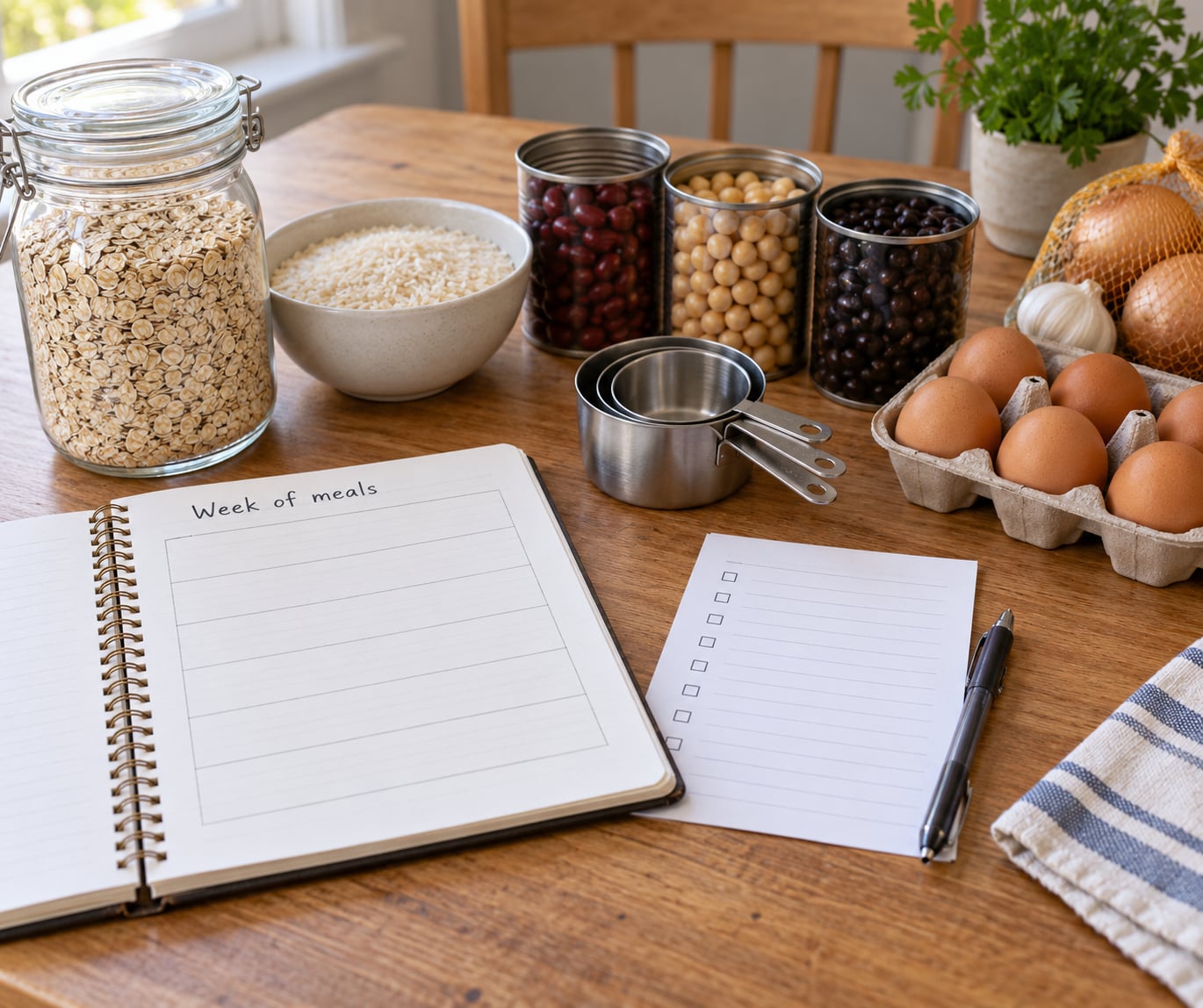
None of this costs money. The point is to have the system ready before hunger makes the decisions.
- A notebook or meal planner app — paper works better for most beginners because you cannot auto-sort your way out of a bad plan.
- A reusable shopping list — paper or a notes app, but written out by store section rather than as one long stream.
- Reusable containers — the same three or four containers do the work for lunches, freezing and portioning.
- Measuring cups and a kitchen scale — helpful for the first two weeks so you learn what a serving of oats or rice actually looks like.
- A freezer that works — flat, loosely packed items freeze faster and thaw faster.
Then stock these low-cost pantry basics. Every sample plan below assumes you have the first group already in the cupboard.
- Free: salt, pepper, garlic powder, onion powder, paprika, dried herbs, cinnamon, oil and vinegar.
- Roughly 2 dollars a serving: dried or canned beans and lentils, rice, rolled oats, pasta, canned tomatoes, frozen vegetables.
- Roughly 4 dollars a serving: eggs, canned tuna, plain yogurt, tofu, frozen berries.
- Cheaper by the pound: chicken thighs, ground turkey, canned fish with bones if you eat them.
If you are starting from an almost empty kitchen, buy the second group first and build the plan around it. If you want help with the shopping side, our guide to picking a healthy yogurt at the store shows how to compare two nearly identical tubs by label rather than by front-of-package claims.
Step-by-Step
Work through these in order once, then repeat the last two steps every week. The order matters more than the tools: budget first, pantry second, meals third, list fourth.
Step 1: Set a Weekly Food Budget and Eating Plan
Decide the number before you see a single flyer. A practical baseline is about 3 dollars per person per day for food eaten at home, which lands near 100 dollars a week for a household of three, assuming a pantry you can already draw from.
Then account for food you own. If you have half a bag of rice, a jar of peanut butter and frozen spinach, that week is already partly paid for. Subtract it before you shop, not after.
Next, decide how many meals the money has to cover. Seven dinners for a household of three is 21 servings. If you only have enough for 15, plan four leftovers now rather than discovering it on Wednesday night.
You know the step worked when you can name the number before you leave the house. If you cannot name it, the week will decide for you.
Step 2: Check Your Pantry and Plan Around What You Already Have
Spend five minutes on an actual inventory: open the pantry, the fridge, the freezer. Write down what needs to be eaten first, and put those items in the top half of the fridge where you will see them.
Then build two or three meals around those items before anything else. Half a bag of rice, half an onion and a tin of beans becomes fried rice, a bean and rice soup, or a burrito bowl. Same three ingredients, three different dinners.
On r/EatCheapAndHealthy, the most repeated line is almost identical every time: the hard part of buying fresh is making sure you actually eat it before it goes bad. Treat that as the first rule, not an afterthought.
Step 3: Choose Flexible, Budget-Friendly Meals
Pick meals built from four slots: a grain, a protein, a vegetable, and something to make them into a meal. Once you know the slots, almost any combination works, and leftovers stop being a problem.
- Grain: rice, pasta, oats, tortillas, couscous, a baked potato.
- Protein: beans, lentils, eggs, yogurt, tofu, canned tuna, chicken.
- Vegetable: whatever is frozen, in season, or about to turn.
- Sauce or finish: canned tomatoes, salsa, peanut sauce, olive oil and lemon.
Skip any recipe with an ingredient you would buy once and use twice. That rule comes straight from a budgeting advice thread on r/EatCheapAndHealthy: if a recipe needs something you cannot avoid buying, do not save it. Specialty-ingredient creep is how a cheap week becomes an expensive one.
People who hate cooking can still follow this. Oats, no-cook bean salad, yogurt with fruit and frozen veg, and toast with eggs cover a full day without a stove.
Step 4: Build a Balanced Meal Plan
How to plan healthy meals on a budget without special foods comes down to repetition on purpose. Every plate gets a carbohydrate, a protein, a vegetable or fruit, and a small amount of fat. Build the plate from ordinary grocery items, not from a list of superfoods.
This sample week covers a household of three. Ingredients repeat on purpose so one purchase feeds several meals.
- Monday: chicken thighs, rice and frozen broccoli — the first cook, nothing carried over.
- Tuesday: black bean tacos with corn and salsa, using Monday’s rice and extra chicken.
- Wednesday: egg and spinach fried rice, using Monday’s rice and Tuesday’s beans.
- Thursday: overnight oats with banana and peanut butter, from the batch of oats cooked Tuesday.
- Friday: lentil soup with carrots and bread, alongside Wednesday’s rice and leftover chicken stock.
- Saturday: sheet-pan chicken and vegetables — freeze half for next week.
- Sunday: pasta with tomato sauce and frozen peas, using Saturday’s tray and pantry sauce.
Households with mixed preferences should not cook three separate dinners. Cook one base and let people add their own extras — that is the whole idea behind cooking for a family with different diets.
Step 5: Build a Grocery List by Store Section
Write the list in the order you will walk the store. Group it into produce, protein, grains, canned goods, dairy or alternatives, and pantry items, and add a freezer section at the end.
This ordering is not about efficiency alone. Each section has its own swap list, so when an item is out or overpriced you have a replacement ready:
- Fresh vegetables: swap to frozen, or to canned for cooked dishes like soups and curries.
- Fresh herbs: swap to dried, or skip the garnish entirely.
- Pre-cut produce: swap to whole, which costs less and lasts longer.
- Name-brand pantry items: swap to the store brand version.
- Fresh chicken breast: swap to thighs, which stay moist from a slower, cheaper cook.
Compare unit prices, not package prices. A large bag looks like a deal until you divide it by the weight; the smaller package sometimes wins for the number of servings you will actually eat. Markdowns on produce are worth planning around, so check the discount bin at the end of your route.
Step 6: Shop Smart and Cook in Batches
Shop with the list in your hand and stay out of the aisles that are not on it. Then cook once and eat four times: rice in a big pot, a tray of roasted vegetables, a pot of beans, a batch of oats for breakfast.
Store the perishable food properly and follow USDA guidance on temperature. Refrigerate perishables at or below 40F, and use the standard minimum internal temperatures: 165F for poultry, 160F for ground meat, and 145F for whole cuts and fish.
Cooked food keeps three to four days in the refrigerator. Anything past that goes in the freezer in single portions, not one large block, so you can pull out what one person needs.
You do not need a full kitchen. A rice cooker, a microwave and a single pot cover most of this plan, which answers the most common question in budget cooking forums. Batch cooking on a Sunday for 90 minutes is usually enough to get through a weekday.
Step 7: Use Leftovers and Adjust Next Week
Planned leftovers are not reheated last night’s dinner. They are raw material for a different dish with a different flavor profile and a different cost per serving.
- Roast chicken: becomes tacos with salsa and cabbage, then chicken and rice soup.
- Pot of beans: becomes bean and cheese tostadas, then vegetable soup with stock.
- Batch of rice: becomes fried rice with egg and peas, then burrito bowls with salsa.
- Roasted vegetables: become a frittata with eggs, then blended soup with stock.
- Overnight oats: become breakfast jars for the week, then fruit-topped bowls with yogurt.
At the end of the week, answer three questions: what got eaten, what spoiled, and which meal nobody touched. Write the answers on the same page as next week’s plan. That record is what turns the second plan into a better one than the first.
If the plan breaks, that is normal. Keep two backup meals that need only pantry items and ten minutes, and use them without treating the week as a failure. Anyone who has had to restart after a bad few weeks knows how easy it is to abandon a system entirely — rebuilding habits after falling off is its own small process.
Common Mistakes
These are the failures that show up again and again in budget cooking forums, with the fix next to each one.
- Shopping without a written list. A list turns a 20-minute trip into a 40-minute one. Fix: write the list by store section and stick to the order.
- Buying fresh produce you will not cook in time. This is the most common way a food budget disappears. Fix: plan two meals around the perishable item before you buy it, and buy frozen when in doubt.
- Planning unrelated meals. Ten recipes with ten separate ingredient lists cost ten times what one rotated meal costs. Fix: choose dinners that share at least two ingredients.
- Skipping protein. Meals built only on carbohydrates leave people hungry an hour later, and hunger drives takeout spending. Fix: keep one cheap protein in every dinner, beans and eggs included.
- Treating health foods as requirements. Specialty items are optional. Fix: build the plate from beans, grains, eggs, yogurt and frozen vegetables first, then add extras if the budget has room.
- Buying a full week of fresh food at once. Fix: shop heavy on grains, beans and frozen items, and light on anything leafy.
- Cooking only what is on the plan. Fix: cook a double portion of one meal and freeze half before moving on.
Two smaller habits pay off fast. Buy the biggest package of the item you use every single day, and learn the unit price on four items you buy weekly so the comparison takes two seconds in the aisle.
Frequently Asked Questions
What is the cheapest healthiest meal to make?
Beans, rice and frozen vegetables is the usual answer because all three keep well and cost very little per serving. Add oil and spices and it is a complete plate. Eggs, oats and canned tuna cost slightly more but need no cooking at all. The cheapest meal is the one you already have ingredients for, so check the pantry before comparing anything.
How much should one person spend on groceries per week?
Most households eating at home land near 3 dollars per person per day, or about 20 dollars a week for one person, 60 for a household of three and 80 to 100 for a family of four. Those figures assume a pantry with rice, beans, oats and canned goods on hand. Shop figures vary widely by region and change often, so treat this as a planning baseline.
Is 200 dollars a week a lot for groceries?
For a family of four eating most meals at home, that is a workable number. For a household of one or two it is high, and for a family of five or six it is tight. The better question is what the money has to cover: home-cooked meals only, or home-cooked meals plus takeout, household supplies and snacks.
Can you live on 50 dollars a week for food?
For one person, yes, and only with a pantry already in place. Store-brand rice, beans, oats, canned tomatoes, frozen vegetables, eggs and bananas will carry that week. It is not realistic for a family. If the number describes your situation, local food banks, SNAP and community meal programs exist for a reason, and using them is a practical step.
What is the 3-3-3 rule for meals?
It is a loose timing guideline rather than an official rule: eat roughly three meals a day, spaced about three hours apart, and aim to include protein, carbohydrates and vegetables or fruit across the day rather than in any single meal. It helps some people avoid long gaps and mindless snacking. It is not a target you have to hit exactly.
What is the 5 4 3 2 1 rule for groceries?
It is a produce-shopping guideline: buy five vegetables, four fruits, three more of a kind you eat often, two proteins and one treat or extra per shopping trip. The idea is variety and planned quantities instead of grabbing whatever looks good. It fits a budget plan well because it forces you to decide quantities before the cart, not at it.
Conclusion
How to plan healthy meals on a budget comes down to seven habits in order: name your number, inventory what you own, choose meals that share ingredients, build balanced plates from ordinary food, list by store section, batch cook once, and rotate the leftovers into new dishes.
Start tonight rather than Sunday. Open the pantry, write down what needs eating first, set a weekly limit, and plan three dinners that use the same two ingredients. Once that week works, add the rest.
If you have a medical condition, are pregnant, or have specific nutrient needs, talk to a registered dietitian about your own situation. General planning gets you organized; personal nutrition advice is a different conversation.