

To pick a healthy yogurt at the store, look for plain yogurt made mostly from cultured milk, with 5 grams or less of added sugar, 10 grams or more of protein per serving, and live and active cultures on the label. Put any tub back if sugar appears in the first three ingredients.
That is the whole answer, and it takes about sixty seconds per container once you know where to look. The trouble is that the front of the package tells you almost nothing useful, so two tubs that look identical can differ by ten grams of sugar.
I spend a ridiculous amount of time in that aisle, and the same three or four numbers decide it every time. Once you can read those numbers, you can pick a healthy yogurt in front of any brand, including ones that did not exist when this guide was written. That matters because the yogurt shelf changes constantly and the principles do not.
Table of Contents
- What to Look for on a Yogurt Label
- How to Pick a Healthy Yogurt at the Store: Step by Step
- Common Yogurt Shopping Mistakes
- Mistake 1: Treating low-fat as the same as healthy
- Mistake 2: Choosing flavored yogurt for the fruit picture on the lid
- Mistake 3: Reading total sugars and assuming it is all added
- Mistake 4: Comparing a bulk tub to a single-serve cup
- Mistake 5: Assuming plant-based means nutritionally better
- Mistake 6: Ignoring the texture and the water on top
- Red flags that mean put it back
- Storage and shelf life
- Frequently Asked Questions
- Is plain Greek yogurt healthier than regular yogurt?
- How much added sugar should I look for in yogurt?
- Does plant-based yogurt always have more protein than dairy yogurt?
- What does live and active cultures mean on a yogurt label?
- Is low-fat yogurt healthier than whole-milk yogurt?
- How should I compare two yogurts with different serving sizes?
- Conclusion: Start with the Label
What to Look for on a Yogurt Label

Start with the nutrition facts panel, not the marketing on the lid. Four numbers decide almost everything: serving size, added sugar, protein, and the percent daily value for calcium and vitamin D.
The 60-second read: how to pick a healthy yogurt at the store
- Serving size, so you know what the numbers actually describe.
- Total sugars and added sugars, which are listed as separate lines.
- Protein in grams per serving.
- Calcium and vitamin D percent daily value.
- The ingredient list, read top to bottom.
- Any statement about live and active cultures, near the front or the back of the tub.
Serving size changes what you actually eat
The serving size line quietly sets every other number on the panel. A single-serve cup usually lists about 5.3 ounces, roughly 150 grams. A large tub often lists a full cup, or a full half cup for Greek yogurt, which is a much bigger number.
This is the trap that catches people comparing a 32 ounce tub against a small cup. A tub with 8 grams of added sugar per cup may have less sugar per ounce than a single-serve cup with 13 grams, even though the bigger tub looks worse on paper.
Compare like with like. Either compare two containers at the same serving size, or do the math yourself and compare per 100 grams, which is the most honest basis and the one I use.
Added sugar and total sugar are different numbers
Total sugars include the lactose naturally present in milk, which is not added by the manufacturer. Added sugars are the ones that come from cane sugar, syrups, honey, or concentrates. Under current US labeling rules the panel breaks added sugars out on its own line, and that is the line to judge the product by.
Plain whole milk yogurt typically shows around 5 to 7 grams of total sugar per cup with zero added. A fruit-on-the-bottom cup aimed at kids can run 15 to 20 grams of total sugar with a meaningful chunk of it added. You are not comparing apples to apples unless you separate those two lines.
Protein per serving
Protein is what makes yogurt a real snack rather than a sweet topping. Roughly 8 grams is a reasonable floor for a filling snack, and 10 to 20 grams is what you will find in strained Greek yogurt and Icelandic-style skyr. Regular stirred yogurt usually sits much lower, often in the 4 to 5 gram range.
Keep the number paired with the serving size. A 30 gram scoop of skyr with 7 grams of protein is a different product from a 170 gram cup with 17 grams.
Calcium and vitamin D
Yogurt is a genuinely good source of calcium, and fortification is common, so look for a decent percent daily value, often 10 to 20 percent or more per serving. Vitamin D is usually added to dairy yogurt in the same pass.
Plant-based yogurts vary more here, because fortification is a choice each brand makes for each product. If calcium and vitamin D are your reason for eating yogurt, check the panel rather than assuming a plant-based tub matches a dairy one.
Live and active cultures
Yogurt is milk fermented with live bacteria, mainly Streptococcus thermophilus and Lactobacillus delbrueckii subspecies bulgaricus, with Lactobacillus acidophilus and Bifidobacterium species added by many brands. If those bacteria are still alive when you eat the yogurt, the label can say live and active cultures.
Read this as a statement about food labeling, not a promise about your health. Some tubs list strain names and a colony-forming unit count, which tells you how many organisms were present at the end of shelf life. Nothing on the package tells you what happens to them once you heat the yogurt or leave it on the counter.
Ingredient order tells you what the yogurt is made of
Ingredients are listed in descending order by weight, and in plain yogurt, cultured milk should be first and sometimes the only thing there. The shorter the list, the less has been added to it.
A few words you will meet on the list and what they mean: modified corn starch, modified food starch, locust bean gum, guar gum, carrageenan, gelatin, and pectin are thickeners and stabilizers. They are legal and common, and they are not harmful in normal amounts. They exist to make yogurt thicker, smoother, and more uniform.
The issue is that you are paying for milk that is less milk, and in my experience a starchy tub has that slightly dull, glued texture that people rarely name out loud. Sweeteners such as cane sugar, honey, agave, or sugar syrups belong near the front on flavored cups, and artificial colors and flavors show up as names like red 40 or natural flavor.
| What to check | A good label looks like | A label to put back |
|---|---|---|
| Added sugars | 0 g, or 5 g or less per serving | Over 10 g per serving, or sugar in the first three ingredients |
| Total sugars | Around 5 to 7 g from milk lactose alone | 18 g or more, most of it added |
| Protein | 10 g or more per serving for a filling snack | Under 5 g in a tub marketed as high protein |
| Ingredients | Two or three, with cultured milk first | Eight or more, with several starches and gums |
| Sweetener | None, or a small amount of added sugar | Cane sugar, syrup, or honey listed first |
| Cultures | Live and active cultures stated plainly | No culture statement anywhere |
| Additives | Minimal, or natural flavor only | Artificial colors and several thickeners |
Read the table as a pattern, not a checklist of hard rules. A whole milk yogurt with 6 grams of added sugar for kids who will not eat plain yogurt is a reasonable trade, and I would not call it a bad choice.
How to Pick a Healthy Yogurt at the Store: Step by Step
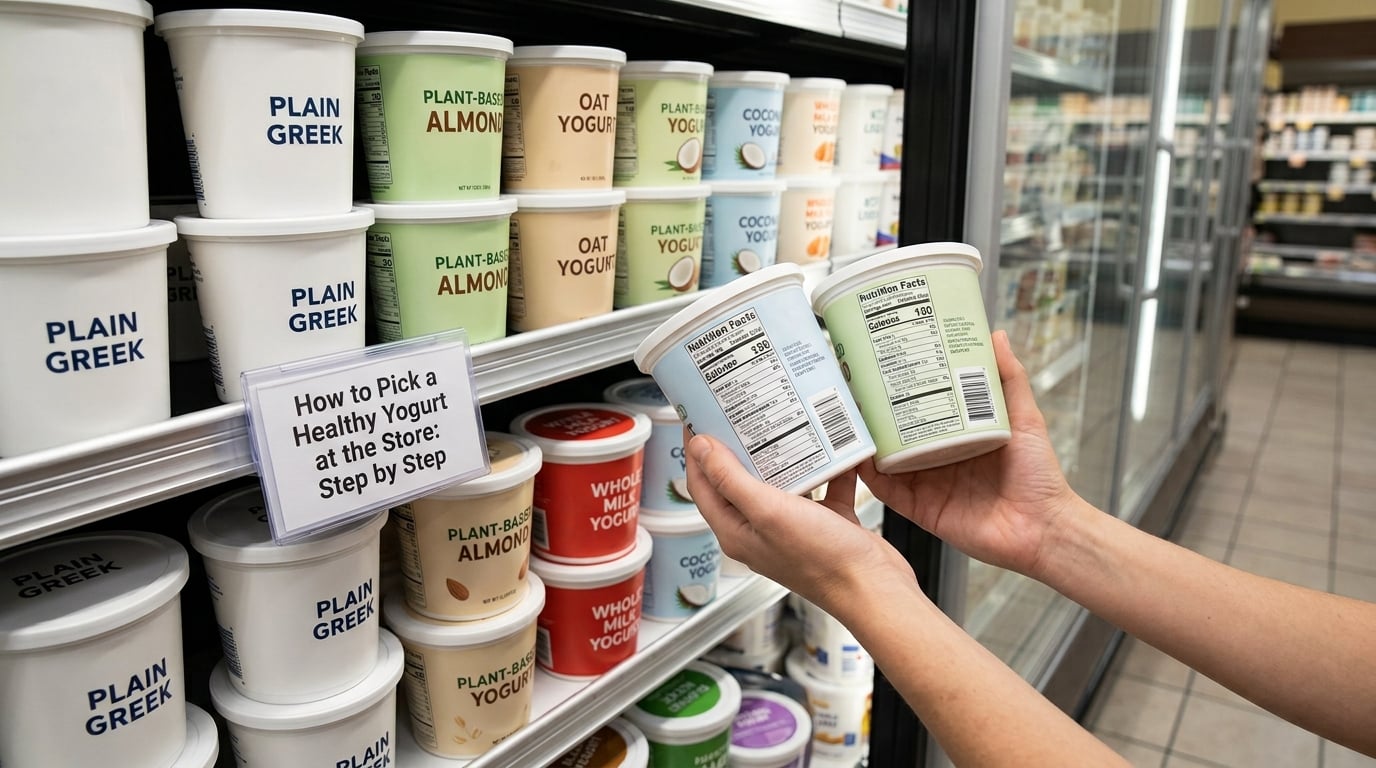
Here is the repeatable version. It takes two minutes for the first container and about twenty seconds for each one after that.
Step 1: Decide Which Type of Yogurt Fits Your Needs
Decide the category before you read a single number, because otherwise you will fall for whichever package shouts loudest.
- Plain versus flavored. Plain means no added sweetener. Flavored means the sugar number already went up before you did anything. On Reddit, in budget and weight-loss threads especially, the most repeated advice is to buy plain and add your own fruit.
- Regular versus strained. Regular yogurt is cultured milk thickened in place. Strained Greek yogurt and skyr push more whey out, which concentrates the protein and the milk solids. That is why they are thick and tangy and why they carry more protein.
- Full-fat, low-fat, or nonfat. Whole milk yogurt has more calories per cup and more of the milk fat. Nonfat is the reverse. Current thinking on fat in the diet has moved away from treating fat as automatically bad, so pick based on what you actually enjoy and will eat, not on a fat-free goal.
- Dairy versus plant-based. Soy and pea protein bases usually outnutrient almond, coconut, and cashew bases on protein. Coconut and almond bases are frequently closer to dessert than to yogurt nutritionally, because they take more sugar and oil to taste right. If you eat plant-based yogurt, the panel is the only place the answer lives.
Skirt and Icelandic-style yogurt sit alongside Greek yogurt as the thickest, highest-protein option, and a lot of regular gym-goers prefer them because the texture holds up to toppings.
Step 2: Check Protein and Added Sugar
Now do the arithmetic that decides the purchase. Find protein grams and added sugar grams, then divide added sugar by protein.
A plain Greek cup with 18 grams of protein and 0 added grams is the easy case. A vanilla cup with 14 grams of protein and 12 grams of added sugar lands around 0.9 grams of added sugar per gram of protein, which is a lot of sugar buying a moderate amount of protein. Cut the same tub in half and you get 6 grams of added sugar, which is workable if you top it with fresh fruit instead of the fruit already at the bottom.
For comparison across brands, do the per-100-gram conversion: take the serving size in grams from the label, multiply the added sugar by 100, then divide by the serving size. A cup with 5 grams added in 150 grams works out to about 3.3 grams per 100 grams. A 32 ounce tub with 24 grams added per cup in 227 grams works out to about 10.6 per 100 grams. The tub is the sugary one, whatever the front says.
Step 3: Read the Ingredient List
Flip the container. You are looking for cultured milk or pasteurized milk in first position, and you are counting how many things follow it.
Two or three ingredients is the clean end of the shelf. Eight or more usually means sweeteners, thickeners, and flavoring stacked on top of each other. None of that is dangerous, and a lightly flavored yogurt meant for a four-year-old is doing its job, but if you are choosing for yourself, you have more control than the package suggests.
Sweetener names worth scanning for: cane sugar, evaporated cane juice, honey, agave nectar, corn syrup, rice syrup, sugar syrup, dextrose. Some of those are nutritionally the same as sugar even when they sound botanical, which surprises people.
Sugar alcohols like erythritol, sorbitol, and xylitol count toward total sugars on the panel but are handled differently by the body than table sugar. They are also the reason some zero-sugar tubs still taste sweet enough to be satisfying. Stevia leaf extract and monk fruit appear on plant-based products, sometimes alongside a small amount of real sugar.
Step 4: Look for Live and Active Cultures
Find the culture statement. Good tubs print it clearly on the front, the back, or both, usually as a short line with the words live and active cultures, sometimes followed by the specific strains and a CFU count.
Strain specificity tells you more than the count alone. Names such as L. acidophilus, Bifidobacterium animalis, L. bulgaricus, and S. thermophilus are the strains used widely in yogurt and in fermented dairy products, and a yogurt listing several of them is describing a more complex culture blend than one listing a single organism.
Keep it practical. This is a food labeling fact, and anyone with a medical question about probiotics and specific health conditions should ask a doctor or a registered dietitian rather than reading a yogurt tub.
Step 5: Compare Two Containers Side by Side and Choose
Pick the best from each aisle and put them next to each other. Compare in this order: serving size, added sugar, protein, ingredient count, additives, then taste if the container is a single serve you are about to buy.
When brands come down to it, what matters is which style fits your goal. Chobani and Fage are the two names people ask about most often, and both sell plain versions with a short ingredient list, so the comparison is really about fat percentage and price rather than health. Dannon Oikos and Chobani get compared the same way, with Oikos Triple Zero promising zero added sugar and zero honey in many of its flavors. Siggi’s, Icelandic Provisions, Cabot, Maple Hill Creamery, and Noosa sell in the strained and high-protein range, and Stonyfield Farm and Organic Valley are the familiar organic names in both dairy and plant-based lines.
Do not treat that list as a scoreboard. Formulas change, and a single label check beats any brand reputation. Use the names to find a starting tub, then read the panel on the tub in front of you.
How to Flavor Plain Yogurt So You Actually Eat It
Plain yogurt wins on the label and loses in the bowl, which is the whole reason people end up buying the sweet stuff again. Five combinations that fix that without adding sugar:
- Half a cup of plain Greek yogurt, a handful of berries, and a spoonful of chopped walnuts.
- Plain yogurt with a drizzle of nut butter and a pinch of cinnamon.
- Banana sliced in, a spoon of peanut butter, and a little vanilla.
- Plain yogurt with a spoonful of salsa and a few cucumber pieces if you want it savory.
- A spoonful of olive oil, flaky salt, and pepper on thick strained yogurt, which is how a lot of people in the Middle East eat it.
Use the frozen banana trick if the yogurt is too tart for you: mash one frozen banana into a cup of plain yogurt and the sweetness comes from the fruit itself.
Common Yogurt Shopping Mistakes
Most bad picks in this aisle come from one of six habits. Each one has a simple fix.
Mistake 1: Treating low-fat as the same as healthy
Low-fat is a fat claim, not a quality claim. A low-fat flavored yogurt can carry more added sugar than a full-fat plain one. Pick the fat level you enjoy and judge sugar, protein, and ingredients separately.
Mistake 2: Choosing flavored yogurt for the fruit picture on the lid
Those berries are frequently a puree and a color. Fruit-on-the-bottom adds sugar directly to the milk, and the original-flavored cups marketed to adults are dessert in dairy form. Buy plain and add whole fruit yourself if you want fruit in it.
Mistake 3: Reading total sugars and assuming it is all added
The lactose in plain milk yogurt is around 5 to 7 grams per cup and is not something you can remove by picking a different brand. Read the added sugars line, which is the one the manufacturer put there.
Mistake 4: Comparing a bulk tub to a single-serve cup
You are comparing a 227 gram serving to a 150 gram one, or worse. Divide by the serving weight before you compare, or just match the serving sizes.
Mistake 5: Assuming plant-based means nutritionally better
Almond and coconut bases often need more sugar and added oils to hit the texture and taste people expect, and protein can be a few grams where dairy has twenty. Soy and pea bases tend to do better. Check the panel; do not infer from the carton.
Mistake 6: Ignoring the texture and the water on top
A pool of clear whey on top is normal in strained yogurt, but heavy separation or a watery, broken texture usually means the tub has been handled, warmed in transit, or is near the end of its life. Many people treat that as a quality signal, and they are right to. Give the tub a gentle shake before you decide.
Red flags that mean put it back
- Sugar, syrup, or honey listed as one of the first three ingredients.
- Zero added sugar but eight or more ingredients, several of them thickeners.
- A high protein claim on a tub with under 5 grams of protein.
- More than 20 grams of total sugar with most of it added.
- No culture statement on the front, the back, or anywhere else.
- A date already passed, or a tub sitting unrefrigerated in the case.
Storage and shelf life
Keep yogurt refrigerated at or below 40 degrees Fahrenheit, including the tub you bring to work. Yogurt sits in the danger zone for bacteria well below what you would expect, so the two-hour rule matters more here than it does for shelf-stable food.
An unopened tub is usually good until a few days past the printed sell-by date, which is about quality rather than safety. Once opened, eat it within about five to seven days, and use the printed date on the tub as your guide if the label gives one.
Freezing works in a pinch. Yogurt loses some of its smooth texture and separates, but it is still safe and still perfectly usable in smoothies, dips, and baking. Do not refreeze it after it thaws.
Frequently Asked Questions
Is plain Greek yogurt healthier than regular yogurt?
Usually, on the numbers that matter. Strained Greek yogurt concentrates the milk solids, so a typical cup carries roughly 15 to 20 grams of protein against 4 to 5 grams in regular yogurt, and it is naturally lower in sugar. Watch two things: Greek yogurt can carry more milk fat in full-fat versions, and many brands add starch to thicken it. Plain versions with two or three ingredients are the ones worth buying.
How much added sugar should I look for in yogurt?
Five grams or less per serving is a sensible ceiling for an everyday tub, and zero is achievable if you eat plain. Anything above 10 grams per serving means the yogurt is sweet enough to sit alongside a dessert. One more check matters: convert to grams per 100 grams of product, because serving sizes vary enough between brands that per-serving numbers are not directly comparable.
Does plant-based yogurt always have more protein than dairy yogurt?
No. Soy and pea protein bases often match or beat plain dairy yogurt, but almond, coconut and cashew bases usually carry only a few grams, and some rely on added sugar and oils to taste right. Compare protein, added sugar and the ingredient count on each specific tub, because the same brand makes very different products across its plant-based range.
What does live and active cultures mean on a yogurt label?
It means the yogurt contains live microorganisms at the time of sale, and the manufacturer must hold enough of them through shelf life to make the claim. Common strains include Streptococcus thermophilus, Lactobacillus bulgaricus, Lactobacillus acidophilus and Bifidobacterium species. Some tubs list a colony-forming unit count. For questions about probiotics and a specific health condition, ask your doctor or a registered dietitian.
Is low-fat yogurt healthier than whole-milk yogurt?
Not automatically. Low-fat only tells you the fat was reduced, and flavored low-fat yogurt regularly carries more added sugar than full-fat plain yogurt. If you want a filling breakfast that keeps you satisfied, whole-fat plain yogurt with fruit and nuts is a reasonable pick. If you are limiting calories for a specific reason, choose nonfat plain and check that sugar and protein still pass your own criteria.
How should I compare two yogurts with different serving sizes?
Normalize first. Take the serving size in grams from each label, then multiply the added sugar or protein by 100 and divide by the serving weight. That gives you grams per 100 grams for each tub, and the comparison becomes fair. If you are happy doing mental math, a simpler rule is to only compare tubs where the serving sizes match.
Conclusion: Start with the Label
Your first move in the aisle is to ignore the lid, flip the container, and check the serving size, the added sugars line, and the protein number. Those three decide the purchase before taste ever enters into it.
After that, the ingredient list tells you whether the yogurt is mostly cultured milk or mostly additions, and a line about live and active cultures tells you it was made by fermentation rather than assembled from a powder. Past that, the right yogurt is the one that fits your protein needs, your fat preference, and your tolerance for tartness, so that you are still eating it three weeks from now.
For personal advice on nutrition, allergies, or health conditions, talk to a doctor or a registered dietitian rather than a tub.