
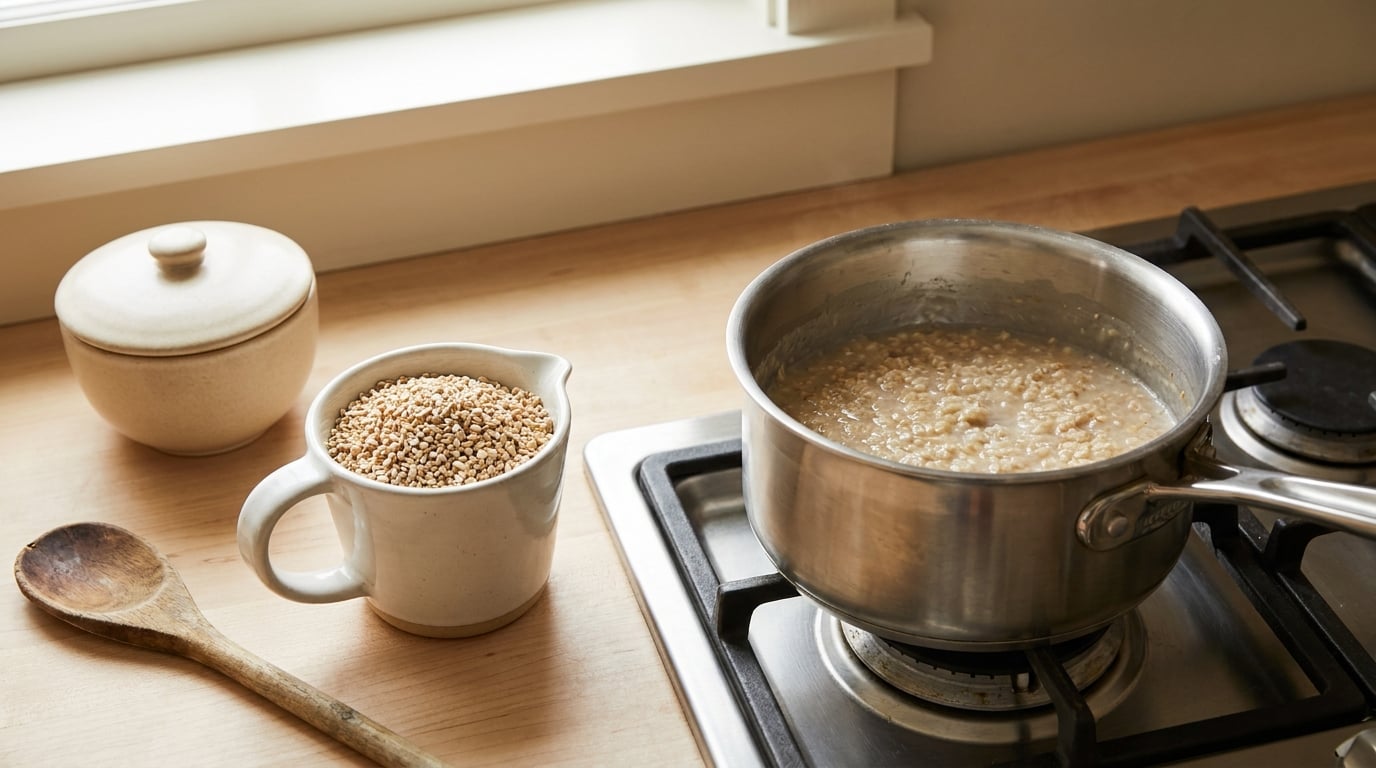
To make steel cut oats faster, soak the grains in just-boiled water for 10 to 15 minutes, then simmer them covered for another 12 to 15 minutes. A pressure cooker does the same job in about 3 minutes at high pressure plus a 5-minute rest, almost hands-off.
The reason steel cut oats are slow is simple: they are whole oat groats cut with steel blades, not steamed and rolled like old-fashioned oats. Nothing has been pre-cooked, so the grain has to absorb liquid and its starch has to gelatinize before it turns tender. Nearly every shortcut works by attacking one of those two jobs.
Table of Contents
- What You Need
- How to Make Steel Cut Oats Faster, Step by Step
- Common Mistakes That Make Steel Cut Oats Take Longer
- Frequently Asked Questions
- Can I make steel cut oats faster by soaking them overnight?
- How long should steel cut oats cook after being soaked?
- Can I use a pressure cooker or rice cooker for steel cut oats?
- What is the best liquid-to-oat ratio for faster steel cut oats?
- How long do cooked steel cut oats last in the refrigerator?
- Does soaking steel cut oats make them taste better?
- Conclusion
What You Need
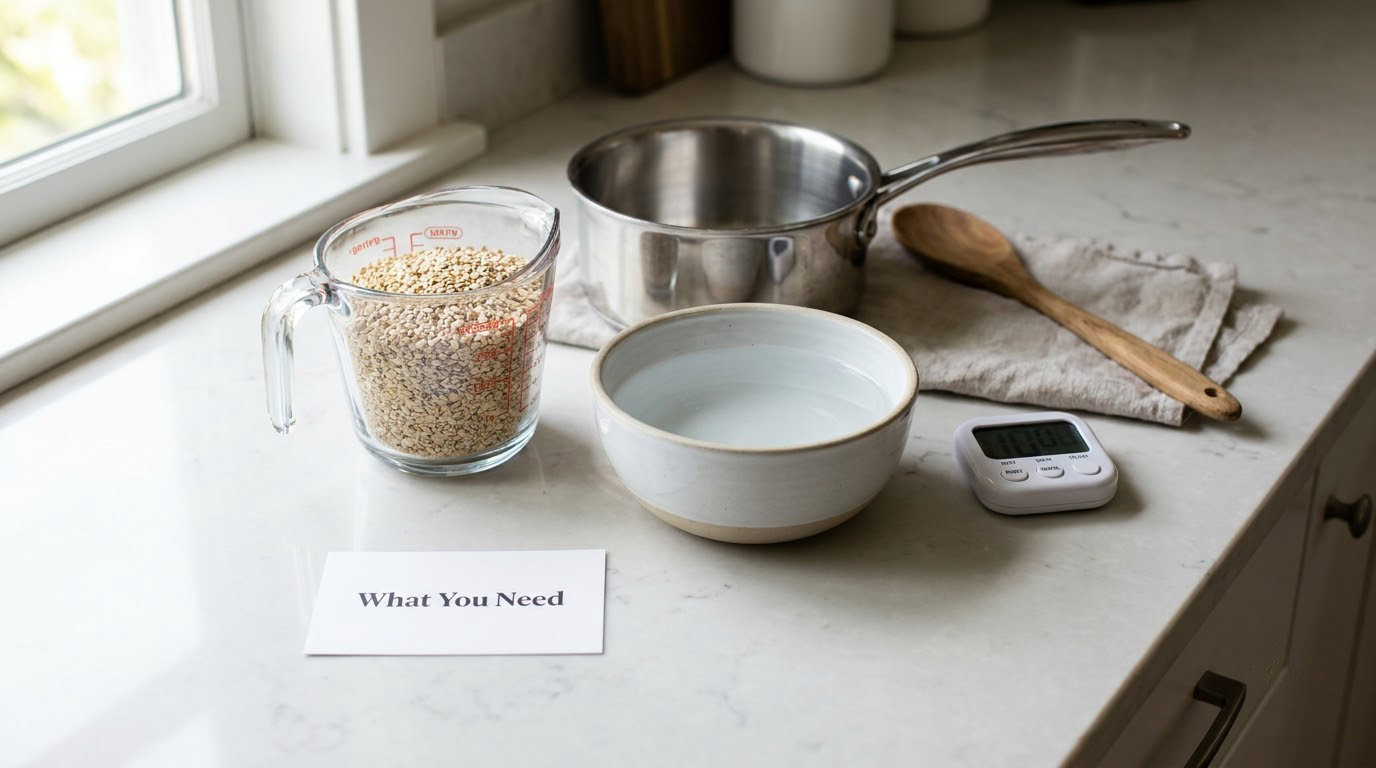
Not much. The soaking and simmering methods need nothing more than steel cut oats, water or broth or milk, a bowl with a lid, a saucepan with a lid, and a fine-mesh strainer if you are soaking and draining.
The optional tools change how much hands-on time you spend. A pressure cooker or Instant Pot removes the stirring entirely. A rice cooker or a slow cooker with a timer lets you set it the night before and wake up to breakfast. A microwave works, but only in an oversized bowl.
The planning each method needs is small. Soaking takes ten seconds the night before. Pre-cooking takes one batch session on a weekend. The pressure cooker takes nothing but a clean ring and a little attention at the release valve.
How to Make Steel Cut Oats Faster, Step by Step
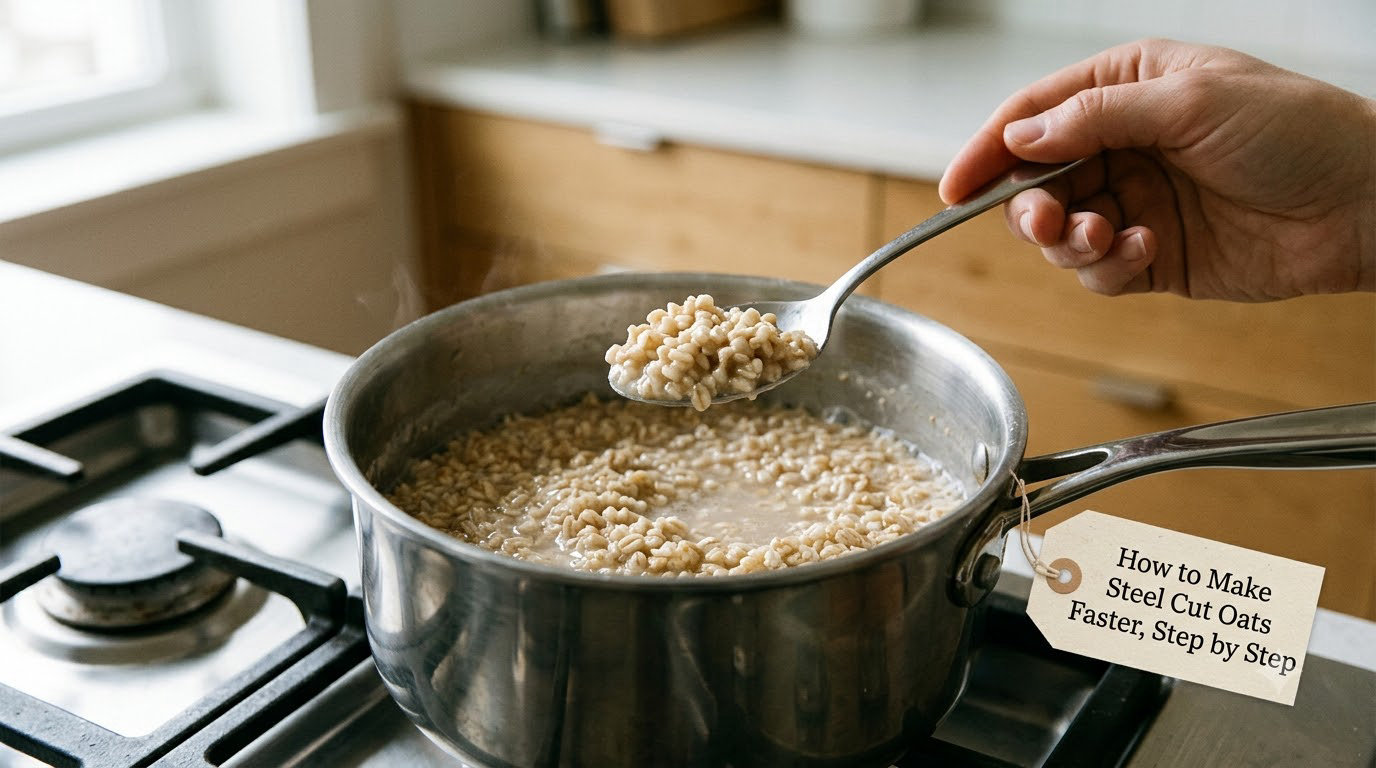
Here is the whole process from fastest to slowest. The steps stack: every method below is the base stovetop method with a different way of shortening it.
- Measure. Use 1 part oats to 3 parts liquid for a creamy bowl, or 1 part oats to 2 parts liquid if you like it thicker and will top it with yogurt or fruit.
- Soak. Cover the oats with cool water and refrigerate 8 to 12 hours, or pour just-boiled water over them and let them sit covered 10 to 15 minutes.
- Drain. If you soaked in plain water, strain it off. If you soaked in the milk you plan to cook in, keep it and count it toward your liquid.
- Bring to a boil. Add the soaked oats to your remaining liquid, bring to a full boil uncovered, and stir once so nothing sticks.
- Drop to a simmer. Cover, turn the heat to the lowest setting that keeps a bubble every second or two, and cook 12 to 15 minutes if soaked, 20 to 25 minutes if not.
- Rest. Kill the heat, leave the lid on for 5 minutes. The oats keep cooking in the residual heat and the starch finishes setting into something creamy.
You know step six worked when a spoonful slides off the spoon but the grains still have a distinct, slightly firm bite. If it looks finished the moment the simmer ends, it will be glue by the time it reaches the table.
| Method | Hands-on time | Total time |
|---|---|---|
| Boiling-water soak plus covered simmer | About 5 min | About 30 min |
| Pressure cooker, 3 min high pressure | About 5 min | About 8 min |
| Microwave, quick-cook steel cut oats | About 3 min | About 5 min |
| Refrigerator overnight soak plus simmer | About 5 min | About 20 min morning of |
| Batch cook and freeze, reheat from frozen | About 2 min | About 6 min |
| Rice cooker on a timer | About 1 min | Set the night before |
| Plain stovetop, no soak | About 15 min stirring | About 30 min |
| Slow cooker on low | About 1 min | 7 to 8 hours |
How to Make Steel Cut Oats Faster With Soaking
Soaking works because hydration is most of the cooking time. Water gets into the groat and starts swelling the starch before any heat is applied, so the simmer only has to finish the job. Expect the stovetop time to drop by roughly half.
The overnight version is the least effort: put a cup of oats in a jar or bowl, add about 3 cups of water, cover it, and refrigerate 8 to 12 hours. Drain in the morning, then simmer in fresh liquid. A cup of dry oats makes roughly 3 cups cooked, so pick your container accordingly.
The boiling-water version is the one worth learning. Measure the oats into a bowl, pour on about 3 cups of water that has just boiled, cover, and let it sit 10 to 15 minutes. The outside of the grain softens first and the inside catches up, which is exactly the part a short cook cannot fix. Drain and simmer for 12 to 15 minutes.
Two honest caveats. A plain overnight soak does not cook the oats, so they will still need a real simmer afterward, and a soak longer than about 24 hours can start breaking down the surface of the grain and turning the texture past chewy into mushy.
How to Make Steel Cut Oats Faster by Pre-Cooking
Pre-cooking moves all the work into one session and turns every later breakfast into a five-minute affair. Cook a triple or quadruple batch of dry oats in one pot using the same 1:3 ratio, then cool it fast.
Spread it on a plate or slide the pot into an ice bath so it stops cooking. Refrigerated in a sealed container it keeps about 4 to 5 days; frozen in individual portions in freezer bags it keeps 2 to 3 months. Home cooks who batch this for the week often portion straight into a muffin tin, freeze, and pop the pucks out.
Reheating is where most people go wrong. Warming the oats dry is why so many leftovers taste like paste. Add a splash of liquid, a tablespoon or two per serving, and warm in 30-second microwave intervals, stirring between each one, or in a small saucepan over medium-low heat. It should loosen and steam, never boil.
For the fastest morning result, freeze the cooked oats slightly loose rather than packed solid. Frozen portions reheat more evenly that way, and you can go from freezer to bowl in the time it takes the microwave to finish counting.
Common Mistakes That Make Steel Cut Oats Take Longer
Running the heat too high. A rolling boil does not cook oats faster, it just pushes water off the bottom of the pan and scorches what’s left. Bring to a boil once, then drop to the lowest heat that keeps a bubble moving.
Leaving the lid off. An uncovered pot can lose a surprising amount of liquid over 25 minutes, and the oats then stick before they soften. Cover for the simmer and lift the lid only to stir.
Using too little liquid. The 1:2 ratio is for a thick bowl and assumes you will loosen it later. If your oats are hard at the end, the usual cause is liquid that ran out or was absorbed faster than expected. Add hot water a quarter cup at a time and give it two minutes.
Stirring constantly. Frequent stirring breaks grains down and starts the glue. Stir at the boil, then once or twice during the simmer, and let the pot do the rest.
Buying the wrong cut of oats. Rolled oats cook in about 5 minutes and instant oats need only boiling water. If you want a chewy bite and you have been reaching for a five-minute grain, no technique will close the gap. Steel cut oats are the label to look for.
Microwaving a small bowl. Steel cut oats foam violently, and a normal bowl will end up on the ceiling of your microwave. Use a bowl with at least 8 cups of capacity for 2 cups of liquid, stir halfway, and expect about 4 to 6 minutes for traditional steel cut oats. Quick-cook varieties run 2 to 3 minutes.
Cooking in very hard water. Minerals in hard water slow how well starch hydrates and can leave grains stubbornly tough. Filtered water or a mix of water and milk is an easy fix if your tap water is very hard.
Overcooking. You can overcook steel cut oats, but only well past the point where you would want to eat them. Once the starch has fully gelatinized it keeps thickening as it cools, which is why the resting step matters and why a ten-minute too-long pot turns to paste.
Two habits that keep results consistent. Measure liquid by volume rather than by eye, and start checking texture in the last five minutes rather than trusting the clock. Pan thickness, liquid volume and the age of the oats all shift the real cook time by several minutes.
Frequently Asked Questions
Can I make steel cut oats faster by soaking them overnight?
Yes, and it is the most reliable shortcut. Cover 1 cup of steel cut oats with about 3 cups of water, refrigerate 8 to 12 hours, drain, then simmer in fresh liquid for 12 to 15 minutes instead of 20 to 25. Soaking only hydrates the grain though, so a soak alone will not cook it. You still need the stovetop finish.
How long should steel cut oats cook after being soaked?
About 12 to 15 minutes of gentle simmering after an overnight soak, or after a 10 to 15 minute soak in just-boiled water. Without any soak, budget 20 to 25 minutes at a low simmer. Then let the pot sit covered for 5 minutes off the heat, because the oats keep cooking and the starch keeps thickening during the rest.
Can I use a pressure cooker or rice cooker for steel cut oats?
Both work well. In a pressure cooker, add 1 cup oats to 3 cups liquid, cook 3 minutes at high pressure, then release naturally for 5 minutes before opening. A rice cooker or slow cooker with a timer can be set the night before on its cook setting, and the oats are waiting when you wake up. Skip the warm setting, which dries the pot out.
What is the best liquid-to-oat ratio for faster steel cut oats?
Use 1 part oats to 3 parts liquid for a creamy result, or 1 to 2 for something thicker that you will loosen with milk or yogurt later. More liquid does not mean faster cooking, so do not go higher than 1 to 3 or the oats turn gluey. Keep the ratio the same for soaking and simmering so the grain hydrates evenly.
How long do cooked steel cut oats last in the refrigerator?
Cooked steel cut oats keep about 4 to 5 days in the refrigerator in a sealed container. Cool them quickly first, either spreading them on a plate or chilling the pot in an ice bath. Frozen portions keep 2 to 3 months. Always reheat with a splash of liquid, or the starch sets hard and the texture turns pasty.
Does soaking steel cut oats make them taste better?
It changes the texture more than the flavor. A soak softens the outer layer of the groat, so the oats cook more evenly and you get a creamier bowl with less chalky edge. Many cooks also like to soak steel cut oats in the milk they plan to cook in, which seasons the grain from the inside. Some notice a slightly nuttier, less raw note.
Conclusion
The routine that works on a weekday morning is short: measure a cup of oats, pour on just-boiled water, cover it for 10 to 15 minutes while you get dressed, then simmer it covered for 12 to 15 minutes and let it rest 5 more. On busy weeks, cook a big batch instead and freeze it in portions.
Whatever route you take, start checking texture during the final five minutes. Pans, liquid amounts and the age of the oats all move the real cook time around, and the last few minutes are where chewy turns to creamy or creamy turns to paste.