
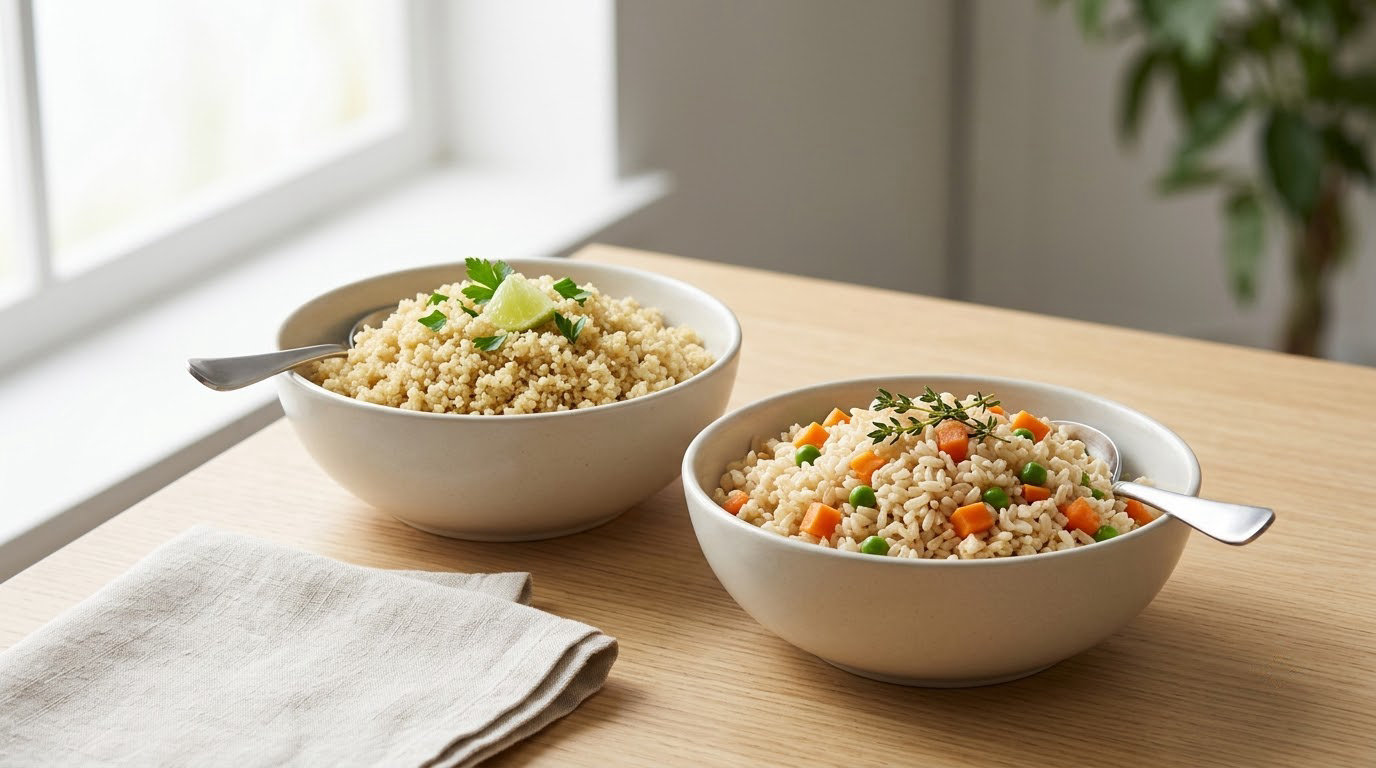
Short answer for the quinoa vs brown rice question: pick quinoa when you want more protein, more fiber and a fully gluten-free seed you can cook in about 15 minutes. Pick brown rice when you want a chewy, hearty side, more manganese, and a grain that costs noticeably less for the same number of dinners.
Both are everyday staples and both are good swaps for white rice. The difference is not a health verdict, it is a fit verdict. I cook both several times a week, and the honest truth is that most people do not need to pick a side permanently — most need one for a specific dish and the other for a different one.
One botanical fact explains a lot of the nutritional gap. Quinoa is a pseudocereal seed from a goosefoot-family plant, so it cooks and eats like a grain but is not one. Brown rice is a true whole grain that keeps its bran, germ and endosperm. That bran and germ layer is where fiber and a big chunk of the mineral content sit, which is why brown rice is not simply white rice with a color change.
This comparison covers what actually changes your week: nutrients per cooked cup, how each one tastes, how long it takes, what a serving costs, how long it keeps, and which dishes each one earns a place in. Updated for October 2026.
Table of Contents
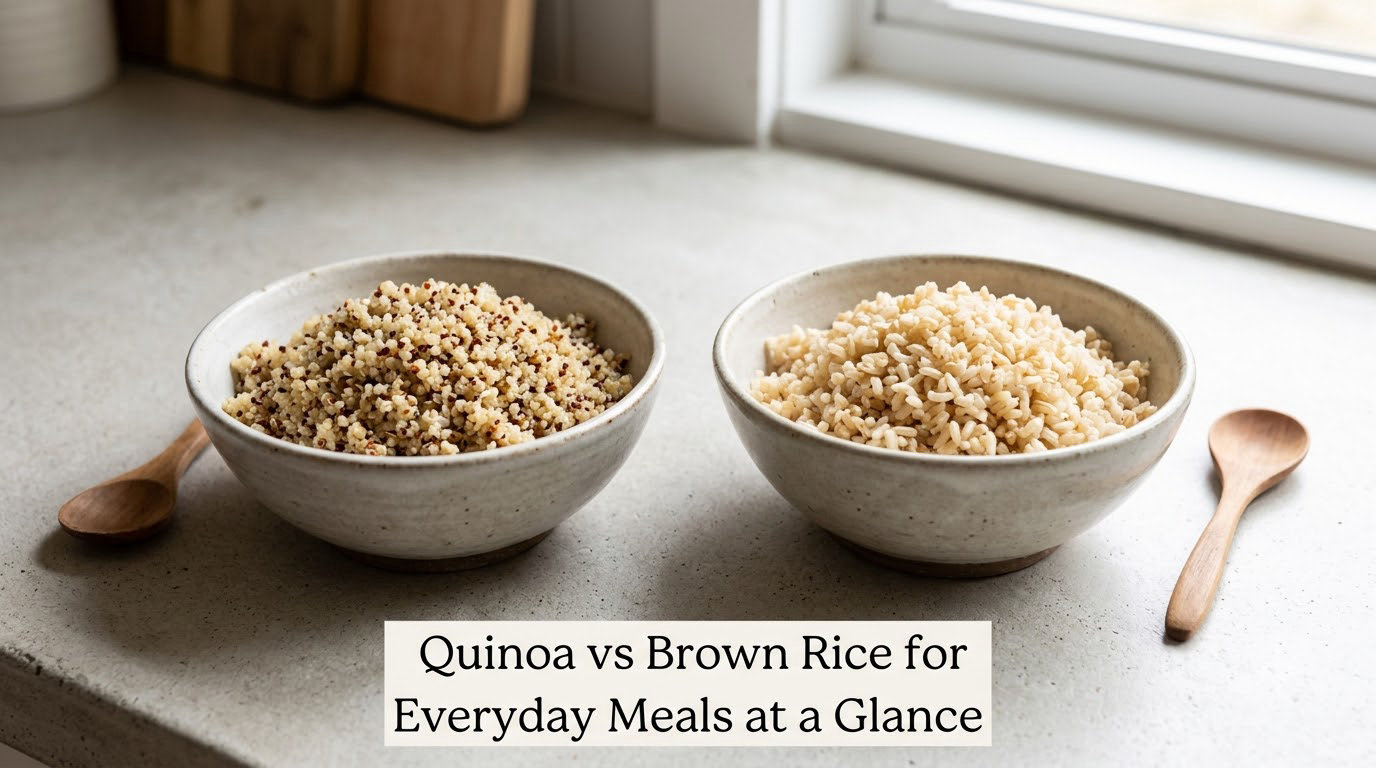
Quinoa vs Brown Rice for Everyday Meals at a Glance
| Criterion | Quinoa | Brown Rice |
|---|---|---|
| What it is | Pseudocereal seed, cooked like a grain | True whole grain with bran, germ and endosperm |
| Protein per cooked cup | About 8 g | About 5 g |
| Fiber per cooked cup | About 5 g | About 3.5 g |
| Carbohydrate per cooked cup | About 39 g | About 45 g |
| Texture | Light, fluffy, slightly crunchy if undercooked | Firm, chewy, nutty when toasted |
| Flavor | Mild, faintly nutty, can taste grassy or bitter if poorly rinsed | Earthy and toasted, forgiving of long cooking |
| Water ratio | Roughly 1 part grain to 2 parts water | Roughly 1 part grain to 3 parts water |
| Cook time | About 15 minutes plus resting | About 45 minutes plus resting |
| Typical cost | Several times brown rice per pound | One of the cheapest whole grains |
| Best everyday uses | Salads, cold grain bowls, breakfast porridge, quinoa burgers | Curries, stir-fries, fried rice, soups, stuffed peppers |
| Main reason to choose it | More protein and fiber per serving | Better chew, lower typical cost, more meal variations |
| Gluten-free | Yes, naturally | Yes, naturally, but check for cross-contact on shared lines |
Everything above is approximate. Exact figures shift with variety, brand and cooking method, so treat them as a comparison rather than a lab report.
How Do Quinoa and Brown Rice Compare Nutritionally?
The numbers below are per 1 cup cooked and come from USDA FoodData Central entries for cooked quinoa and cooked long-grain brown rice. If you want to check my work, those entries are searchable by name in the USDA database.
| Nutrient (1 cup cooked) | Quinoa | Brown Rice |
|---|---|---|
| Calories | 222 | 216 |
| Protein | 8.1 g | 5.0 g |
| Total carbohydrate | 39.4 g | 44.8 g |
| Total fat | 3.6 g | 1.8 g |
| Dietary fiber | 5.2 g | 3.5 g |
| Iron | 1.8 mg | 0.6 mg |
| Magnesium | 118 mg | 39 mg |
| Manganese | 0.8 mg | 1.3 mg |
| Zinc | 1.1 mg | 0.6 mg |
| Copper | 0.35 mg | 0.19 mg |
| Phosphorus | 172 mg | 83 mg |
| Folate | 78 mcg | 9 mcg |
| Vitamin B6 | 0.12 mg | 0.15 mg |
Two rows stand out immediately. Quinoa runs roughly three times the magnesium and about triple the iron of brown rice, while brown rice wins manganese by a wide margin. Vitamin B6 is the one place brown rice edges ahead, and it is a small margin.
Quinoa’s higher fat is almost entirely unsaturated, roughly two grams of it linoleic acid. That is a meaningful point, because the most common objection to quinoa is that it is “fatter” than rice, and at 3.6 grams per cup it is fatter, just not in a way that works against you.
Quinoa vs Brown Rice Protein and Fiber
Quinoa carries about 8 grams of protein per cooked cup against roughly 5 grams for brown rice, and it is a complete protein, meaning it supplies all nine essential amino acids in amounts your body can use. Most plant staples are missing one or two. Quinoa is the rare exception, and that is why plant-based cooks reach for it when they want a grain that pulls its weight on protein.
The fiber gap is about 1.7 grams per cup, roughly 5.2 g against 3.5 g. Against a general adult target of 25 to 35 grams of fiber a day, a cup of quinoa gets you closer to a fifth of it than a cup of brown rice does.
For a protein target, the math is simpler than it sounds. A cooked chicken breast of about 85 grams delivers roughly 26 grams of protein, which takes about three cups of cooked quinoa to match. That is why quinoa keeps you full longer, and also why it is not a substitute for a protein centerpiece. Two-thirds of a cup of quinoa alongside tofu, beans or eggs gets you most of the grain’s benefit without crowding out the actual protein in the bowl.
If you want a firmer answer for your own situation, a registered dietitian can work the numbers against your body weight and goals. That is well beyond what a general article can do responsibly.
Which Grain Is Better for Blood Sugar?
Both grains are low glycemic. Cooked quinoa sits around 53 and cooked brown rice lands in the low-to-mid 50s, which is the same neighborhood. Neither is a low-carb food, and neither needs to be treated like one.
What actually moves a post-meal blood sugar reading is portion size, how much you add to the grain, and what you eat alongside it. A cup of either grain with a cup of white rice in a stir-fry will behave similarly. A half cup of either grain next to protein, fiber and vegetables is a flatter curve than a full cup of either grain on its own.
One practical point for anyone monitoring glucose: cooked quinoa and brown rice both reheat with a firmer bite than when they were fresh, and brown rice firms up more. Serving a smaller portion cold in a salad is an easy way to soften the curve without changing the grain.
This is general nutrition information, not a diabetes plan. If you are managing blood sugar, work with your doctor or a registered dietitian on portions and timing that fit your medication and readings.
What Tastes and Feels Better?
Quinoa is mild and faintly nutty with a small fluffy bite. Rinse it well and it disappears into a dish, which is a compliment and also a complaint: some people find it bland and call it cardboard. Its flavor depends almost entirely on how it was washed, toasted and seasoned. Toasting dry in a pan before adding liquid is the single biggest upgrade, and it takes two minutes.
Brown rice is earthier and chewier, and it improves the longer you cook it. That is why it belongs on weeknight stir-fries and in curries, where the grain has time to sit in a wet sauce and pick up flavor. The tradeoff is a grain that can be chewy or hard if you rush it.
Cold dishes favor quinoa. It holds its shape in a salad, so it does not turn the dressing into porridge, and a forkful has some resistance. The plant-based cooking forums describe exactly this split: brown rice for hot savory dinners, quinoa for cold bowls and salads, used side by side rather than as rivals.
Hot, saucy dishes favor brown rice. It absorbs curry, broth and soy-based sauces, and its chew keeps it interesting next to tender meat. Quinoa can absolutely go into a curry, but the sauce will coat it rather than soak in, so the dish ends up drier and a little more separated than you probably want.
Fried rice is brown rice territory. Day-old cold brown rice is dry enough to hit a hot pan without turning to porridge, and it takes on the egg and soy without falling apart. Quinoa goes soggy in a fried rice pan faster than rice does.
Which Is Easier and Faster to Cook?
Quinoa is the clear winner on time. It cooks in about 15 minutes and needs a fork, a saucepan and a strainer if you like to drain it. Brown rice routinely takes 40 to 50 minutes, and it benefits from time you do not spend watching it.
Here is the practical version of cooking each one well.
How to cook quinoa so it is not mushy
Use roughly 1 part quinoa to 2 parts water, so 1 cup of dry quinoa gets 2 cups of water. Rinse it under cold water for 30 to 60 seconds until the water runs clear, which removes the bitter saponins on the outer coating. That bitterness is the single most common complaint about quinoa, and rinsing solves most of it.
Toast the dry grain in the pan for two minutes with a little oil until it smells nutty, then add the water, bring to a boil, cover, drop to the lowest heat and simmer 15 minutes. Turn off and let it sit covered for five more minutes, then fluff. That covered rest is the trick. Forum cooks on r/MealPrepSunday and r/cookingforbeginners report the same pattern: overcooked quinoa comes from lifting the lid and from adding extra water out of fear it will burn.
For texture problems, the fix is steam, not boiling. If the bottom of the pan is a thin crunchy layer at the end, too much water or too much heat was the cause. Use one less splash and cover from the moment it hits a boil.
How to cook brown rice so it turns out chewy, not crunchy
Use roughly 1 part rice to 3 parts water, so 1 cup of dry brown rice gets 3 cups. Rinse until the water is milky, then drain. Rinsing washes away surface starch and is the difference between separate grains and a gluey pot.
Soaking for 30 minutes in the water before you cook is optional but helpful. It starts the water moving into the grain, so you can drop the simmer time and get a more even result. Bring to a boil, cover, drop to the lowest heat and simmer about 40 minutes, then remove from the heat and leave covered for 10 minutes before fluffing.
That covered rest after the heat is off is the step most people skip and the main reason restaurant brown rice is tender. Also worth knowing: a stovetop rice cooker with a proper basket separates the grains properly. An inner pot of water under a colander, or a pot with a tight lid and a spoon hole for steam, both work well.
Batch cooking favors brown rice on convenience and quinoa on speed. Either way, cook a full batch on Sunday, cool it fast in a shallow container, and refrigerate. Use cooked grains within three to four days, and reheat with a splash of water so they steam back to soft instead of drying out.
Freezing works for both. Spread the cooked grains on a tray to freeze individually, then bag them. Thaw overnight in the fridge and they reheat better than they do from frozen. Grain bowls made of frozen-thawed rice or quinoa are the meal-prep shortcut I use most often.
Quinoa vs Brown Rice Cost and Storage
Price is where the two grains separate most clearly, and it is the reason many households default to brown rice. Quinoa commonly costs several times more per pound, and prices swing by brand, package size and retailer, so treat any figure you see as a snapshot rather than a fixed number.
The per-pound gap looks worse than the per-serving gap because quinoa absorbs less water and expands less. One cup of dry quinoa is about 170 grams and yields roughly three cups cooked, while a cup of dry brown rice yields closer to two to three cups. Per cooked serving, quinoa is still the more expensive option, but the difference is a few servings of difference across a week, not a lifestyle change.
Cost per serving, in relative terms: brown rice is the cheaper side of the comparison, quinoa is the pricier side, and for most people the gap only becomes decisive if the grain is the center of the meal rather than one component of it. If quinoa is a third of a bowl with tofu and vegetables, the total meal cost difference is smaller than it sounds.
Storage on the shelf: dry quinoa keeps roughly a year in an airtight container in a cool pantry, and dry brown rice keeps two to three years. Both benefit from a freezer bag if you live somewhere humid.
Storage in the fridge is the more practical question. Both cooked grains keep three to four days refrigerated when cooled promptly and covered, and both freeze well. Brown rice firms up noticeably by day four, while quinoa holds its texture a little longer and can go a day or two further before tasting dry.
One safety note for both grains, and it is the same guidance the USDA gives for cooked rice and other grains: cool them within two hours, store them shallow rather than in a deep mound, and reheat until steaming hot all the way through.
Which Grain Is More Versatile?
Each one covers dishes the other handles poorly. Here is the practical match for everyday meals.
Breakfast porridge. Quinoa wins. Simmered with milk, cinnamon and fruit, quinoa makes a creamier, higher-protein porridge than rice does, and the small bite survives the texture of cooked oats. Both work, but quinoa is the better bowl.
Lunch grain bowls. Quinoa wins again, especially cold. Combine one cup cooked quinoa with chickpeas, cucumber, herbs, feta and a lemon dressing, and the bowl holds together through an afternoon without absorbing the dressing.
Side dish next to protein. This is a tie, and it depends on the main. Brown rice sits better with roast chicken, salmon and braises. Quinoa sits better with anything acidic or fresh, because its mild flavor does not compete with bright sauces.
Curries and stews. Brown rice. It drinks the sauce and keeps its chew for a long simmer, and the flavor advantage over quinoa is obvious after an hour on the heat.
Stir-fries. Brown rice, ideally cooked a day ahead so it is dry and separate. Quinoa works too, but add it at the very end so it does not soften.
Fried rice. Brown rice, without much debate. Cool, day-old brown rice is the texture fried rice is built around.
Soups. Brown rice for broths and soups, because it holds up to long simmering and adds body. Quinoa can go into shorter soups, added late.
Stuffed peppers and squash. Both work. Quinoa is the classic choice because it keeps the filling from getting soggy and adds protein to what is otherwise a vegetable-and-rice dish.
Grain burgers and patties. Quinoa. Cooked quinoa binds with a little flour and egg into a patty that holds together, and the extra protein matters when the patty is the protein.
Mixing both. A lot of cooks use a blend, roughly half quinoa and half brown rice, in pilafs and stuffed vegetables. You get the fiber and protein of quinoa with the chew and sauce absorption of brown rice. It is a reasonable compromise with no nutritional downside, and it is common enough in meal-prep communities that it is worth knowing it is normal.
Which Should You Choose?
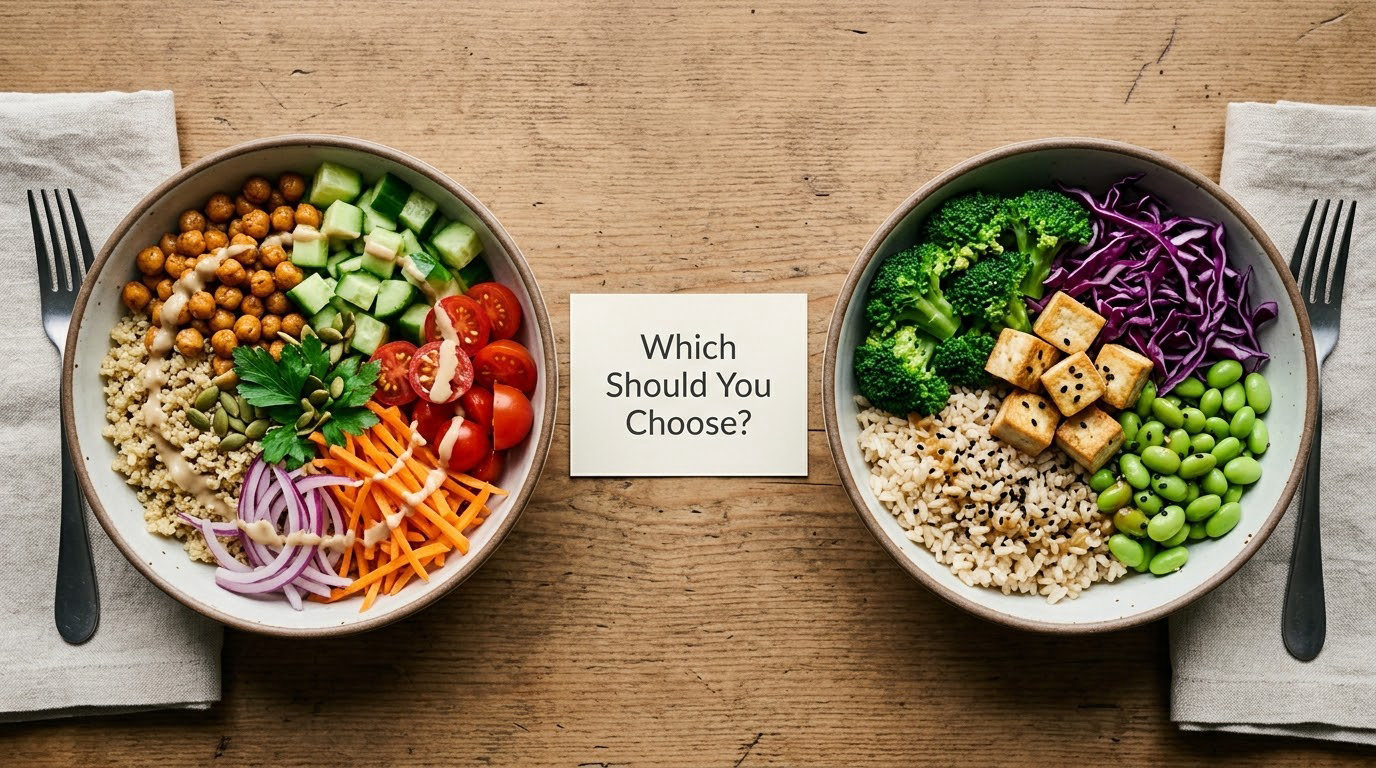
Choose quinoa if you want the higher protein and fiber per serving, cook fast, eat gluten-free by default, and mostly eat cold bowls, salads and breakfast porridge. It is also the better pick for vegetarian and vegan plates where the grain is doing part of the protein job, and for anyone who finds brown rice too chewy.
Choose brown rice if you want a warm, chewy side that pairs with curries, stir-fries and soups, if cooking time and cost are your main constraints, or if your household will simply eat more of it. It is the default that gets eaten five nights a week, and there is something to be said for the grain people actually finish.
Choose both if you are not trying to solve a nutrition problem. Most cooks I know use brown rice for the hot savory dinner and quinoa for the cold weekday bowl, and that split works without any rule behind it.
Pick based on the dish first and the numbers second. That is the whole difference between quinoa vs brown rice for everyday meals: one is the more nutrient-dense option, the other is the more comfortable one, and your plate decides which wins on a given night.
Frequently Asked Questions
Is quinoa healthier than brown rice?
Depends on the goal. Quinoa is higher in protein, fiber, iron, magnesium and folate, and it is a complete protein, so it suits plant-based eaters, gluten-free diets and anyone chasing more protein or fiber per serving. Brown rice wins on manganese, costs less by weight and is the easier grain to eat in large warm dishes. Both are clearly healthier than white rice.
Is brown rice better for weight loss than quinoa?
For most people quinoa is the better pick for weight management, because its higher protein and fiber content keeps you full longer for the same serving size. Neither grain causes fat gain on its own, since both are calorie-dense enough that portion size is the real variable. A registered dietitian can help you size portions against your own goals and needs.
Is quinoa or brown rice better for blood sugar?
They are close. Cooked quinoa has a glycemic index near 53 and cooked brown rice sits in the low-to-mid 50s, so both are low. The bigger levers are portion size, what you add to the grain and what you eat alongside it. A half cup next to protein and vegetables flattens the curve more than any grain swap alone.
Does quinoa or brown rice have more protein and fiber?
Quinoa has more of both. One cooked cup gives about 8.1 g of protein and 5.2 g of fiber, against roughly 5.0 g and 3.5 g for brown rice. Quinoa is also a complete protein, providing all nine essential amino acids, while brown rice carries more carbohydrate and considerably more manganese.
Can you eat both quinoa and brown rice in the same day?
Yes, and plenty of people do. There is no rule against eating both, and no meaningful interaction to worry about unless a clinician has told you otherwise for a specific condition. Many cooks split them by dish, using brown rice for hot curries and stir-fries and quinoa for cold bowls, or blend them in pilafs and stuffed vegetables.
Is brown rice gluten-free?
Yes, naturally. Brown rice is a whole grain that does not contain gluten, unlike barley, farro and wheat. One caveat matters if you have celiac disease or a serious sensitivity: mills often cross-contaminate grains, so look for a package labeled gluten-free if you are highly sensitive or reacting to symptoms.
Conclusion
For quinoa vs brown rice, pick quinoa for quicker cooking, more protein and fiber per serving, and a lighter texture that suits salads, bowls and porridge. Pick brown rice for a chewier side, a lower typical cost, and more room in curries, stir-fries, soups and fried rice.
If you are starting from scratch, cook one cup of brown rice for a week of dinners and keep quinoa for the cold bowls you look forward to. The simplest place to begin is the dish you already cook most often, and let the grain follow it.