
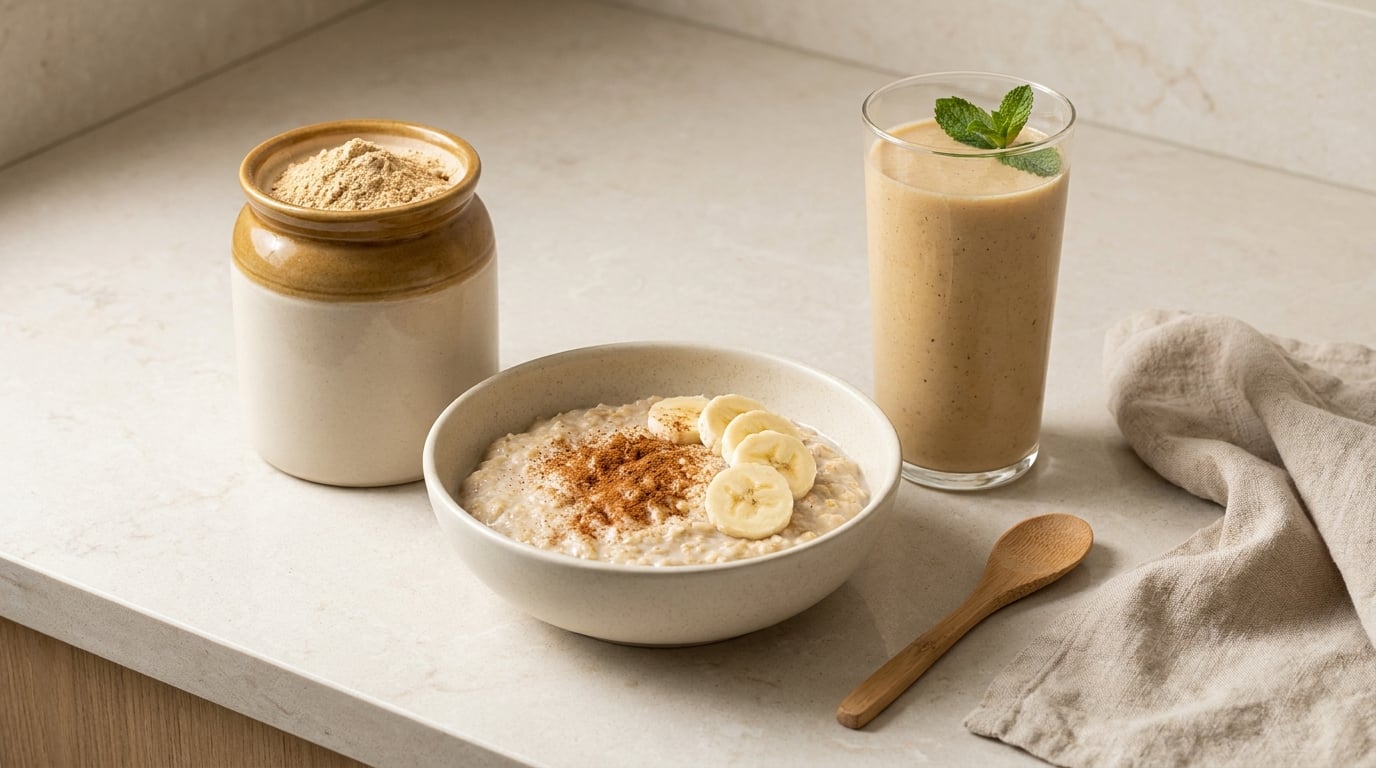
To use maca powder in smoothies and oatmeal, start small: half a teaspoon in a single smoothie, one teaspoon in a bowl of oats, and mix it into the wet ingredients first so it disperses instead of sitting in a clump. Maca is a dried, ground Peruvian root with a sweet, nutty, faintly roasted flavor, so it works best when something in the bowl already carries sweetness. Both methods take about five minutes of active time, and neither needs anything beyond a spoon and a pot or a blender.
Maca has no caffeine in it, so it does not give you the spike and drop of coffee. It is also easy to overuse, and that is the reason so many people try it once and write it off. The measurements below are culinary, in a large breakfast serving, and they were checked and updated for 2026. Nothing here is health advice.
Table of Contents
What You Need
For the smoothie method: a blender (a high-speed one if you use frozen fruit), a measuring teaspoon rather than a heaped spoon, and a liquid you already drink. Oat milk or almond milk keeps the drink mild, and dairy milk works too if that is your habit. Half a frozen banana is the single most useful ingredient in the whole guide, because its starch and sugar do the flavor-balancing work that maca needs.
For the oatmeal method, you need rolled oats, a saucepan or a small pot, a wooden spoon or whisk, and a splash more liquid than you think. Quick oats work in about three minutes on the stove; rolled oats take five to eight and stay creamier. Any milk you like will do, and a spoonful of nut butter stirred in at the end changes the texture more than anything else on this list.
A few supporting ingredients earn their place. Frozen mango and frozen pineapple sweeten without turning the drink into a syrup. Dates and maple syrup handle the chocolate version. Ground cinnamon is the most natural pairing of all. Chia seeds thicken overnight oats and give them a texture closer to pudding. Peanut butter and almond butter are not optional decoration either, since fat is what carries a powder that does not dissolve on its own.
On measuring: one level teaspoon of maca powder weighs roughly four grams, one tablespoon roughly twelve, and a half teaspoon is a small mound. If your spoon is deep, level it with the back of another spoon before it goes anywhere near liquid. A cheap digital scale that reads to one gram removes all guesswork if you make this often.
Storage matters more than most recipes suggest. Keep the powder in the airtight container or bag it came in, sealed and away from light, somewhere cool and dry. Do not leave it open on a counter near the stove, because it picks up moisture and then clumps permanently. Many people keep the opened bag in the refrigerator after the first few months, and most jars stay good for about a year after opening, though the aroma is the honest test: maca that smells flat and dusty has gone stale.
Step-by-Step
Four applications cover almost every way people use this powder. Two are drinks, two are bowls, and the difference between the hot and cold oatmeal methods is the part most guides skip.
1. Add Maca to a Basic Fruit Smoothie
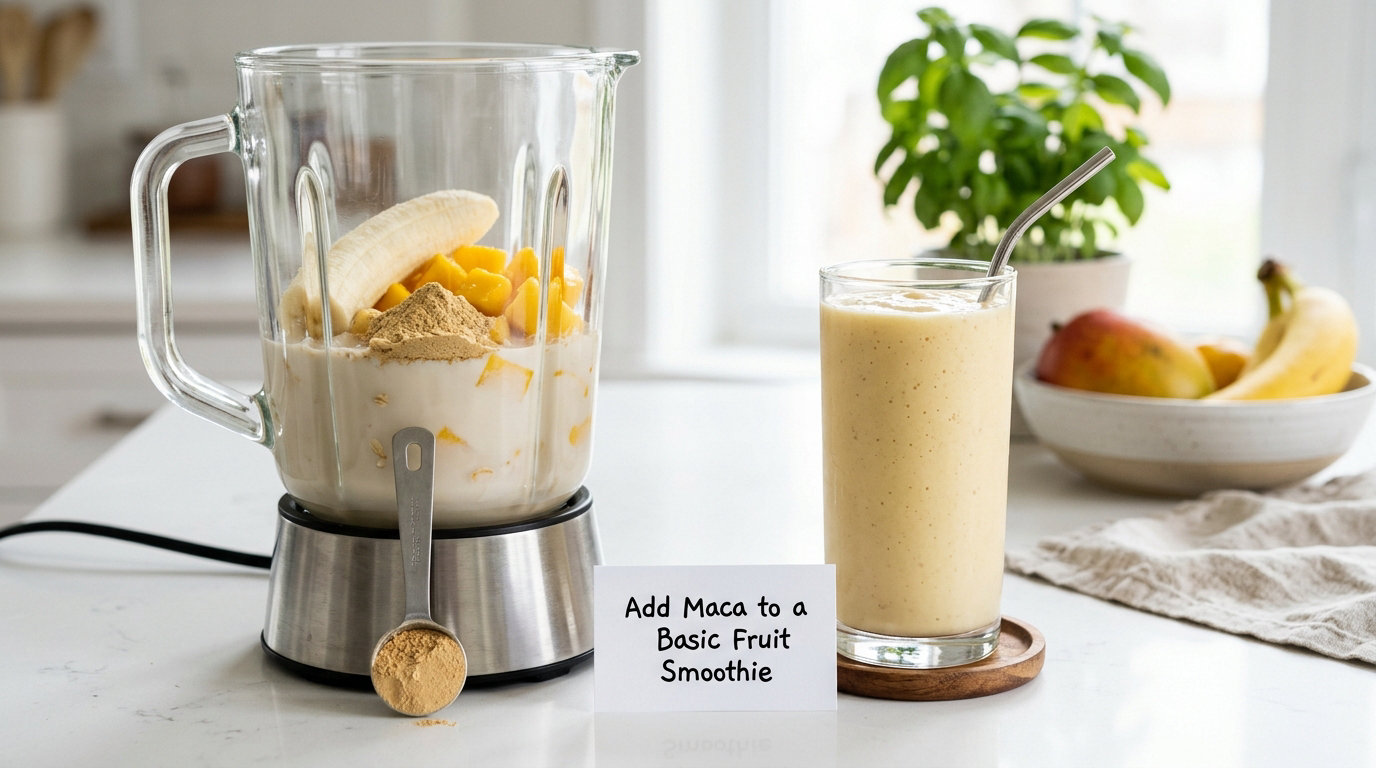
Measure half a teaspoon of maca powder into an empty glass or the bottom of the blender jar, then add about a cup of oat milk. Stir that pair together until the powder is a smooth paste with no dry pockets. This one step removes nearly all of the clumping risk, because the powder dissolves in liquid before the thick ingredients arrive.
Add one frozen banana, about half a cup of frozen mango, and a tablespoon of chia seeds if you have them. Blend on high for 45 to 60 seconds, scraping down once if your jar has a narrow base. You are looking for a drink that pours like loose cream with no speckled grit on the walls and no powdery layer in the bottom third of the glass.
If the blend is thicker than you like, add liquid a tablespoon at a time rather than reaching for ice, which dulls the flavor. If the flavor is a little flat, a quarter teaspoon more maca and 10 more seconds of blending fixes it. If it tastes earthy rather than sweet, the fix is more banana, not more powder, and that rule holds for every recipe in this article.
2. Balance Maca in a Chocolate Smoothie
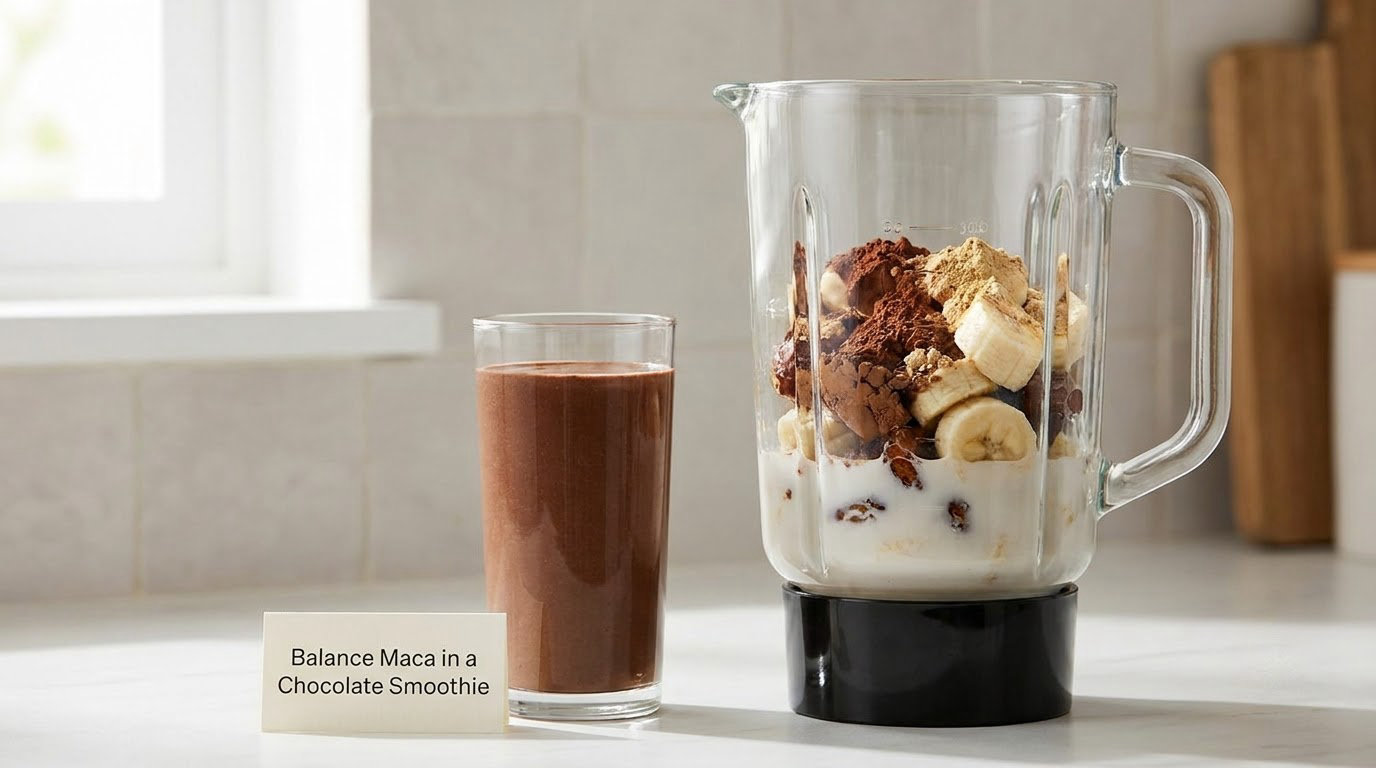
Soak two or three pitted dates in four ounces of warm water for ten minutes, or use one to two tablespoons of maple syrup if you would rather skip the soaking. Both maca and cacao carry a roasted bitterness, so this version needs a real sweetener, not just more powder. Two ingredients that are bitter together turn a drink muddy fast.
Blend the softened dates with the liquid first until there are no date pieces, then add one tablespoon of cacao powder, one teaspoon of maca powder, one frozen banana, a tablespoon of peanut or almond butter, and a half teaspoon of vanilla. Blend for a full minute. The nut butter is what gives it that thick, pudding-like body that makes the drink read as a dessert rather than a supplement shake.
A successful chocolate maca smoothie tastes like a mocha shake and leaves no roasted aftertaste. If it tastes flatly bitter, you are short on sweetener, so add another date or a teaspoon of maple. If it tastes like dirt, you have gone past roughly a tablespoon of cacao without enough fruit to carry it, and the recovery is banana, not more cacao. A shot of espresso also works well here, since the bitterness gets framed as coffee rather than standing on its own.
3. Make Creamy Maca Oatmeal
Cook the oats first, with no maca in the pot. Bring one cup of rolled oats, two cups of milk or water, a pinch of salt, and a tablespoon of maple or honey to a simmer, then stir occasionally for five to eight minutes until the oats have swollen and the liquid has gone tacky. Pull the pot off the heat and let it sit for a minute, since a hot bowl scatters powder and a barely warm bowl absorbs it.
Now stir in half a teaspoon of maca powder and a teaspoon of cinnamon, working in small circles from the edge of the bowl toward the middle until the color is completely even. The finished bowl should look uniform beige with no streaks, and it should taste of warm oats and cinnamon first, with maca sitting quietly in the background. If you can identify the powder on its own, you used too much.
Stir in a spoonful of nut butter, a splash of milk to loosen it, and toppings after the maca is in: sliced banana, apple with cinnamon, a drizzle of maple, a handful of walnuts, or a spoon of yogurt on top. Adding the toppings in layers keeps the top of the bowl interesting, which matters more than it sounds at 7am.
If you prefer to prep it in one go, whisk a teaspoon of maca into the dry rolled oats before adding any liquid. Distributed into the dry oats rather than dumped on top, it disperses during cooking and leaves far less sediment. This is also the method to use if you are doubling the recipe for meal prep.
4. Prepare Maca Oatmeal Overnight
Cold oats have a different problem from hot ones. There is no cooking step to break the powder down, so what you build in the jar is what you eat the next morning. Start with half a cup of rolled oats in a jar, half a teaspoon of maca powder, and a teaspoon of chia seeds, and mix those three dry ingredients together first with a fork until the color looks even.
Add three-quarters of a cup of milk of your choice, one tablespoon of maple syrup, a quarter teaspoon of cinnamon, and a splash of vanilla. Stir for a full 20 seconds, scraping the bottom and the sides, until nothing is sitting in a layer at the bottom. If the mixture looks pasty, the chia seeds and oats need another ten minutes of soaking in the fridge, not more liquid.
Cover and refrigerate for at least six hours, ideally overnight, and eat it cold or take the jar out of the fridge 20 minutes before breakfast so it thickens slightly. The finished texture should be loose enough to spoon with a tilt, closer to thick yogurt than wet oatmeal. A thin, watery layer on top means you need more chia; a set, pudding-like scoop means the next jar gets more liquid.
Maca settles because of density, so stir from the bottom right before eating rather than eating the top layer. Ground flax or hemp instead of chia works well here too, and so does a spoonful of yogurt stirred in before the jar goes into the fridge, which both thins the mix and mellows the flavor.
Common Mistakes
Most of these trace back to one thing: how to use maca powder in smoothies and oatmeal at a dose you can actually taste, and when to add it relative to heat and liquid.
Overdosing is the mistake behind almost every bad first experience. Two tablespoons in a sixteen-ounce smoothie does not read as twice as much of a good thing, it reads as a different drink. Stay at half a teaspoon, taste, and only then increase.
Dumping the powder on top of an already-poured liquid is how you get grit in the bottom of the glass. Always make it a paste with a little liquid, or stir it into a spoonful of nut butter, before it meets the rest of the recipe.
Skipping the sweetener changes what you are tasting. Maca has real caramel sweetness, but it is not sweetness on the level of sugar in a smoothie. Banana, dates, maple, and ripe mango are doing load-bearing work; take them out and the powder’s roasted edge comes forward as bitterness.
Two bitter things stacked together is a common mistake in the chocolate version. Cacao plus maca with nothing sweet makes a drink that is genuinely unpleasant, which is the single most common complaint in the comment sections under these recipes.
Very acidic liquids are worth avoiding in a first attempt. Lemon juice, grapefruit, and vinegar sharpen the earthy note into something closer to dirt. Cinnamon, vanilla, and a splash of espresso are the flavors that play well instead.
Thick drinks and thin oatmeal are the mirror-image version of the same problem. If a smoothie sits like pudding, add liquid a tablespoon at a time. If your oatmeal runs loose, let it cook another two minutes or add a spoon of chia to the pot.
Storing the powder badly ruins it faster than any recipe can. Airtight, cool, dark, and dry is the whole rule, and a wet spoon is enough to start the damage.
Two habits help more than anything else. Keep a small scoop measure inside the jar so the dose is repeatable rather than a guess, and give the flavor three or four days before deciding whether you like it. Most people find the earthy note fades as they get used to it, and the people who keep it up tend to build to about a teaspoon rather than staying at a heavy tablespoon.
Frequently Asked Questions
How much maca powder should I use in a smoothie or oatmeal?
Does maca powder make smoothies or oatmeal taste bitter?
Should maca powder be mixed before or after heating?
Can I use maca powder with regular oats and dairy-free milk?
How should I store maca powder after opening it?
Start With a Small, Balanced Serving
The easiest first attempt is the one-pour banana and oat milk smoothie: half a teaspoon of maca whisked into a cup of oat milk, one frozen banana, and half a cup of frozen mango. No blender technique, no measurement beyond the spoon, and about two minutes. Taste it, write the amount on the jar, and adjust from there.
Once that is comfortable, move to the chocolate version for variety, or cook a bowl of oats the same night and stir in half a teaspoon off the heat. Oats tend to be the more forgiving of the two, since warm starch carries the flavor further than a cold drink does, and many people end up preferring them.
So start there, keep the dose small, and treat the flavor as something you adjust over a week or two rather than judge in one spoonful. That is how to use maca powder in smoothies and oatmeal without turning breakfast into a project.
Whether maca suits you at all is a personal question, and the amount that feels right to one person is a lot to another. If you are pregnant or breastfeeding, managing a hormone-sensitive condition, or taking regular medication, talk to your doctor or a registered dietitian before making it a daily habit. The measurements here are for cooking, not for deciding what is safe for you.