
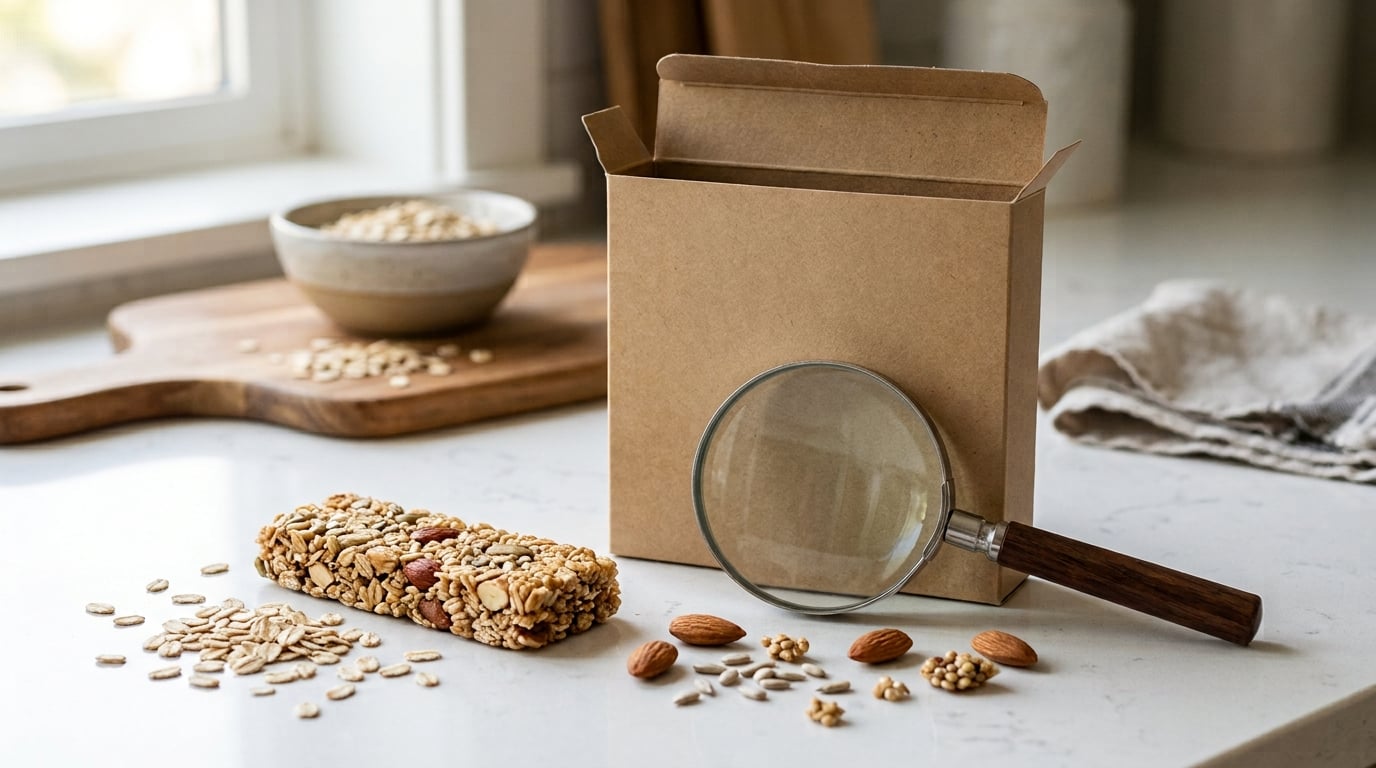
To know how to tell if a granola bar is actually healthy, turn it over and read the panel in a fixed order: serving size, total sugars, added sugars, fiber, protein, calories, then the ingredient list. A bar earns a pass when it delivers roughly 3 to 5 grams of fiber, 5 grams or more of protein, keeps sugar near or under 6 grams, stays under about 200 calories, and lists oats, whole grains, nuts or seeds among its first three ingredients. That is the whole test, and it takes about thirty seconds.
The reason the front of the package tells you so little is that every brand prints the same three words in the same font. Oats, a glossy photo, a strip of chocolate, and a word like “natural” or “fuel.” The information that actually separates a decent bar from a candy bar with nuts in it lives on the back, in two places: the Nutrition Facts panel and the ingredient list. Those two blocks are where the verdict lives.
None of that requires nutrition-label training, and it does not require a stack of reference books either. Turn the box over, read in the same order every time, and the comparison across three brands takes about a minute. Everything below is general information about labels and how the numbers are printed, not personal medical advice. If you are managing a health condition, following a specific diet plan, or working with a clinician on nutrition, talk it through with a registered dietitian or your doctor.
Table of Contents
- What You Need
- Step-by-Step: How to Tell If a Granola Bar Is Actually Healthy
- Common Mistakes
- Frequently Asked Questions
- How many grams of added sugar are healthy in a granola bar?
- Is a granola bar healthy if it has high fiber?
- Are gluten-free granola bars healthier than regular granola bars?
- How much protein should a granola bar have?
- Is organic granola automatically healthier?
- Can you eat granola bars while trying to lose weight?
- Conclusion: Start With the Ingredient List
What You Need
You need the whole package, not the bar wrapper. Nutrition labels live on the box, and the wrapper in your hand usually has nothing but a marketing claim. Turn the box over and put the bar next to it so you can cross-check the serving count against the physical size of what you are about to eat.
You also need a rough sense of your own needs, because “healthy” is not a property a bar has on its own. It is a property a bar has relative to what you are trying to do with it. Someone running a long trail needs a dense, calorie-heavy bar with oats, fat and nuts. Someone managing blood sugar wants fiber, protein and a low total sugar number, even if the bar is small. Different targets, same label.
One thing worth saying up front: no single ingredient makes a granola bar healthy or unhealthy. Sugar at position four in a bar built from oats, nuts and seeds is a different situation from sugar at position one in a bar that is mostly syrup and rice. The list only works as a whole, which is exactly why a single-number check fails so often.
Step-by-Step: How to Tell If a Granola Bar Is Actually Healthy
Read in this order and stop making decisions until you finish. The order matters because the serving size changes every number that follows it, and the ingredient list explains why the numbers look the way they do. Each step ends with a decision rule you can apply on the spot.
1. Check the Serving Size and Ingredient List First
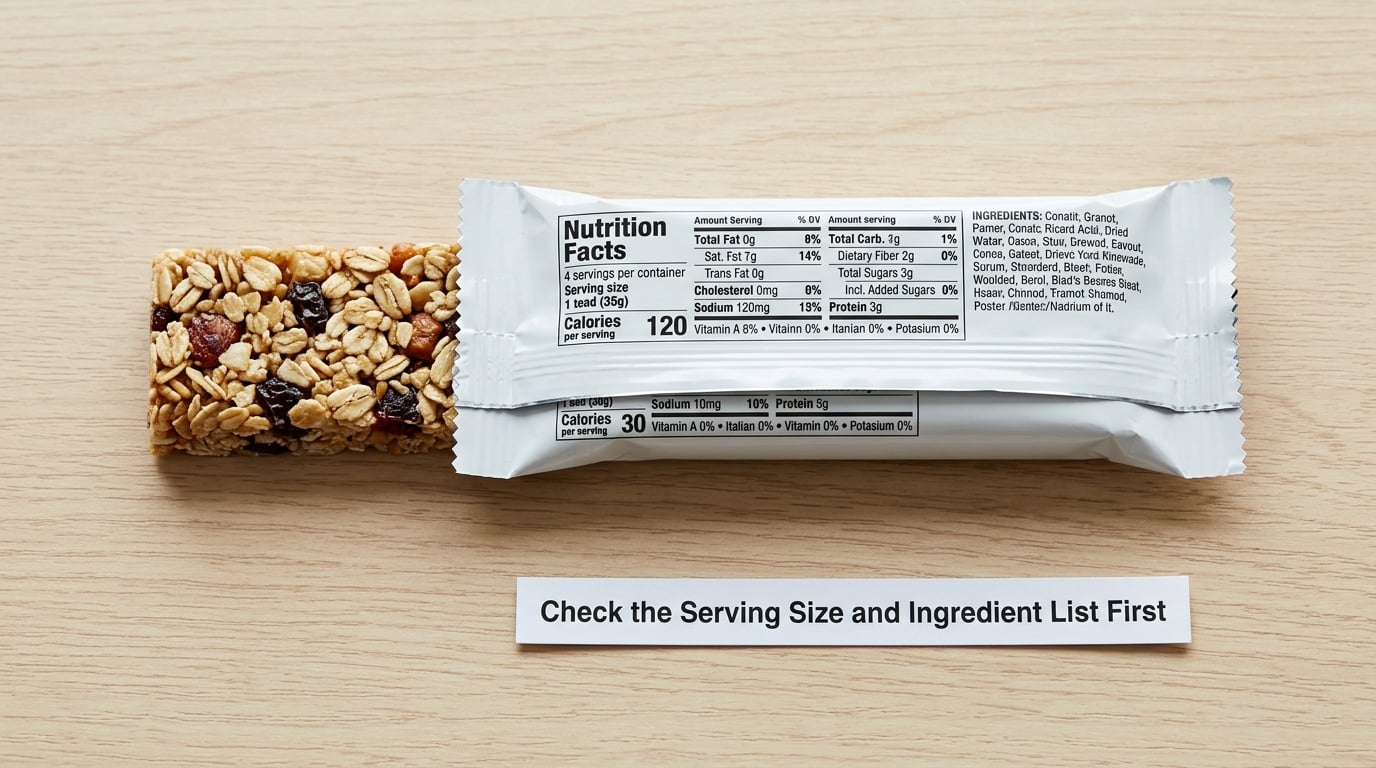
Start with the serving size at the very top of the panel, then read it against the box. Many bars are printed as two servings, which means every number on the panel has to be doubled before it describes the bar in your hand. A 12-gram added sugar figure across two servings is a 24-gram bar, and plenty of bars are set up exactly that way.
Then read the ingredient list top to bottom. Ingredients are listed by weight, descending, so the first three tell you what the bar physically is. Whole grains come first in a grain-forward bar: rolled oats, whole grain oats, whole wheat flour, brown rice crisp. If a bar is mostly sugar, syrups or a protein isolate, you will see that in the first two lines. Nuts, seeds, dried fruit and cacao appear by weight too, so a bar with almonds at number one genuinely contains more almond than anything else.
Decision rule: if the serving size is not one bar, double the numbers before you go any further. If the first ingredient is a sweetener or a refined starch, you are looking at a candy bar with a granola wrapper, and the rest of the panel will not change your mind.
2. Compare Total and Added Sugars
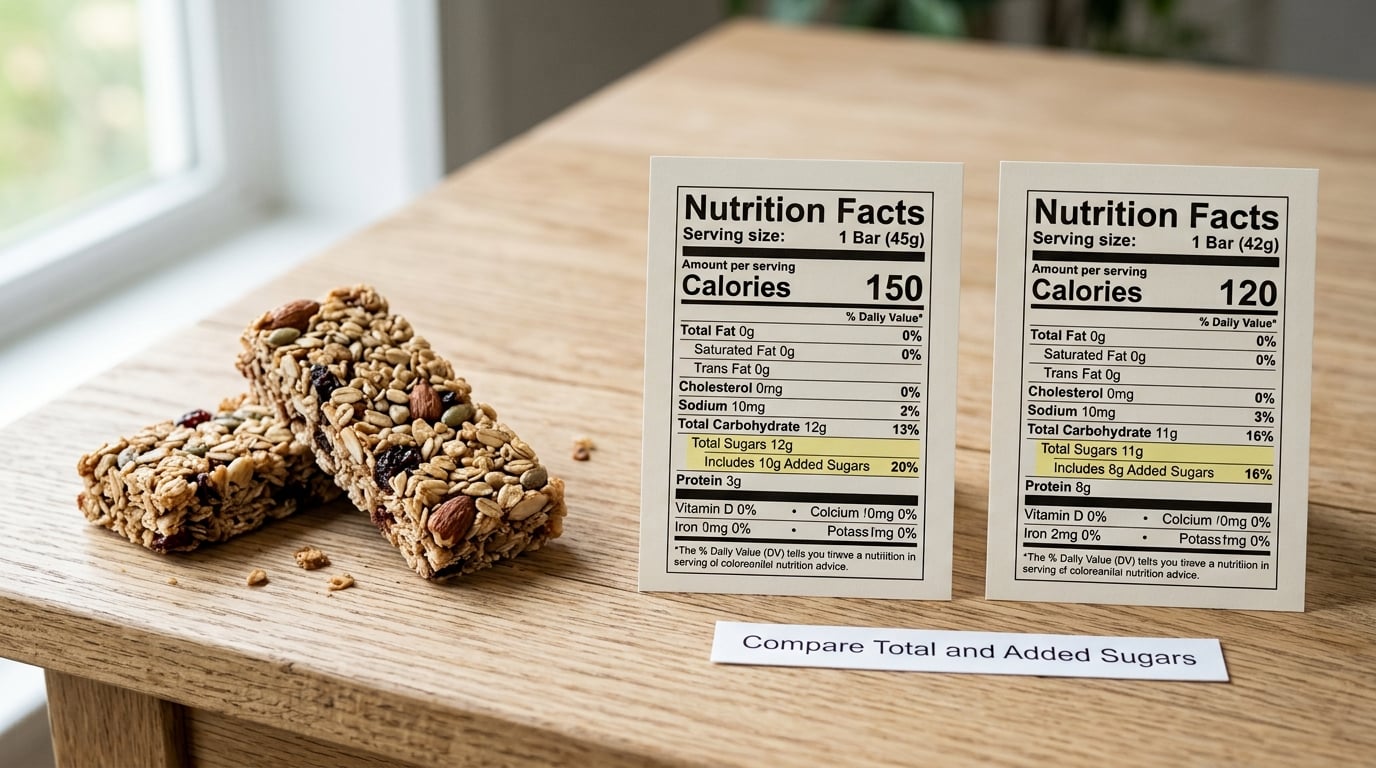
Two lines matter here, and they are not the same line. Total sugars is everything: added sweeteners plus the sugar that arrives inside fruit and milk ingredients. Added sugars is the part a manufacturer put in, and it appears on its own line directly under total sugars on US labels, with a note about how many grams are naturally occurring.
Subtract one from the other and you get the natural contribution. A bar with 14 grams of total sugar and 6 grams of added sugar is carrying roughly 8 grams of sugar from dried fruit, which is not nothing, but it is a different profile from a bar with 14 grams of total sugar and 13 grams added. The line item under Added Sugars tells you the source too, so you can see whether that 6 grams came from honey, cane sugar, rice syrup or fruit juice concentrate.
Set a number and hold to it. Around 6 grams or less of total sugar per bar is a reasonable working target for a roughly 200-calorie snack, and 5 grams or less of added sugar keeps the sweetener load down without pretending fruit-sweetened bars are a separate species.
Decision rule: total sugars above 10 grams in a single bar means the sugar, not the oats, is what you will be eating. The ingredient list will confirm it, and a bar that fails here rarely recovers at the fiber or protein line.
3. Look for Fiber and Whole Grains
Fiber is the quiet number that separates a snack from a piece of cake. It slows digestion, adds bulk, and it is the main reason oats feel different from refined crackers. Look for at least 3 grams per bar, and 4 to 5 grams if the bar is meant to hold you between meals. The percent daily value line is a useful sanity check, since 3 to 4 grams of fiber is roughly 11 to 14 percent of the daily value on current US labels.
Whole grains go with it. Whole grain oats and whole wheat flour keep the grain kernel intact, which is where the fiber lives. Words like “multigrain” and “seven grains” sound better than they measure, because a blend can still be mostly refined flour with a small amount of whole grain mixed in. A single oat or two does not outweigh a large quantity of refined starch sitting above it in the list.
There is a well-known benchmark in hiking and backpacking circles, and it holds up for everyday snacking too: roughly 5 grams of fiber, 5 grams of protein and 5 grams of unsaturated fat in one bar, and it will fill you up. That combination is a reasonable barometer for anything you expect to survive a hike or a long afternoon.
Decision rule: under 2 grams of fiber and no whole grain in the first three ingredients, the bar is a crunchy cookie in costume. Look elsewhere.
4. Review Fat, Protein, and Sodium
Fat is where the type matters more than the number. Oats, almonds, peanuts, sunflower seeds and canola oil contribute mostly unsaturated fat, which is the kind associated with a better fat profile. Palm oil, vegetable shortening, butter and coconut oil carry more saturated fat, and when they sit high in the ingredient list the bar is built around them. Low total fat is not automatically better either, because the unsaturated fat and some of the protein are exactly what help a bar fill you up.
Protein is the other number people skip. A bar under 3 grams of protein is mostly carbohydrate, and a mostly carbohydrate snack paired with a carb-heavy afternoon is how people end up hungry again in twenty minutes. For a filling bar, look for 5 grams or more. If the bar you like most falls short, that is a normal situation, and the simple fix is to eat it alongside something with protein, like a handful of nuts, a piece of cheese or a hard-boiled egg.
Sodium is worth a glance, mostly because nuts and seeds bring a fair amount with them. There is no need to panic over a moderate number. But if a bar runs high on sodium and you eat it daily, the total across a week starts to matter in a way that one bar never does.
Decision rule: 5 grams or more of protein plus mostly unsaturated fat and no shortening or palm oil high in the list. A bar that misses on protein is not a problem you have to live with, as long as you know to pair it.
5. Treat Package Claims as Marketing, Not Proof
Almost every front-of-pack phrase on a granola bar is legally vague on purpose. Here is the honest reading of the common ones.
- No added sugar. This is a real regulated claim in the US, and it is the most misread phrase in the category. It means no sugar was added during manufacturing. It says nothing about the total sugar already in the bar, so a date- or juice-sweetened bar can carry 12 to 20 grams of total sugar and still print this on the front. Read the Added Sugars line, then read Total Sugars, and treat this claim as the first half of a sentence, not the whole one.
- Natural. There is no single standard the phrase has to meet, and manufacturers can use it for a wide range of products. It is a description of how a product was handled, not a statement about its nutrition.
- Organic. USDA organic governs how ingredients were grown and processed, not how much sugar is in the finished bar. An organic bar can and often does have a very similar sugar profile to its conventional neighbour.
- Whole grain. Meaningful only when a whole grain is genuinely present, and most meaningful when it appears early in the ingredient list rather than in a footnote-style claim on the front.
- High protein. Commonly reserved for bars with a meaningful amount per serving, and worth verifying against the panel rather than trusting the badge.
- Plant-based, non-GMO, gluten-free, no artificial sweeteners. Each one is accurate about its own narrow question and silent about everything else. Gluten-free in particular says nothing about added sugar or fiber.
- Functional extras. Probiotic counts, fruit and vegetable blends, added vitamins and phrases like “supports immunity” are the claims to be most careful with. A blend present in an amount too small to contribute meaningful micronutrients is a marketing line, and the viability of a probiotic at the moment you eat it is not something the package can promise.
Decision rule: every claim on the front has to be confirmed on the back. If a phrase cannot be matched to a number on the panel or an ingredient in the list, treat it as decoration.
6. Decide Whether the Bar Fits Your Needs
Now put the pieces together against your own situation rather than against an abstract idea of healthy. The thresholds above describe a well-built snack bar. They do not decide whether any bar belongs in your day.
Think about portion and satiety. A 200-calorie bar of oats and nuts is a fine snack and a poor meal replacement, however good the panel looks. Marketers lean on the meal-replacement language because it sells, but most bars are not built to replace a meal, and treating one as lunch is how people feel hungry again an hour later.
Think about dietary restrictions before anything else. If you avoid gluten because of celiac disease rather than a preference, read the allergen statement and the oats question carefully, because oats are only naturally gluten-free when they are processed in a dedicated facility. The same goes for tree nuts and peanuts: a printed allergen statement is the only thing that tells you whether a bar is safe for the person eating it.
For readers managing blood sugar or carbohydrate intake, total carbohydrate and net carbs matter more than the added-sugar framing. Net carbs is total carbohydrate minus fiber, and experienced low-carb readers tend to treat anything above about 10 grams of net carbs per bar as a poor fit, which is a stricter standard than most packaging implies. Work out the number that suits your plan rather than borrowing a general guideline.
Decision rule: the bar passes if it clears the sugar, fiber and ingredient checks and fits the job you are giving it. If it clears two out of three, pair it with something that fixes the gap rather than putting it back on the shelf.
Common Mistakes
Judging by organic certification alone. Organic describes farming and processing standards, not the sugar content, and organic bars routinely carry the same added sugar as conventional ones. Check the panel anyway, exactly as you would for any other bar.
Looking only at fiber. High fiber makes a bar more filling and slows its effect on blood sugar, but a bar can hit its fiber number with a fractionated fiber ingredient such as tapioca fiber while the rest of the package is still mostly sugar. Pair the fiber win with a check of total sugar and the ingredient list.
Looking only at total sugar. A date-sweetened bar with no added sugar can still carry a large total sugar load, and that number is what your body responds to. Read both lines, and set your threshold on total sugar if you are managing carbohydrates or calories.
Treating gluten-free as a proxy for better. A gluten-free bar may be higher in sugar and lower in fiber than the standard version next to it, because the texture has to come from somewhere else. Apply the same checks, and confirm the gluten-free claim matters for a real reason in your life.
Reading one serving and forgetting the box. Two-serving packaging quietly halves the printed numbers. Count the servings per container, then multiply before you compare two brands.
Skipping fortified and functional claims. Probiotic counts, vegetable blends and added vitamins sound substantive and often are not, at the amounts used. Treat these as garnish unless the label or a study supports a specific amount.
Quick Tips for Choosing a Better Bar
Compare two bars from different brands side by side rather than one against your memory of another. Favor short ingredient lists, because a list you can read at a glance is usually a list with less to hide. Check the serving size before you check anything else, so you never get surprised twice. Pair a lower-protein bar with a protein source. And eat granola as part of a balanced diet rather than as a way to skip one, because that is where even a well-built bar stops being a good idea.
Frequently Asked Questions
How many grams of added sugar are healthy in a granola bar?
Most dietitians use somewhere around 5 grams of added sugar per bar as a practical working target for a 200-calorie snack, and the wider guidance is to keep added sugar under 10 percent of daily calories. Treat that as a range rather than a hard line. Added sugar alone is also an incomplete measure, so check the total sugars line too, since a fruit-sweetened bar can carry a large total load with zero added sugar.
Is a granola bar healthy if it has high fiber?
High fiber is one of the strongest signals a bar can have, because it slows digestion, adds bulk and keeps you full longer. On its own it is not a pass, though. A bar can hit its fiber number with a processed fiber ingredient while the rest of the product stays sugary, so read the total sugar, protein and ingredient list before deciding.
Are gluten-free granola bars healthier than regular granola bars?
Not necessarily. Gluten-free is a narrow claim about one thing, and it says nothing about added sugar, fiber or calories. Because texture has to come from somewhere, some gluten-free bars end up with more sugar and less fiber than the standard version beside them. If gluten avoidance is a medical requirement, check the allergen statement carefully; if it is a preference, compare the panels the same way you would compare any two bars.
How much protein should a granola bar have?
Around 5 grams or more per bar is a sensible target for something meant to hold you between meals, and 8 to 10 grams suits a bar you are relying on after a workout. A popular benchmark from hiking communities is 5 grams each of fiber, protein and unsaturated fat as the filling combination. Bars under 3 grams of protein are mostly carbohydrate, and work far better paired with another protein source.
Is organic granola automatically healthier?
No. USDA organic standards cover how ingredients are grown and processed, not how much sugar ends up in the finished bar. Organic granola bars can have an added sugar profile nearly identical to their conventional counterparts. Organic is worth paying for if the farming practices matter to you, but it should never stop you from reading the Nutrition Facts panel and ingredient list.
Can you eat granola bars while trying to lose weight?
Yes, as long as the bar earns its place. A bar with real fiber, 5 grams or more of protein and mostly unsaturated fat, at around 150 to 200 calories, can help manage hunger between meals. What works against weight loss is mindless eating, oversized portions and bars marketed as meal replacements when they are really a snack. Portion matters, so read the serving size and stick to what one bar actually is.
Conclusion: Start With the Ingredient List
If you do one thing, read the first three ingredients before you read anything else. That single habit catches most of the bars you would rather not buy, because the list tells you what the bar is made of while the front of the box tells you what the brand wishes it were. After that, work through the panel in a fixed order: serving size, total sugars, added sugars, fiber, protein, calories, then the fat type.
Keep the thresholds nearby, treat the front-of-pack claims as unverified until the back confirms them, and remember that a well-built bar is a snack rather than a meal. If you are working around a health condition, following a prescribed diet, or managing allergies, bring the label to a registered dietitian or your doctor and let them tell you what your own numbers should look like.