

Ingredients on a packaged food are listed in descending order by weight, from the largest amount to the smallest, and the panel usually sits on the back or side next to the Nutrition Facts. The first ingredient is the one the product contains most of.
That is the whole trick, and it takes about sixty seconds once you know what to look for. Everything else on the package — the front claims, the color, the photo of a farm — is marketing. The ingredient list is the part nobody gets to sell you on.
I started reading these properly when I started buying cereal for a toddler and realized I had no idea what I was choosing. Twenty minutes of learning the rules saved me a lot of bad purchases after that. Below is the method I use now, and it works on anything from granola bars to canned soup.
Table of Contents
- What You Need
- Step-by-Step: How to Read an Ingredient List on a Food Package
- 1. Find the ingredient list and separate it from the Nutrition Facts panel
- 2. Read the ingredients in order, not as a list of equals
- 3. Separate basic foods from added ingredients
- 4. Catch the names hiding in parentheses
- 5. Spot the sugar aliases without memorizing hundreds of names
- 6. Check allergens and your own priorities
- 7. Compare two similar products per 100 g
- 8. Compare the front claim against the list
- Reading the Ingredient List for a Specific Condition
- Common Mistakes
- Frequently Asked Questions
- Are ingredients listed from most to least?
- Why are there so many different names for sugar?
- Does organic mean an ingredient list is healthier?
- Where should I look if I have a food allergy?
- Can an ingredient list tell me whether a food is whole or processed?
- Should I compare the ingredient list or the nutrition facts panel?
- Conclusion
What You Need

Almost nothing. You need the package itself, a pen or a notes app, and about a minute.
A magnifying glass or your phone camera helps with small print on a curved can, and honestly a screenshot of the panel in your phone’s notes app beats trying to remember what you saw in the aisle. If you are shopping for someone with a diagnosed allergy, celiac disease, or another medical restriction, bring the full package home rather than deciding in the aisle, and check with your doctor or a registered dietitian on anything ambiguous.
Have the package in your hand and read the panel twice: once for the big picture, once for the details. The two passes catch different things.
Step-by-Step: How to Read an Ingredient List on a Food Package
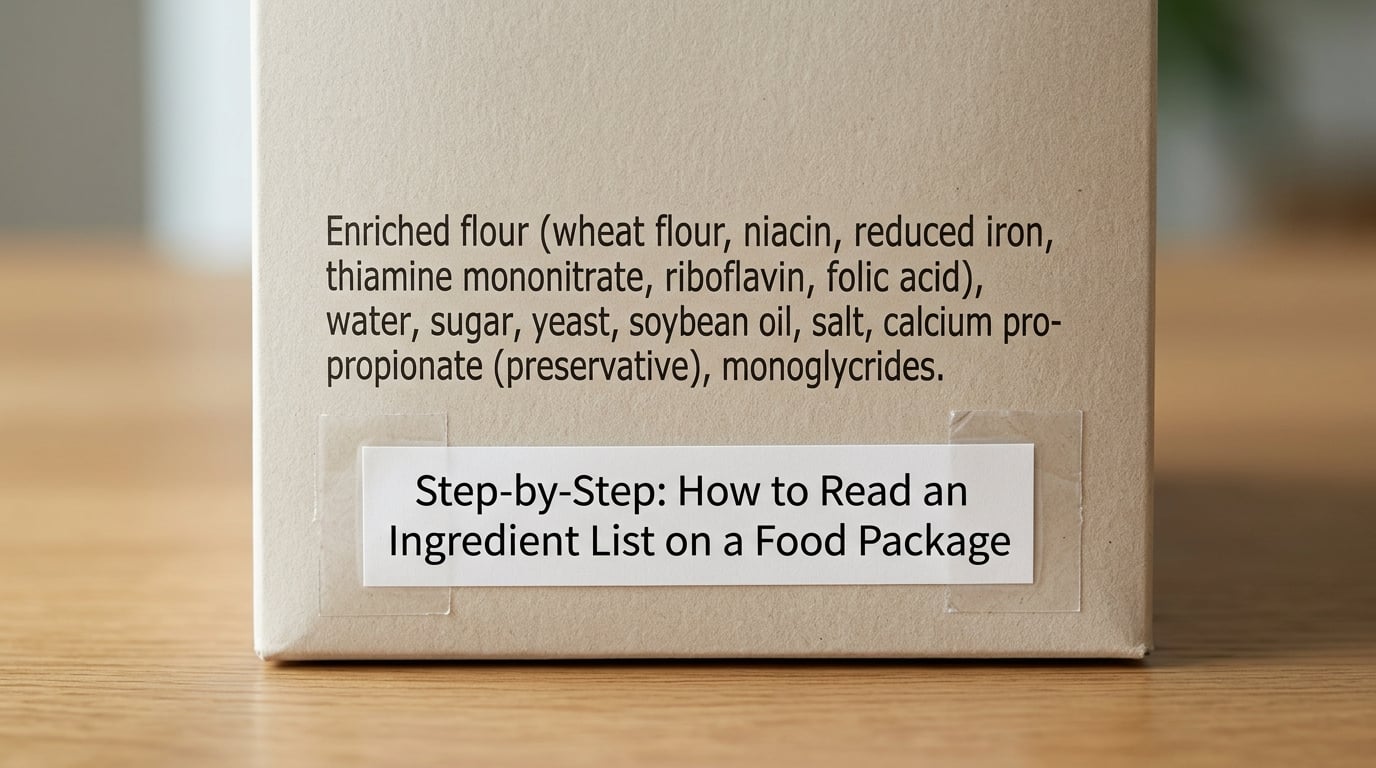
1. Find the ingredient list and separate it from the Nutrition Facts panel
The ingredient list is a simple run of text, usually under or beside the Nutrition Facts box. It can also be printed directly on the wrapper for things like bread, or on a bagged inner layer for a boxed cereal, which is why the outer box is often a billboard and the inner bag is the honest part.
The Nutrition Facts panel tells you quantities. The ingredient list tells you composition. You need both, and they answer different questions.
2. Read the ingredients in order, not as a list of equals
Ingredients are listed in order of predominance by weight, so the one at the top weighs more than the one beneath it. Most of what is in the package is sitting in the first three lines.
There are honest limits to this. An ingredient has to make up 2 percent or more of the product to earn its own line; below that, the manufacturer can group several minor ingredients together. And the order reflects weight at the time of formulation, not after processing changes things. Read the top of the list closely and the tail loosely.
3. Separate basic foods from added ingredients
Start by marking the ingredients you would find in your own kitchen: a grain, a bean, eggs, milk, an oil, a vegetable. Those are the building blocks of the food.
Then mark everything else — added sweeteners, syrups, oils, flavor compounds, colors, preservatives, emulsifiers, thickeners. That second group tells you what the manufacturer did, and it is usually where the sugar, the salt and the refined starch come from.
4. Catch the names hiding in parentheses
Compound ingredients are the biggest blind spot on most packages. When a seasoning, a sauce or a filling is itself made from several ingredients, its own ingredients go in parentheses right after its name, and the whole group sits where the compound ingredient sits.
So a cracker might read: “wheat flour, vegetable oil (palm, soybean), seasoning (salt, monosodium glutamate, paprika, yeast extract).” If you were only scanning for the word “salt,” you would have missed it three lines down. This is the single biggest blind spot on most packages, and plenty of shoppers never open those parentheses at all.
Any ingredient named more than once under different names still counts toward its total, which is why one product can list four forms of sugar and still be over a third sugar by weight.
5. Spot the sugar aliases without memorizing hundreds of names
There are a lot of names for sugar, and memorizing the full list is a waste of an afternoon. Use three buckets instead.
| Bucket | What it looks like | Examples |
|---|---|---|
| Ends in -ose | Scientific name of a sugar | Sucrose, glucose, fructose, maltose, lactose, dextrose, galactose |
| Syrup or juice concentrate | Liquid or concentrated forms | Corn syrup, high fructose corn syrup, rice syrup, cane syrup, fruit juice concentrate, malt syrup |
| Honey family | Words that sound wholesome | Honey, agave nectar, jaggery, molasses, date syrup, barley malt, brown rice syrup |
Read down the list, pull every name into one of those three buckets, then add the counts together. The total tells you the share of the product that is added sugar, whatever the package calls it. The Nutrition Facts panel still governs what goes on the label as “Added Sugars,” but the bucketing tells you what the words actually cover.
Worth knowing: ingredients that are not added sugars but behave like them include fruit juice concentrate and maltodextrin, a starch that is cheaper and sweeter than sugar and often the very first ingredient in a “protein” bar.
6. Check allergens and your own priorities
Allergen declaration is where labels differ most by country, so check the rules for where you shop.
| Region | How allergens are declared |
|---|---|
| United States | A “Contains” statement near the ingredient list, or after it, naming milk, eggs, fish, crustacean shellfish, tree nuts, peanuts, wheat, soy and sesame |
| United Kingdom | Pre-packed foods must have an ingredient list with allergens highlighted in bold on the pack or on an attached label |
| European Union | Allergens must be emphasized within the ingredient list, under Regulation 1169/2011 |
Two cautions. Some people react to something that is not one of the nine named allergens, so a clean list is not a guarantee for everyone. And ingredient lists change without any headline announcement, so if a reaction is new and unexpected, contact a clinician and report it rather than self-diagnosing.
7. Compare two similar products per 100 g
Serving sizes are the other place shoppers get misled. A 30 g serving on one package and a 40 g serving on another means the numbers on the front cannot be compared without arithmetic.
Normalize instead. Divide each number by the serving size and multiply by 100, and you get the amount per 100 g for both. If one yogurt works out to 12 g of sugar per 100 g and the other to 7, you have a real comparison in about fifteen seconds. The same trick works for sodium, fat and fiber, and it is the fastest way to settle an argument between two nearly identical packages.
8. Compare the front claim against the list
Last step, and the one that catches the most. Read the front claim, then check whether the list supports it.
| Front-of-package claim | What the ingredient list usually shows |
|---|---|
| No added sugar | No cane sugar or syrup, but fruit juice concentrate, honey, agave or maltodextrin may lead the list |
| Made with whole grains | Whole grain appears, but refined flour or sugar may still be first or second |
| Multigrain | Often mostly refined wheat with a small quantity of one or two other grains |
| Natural | A category with no legal definition on US labels; “natural flavor” is a compound ingredient with its own sub-list |
| Fruit flavored | Flavor compounds rather than fruit; check whether any real fruit is in the first three lines |
| Low fat | Fat replaced by sugar or starch to keep the texture |
| Enriched or fortified | Refined grain with added nutrients, which is a good thing, and still a refined grain |
| Gluten-free | No gluten-containing grains, but sugar and starch may still lead the list |
Reading the Ingredient List for a Specific Condition
Once the basic method is automatic, the same sixty seconds gets sharper when you know what you are filtering for. The tedious version of this task is scanning dozens of packages looking for a handful of specific terms, then losing patience halfway down the aisle.
For diabetes or blood sugar management, look for where the added sugars sit in the order rather than only at the total grams, and check the serving size before the number, since the panel describes a serving and not what you actually eat.
For celiac disease, read for wheat, barley and rye specifically, and check the sub-ingredients and the allergen statement, because a shared line or a “seasoning contains” bracket is where barley and rye tend to appear. Confirm anything ambiguous with your clinician rather than guessing from a label.
For low-sodium diets, count every place salt appears: the ingredients list, the sub-lists, and the nutrition panel. Many packages use potassium chloride as a substitute, so its presence is worth knowing about.
For high-FODMAP diets, the ingredient list saves real time because the culprits are named plainly, such as inulin, chicory root, wheat, onion and garlic, and the relevant terms are searchable rather than hidden behind a trade name. Monash University maintains the current FODMAP food list if you want a reference to check terms against.
For a baby or young child, the ingredient list and the allergen statement are the fastest way to see what is actually in a jar or pouch, and the order tells you what dominates. If you are introducing foods one at a time, give yourself a few days with a single new food so any reaction is easier to trace.
None of this is medical advice, and none of it should replace a plan from your doctor or a registered dietitian. It is a way to walk into the shop already knowing which words to search for.
Common Mistakes
Treating every line as equally important. The first three ingredients are the product. A cast-off name at position 22 matters far less than what is sitting at the top.
Scanning for one word instead of one idea. A package can avoid the word “sugar” entirely and still be sweetened four different ways, because the rule counts every alias together. Bucketing beats keyword spotting.
Stopping at the top of the list. Compound ingredients in parentheses put real ingredients further down. Open the parentheses, always.
Comparing serving-size numbers directly. Different serving sizes on two packages mean the numbers are not comparable until you convert to a common basis.
Trusting the length of the list as a verdict. A twenty-item list is a signal that something is worth checking, not proof that the food is bad. A two-item list can still be all added sugar.
Treating “natural” or “organic” as a nutrition claim. On US labels, organic describes a production method, not nutritional quality, and natural has no legal definition at all. The ingredient list is where the food’s actual composition shows.
A useful habit: read the list once when you first buy a product, and then only again when the recipe or the package changes. Brands reformulate quietly, and your memory of last year’s version is not a reliable guide.
Frequently Asked Questions
Are ingredients listed from most to least?
Yes. Ingredients are listed in descending order by weight, so the first item is the one present in the largest amount. One caveat: an ingredient only needs its own line if it makes up 2 percent or more of the product, and everything below that can be grouped. The order also reflects weight at the time of formulation, so the tail of the list is less precise than the top.
Why are there so many different names for sugar?
Because the same substance can be derived from different sources and labeled under a generic name, a botanical name or a trade name, and the rules allow any of them. Instead of memorizing the very long list, sort what you see into three buckets: names ending in -ose, syrups and juice concentrates, and the honey family. Add up everything that lands in a bucket and you have your added sugar total.
Does organic mean an ingredient list is healthier?
Not on its own. In the United States, organic describes how the crop was grown and processed, not the nutritional quality of the finished food. An organic cookie can still lead with sugar, refined flour and palm oil. Treat the organic seal as a production detail, then read the ingredient list for what the food actually contains.
Where should I look if I have a food allergy?
Look for the allergen statement near the ingredient list, and check for sub-ingredients inside parentheses. In the US, look for the Contains statement naming milk, eggs, fish, shellfish, tree nuts, peanuts, wheat, soy and sesame. In the UK, allergens are bolded in the list or on an attached label. In the EU, they are emphasized within the list. For a diagnosed allergy, confirm with your doctor or dietitian and check the package every purchase, since recipes change.
Can an ingredient list tell me whether a food is whole or processed?
Partly, and honestly. A short list built from recognizable foods, such as oats, almonds and apple pieces, is a reasonable sign of a minimally processed product. A long list of technical names points the other way, but length alone is not proof. Ingredients such as modified food starch, maltodextrin, carboxymethylcellulose or natural flavor are common markers of a processed formulation.
Should I compare the ingredient list or the nutrition facts panel?
Use both, for different jobs. The ingredient list tells you what the food is made of and in what order, which is the only way to catch split sugar names and hidden sub-ingredients. The Nutrition Facts panel gives you actual quantities per serving and per container. When you compare two similar products, convert both to a common basis, usually per 100 g, so the numbers can be compared directly.
Conclusion
Start where every read should start: the first three ingredients, in order, then open every set of parentheses. Sort the sweetener names into three buckets, check the allergen statement, and convert to per 100 g when you are comparing two packages. Only then decide whether the front-of-package claim holds up.
None of this takes more than a minute, and it turns the label from fine print into a decision you can actually make.