
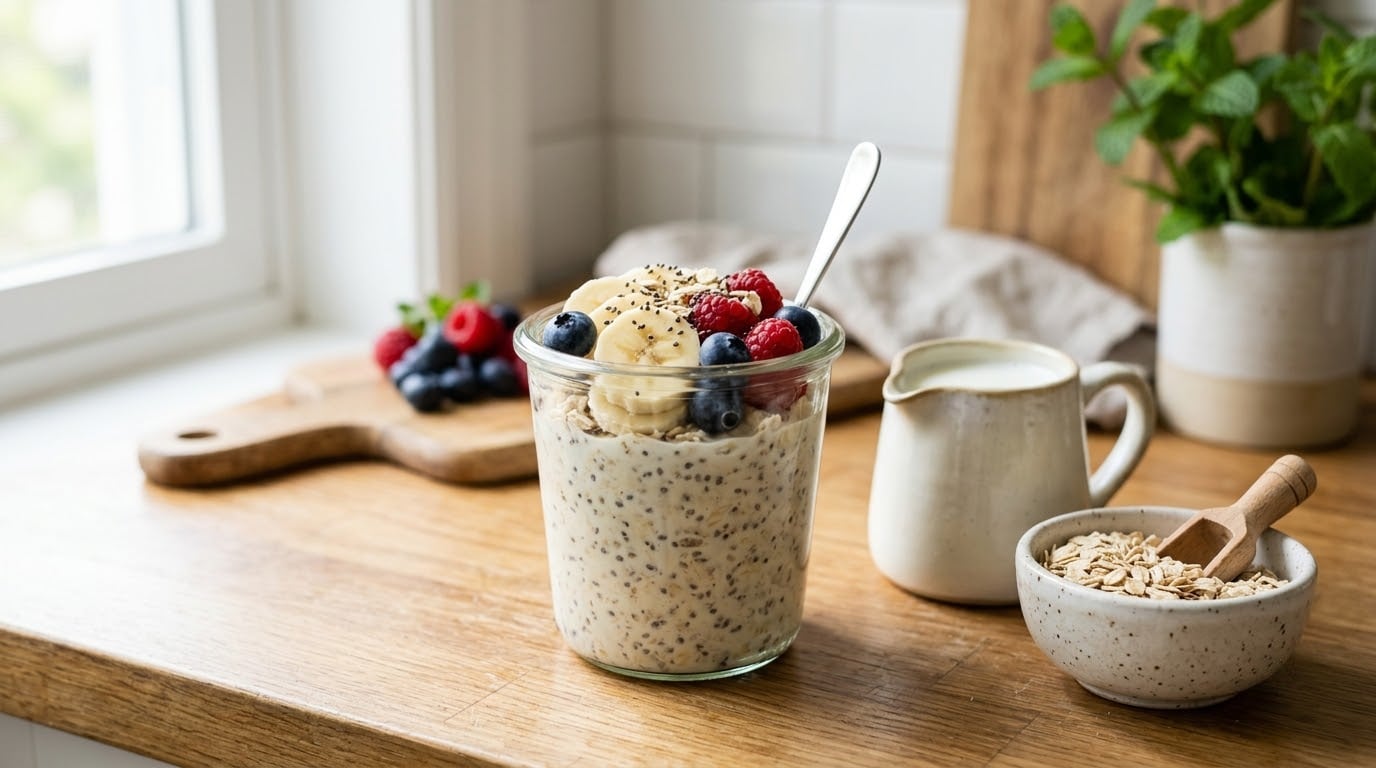
Overnight oats work with either water or milk, and the choice is entirely about the texture and nutrition you want. Water gives you a lighter, dairy-free bowl that costs almost nothing per serving, while milk adds creaminess, protein and a rounder flavor. To make overnight oats with water or milk, you combine half a cup of rolled oats with an equal amount of liquid, stir, and refrigerate for at least four hours. Five minutes of work the night before, breakfast handled.
The one detail that trips people up is ratio. Too much liquid and you get something closer to cold porridge soup, too little and the oats are still chewy at breakfast. Once you know which ratio matches the oats you keep in the cupboard, the rest is easy.
Table of Contents
- What You Need
- Step-by-Step: How to Make Overnight Oats with Water or Milk
- Common Mistakes
- Frequently Asked Questions
- What is the best ratio of oats to water or milk for overnight oats?
- Can I use almond milk or oat milk instead of dairy milk?
- How can I add more protein to overnight oats without using a supplement?
- Can I eat overnight oats without fruit or other toppings?
- How long should overnight oats chill before eating?
- How long do overnight oats stay safe in the refrigerator?
- Conclusion
What You Need
For one serving you need half a cup of rolled oats, half a cup of liquid, a jar or container with a lid, and whatever you want on top. That is the whole recipe. The rest is adjustment.
Old-fashioned rolled oats are the best choice here. They hold their shape, drink up liquid evenly and soften to a creamy but still textured bite after a night in the fridge. Quick-cooking oats work too, but they break down faster and turn pasty if you soak them more than a few hours, so cut the liquid by a tablespoon or two when you use them. Steel-cut oats are a different food entirely; they are whole oat groats cut rather than rolled, and a night in the fridge will barely touch them. If you like steel-cut, cook them on the stovetop first and then soak the cooked grains, or check our guide to making steel cut oats faster for a shortcut.
Optional add-ins change the character of the bowl. Greek yogurt or any thick plant yogurt gives creaminess and holds the mixture together. Chia seeds or ground flaxseed thicken the liquid and add fiber, and they form a gel that keeps water-based oats from separating. Nut butter, vanilla extract, cinnamon, maple syrup or honey handle sweetness and flavor. A spoonful of cocoa powder works as both a flavor and a thickener.
On ratios, there are two that cover almost everything:
- 1:1 is the standard: half a cup oats to half a cup liquid. It sets into a thick, spoonable bowl.
- 2:1 is looser: half a cup oats to a full cup liquid. It is thinner, and it works well if you plan to top it with something bulky or stir in extra liquid at breakfast.
Users in cooking forums settle on a range. Some soak at 1:2, meaning twice as much water as oats, for a very loose mix, and others use 2:1 liquid to oats so they can add hot water at the fridge in the morning and eat it right away. Start at 1:1 and adjust from there.
Step-by-Step: How to Make Overnight Oats with Water or Milk
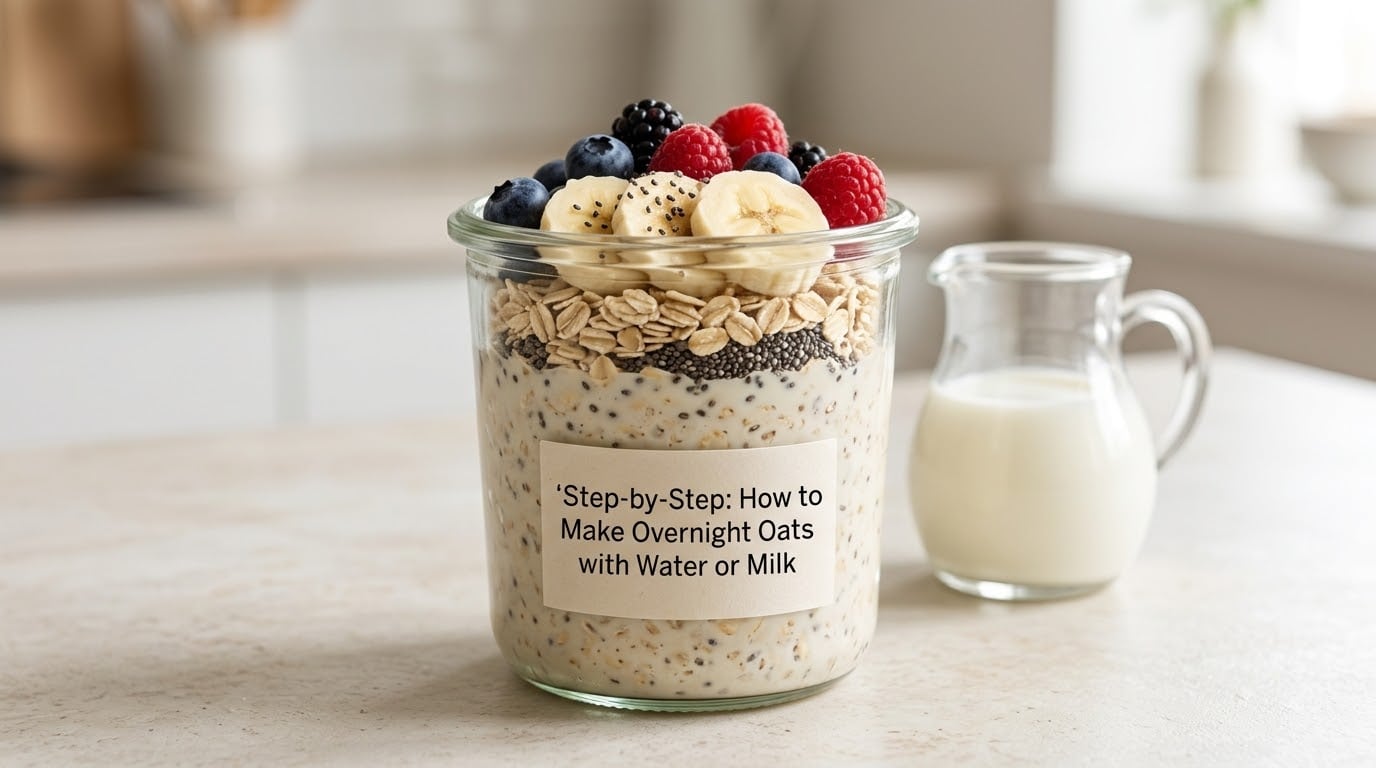
Choose Water or Milk for the Texture You Want
Use water for a light, clean-tasting base that keeps the oat flavor front and center, or milk when you want something rich enough to eat with a spoon and nothing else.
Dairy milk is the creamiest option and the most protein-forward. Two percent is the all-purpose choice because the small amount of fat keeps the mixture from feeling watery without turning it heavy. Any unsweetened plant milk works too, and oat milk is the closest dairy match in texture since it is made from oats. If you make your own, our piece on fixing slimy oat milk is worth reading first. Soy milk is the highest-protein plant option, and almond milk is the lightest but thinnest, so use a splash less of it or the bowl will taste thin.
The reason water-based oats often disappoint is not the water, it is the missing fat and protein. Add one of these and the same recipe works: two tablespoons of Greek yogurt, a tablespoon of nut butter, a tablespoon of chia seeds with five extra minutes of chilling, or a scoop of protein powder plus two tablespoons of extra water to replace what the powder drinks up.
A hybrid is the compromise worth knowing about. Half water and half milk gives you most of the creaminess of milk at half the fat, and it is a common fix for people who like the body of dairy but want it lighter. A popular version in home cooking forums is half a cup Greek yogurt, half a cup water and a third of a cup of oats, stirred together with a scoop of protein powder or peanut butter powder.
Mix the Oats and Liquid
Put half a cup of rolled oats in a jar first, then pour the liquid over it rather than stirring them together dry. Liquid poured onto oats wets the surface evenly and helps prevent dry pockets and clumps.
Stir until the oats are fully submerged and no dry flour-like dust clings to the sides of the jar. Scrape the bottom down, because rolled oats settle fast, and make sure nothing is floating in a dry raft. Stirring for a full twenty seconds is worth it.
If you are adding protein powder, cocoa powder, PB2 or nut butter, mix those with the liquid first and let them sit for a minute before the oats go in. Dry powders dumped on top of oats clump and leave bitter streaks. Any of these also drink up extra liquid, so add a tablespoon of water per scoop or tablespoon of powder.
Ordinary rolled oats need a full night, at least eight hours, to soften properly. Quick oats only need about four, and soaking them longer pushes them into mush, which is the single most common complaint about overnight oats.
Chill Until the Oats Are Creamy
Seal the jar and refrigerate it. A glass mason jar works, but any container with a tight lid does the job, and a wide-mouth jar makes stirring easier in the morning. Leave at least half the jar’s volume of room since the oats swell as they absorb liquid.
Four hours is the minimum, most nights give you eight to twelve, and there is no harm in a longer soak. Just keep quick oats out of the long-soak category.
You know they are ready when the mixture holds a spoon upright for a second when you pull it out, and the oats bend without a hard bite in the center. The test is simple: tilt the jar. If the surface slides as one mass, it is set. If it runs like a thin liquid, give it more time or add oats.
Water-based oats often separate overnight, leaving a thin layer on top and a dense layer at the bottom. The fix takes five minutes the next morning. Shake the closed jar hard for thirty seconds, let it sit for five minutes, then stir for twenty seconds. The oats redistribute and the mix goes creamy again.
Add Toppings and Serve
Keep fresh fruit, crunchy items and wet ingredients out of the jar until you are about to eat. Fruit and yogurt release water and turn the oats to mush if they sit overnight, and anything crisp goes soft.
A few combinations work well. The simple version is banana slices and a spoon of peanut butter stirred through. The creamy version is a scoop of Greek yogurt, a handful of berries and a drizzle of maple or honey. For more fiber, add a tablespoon of chia seeds, a tablespoon of ground flaxseed and a small handful of chopped walnuts, which also adds crunch. The naturally sweet route is diced apple with cinnamon and a spoonful of almond butter, no added syrup at all.
Eat it cold straight from the jar, or warm a portion in the microwave for a minute with a splash of milk or water to loosen it. Some people prefer it loose and drinkable, and adding hot water at breakfast to a 2:1 batch does exactly that. For a kid who turns up her nose at plain oats, blend half a portion and serve it like a smoothie, using our smoothie ideas that kids actually drink for the base.
Common Mistakes
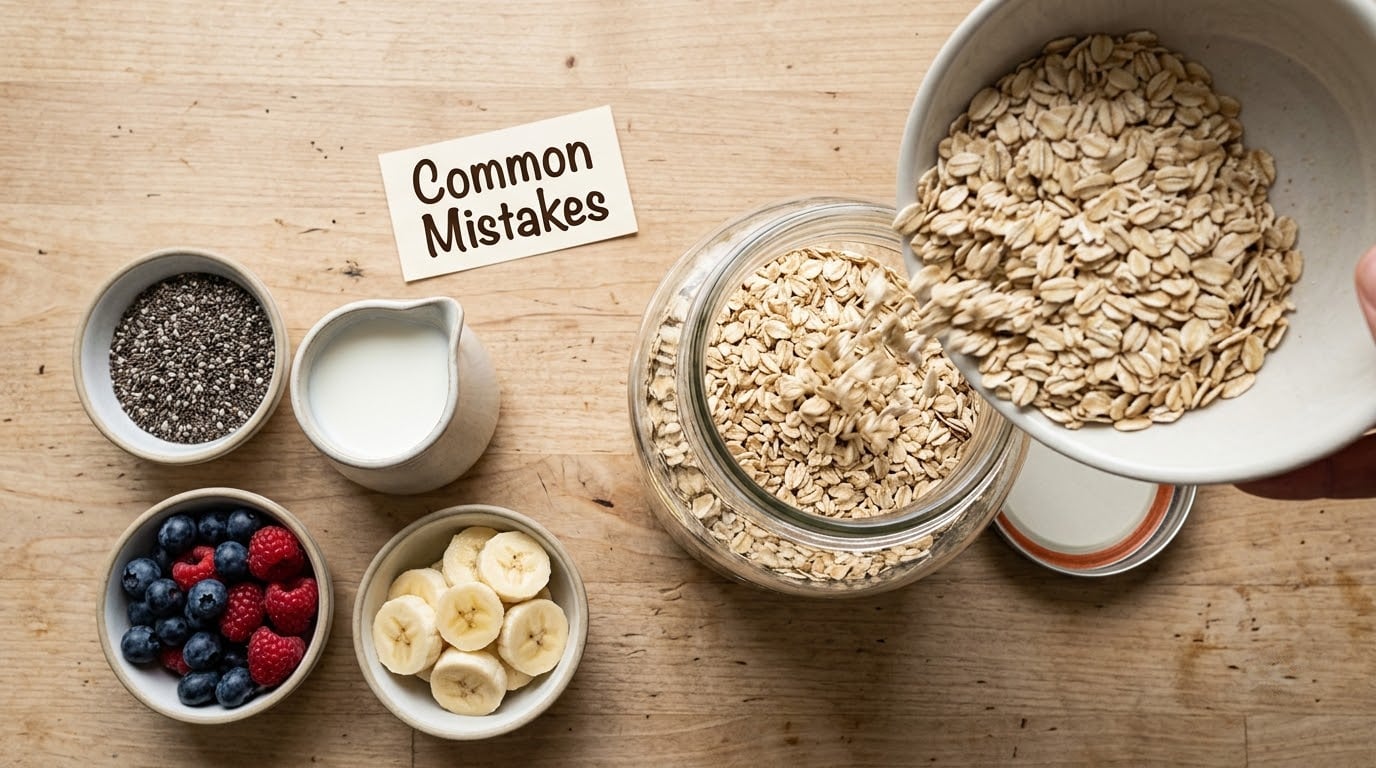
Most disappointing overnight oats come down to ratio, oat type or how the batch was handled the night before. Each problem has a direct fix.
The oats are watery and thin. You used too much liquid for the oat type, or you used steel-cut and quick oats together. Next time measure one part oats to one part liquid and use rolled oats. If a batch is already thin, stir in two tablespoons of rolled oats and let it sit for thirty minutes, or add a tablespoon of chia seeds and give it an hour.
The oats are too firm at breakfast. The soak was too short, or the jar was too full, so the oats could not swell. Give it another two hours in the fridge, or add two tablespoons of hot water and stir. Steel-cut oats will not fix themselves this way; they need cooking first.
The mixture is clumpy or powdery. The oats went into the liquid dry, or the liquid was poured on top of something powdery without mixing. Wet the powder with the liquid first, then stir the oats in gradually.
Water-based oats taste bland. Water carries no flavor of its own, so it needs more seasoning than milk does. A teaspoon of vanilla, half a teaspoon of cinnamon, a pinch of salt and a spoonful of nut butter or yogurt will fix it. A pinch of salt sounds small but it does more for a bowl of oats than anything else you can add.
The batch separated overnight. A thin layer sits on top of dense oats at the bottom. Shake, rest and stir as described above. Adding a tablespoon of chia seeds or a spoonful of yogurt to the base prevents it in the first place, because both thicken the liquid enough to hold oats in suspension.
The oats turned to paste. You used quick-cooking oats and soaked them too long, or you stirred in a large amount of banana or other soft fruit hours ahead. Use rolled oats and add soft fruit at serving time.
The toppings went soggy. Anything crunchy added the night before will be soft by morning. Store granola, nuts, seeds and fruit separately and add them in the morning. The only things that belong in the jar overnight are oats, liquid, spices and things that thicken.
Two habits cover most of these. Measure the liquid with the same cup you measured the oats in, and always stir the mixture again right before eating it.
Frequently Asked Questions
What is the best ratio of oats to water or milk for overnight oats?
Half a cup of oats to half a cup of liquid, or 1:1, is the most reliable starting point for rolled oats. It sets overnight into a thick, spoonable bowl. Use 2:1 when you want a looser mix you can thin further at breakfast or top with something bulky. Quick-cooking oats absorb faster, so drop the liquid by a tablespoon or two. Steel-cut oats need a much longer soak and usually need cooking first.
Can I use almond milk or oat milk instead of dairy milk?
Yes, and both work well. Almond milk is the lightest option, so it gives a thinner bowl and less protein than dairy. Oat milk is the closest dairy substitute in texture and creaminess because it is made from oats, and unsweetened versions are what you want here. Soy milk has the most protein of the common plant milks. Check that the label says unsweetened, since flavored versions will make the batch far sweeter.
How can I add more protein to overnight oats without using a supplement?
Greek yogurt is the easiest route: two tablespoons folded into the liquid adds protein and thickens the bowl at the same time. A tablespoon of nut butter, a handful of hemp seeds or a scoop of powdered peanut butter also work. Dairy milk and soy milk carry more protein than water or almond milk, so switching the base liquid helps. If you do use protein powder, add a tablespoon of extra water per scoop to replace what the powder absorbs.
Can I eat overnight oats without fruit or other toppings?
You can, and plenty of people do. The base of oats and liquid is a complete breakfast on its own, roughly 150 to 200 calories depending on the liquid. Without toppings the bowl is milder, so a little cinnamon, vanilla or a pinch of salt helps. If you want more staying power rather than flavor, add something with fat and fiber such as nut butter, chia seeds or ground flaxseed, which also keeps the mixture from separating.
How long should overnight oats chill before eating?
At least four hours, and ideally eight to twelve. Rolled oats need a full night to soften all the way through, while quick-cooking oats only need about four hours and turn pasty if soaked longer. You can leave a batch for up to four days and it will still be fine. Two hours is not enough with rolled oats, and the centers usually still have a hard bite at that point.
How long do overnight oats stay safe in the refrigerator?
Keep them refrigerated in a sealed container and eat within four days, with the first three days being the best texture. Because there is no cooking step, treat the batch like any other cooked-and-cooled food and do not leave it on the counter for more than two hours. If you make a large batch, freeze single portions rather than the whole jar, and thaw in the refrigerator overnight.
Conclusion
Making overnight oats with water or milk comes down to three things: half a cup of rolled oats, an equal amount of liquid, and a night in the fridge. Water keeps it light, dairy-free and cheap, while milk gives you creaminess and more protein. A 50/50 mix of the two is the middle ground, and adding a spoonful of yogurt, nut butter or chia seeds makes the water version work just as well as the milk version.
For your first batch, use equal parts oats and liquid with rolled oats, then add your toppings in the morning. Once you have eaten it, adjust the ratio one step at a time based on whether you wanted it thicker or looser, and that is the whole recipe.