
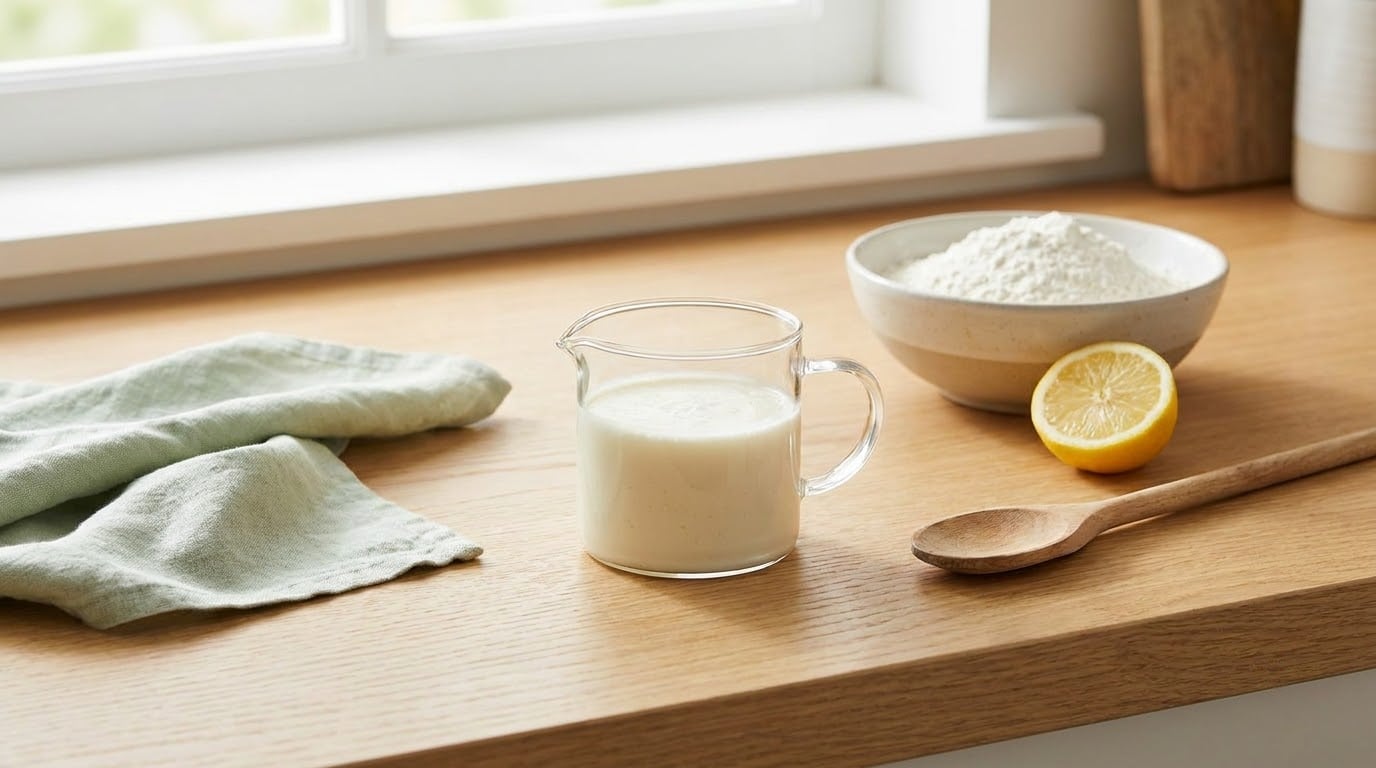
To make vegan buttermilk for baking, stir 1 tablespoon of apple cider vinegar or lemon juice into 1 cup (240 ml) of unsweetened plant milk, let it stand for 5 to 10 minutes until it thickens, then use it cup for cup wherever a recipe calls for buttermilk. It takes about five minutes and one bowl.
The acid is the whole trick. It does the job cultured dairy buttermilk would do in a batter, which means your pancakes, muffins, biscuits and quick breads still rise and stay tender even though there is no dairy and no egg doing the structural work.
Table of Contents
- What You Need
- Step-by-Step: How to Make Vegan Buttermilk for Baking
- Common Mistakes
- Baking Tips and Easy Substitutions
- Frequently Asked Questions
- Can I make vegan buttermilk without vinegar?
- Which plant milk is best for vegan buttermilk?
- How much vinegar or lemon juice should I add to plant milk?
- Does homemade vegan buttermilk need to be refrigerated before using?
- Can I use almond milk instead of buttermilk in baking?
- Will vegan buttermilk make baked goods rise properly?
- Conclusion
What You Need
Two ingredients, one of them optional. Everything else is equipment.
- 1 cup (240 ml) unsweetened, unflavoured plant milk. Soy is the strongest all-rounder. Oat works well if you avoid soy.
- 1 tablespoon acid. Apple cider vinegar for a neutral flavour, lemon juice for a slightly brighter one. Distilled white vinegar is the mildest option.
- A small bowl, jar or measuring jug with room to stir without spilling.
- A spoon or whisk for the initial mix.
Skip the vanilla and chocolate varieties. Vanilla unsweetened soy milk actually works well and adds a subtle flavour, but sweetened or flavoured milk carries sugar into the batter and throws off the recipe’s ratios.
For soy-free baking use oat or almond milk. For nut-free baking, use soy, oat or pea milk, all of which are sold without tree nuts in the ingredient line.
Step-by-Step: How to Make Vegan Buttermilk for Baking
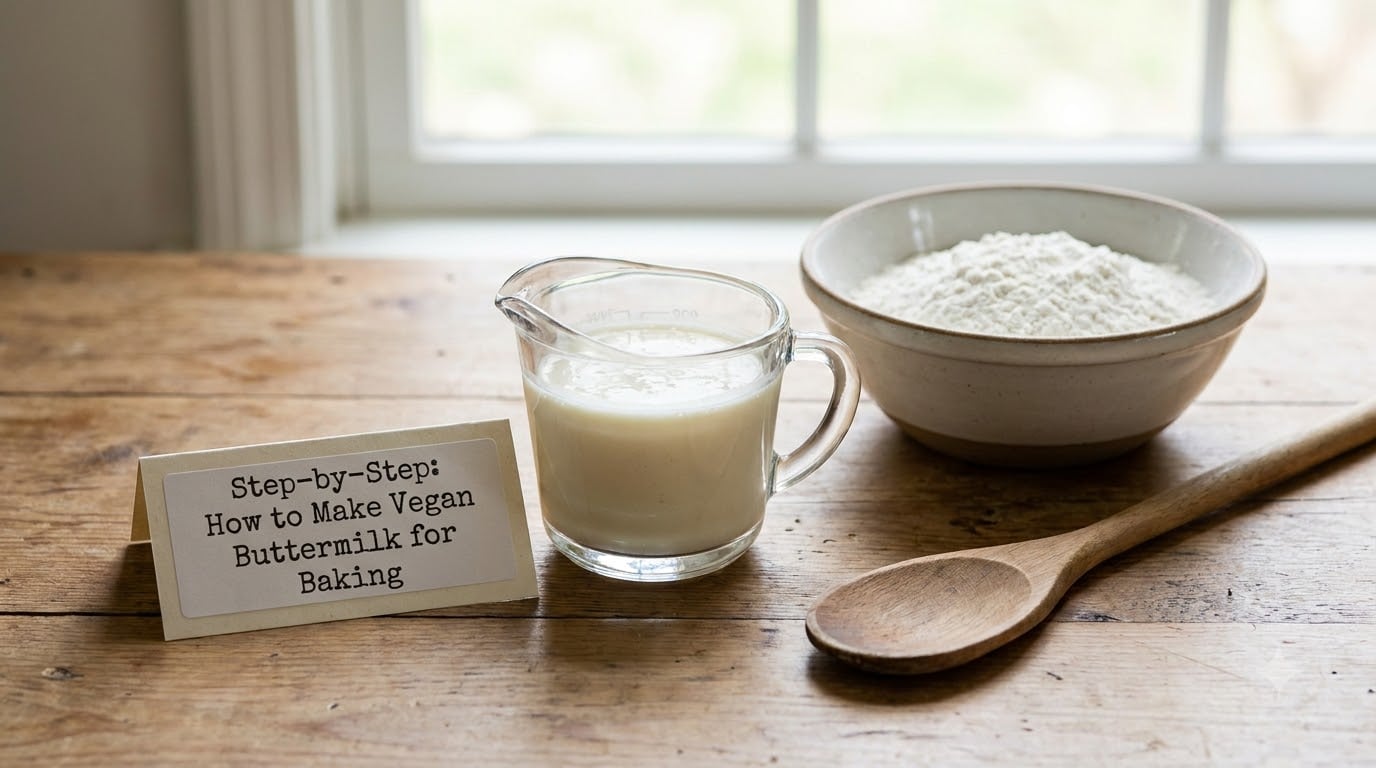
Pour the acid into your bowl or measuring jug first, then add the milk up to the 1 cup line. That order matters, because it saves you from under-measuring the acid and pouring out the excess.
Whisk or stir until the milk looks evenly cloudy with no streaks of undiluted vinegar at the bottom.
Leave it on the counter for 5 to 10 minutes. You will see it thicken, separate slightly, and develop fine white flecks or a soft curd. That is the reaction you want, and it is not a sign of spoilage.
Give it a quick stir or a shake and use it straight away. The mixture goes in cup for cup: one cup of vegan buttermilk replaces one cup of dairy buttermilk with no adjustment to the rest of the recipe.
Do not strain out the curds. They carry most of the flavour and body, and readers baking for a dairy-allergic household are advised to use the whole mixture, curds included.
How to Choose the Best Plant Milk
Milk choice decides how well the mixture thickens and how much it flavours the bake. Here is where each one lands.
| Plant milk | How it curdles | Flavour effect | Best for |
|---|---|---|---|
| Unsweetened soy | Strong, reliable curdle | Neutral, closest to dairy | Everything, especially cakes and red velvet |
| Oat | Moderate curdle | Slightly creamy, neutral | Soy-free bakes, pancakes, waffles |
| Almond | Mild curdle, varies by brand | Lightly nutty | Muffins and quick breads |
| Cashew | Light curdle | Creamy and mild | Cakes where you want body over tang |
| Coconut | Will not curdle | None if unsweetened | Still works as an acid base for baking soda bakes |
| Pea | Weak curdle | Neutral, slight earthiness | Nut-free and soy-free baking |
Coconut milk not curdling is completely fine. It is mostly fat with very little protein to break, so it stays smooth, but the acid still activates the baking soda and the bake still rises.
Brand matters more than most guides admit. Readers report that Silk soy milk comes out thick and creamy, almost like whipped cream, while some store-brand almond milks barely react at all. If your preferred milk sits flat after ten minutes, it will still work, it just will not thicken.
Oat milk is easy to make at home too, and if yours turns out slimy there is a fix for that in how to make oat milk that is not slimy.
Using Vinegar or Lemon Juice
One tablespoon of acid per cup is the standard measure. Both work at 1:1, so you can swap them without recalculating anything.
| Acid | Taste | Strength | Notes |
|---|---|---|---|
| Lemon juice | Bright, clean | Medium | Best in vanilla and yellow cakes |
| Apple cider vinegar | Mildly tangy | Medium | The everyday pick, very forgiving |
| White wine vinegar | Light and sharp | Medium | Clean finish, no fruit note |
| White vinegar | Sharper | Strong | Fine in biscuits, noticeable in cakes |
| Distilled white vinegar | Nearly neutral | Strong | The safest choice for delicate bakes |
Any vinegar works because the baking soda masks the acidity in the finished bake. The fear of a vinegary aftertaste is the most common one people have, and in practice it does not happen at one tablespoon per cup.
How Thick Should Vegan Buttermilk Be?
Think pourable cream, not yoghurt. It should coat the back of a spoon lightly and look slightly separated, with soft lumps you can stir back in.
If you over-acidified it, add a splash more plain plant milk until it loosens. If you need it thinner for a cake batter, extra milk helps; if a biscuit dough feels too wet, that is usually a flour measurement problem rather than a buttermilk one.
Do not try to build thickness into it yourself. Aiming for a yoghurt-like mix means you over-acidify, and the bake picks up a sharp note it should not have.
How Long Does Vegan Buttermilk Last?
Use it within the same sitting, or refrigerate it covered for up to 3 days. That figure is the safe one, and it settles the conflicting advice you will find elsewhere, where two to three days sits next to a full week.
Keep it in a jar or any airtight container so the acid aroma does not settle into everything else on the shelf. Give it a shake before pouring, because the curds settle at the bottom.
For longer storage, freeze it in an ice cube tray and move the frozen cubes to a bag. Portions of about 2 tablespoons thaw in the fridge in an hour or so and drop straight into a batter. Make a fresh batch when you can, though, since the flavour is cleaner.
To scale up for a recipe that wants two or three cups, keep the ratio at 1 tablespoon per cup. Six cups needs six tablespoons of acid, and nothing else changes.
| Amount needed | Plant milk | Acid |
|---|---|---|
| 1 cup (240 ml) | 1 cup | 1 tablespoon |
| 2 cups (480 ml) | 2 cups | 2 tablespoons |
| 4 cups (960 ml) | 4 cups | 1/4 cup |
| 8 cups (1.9 L) | 8 cups | 1/2 cup |
Common Mistakes
Using sweetened or flavoured plant milk. The sugar is already in your batter, so the bake comes out sweet when the recipe did not ask for it. Reach for the plain unsweetened carton.
Adding too much acid. Going beyond one tablespoon per cup is the fastest way to a sour bake, and it is not something you can fix later. If you are unsure, measure the tablespoon rather than pouring from the bottle.
Not letting it rest. Using it straight away means the acid has not had time to shift the pH of the milk. Give it the full 5 to 10 minutes. If the milk shows no thickening at all after ten minutes, that is usually the milk, not the timing.
Expecting every plant milk to curdle. Coconut will not, and neither will some brands of almond milk. Lack of curds is not failure. The acid still does its chemical job in the bowl.
Adding extra baking soda to compensate. You do not need more leavening. A small pinch of baking soda in a recipe that calls for none is acceptable because the acid is doing that part already.
Skipping the stir or straining out the curds. Unmixed acid pools at the bottom of the jug, and discarded curds take the body of the mixture with them. Stir it, then use it whole.
Baking Tips and Easy Substitutions
Vegan buttermilk is most useful in anything leavened with baking soda. That means pancakes, waffles, biscuits, muffins, quick breads, cornbread, soda bread and red velvet cake, all of which improve with it.
For a thicker, tangier result in pancakes and waffles, let the mixture sit for the full ten minutes and use oat or cashew milk. For cakes and cupcakes where you want a tender crumb without a sharp edge, use distilled vinegar and soy milk.
It works outside baking too. A cup of vegan buttermilk works as a marinade base for fried chicken, thinned into a dressing with herbs, and seasoned it does a solid job as a ranch-style dip. Pairing it with a savoury recipe built on broth, like a vegetable broth from kitchen scraps, is a good way to stretch the same batch.
If you want to skip the acid entirely, unsweetened plant yoghurt thinned with a splash of water is the closest single-ingredient swap. It is thicker and more sour, so use it one to one in breads and dressings rather than cakes.
Dried vegan buttermilk powder exists on the market and lasts for months, which makes it the practical pick for someone who bakes a lot and does not want a five-minute wait every time. Homemade is fresher, cheaper per cup, and you control the milk.
Frequently Asked Questions
Can I make vegan buttermilk without vinegar?
Yes. Lemon juice does the same job at one tablespoon per cup and is the most common swap. You can also use unsweetened plant yoghurt thinned with water, though it is thicker and sharper, so it suits breads and dressings better than cakes.
Which plant milk is best for vegan buttermilk?
Unsweetened soy milk gives the most reliable curdle and the most neutral flavour, so it is the safest default. Oat is the best soy-free option. Almond curdles mildly and varies by brand, coconut will not curdle at all but still works as an acid base.
How much vinegar or lemon juice should I add to plant milk?
One tablespoon per cup (240 ml) of plant milk, then rest for 5 to 10 minutes at room temperature. The ratio scales directly: two tablespoons for two cups, a quarter cup for four, half a cup for eight. Avoid going over, since extra acid is what makes a bake sour.
Does homemade vegan buttermilk need to be refrigerated before using?
No, if you use it within an hour or two of mixing. For longer, cover it and refrigerate for up to 3 days, then shake or stir before pouring. Frozen in an ice cube tray it keeps for a few months, though a fresh batch always tastes better in the finished bake.
Can I use almond milk instead of buttermilk in baking?
You can make vegan buttermilk from almond milk, but it curdles more mildly than soy, and some brands barely react. Plain almond milk on its own is not a real substitute, because it is not acidic and will not activate baking soda, which leaves the bake dense.
Will vegan buttermilk make baked goods rise properly?
Yes. The acid lowers the pH of the milk and activates the baking soda or baking powder, releasing carbon dioxide that gives the batter its lift. Vegan bakes lean harder on leavening since there are no eggs, so a properly acidified buttermilk matters more here, not less.
Conclusion
Start with one cup of unsweetened soy milk and one tablespoon of apple cider vinegar, stir, wait five to ten minutes, and use it exactly where the recipe called for buttermilk. From there, swap in lemon juice for a brighter flavour or oat milk if you avoid soy.
If nothing thickens, carry on anyway. The acid still activates your leavening, and a flat-looking cup of vegan buttermilk is a working cup of vegan buttermilk.