
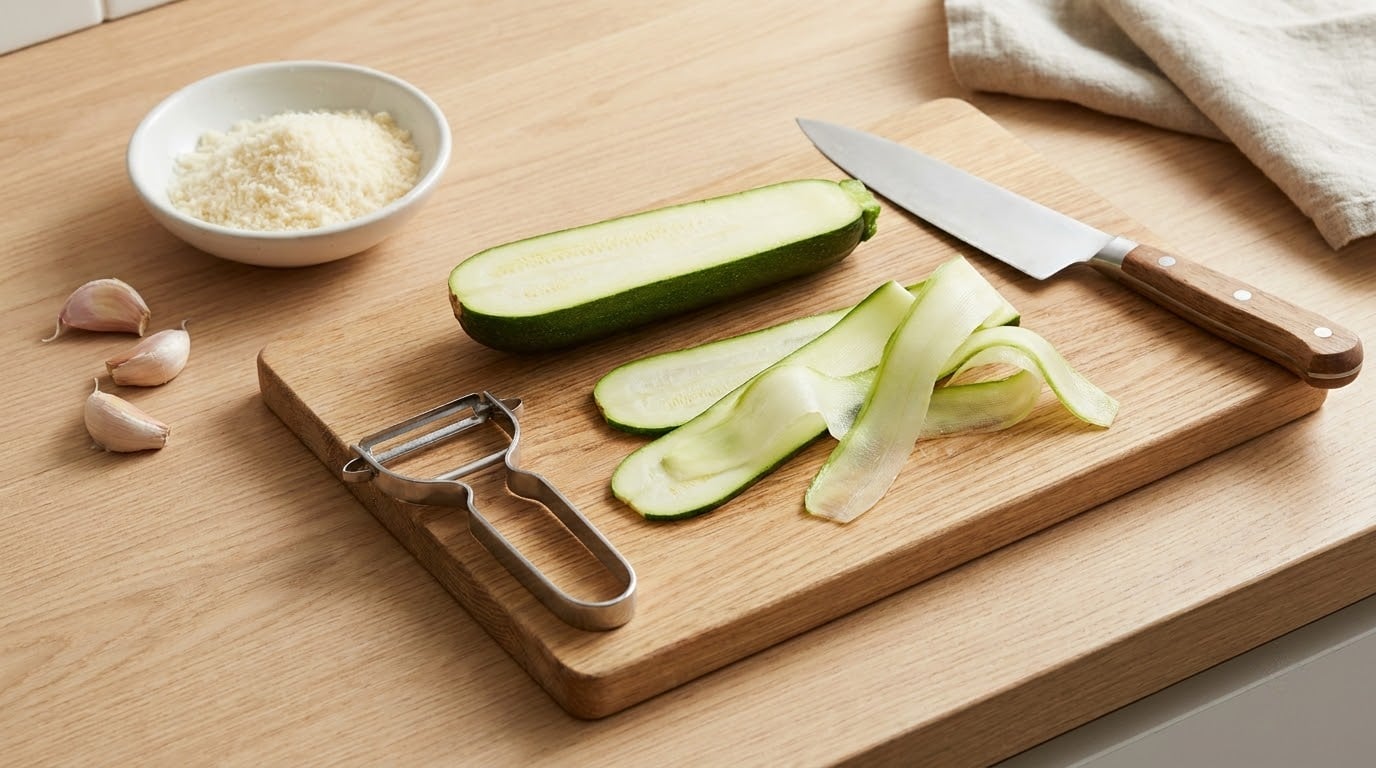
Zucchini noodles are quick to make with a vegetable peeler, a sharp knife, or even a blender. A peeler gives you wide ribbons in about five minutes, a knife gives you the most control, and a blender works if you pulse it in short bursts. No spiralizer, no special attachment, no new equipment.
Zucchini is roughly 95 percent water, which is exactly why it makes convincing pasta and exactly why it turns into a puddle if you let it sit in a hot pan too long. Everything below comes down to cutting thin and moving fast.
If you’re trying to eat more vegetables without cooking every night, these noodles fit well into that plan. They take about the same amount of time as boiling pasta, and the pan cleans itself while you eat.
Table of Contents
- What You Need
- How to Make Zucchini Noodles Without a Spiralizer: Step by Step
- Frequently Asked Questions
- How do you make zucchini noodles without a spiralizer?
- What is the easiest tool to use for zucchini noodles?
- Are zucchini noodles better with a peeler or a knife?
- How do you keep zucchini noodles from getting watery?
- Can a blender make zucchini noodles without turning them into puree?
- How long can leftover zucchini noodles be stored?
- Conclusion
What You Need
You need one medium zucchini, a cutting board, and whatever tool from the list below already lives in your drawer. Medium is the right size here — the extra-large ones are watery and seedy through the middle, and small ones give you not enough noodle to work with.
Look for zucchini that feels heavy for its size, has smooth skin with no soft spots, and is firm at both ends. Two medium zucchini will feed two people as a side, or one hungry person as the whole meal.
Trim both ends off with a sharp knife and stand the zucchini upright. That’s the only cutting you have to do before you pick a method.
Your four options, in order of how much they ask of you:
- Vegetable peeler — the easiest starting point, zero skill required. If it has a julienne blade, mount it and you get thin matchsticks in one pass.
- Chef’s knife — the most control over width and texture. Slower, but this is the one that looks most like real pasta.
- Blender — fastest for large batches, and the easiest way to get restaurant-style strands, provided you pulse rather than blend.
- Box grater or mandoline — worth mentioning for volume, though the grater side shreds the zucchini into pulp rather than noodles, and a mandoline needs its safety guard on.
How to Make Zucchini Noodles Without a Spiralizer: Step by Step
Every method starts the same way: trim the ends, then decide whether to salt. Salting is optional, but it’s the single biggest upgrade if your noodles tend to go watery.
Cut the zucchini lengthwise in half, sprinkle the cut faces with a pinch of kosher salt, and leave them cut-side down on a colander for 10 to 20 minutes. You’ll see liquid pooling underneath. Blot the halves with a paper towel before cutting and you’ll notice the difference in the pan later.
Then pick your method.
How to Make Zucchini Noodles with a Vegetable Peeler
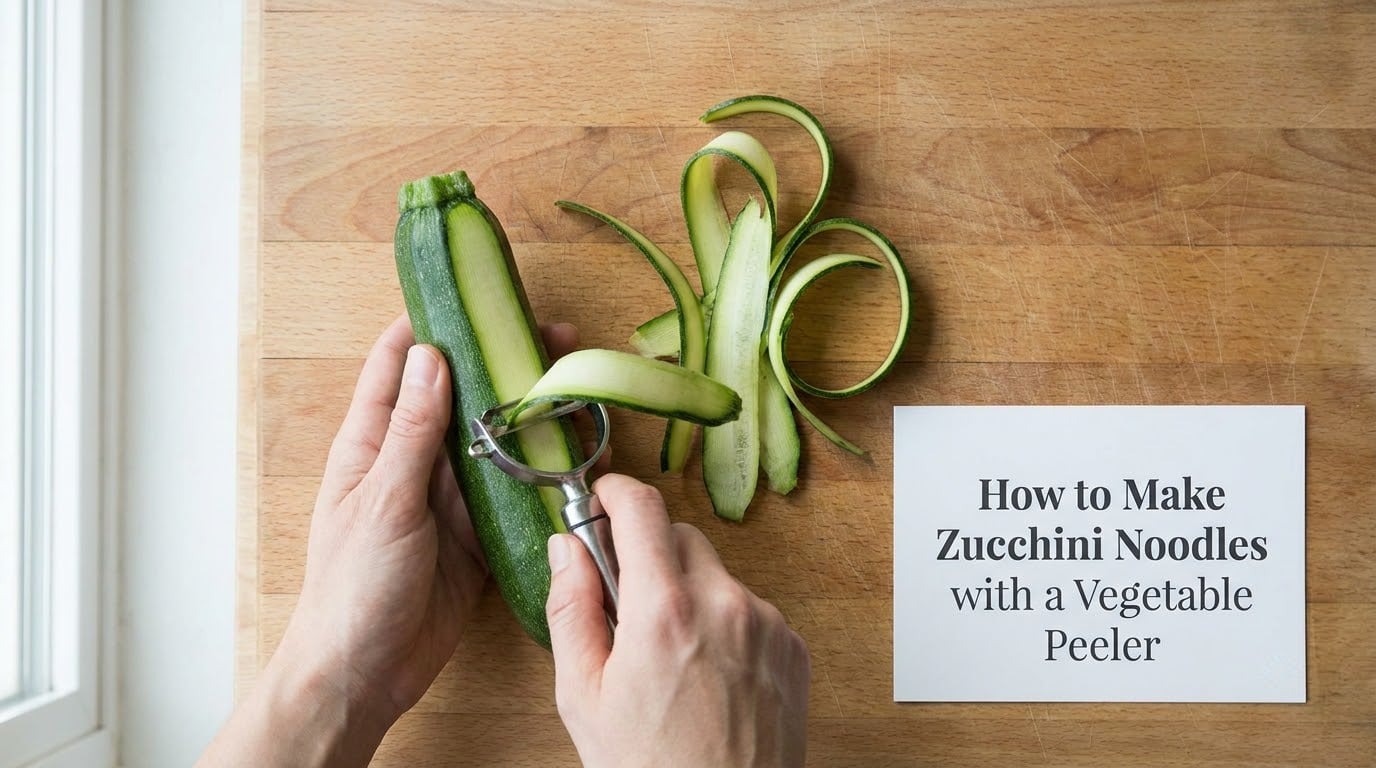
Hold the zucchini on its narrow end and pull the peeler toward you in one long stroke. Rotate it a quarter turn and pull again, overlapping the strips slightly so you don’t waste any flesh.
Keep going until you reach the seedy center and the core becomes too small to grip safely. Stop there. The middle is where most of the water and the bitterness live, and it’s fine to leave a thumb-sized core on the cutting board.
What you end up with is ribbon-like, closer to lasagna fettuccine than to spaghetti. That’s the honest trade-off with the peeler: it’s fast, but the strips run wide, usually a quarter inch or more.
For narrower noodles, flip the peeler to its julienne blade. Two passes per side gives you matchstick-width strands that behave much more like pasta in a bowl.
How to Cut Zucchini Noodles with a Knife
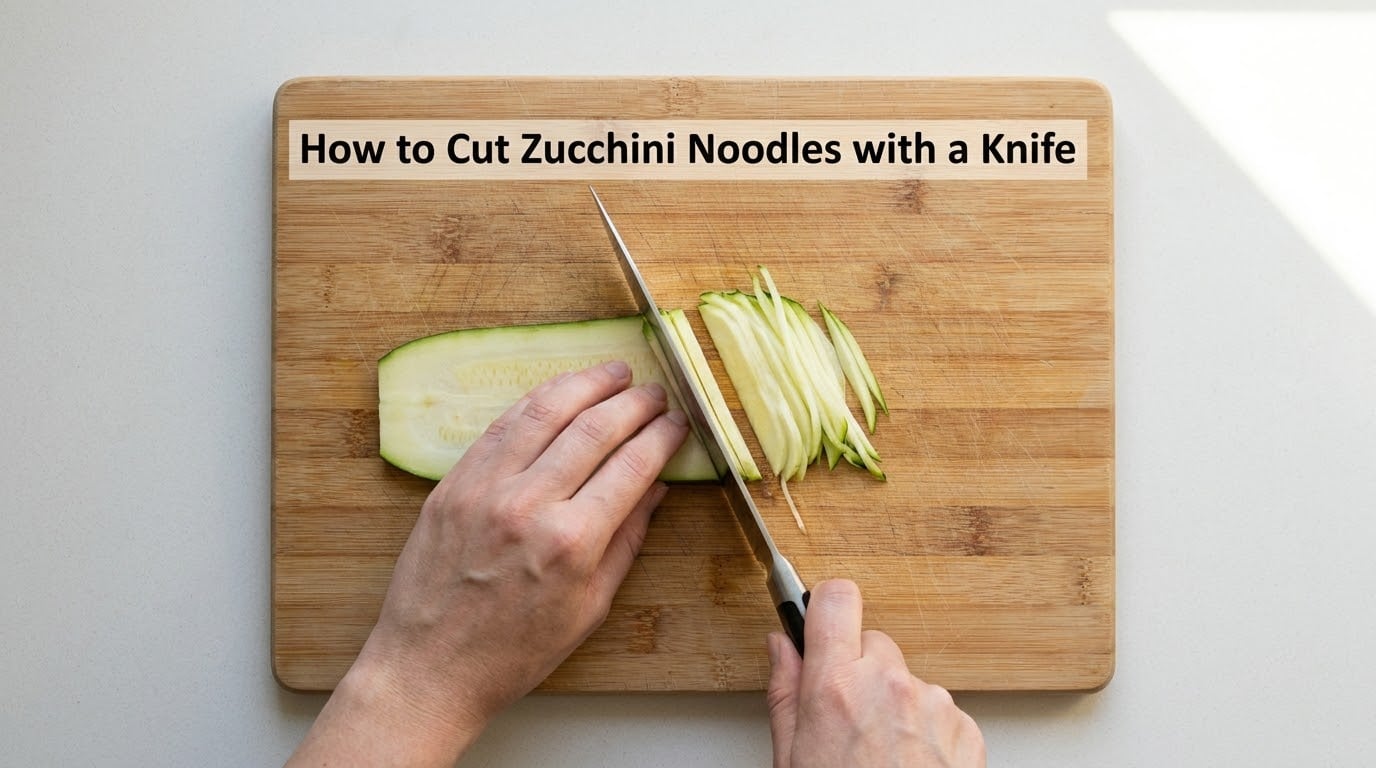
Cut the zucchini lengthwise into planks about a quarter inch thick, slicing right down the center first and then working outward. Wider planks are easier and safer to handle than thin ones.
Set a plank flat-side down on the board. Keeping your fingertips curled back and your knuckles riding on top of the blade’s spine, make long thin cuts along the plank to get strips about an eighth inch wide.
Rotate the strips 90 degrees and repeat to get the length you want. That’s your julienne, and the width you cut is the width of your noodle — cut a quarter inch and you have a flat ribbon, cut an eighth and you have something close to linguine.
Cut away from your fingertips every time. Zucchini skin slips, so if you’re dicing close to your hand, slow down and use a taller blade if you have one.
If you have a julienne peeler, a mandoline, or even a cheap accordion-style plastic slicer, all three do this same job faster. The knife is what gives you width control without another drawer to buy from.
How to Make Zucchini Noodles with a Blender
Cut the zucchini into one-inch chunks. Don’t overthink the size here — the blender is the tool that fixes inconsistency, not the tool that needs careful prep.
Add about two cups of chunks to a high-speed blender with a cup of water and blend on low, pulsing in one- to two-second bursts. You’re watching for strands to separate from each other, not for a smooth sauce.
As soon as you see strands pulling away from the mass, stop. Pour the mixture into a colander and press it with the back of a spoon to push the water out. Repeat with the remaining zucchini in small batches.
Why small batches? A full blender of zucchini has nowhere to go. It hits the blades, the air can’t move through it, and 20 seconds later you have warm zucchini purée with no structure left.
If you already own a blender you use for smoothies, cleaning the pitcher afterward is straightforward — here’s how to clean a blender without taking it apart — but be aware that the blade is the part that needs a brush and a bit of care.
If your blender is a low-powered stick model, the result is usually too soft to work. Stop at the halfway point and switch to the peeler method.
How to Season and Serve Zucchini Noodles
Heat olive oil in a skillet over medium-high. Add the noodles in a single layer and leave them alone for the first 30 seconds so they get some color.
Toss and cook for 1 to 2 minutes total, no longer. Then take the pan off the heat and season while the noodles are still hot — garlic, black pepper, a squeeze of lemon, and a handful of grated Parmesan or nutritional yeast. Parmesan and nutritional yeast both add salt and umami, so taste before you add more.
Other finishing options that work the same way: a ladle of marinara or pesto stirred through in the pan, a spoonful of peanut sauce for something Asian-style, or no heat at all. Cold ribbons with a drizzle of olive oil, lemon, and flaky salt are excellent for a salad.
The whole plate takes about five minutes from cutting board to table.
Common Mistakes to Avoid
Ribbons that are too wide. Wide peeler strips can’t hold sauce and collapse under anything heavier than a salad. Fix it by cutting the strips in half lengthwise after peeling, or switch to a julienne blade.
Watery noodles. Salt and drain for 10 to 20 minutes, blot with a paper towel, and cook in a hot pan rather than a cold one. Moisture releases all at once in a cold pan; a hot pan sears the outside before the inside can steam.
Uneven cutting. Nearly always means one piece was bigger than the others when you started. Make your planks the same thickness and finish one end of the zucchini before you start the other.
A blender that went to purée. You blended too long or too much at once. Pulse in short bursts, work in two-cup batches, and stop the second strands appear.
Overcooking. Zucchini goes from al dente to mush in about 20 seconds. Pull the pan when the edges just start to look translucent, and remember it keeps cooking from residual heat after you serve it.
Bland seasoning. Zucchini tastes like nothing on its own, and underseasoned noodles are the number one complaint about this dish. Season in the pan, then taste one before plating.
Bitter flavor. That comes from the skin on old zucchini and from the seedy core. Buy smaller, younger squash and stop cutting before you reach the center.
If you’re weighing tools, match the method to the dish: ribbons for a salad, knife-cut julienne for anything with sauce, blended strands for a large batch, and a wider blade cut for layering into a lasagna.
Frequently Asked Questions
How do you make zucchini noodles without a spiralizer?
Use a vegetable peeler for wide ribbons, a sharp knife for matchstick-width julienne strips, or a blender pulsed in short bursts for strand-style noodles. Start by trimming both ends off one medium zucchini, then salt the cut halves and drain them for 10 to 20 minutes if you want less water in the finished dish. Cook the noodles in a hot skillet with olive oil for 1 to 2 minutes only.
What is the easiest tool to use for zucchini noodles?
A standard Y-peeler, the kind you already use for potatoes. Hold the zucchini upright and pull long strips toward you, rotating as you go, until the seedy core is too small to hold safely. It takes about five minutes for one zucchini, requires no cutting skill, and the noodles are ready to season and eat raw or cook immediately in a hot pan.
Are zucchini noodles better with a peeler or a knife?
A peeler is faster and easier but produces wide ribbons that suit salads and cold dishes. A knife takes longer and gives you even eighth-inch strips that hold up under marinara, pesto, or peanut sauce. If your peeler has a julienne blade, that is the best of both: it is still a peeler, and the strands come out narrow enough to eat with a fork.
How do you keep zucchini noodles from getting watery?
Salt the zucchini before cutting it. Halve it lengthwise, sprinkle the cut faces with kosher salt, set them cut-side down on a colander for 10 to 20 minutes, and blot them with a paper towel. Then cook in a preheated skillet with olive oil and keep the total cook time to 1 to 2 minutes. Zucchini is about 95 percent water, so any extra moisture you leave on the surface ends up in your sauce.
Can a blender make zucchini noodles without turning them into puree?
Yes, if you pulse instead of blending. Cut the zucchini into one-inch chunks, blend two cups at a time with a cup of water, and pulse in one- to two-second bursts on low speed. Stop as soon as you see strands separating, then drain in a colander and press out the water with the back of a spoon. A high-speed blender handles this far better than a low-powered one.
How long can leftover zucchini noodles be stored?
Raw, cut zucchini noodles keep about 3 to 4 days in the refrigerator in an airtight container lined with a paper towel, which soaks up moisture as it collects. Cooked noodles keep about 2 to 3 days. Freezing works, but thawed zucchini goes soft and watery, so freeze the raw cut noodles in a single layer if you plan to use them later in soup or a stir-fry.
Conclusion
A vegetable peeler is the easiest place to start — five minutes, no cutting skill, and the ribbons are good enough for a salad or a quick skillet. A chef’s knife gives you the most control over width and is what I’d reach for when the noodles have to carry a sauce. A blender works when you pulse carefully and work in small batches.
Whichever one you pick, start with a single medium zucchini, salt it if you have ten spare minutes, and keep the cook time short. That is how to make zucchini noodles without a spiralizer and still end up with something worth eating.