
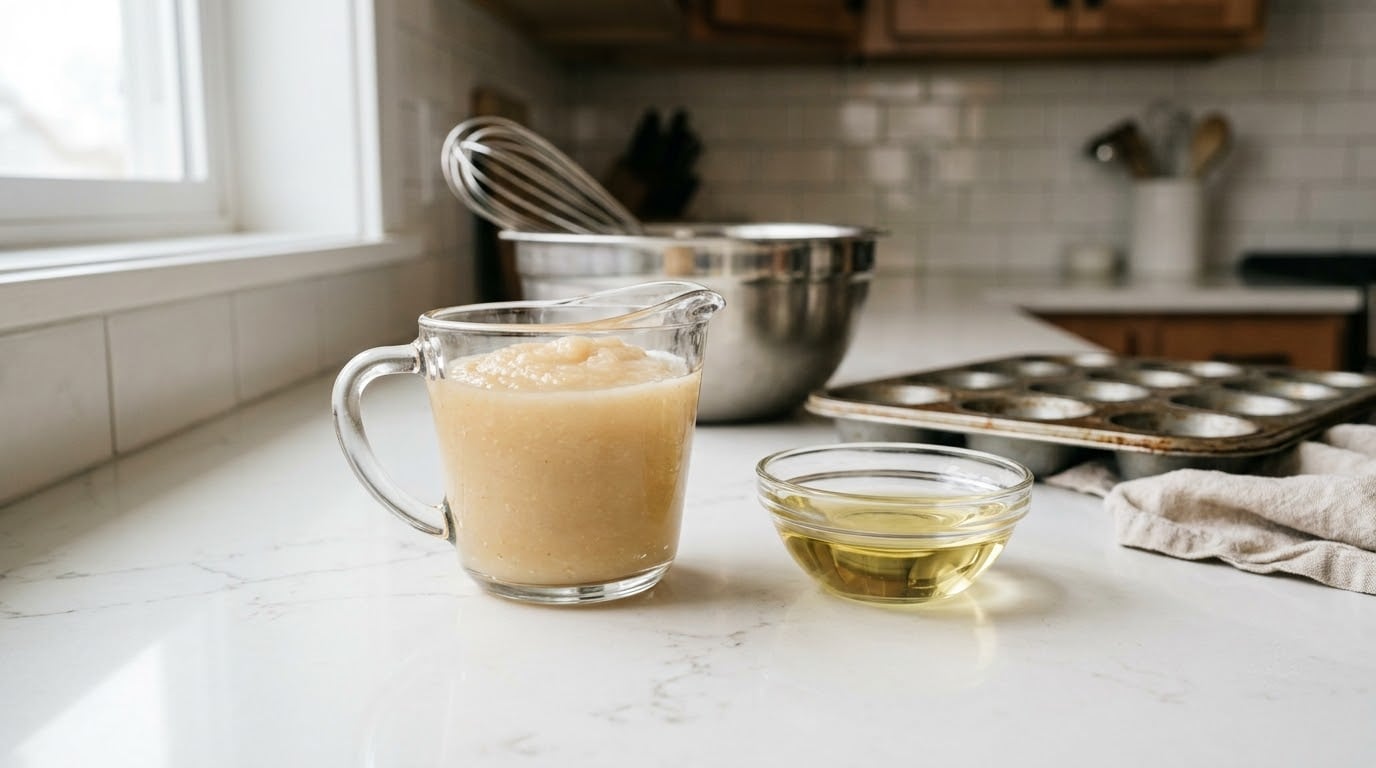
To substitute applesauce for oil in baking, use a 1:1 ratio: 1 cup of unsweetened applesauce replaces 1 cup of oil, and 1 tablespoon replaces 1 tablespoon. Swap it in fully for muffins, quick breads, brownies and pancakes, or go half-and-half for cakes and cupcakes so they stay light.
Oil tenderizes a crumb by coating the flour and carries no water. Applesauce does the opposite job, adding pectin, water and natural sugar, so the finished bake is moister, slightly sweeter and denser, and it browns faster. That is usually a good trade for home baking, where a dry muffin nobody wants is worse than a slightly heavier crumb.
The reason most people make the swap is math. A cup of neutral oil runs about 480 calories and roughly 57 g of fat. A cup of unsweetened applesauce comes in near 100 calories with no fat and a little fiber, and it keeps baked goods moist for days instead of two.
If you like swapping ingredients out, how to substitute maple syrup for sugar in recipes covers the other half of the equation. If you do the swap and something comes out rubbery, the maple syrup vs honey breakdown for baking explains how sweetness behaves once you take sugar down.
Last updated: October 2026
Table of Contents
- What You Need
- Step-by-Step: How to Substitute Applesauce for Oil in Baking
- Common Mistakes
- Frequently Asked Questions
- How much applesauce should I use instead of oil in baking?
- Do I need to reduce the sugar when using applesauce?
- Can I use applesauce in cookies, brownies, and cakes?
- Will substituting applesauce for oil make baked goods gummy?
- Do I need to change eggs when replacing oil with applesauce?
- Can I substitute applesauce in muffins, quick breads, and banana bread?
- Conclusion
What You Need
Nothing special. The whole swap uses a measuring cup, a mixing bowl, a whisk or a rubber spatula, and the ingredients your recipe already calls for. The one thing to buy is plain unsweetened applesauce, the unsweetened flavored kind, or homemade purée you have cooked down thick.
Baking applesauce is sold as a thicker, coarser product meant to survive the oven without breaking down. Standard jarred unsweetened applesauce is smoother and works just as well, which is why many bakers reach for it instead. Baby food applesauce is the pick when you want the finest texture and the least sugar; a baker on a baking forum pointed out years ago that it is smoother and less sweet than the jarred stuff, and it still holds up.
Skip anything sweetened, anything with visible bits of apple, and anything syrupy or thin. A thin sauce adds water you did not budget for, and that is the single biggest reason a substitution bake turns out gummy.
Step-by-Step: How to Substitute Applesauce for Oil in Baking
Start With a Reliable Substitution Ratio
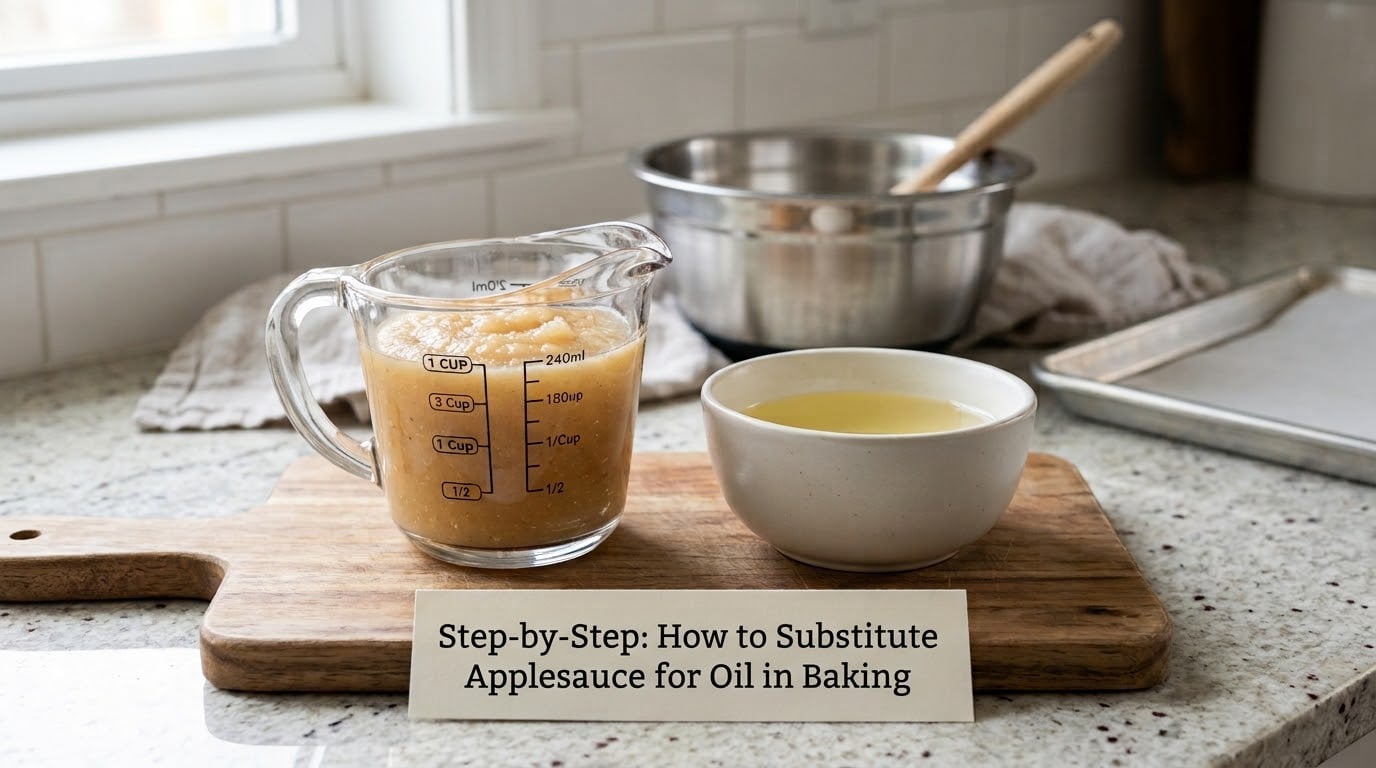
Measure by volume, one for one, and start there. The single most repeated piece of advice across baking forums is that a full swap works in dense, fruit-heavy bakes like muffins and quick breads, while cakes, cupcakes and cookies do better with half the oil kept and half swapped. In one long-running thread on baking-forums.com, bakers described it simply as getting a moist result with less fat.
| Oil in the recipe | Applesauce to use | Metric |
|---|---|---|
| 1 tablespoon | 1 tablespoon | 15 ml |
| 1/4 cup | 1/4 cup | 60 ml |
| 1/3 cup | 1/3 cup | 80 ml |
| 1/2 cup | 1/2 cup | 120 ml |
| 2/3 cup | 2/3 cup | 160 ml |
| 3/4 cup | 3/4 cup | 180 ml |
| 1 cup | 1 cup | 240 ml |
Going half-and-half means 1/2 cup oil plus 1/2 cup applesauce for a recipe that calls for 1 cup of oil. That middle path is the one most home bakers end up on, and it is a good default when you are trying the swap for the first time on a cake.
| Per 1 cup | Vegetable oil | Unsweetened applesauce |
|---|---|---|
| Calories | About 480 | About 100 |
| Total fat | About 57 g | 0 g |
| Added sugar | None | None, natural sugars only |
| Texture effect | Tender, lighter crumb | Moist, denser crumb |
Choose the Right Kind of Applesauce
Plain, unsweetened applesauce is the default and the safest choice. It behaves predictably in every recipe you would swap it into, and it does not push the sweetness anywhere.
Unsweetened flavored varieties, the cinnamon or peach ones, are fine in muffins, quick breads and anything already spiced like carrot cake. You are trading a little of the pure apple note for flavor you probably wanted anyway.
Sweetened applesauce is the one to avoid in most recipes. You can use it, but cut the sugar in your recipe first and taste the batter before it goes in the oven. Add the sugar back a spoonful at a time until the batter tastes right to you, because an overly sweet bake cannot be fixed after the fact.
Homemade applesauce works if you cook it down until it is thick. Spoon it in a cold jar and it should barely move. A loose homemade batch behaves like extra milk, and you will be chasing a wet crumb all afternoon.
Adjust Other Wet Ingredients
Applesauce is a wet ingredient, so look at every other liquid in the recipe before you start. As a starting point, cut the milk, water, buttermilk, or yogurt by about 1/4 cup for every 1 cup of applesauce you add, then adjust from there.
Do not change everything at once. Adjust one variable, mix, look at the batter, and only then decide it needs more. Recipes built on a 2:1 ratio of dry to wet ingredients have less room for error, so those are the ones where trimming liquid matters most.
Add a little leavening to help compensate. About 1/2 teaspoon of extra baking powder for every 1/4 cup of applesauce is a sensible tweak for cakes and muffins, since a wet batter that leans heavy benefits from a nudge upward.
Mix and Check the Batter
Grease and line the pan properly. Removing oil removes the fat that was greasing the tin for you, and the single most repeated tip from people who bake this way is to spray or butter the pan anyway. Skipping it is how you end up with a quick bread stuck halfway out of the pan.
Mix the wet ingredients into the dry the way the recipe directs, and stop while the flour is still barely visible. Overmixing activates gluten and gives you a tight, tough crumb that looks like a substitution problem but is really a mixing problem.
Finished batter should look matte and hold its shape, and a spoon dragged through it should leave a clean line that closes slowly. Signs of too much liquid: a surface that still looks glossy and wet a minute or two after mixing, or a ribbon of batter that pools instead of folding in.
If the recipe is unfamiliar, bake a test batch. Make two muffins or a single small loaf first, check the result, and adjust the rest. It costs ten minutes and saves a full pan that went wrong.
Bake and Evaluate the Result
Start checking a few minutes early. A wet batter with no fat in it browns faster than an oil batter, and one baker on discusscooking.com reported muffins that rose beautifully but filled the kitchen with an almost burnt smell, most likely applesauce caramelizing where it touched the pan.
You are looking for a set center, a springy top that pushes back when you press it lightly, and a toothpick that comes out clean or with a few moist crumbs. Pull it while the center still feels a touch soft, because the residual heat finishes the middle in the pan.
A dense crumb that is chewy and moist is normal for this swap. Gummy is not: gummy feels sticky and wet, the crumbs smear under a finger, and the bottom is often still tacky. That is a liquid problem, not an applesauce problem, and the fix is less milk next time.
Common Mistakes
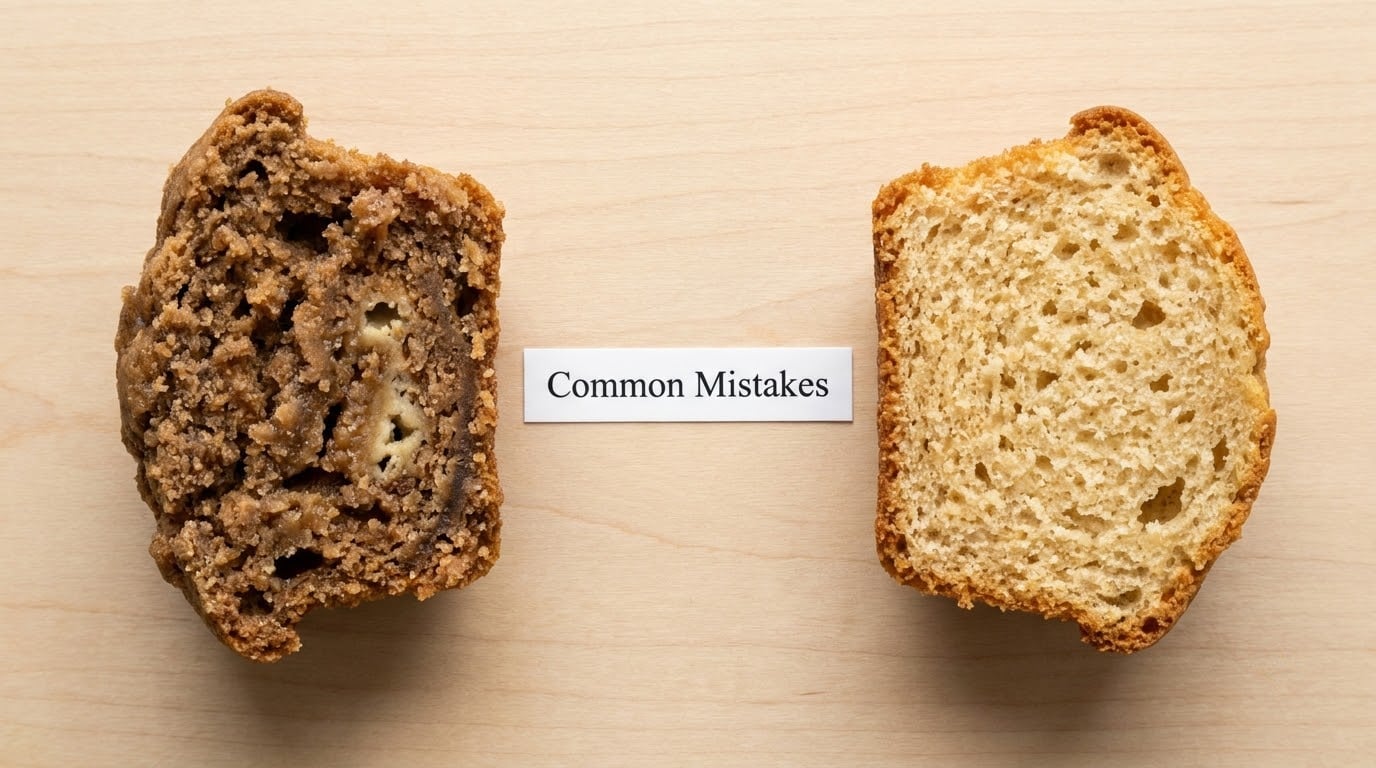
Almost every disappointing applesauce bake traces back to one of these.
| Mistake | What happens | Fix |
|---|---|---|
| Using sweetened applesauce | Bake is cloying and flat | Cut the recipe sugar first, taste the batter, add back by the spoonful |
| Going 100% swap in a creaming-method cake | Dense, heavy crumb, weak rise | Keep half the oil and cream it with the sugar as written |
| Leaving the milk or water untouched | Gummy, tacky crumb | Cut other liquids by about 1/4 cup per cup of applesauce |
| Using thin or homemade-loose sauce | Batter runs, bake never sets | Cook it down until thick, or buy jarred unsweetened |
| Skipping pan grease | Bread sticks, edges tear | Grease and line the pan even when the recipe does not ask |
| Baking to the full clock time | Burnt edges, raw center | Start checking early and pull while the center is still soft |
Cookies deserve their own warning. Fat is what makes a cookie spread, and applesauce does not do that job. Cookies made with a full swap turn out cakey and thick, so if you want to try it, replace no more than half the oil and expect a chewier, cakier cookie.
A few more habits that keep things on track: taste the batter, not just the final bake. Keep the same leavening level and add extra only when the batter looks heavy. And if you are swapping in banana bread or zucchini bread, any moist fruit purée follows the same 1:1 rule, which is handy when the produce is already sitting on the counter.
Frequently Asked Questions
How much applesauce should I use instead of oil in baking?
Use the same volume of applesauce as the oil the recipe calls for, so 1 cup of oil becomes 1 cup of applesauce. For muffins, quick breads, brownies and pancakes, swap the full amount. For cakes, cupcakes and cookies, many bakers replace only half and keep the rest of the oil for a lighter crumb.
Do I need to reduce the sugar when using applesauce?
With plain unsweetened applesauce, reduce sugar only if the batter tastes sweet once mixed, since the sauce adds natural sugars of its own. If you use sweetened applesauce, cut the recipe sugar first and taste the raw batter. Adjust by the spoonful, because you cannot fix sweetness after the bake comes out of the oven.
Can I use applesauce in cookies, brownies, and cakes?
Yes in brownies and most quick breads, where the dense crumb suits the swap. In cookies, replace no more than half the oil, because fat is what makes them spread and applesauce will give you a cakier, chewier cookie. In layer cakes made with the creaming method, keep at least half the oil so the batter still aerates properly.
Will substituting applesauce for oil make baked goods gummy?
It can, but the cause is almost always extra liquid rather than the applesauce itself. Trim other wet ingredients by roughly 1/4 cup for every cup of applesauce, use a thick unsweetened sauce, and add about 1/2 teaspoon of extra baking powder per 1/4 cup of applesauce. Start checking the bake a few minutes early.
Do I need to change eggs when replacing oil with applesauce?
Usually not. Most recipes keep the same egg count, since applesauce is moist rather than fatty and the egg is doing the binding and lifting work. In a lean gluten-free batter, or one where applesauce replaces egg as well, add about 1/2 teaspoon of baking powder per egg you drop. Change one thing at a time so you know what worked.
Can I substitute applesauce in muffins, quick breads, and banana bread?
These are the best places to use it. A full 1:1 swap works well because the batter is already dense, fruit-heavy and moist, so the added water and pectin help rather than hurt. Grease the pan, trim any extra milk or water, and add a small amount of extra baking powder if the batter looks heavy.
Conclusion
Start simple: 1 cup of oil becomes 1 cup of unsweetened applesauce, trim about 1/4 cup of other liquid for every cup you add, grease the pan, and bake a small test batch before committing to the full pan.
Use the conversion table above for the exact amount, and change one variable at a time. Full swaps belong in muffins, quick breads, brownies and pancakes. Half swaps belong in cakes, cupcakes and cookies. If you tell me the recipe you are working on, I can point you at the ratio that fits it.