
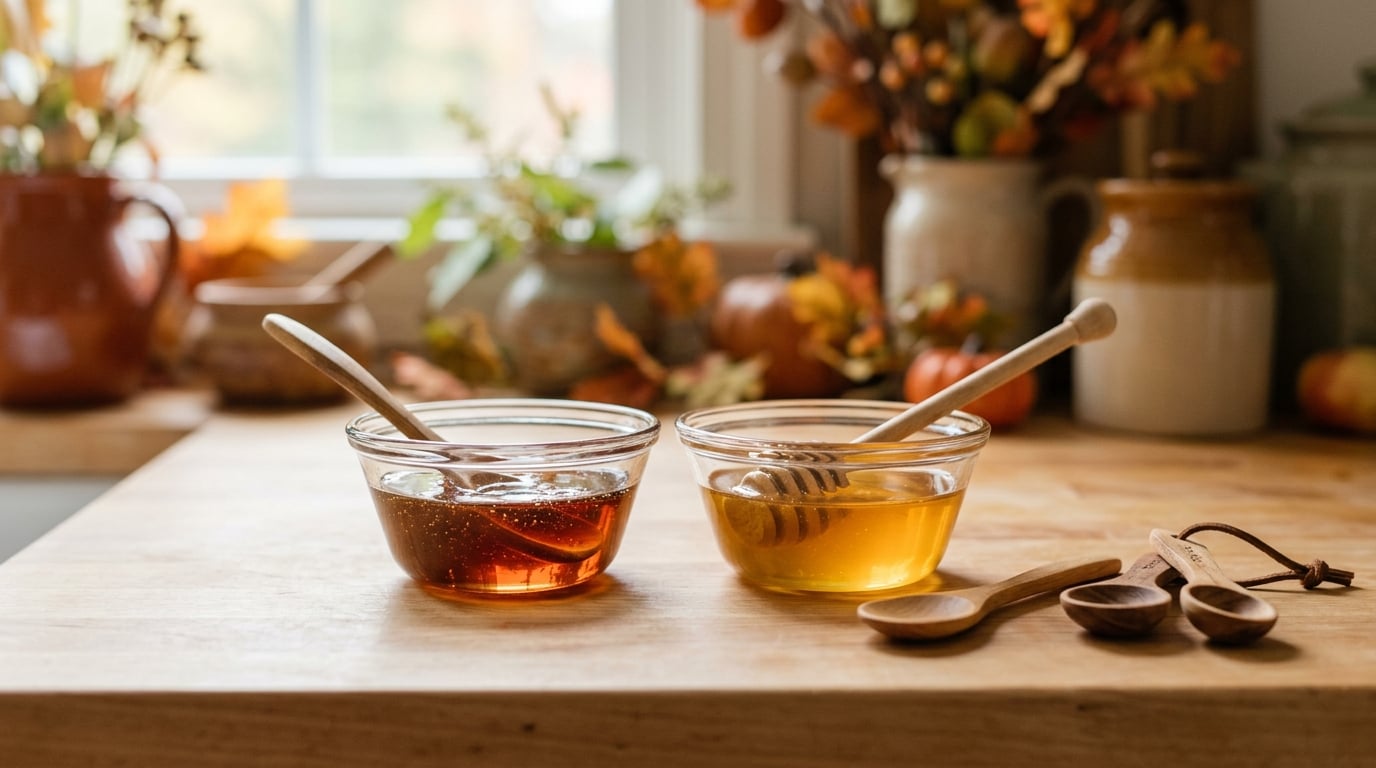
Yes, you can substitute one for the other: use roughly 3/4 cup maple syrup or 1/2 to 2/3 cup honey for every 1 cup of granulated sugar, and pull back the recipe’s other liquids to match. Honey leans floral and keeps bakes soft for days, while maple syrup brings woodsy caramel depth, colors faster, and works in every vegan bake.
The swap gets people into trouble for one predictable reason. Both sweeteners are about 20% water and sweeter than sugar, so a straight cup-for-cup replacement makes a wetter batter, a darker bake, and a cookie that spreads onto the tray.
So this guide covers what each one actually does in the oven, where the moisture comes from, which bakes handle a swap gracefully, and the four adjustments that turn a risky substitution into a clean one.
Table of Contents
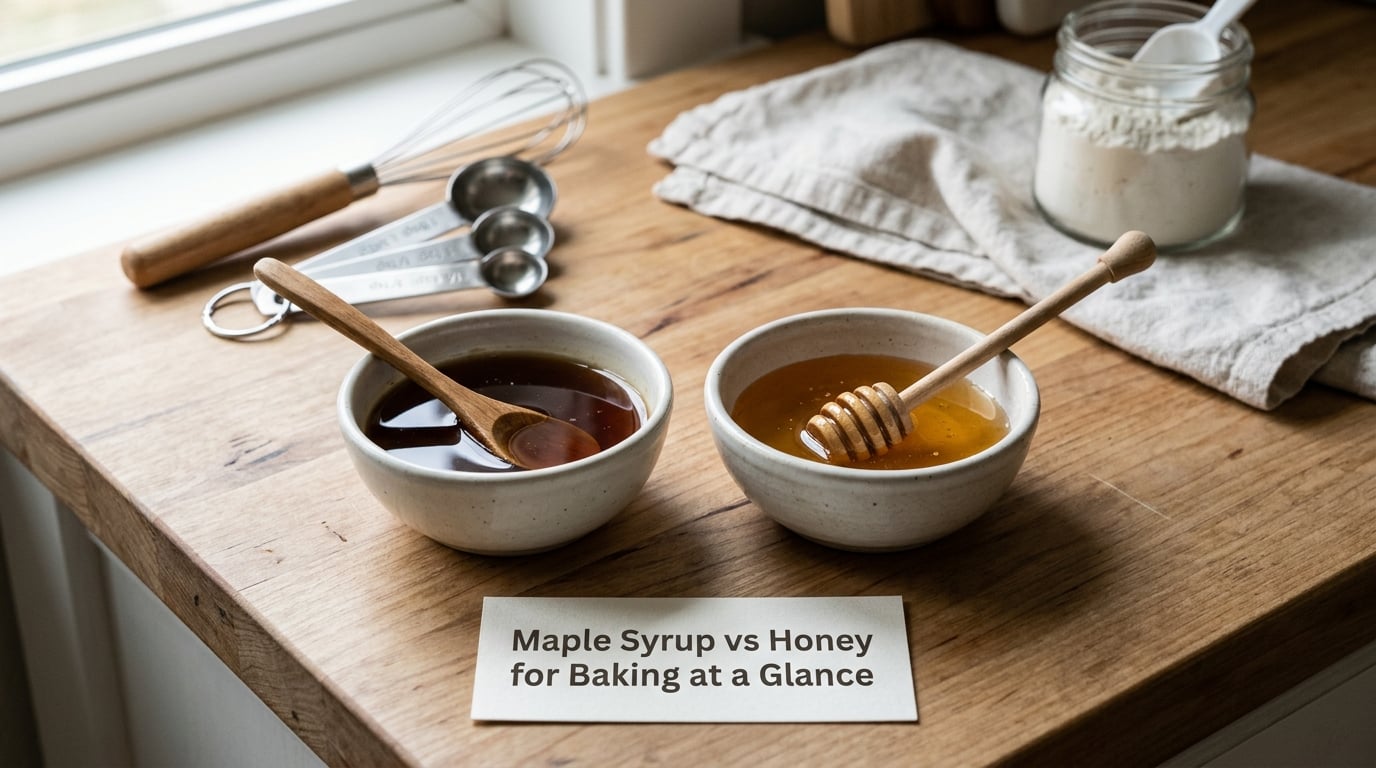
- Maple Syrup vs Honey for Baking at a Glance
- How Do Maple Syrup and Honey Taste in Baking?
- Which Sweetener Changes Texture and Moisture?
- Which One Browns and Caramelizes Better?
- Maple Syrup vs Honey for Baking: Which Is Sweeter?
- Which Works Best in Different Baked Goods?
- How Do Nutrition and Dietary Needs Affect the Choice?
- Which Is Easier to Find and More Affordable?
- How to Substitute Maple Syrup or Honey in a Recipe
- Which Should You Choose?
- Frequently Asked Questions
- Conclusion
Maple Syrup vs Honey for Baking at a Glance
| Criterion | Maple Syrup | Honey |
|---|---|---|
| Flavor in the oven | Woodsy, earthy, caramel, complex | Floral, rounded, lightly herbal |
| Sweetness power | About 1.35x sugar | About 1.25x sugar |
| Amount per 1 cup sugar | 3/4 cup | 1/2 to 2/3 cup |
| Other liquid to remove | 3 tablespoons | 1/4 cup |
| Moisture retention | Moderate, tender crumb | High, soft crumb that stays soft |
| Browning speed | Fast, deep amber color | Very fast, scorch risk at the edges |
| Acidity | Near neutral | Mildly acidic, needs baking soda |
| Best uses | Apples, squash, granola, layer cakes, glazes, vegan bakes | Cakes, muffins, quickbreads, soft cookies, tea breads |
| Dietary profile | Vegan, gluten-free, nut-free | Not vegan, gluten-free, not for infants under 12 months |
| Typical cost per cup | Higher, roughly double in most US kitchens | Lower and steadier across brands |
| Biggest limitation | Overpowers delicate flavors when overused | Burns before the timer finishes and crystallizes in the jar |
Prices vary by brand, size, and retailer, so treat the last two rows as a general pattern rather than a number to plan a budget around.
How Do Maple Syrup and Honey Taste in Baking?
Honey tastes floral and rounded in the finished bake, because heat softens its sharper raw notes into something rounded and slightly herbal. Maple syrup tastes woodsy and earthy with a caramel undertone, and the character survives the oven more than honey’s does.
The difference is easiest to hear in a plain pound cake. With maple syrup you taste the tree. With honey you taste the flower and a background sweetness that never draws attention to itself. That makes maple syrup the better pick for autumnal recipes, squash, apples, ginger, cinnamon, oats, and anything you want to taste as its own ingredient.
Honey wins when flavor is not the point: iced layer cakes, banana breads, coffee cakes, anywhere a frosting or a filling is doing the work. It also plays nicely with dairy and vanilla, which maple can sometimes overpower.
One practical note on maple: buy the grade you would actually drink. Light amber, the standard table grade, is the all-purpose one. Grade B or dark amber carries more of the cooked woodsy flavor that survives baking, which is why it shows up in granola, cookies, and anything where you want the maple to be unmistakable.
Which Sweetener Changes Texture and Moisture?
Honey changes texture and moisture more than maple syrup, because honey is more hygroscopic, meaning it pulls moisture out of the air and holds it in the crumb. That is why honey cookies stay tender on day three and why honey cakes slice without drying out.
Maple syrup still adds moisture, just less of it. Expect a tender crumb that is slightly drier than the honey version and a day or two less staying power.
Here is how that plays out in practice. Cookies baked with honey spread a little more, spread thinner, and have softer centers with crisper edges. Cookies made with maple syrup hold their shape better and bake crisper overall. Cakes and quickbreads get a soft, slightly dense crumb from either one, with honey leading on keeping. Bread and granola see the biggest color change from maple syrup, which toasts dark long before the loaf is done.
Both sweeteners also slow staling, so expect a baked good made with either to stay edible a day or two longer than the same bake made with granulated sugar.
Which One Browns and Caramelizes Better?
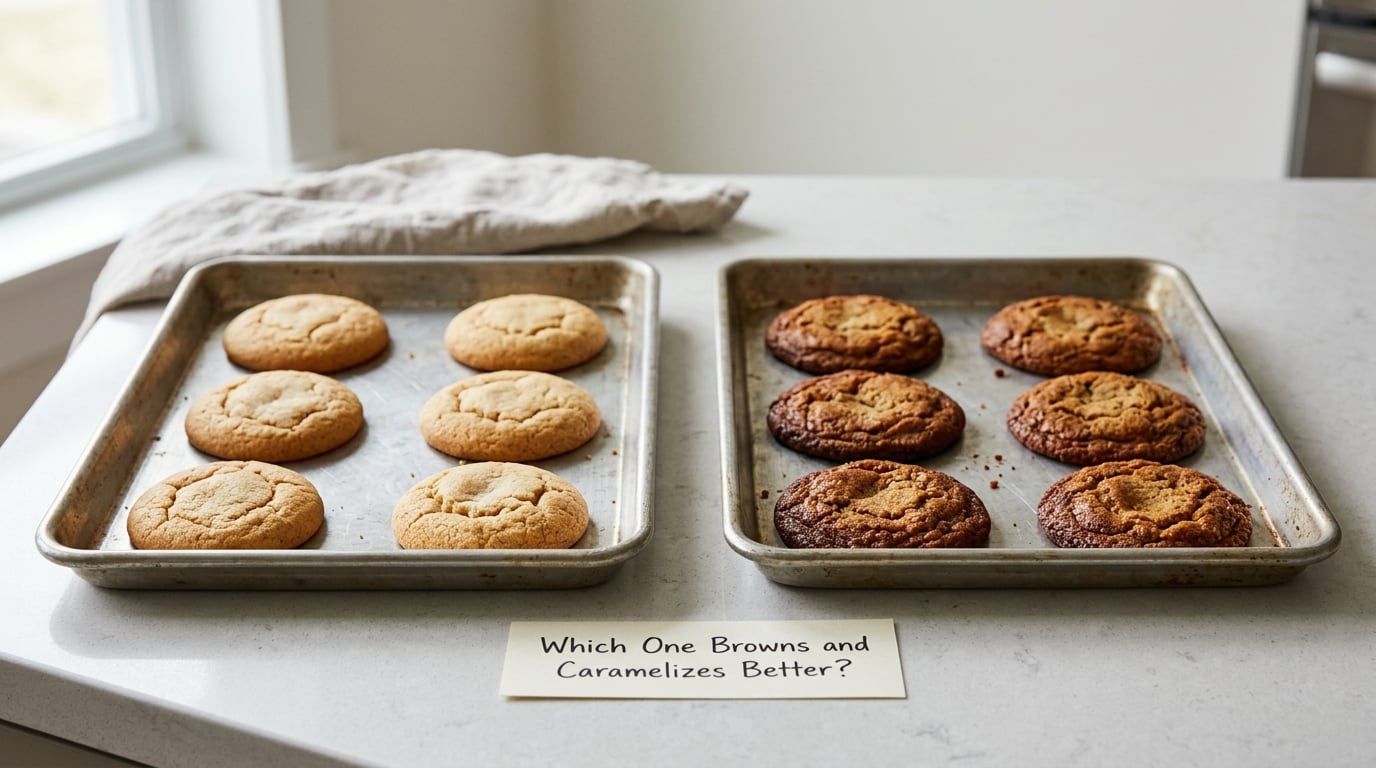
Honey browns and caramelizes fastest of the two, and that is where most scorched trays come from. Sugars caramelize earlier than granulated sugar does, so a sheet of honey cookies can go from golden to bitter at the edges while the centers are still raw.
Maple syrup darkens more steadily and gives a deeper amber color, which usually reads as a pleasant caramel rather than a burnt edge. In a cake or loaf, that means a richer-looking top crust. On a cookie tray, it means you should still pull the pan a few minutes early and watch it rather than trusting the timer alone.
Four habits fix this reliably across both syrups. Drop the oven temperature by 25 degrees. Rotate the tray once at the halfway mark. Check the color starting ten minutes before the recipe’s stated time. And tent loosely with foil if the top is darkening before the center is set.
Glazes and toppings behave differently than batters. Both syrups reduce down to a glossy finish, but honey thickens slightly faster and holds a sharper shine, which is why honey glazes photograph well on the first pour. Maple syrup gives a warmer, more amber glaze that matches fruit toppings.
Maple Syrup vs Honey for Baking: Which Is Sweeter?
Maple syrup is the sweeter of the two by weight, which is why its ratio to sugar is more forgiving, while honey gets used in smaller measures and delivers a longer, smoother sweetness curve.
Neither is sweet enough to replace sugar one-for-one. Both need less volume, and both need the recipe’s other liquids cut back, or the batter goes slack and spreads. That is the whole reason a swap that looks simple on paper produces flat cookies.
Perceived sweetness and flavor intensity are also two different things. Maple syrup carries so much woodsy character that people often describe it as tasting stronger even though the sweetness number is lower. Honey reads as simply sweet, so it disappears into a bake. If you want flavor, maple. If you want sweetness that stays in the background, honey.
Which Works Best in Different Baked Goods?
Cakes and layer cakes favor honey. It keeps the crumb moist for several days, adds color without turning the batter brown, and lets the frosting stay the loudest thing on the cake. Frostings, glazes, and drizzle sauces work with either, and maple wins when the topping goes over apples, pears, or squash.
Cookies split by style. Honey suits soft, thick, stay-fresh cookies. Maple syrup suits thin, crisp cookies and biscotti-style bakes where you want the edges to caramelize and the maple flavor to come through. Sandwich cookies and snickerdoodles take either one without complaint.
Breads, muffins, and quickbreads lean maple syrup. Banana bread, pumpkin bread, bran muffins, and oatmeal cups all already carry warm spice and fruit notes that maple amplifies. A plain oat quickbread also browns better with maple, which matters because pale oat quickbreads underbake easily.
Pancakes, waffles, and baked French toast take either one well, though honey gives a slightly darker griddled surface that caramelizes nicely. Granola and baked oats are the strongest maple case of all, since the sugar is doing visible browning work.
Fruit pies and crisps are split. Maple syrup belongs in apple, pear, squash, and sweet potato fillings. Honey is better in berry and stone fruit situations where you want the fruit to stay bright.
Raw and no-bake desserts are where the differences shrink. Both dissolve easily, though crystallized honey will not, and candied honey needs a warm water bath or a brief warm pan before it goes into a raw cream or drizzle.
Yeast bread, meringue, whipped cream, and custards are the places not to try either one. Yeast breads want granulated sugar to feed the yeast and to hold the gluten structure. Meringue and whipped cream need sugar that stays dissolved and crystallizes in a controlled way, and honey does not behave that way. Custards are temperature-sensitive, and syrups push them toward scorching.
How Do Nutrition and Dietary Needs Affect the Choice?
Both are added sugars with calories, and neither is a health upgrade over white sugar. Roughly 1 tablespoon of either lands near 50 to 55 calories with about 13 grams of sugar. The honest version: maple syrup carries small amounts of manganese and potassium, honey carries small amounts of riboflavin and a little more fructose, and neither changes the nutritional category of what you are baking.
That is worth saying plainly because the “natural sugar is healthier” claim gets repeated constantly, and people who bake with maple syrup or honey instead of sugar usually end up eating the same or more of it. The part these sweeteners do genuinely well is delaying a craving, because the flavor carries further than plain sugar does.
Where the choice does matter: maple syrup is vegan, which makes it the default for plant-based baking. Honey is not, so a vegan cake, cookie, or frosting has to use maple syrup, maple sugar, or another vegan alternative. Both are gluten-free as long as you buy plain syrup rather than a blended product, and neither contains nuts.
Two safety notes. Anyone with a honey allergy should avoid it entirely, and infants under 12 months should not be given honey because of the risk of infant botulism, which matters for honey-sweetened baby food and teething biscuits. People who react to corn or cane sugar may tolerate maple syrup better than commercial pancake syrups, which are often made from high-fructose corn syrup.
Which Is Easier to Find and More Affordable?
Honey is usually the cheaper and easier option. A bottle lasts longer, the price is steadier across brands, and it does not have a maple harvest season driving what you pay. Maple syrup typically runs about double per cup in a typical US kitchen, and dark amber grade costs more still.
Maple syrup is widely sold year-round though, and it keeps indefinitely in the fridge once opened. Honey is stable on the shelf, but it can crystallize in cold weather, which is a texture problem rather than a spoilage problem. Warm the jar in warm water and stir it back smooth, or microwave it in short bursts.
One packaging trap worth knowing. Imitation maple syrup is mostly high-fructose corn syrup and behaves differently: it is thinner, sweeter, batters like plain sugar rather than maple, and adds a lot of liquid. If a recipe calls for real maple syrup, a jug of imitation is not a straight substitute without reducing the other liquids.
Crystallized honey is the mirror-image problem. If your honey will not pour, warm it first or measure it by weight, otherwise you will under-measure and lose the sweetness you were going for.
How to Substitute Maple Syrup or Honey in a Recipe
Swapping one liquid sweetener for the other is a four-step adjustment, and doing all four gets you a bake close enough to the original that nobody notices.
- Convert by ratio first. Replace 1 cup of granulated sugar with 3/4 cup maple syrup or 1/2 to 2/3 cup honey. Going honey to maple is close to 1:1 by volume, so use about 3/4 cup of maple for every 2/3 cup of honey and expect slightly less sweetness.
- Cut the other liquids to match. Subtract 3 tablespoons of milk, water, or butter for maple syrup, or 1/4 cup for honey. If the recipe already has a lot of fruit or applesauce, take half of that adjustment instead.
- Add baking soda when honey is involved. Honey is mildly acidic and reacts with the soda, which lightens the crumb and browns the top faster. Use 1/4 teaspoon per cup of honey for cakes and quickbreads, 1/8 teaspoon for cookies, and none at all if the recipe already includes soda or baking powder. Maple syrup is close to neutral and does not need it.
- Drop the oven 25 degrees and check early. Both syrups caramelize before granulated sugar does. Bake until the color and the internal texture look right, not until the timer ends, and rotate the pan once at the halfway mark.
Cooked maple syrup is the shortcut that solves most liquid problems. Simmer it gently for 8 to 10 minutes until it thickens noticeably, cool it, and then use it like a thicker syrup. You get concentrated maple flavor and almost none of the extra water, which is exactly what a cookie dough wants.
If you want to work out the ratio for an unusual brand rather than trust a table, read the nutrition label. Take the serving size in grams, subtract the grams of sugar, and the remainder is water. Divide by the weight of a cup of water and you have the amount of syrup that carries the same sugar and water load as a cup of granulated sugar. It only takes a minute, and it is worth doing once with a brand you buy often so you stop guessing.
Maple sugar is the easy answer for anyone who wants flavor without the liquid math. It is granulated, so it drops into a recipe one-for-one with the sugar, though it dissolves more slowly and gives a slightly darker, less sweet result.
Which Should You Choose?
Choose honey when the goal is a soft, moist bake that keeps for days and when the flavor should stay in the background: cakes, layer cakes with frosting, muffins, banana and coffee breads, soft cookies. Choose maple syrup when the flavor is the point or the bake has to be vegan: apples, squash, pumpkin, granola, oatmeal quickbreads, oatmeal cookies, fruit glazes, and anything with oats or warm spices.
Choose maple syrup for appearance, because it gives a deeper amber crust. Choose honey for texture, because it stays tender longer. Choose honey for cost, since it usually runs about half the price of maple per cup. Choose maple syrup for anyone avoiding animal products or who reacts to cane and corn sugars.
And if the recipe you want to make is already written and tested, make it once as written. You will learn more about your own oven from one good bake than from any substitution chart.
Frequently Asked Questions
Is maple syrup healthier than honey?
Neither one is meaningfully healthier than the other. A tablespoon of each lands near 50 to 55 calories with about 13 grams of sugar, so both are added sugars. Maple syrup carries small amounts of manganese and potassium, honey carries a little riboflavin and more fructose. The real difference is dietary: maple syrup is vegan, and honey is not suitable for infants under 12 months.
Can I use honey instead of maple syrup in cookies?
Yes, and most cookie recipes take it well. Use about 3/4 cup of honey for every 1 cup of granulated sugar, cut the other liquids by 1/4 cup, and add 1/8 teaspoon of baking soda. Lower the oven by 25 degrees and pull the tray a few minutes early, because honey browns faster than sugar. Expect softer centers and slightly more spread.
Which sweetener caramelizes better in the oven?
Honey caramelizes fastest, which is why honey bakes tend to scorch at the edges before the centers set. Maple syrup darkens more evenly and gives a deeper amber color that reads as pleasant caramel rather than burning. Use dark amber Grade B maple when you want the maple flavor to read clearly in a cookie, granola, or glaze.
Are maple syrup and honey gluten-free?
Yes, both are naturally gluten-free, which makes either a workable sweetener in a gluten-free bake. Two caveats: buy plain syrup rather than a blended or flavored product, and check labels if you are baking for someone with celiac disease, since cross-contamination on shared equipment does happen. Both are also vegan except honey, which comes from bees.
Does maple syrup or honey make baked goods moister?
Honey makes baked goods moister. It is more hygroscopic, meaning it draws moisture and holds it in the crumb, so honey cookies stay tender for days and honey cakes slice without drying out. Maple syrup adds moderate moisture and a slightly drier, more tender crumb with a day or two less staying power. Either one keeps a bake edible longer than granulated sugar alone.
Conclusion
In maple syrup vs honey for baking, honey is the soft, moist, background-sweet option and maple syrup is the flavorful, faster-browning, vegan one. Pick the one that matches the recipe rather than the one that matches the mood.
Start by making the recipe as written, exactly as tested. If you are out of one syrup, convert the ratio, cut the other liquids, add baking soda for honey, drop the oven 25 degrees, and check the color before the timer ends.