
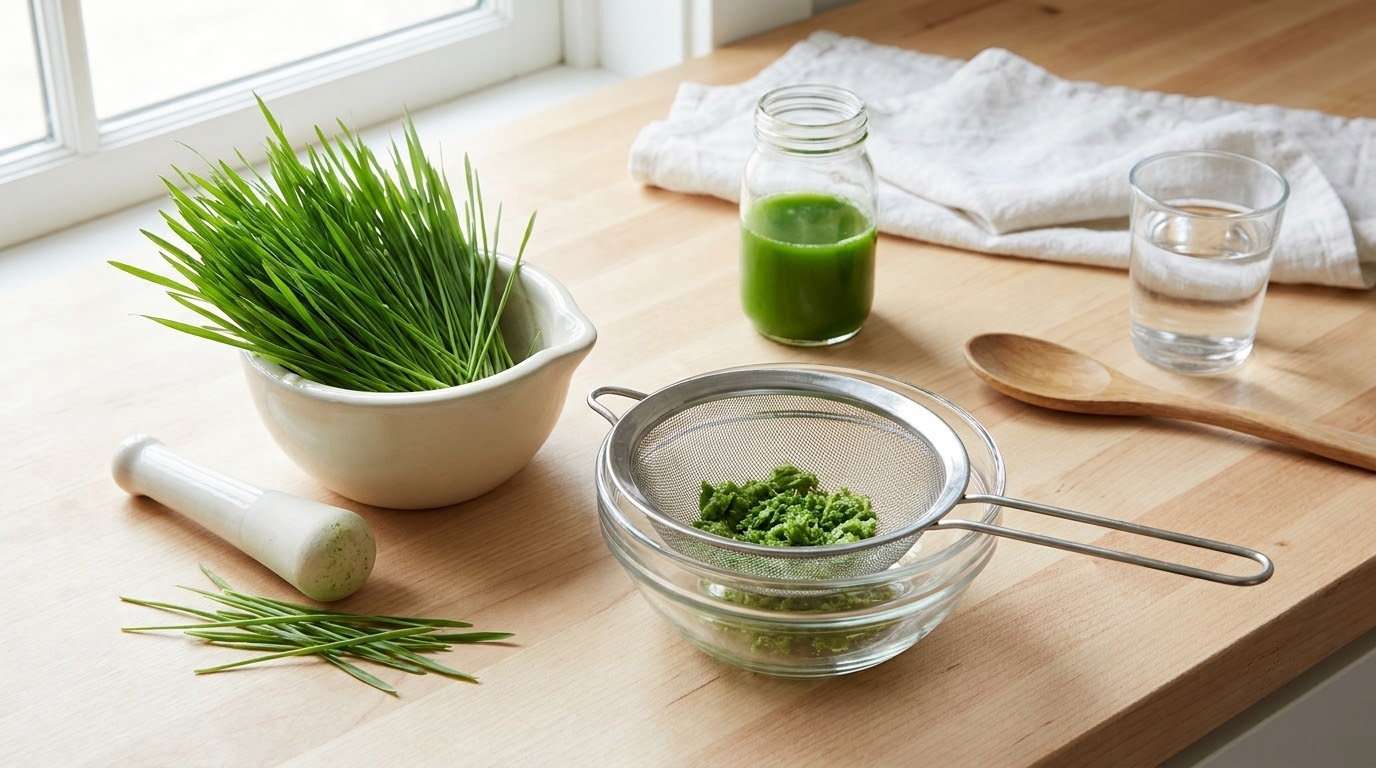
You make a wheatgrass shot without a juicer by blending fresh wheatgrass with a small splash of water, then pressing the pulp through a nut milk bag or cheesecloth so the green liquid comes out. It takes about ten minutes once the grass is washed, and any blender or food processor will do the job. The honest catch: it will taste grassy no matter how careful you are.
That is the part most guides skip. Fresh wheatgrass juice is not sweet, and blending pulls in more of the plant’s fibre than a juicer does, so the texture is thicker and the green flavor is louder. I like it, plenty of people do not, and about half of them lose the habit within a week. The fix is not a better technique, it is knowing what to add and starting at half strength.
You should expect about 1 ounce of juice for every 2 ounces of fresh grass by weight. That is roughly a two-ounce shot, four tablespoons, the size of a small shot glass. A two-ounce serving lands near 20 calories, so this is a beverage, not breakfast.
Across this site we keep coming back to the same idea with greens: a small daily serving beats an occasional big one. That is true here too. Start at 1 ounce, hold there for a week, and only go up if your stomach is happy.
What You Need
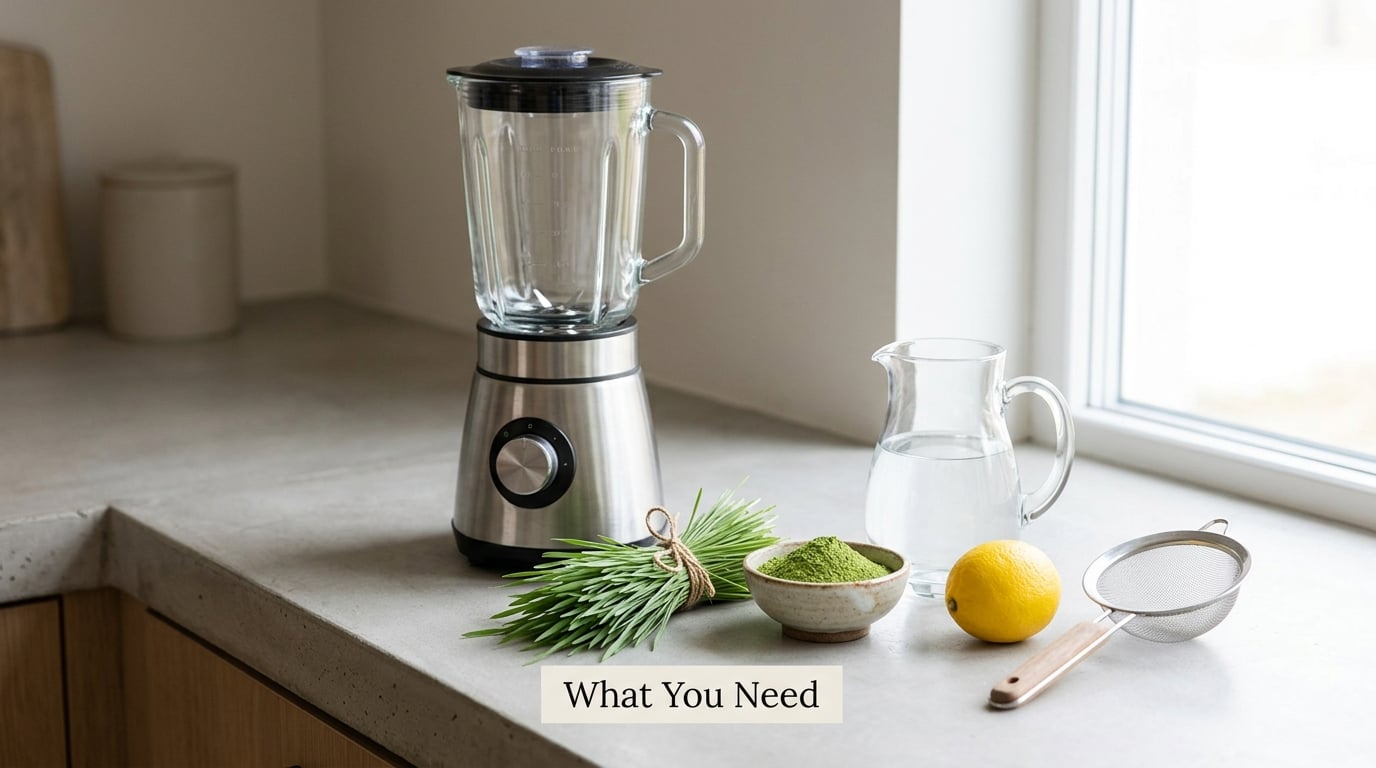
A blender, a strainer, and something green. That is genuinely all it takes.
- A blender or food processor. Any jar with blades will do. A high-speed blender gives you a smoother result in less time, but a cheap one just means you pulse longer and strain more carefully.
- Fresh wheatgrass or wheatgrass powder. Fresh is the real thing. Powder is the fallback for readers with no grass and no patience for growing it.
- Liquid. Water is the cleanest base. Coconut water, cold water with a squeeze of lemon, or a little apple juice all work and all soften the finish.
- A nut milk bag, fine mesh sieve, or cheesecloth. A nut milk bag is the best strainer here. It is a fine mesh nylon or stainless bag sold for straining homemade plant milk, and the same thing is often sold as a jelly bag. In a pinch, a metal sieve with a piece of cheesecloth laid over the top works the same way.
- Measuring tools. A kitchen scale helps more than a cup here, because grass weight is the only reliable way to dose yourself.
- Optional flavor additions. A lemon wedge, a small piece of ginger, apple or pineapple juice, a spoon of honey. Add these after the straining, not before, so you keep control of how strong the grass flavor stays.
- A small glass or mason jar. You drink this immediately, so anything with a lid that holds 2 ounces is fine.
- Scissors and a clean towel. For cutting the grass down to short pieces and drying the blades after rinsing.
Skip the dedicated wheatgrass juicer. People who own blenders tell forums that the reason they blend rather than juice is simple: nothing gets wasted. One permies user, Jeanine, put it plainly, she juices with a blender and strains through a nut bag because there are fewer parts to wash, and the pulp in the bag can then be spread out on a dehydrator tray for crackers.
Step-by-Step
How to Prepare Fresh Wheatgrass for Blending
Rinse the grass, dry it completely, cut away the tough stems, and chop what remains into short pieces. This is the step that decides whether your shot works, because stems are where the bitterness lives.
- Rinse the grass. Hold the blades under cold running water and work your fingers down the length of each one. If you grew the grass yourself on a tray with a soil mat, rinse it more than once.
- Dry it thoroughly. Pat the blades dry with a towel, then let them sit on the towel for a few minutes. Wet grass clumps and dulls the blade.
- Strip the stems. Cut the blades free from the base, or cut each blade into a leaf section and discard the pale, tough lower part. Young grass is usually mostly leaf already, so this takes seconds.
- Roughly chop. Snip or chop the leaves into 1 to 2 inch pieces. Not fine, not mushy. Roughly chopped is what keeps the blade from jamming.
- Weigh it. 2 ounces of chopped leaves makes roughly a 1 ounce shot. Start with half that if this is your first time.
The rule of thumb that keeps showing up is that a standard 2 ounce shot is four tablespoons, the volume of one small shot glass. Measure the finished liquid, not the grass you put in.
How to Blend a Wheatgrass Shot Without a Juicer
Put the liquid in first, the grass in second, and blend in short bursts. Long unbroken blending is what cooks the juice and turns it bitter.
- Add 4 ounces of cold water to the blender jar. If you are making a stronger shot, drop to 2 ounces of water.
- Add the chopped grass on top. It should sit in the water rather than packing against the blade.
- Pulse for 15 seconds, then stop. Scrape the sides down with a spatula, put the lid back on, and pulse another 15 seconds.
- Check the color. You are looking for a dark, even green liquid with no bright green lumps sitting on the surface. Whole leaves mean another burst, not a longer blend.
- Blend again in short bursts until the grass is fully broken up, usually three or four rounds in total.
- Pour into the nut milk bag or over the sieve and press. See the next section for how to get the smoothest result.
You are done when there is no visible leaf and the mixture moves like thin paint. If it looks like cold green soup, blend two more 10 second pulses. This is the whole trick behind how to make a wheatgrass shot without a juicer: short bursts, then press, and you never need a machine built for one job.
One permies regular, Dale Hodgins, explained his own habit as doing most of his juicing with his molars, and liking blenders because nothing is wasted. That is the honest case for this route. The fiber stays in the pulp, and you get a fuller drink than a juicer would give you.
How to Make It Smoother and Easier to Drink
Strain it twice and the fiber goes with it. Most of the unpleasant mouthfeel people complain about is pulp that was never pressed out properly.
- Press the pulp hard. Squeeze the bag in stages rather than one hard pull. Most of the liquid comes out in the first three or four squeezes.
- Strain a second time. Pour the collected juice through a fine mesh sieve set over the glass. This catches the fine particles that make the drink feel gritty.
- Dilute if it is too strong. Add cold water a tablespoon at a time until the strength feels right to you. Half grass, half water is a common first-week ratio.
- Add a bright note. A squeeze of lemon, a small piece of ginger, or a shot of pineapple juice cuts the grassy edge without hiding that it is grass. Most people add about half an ounce.
- Sweeten lightly if you must. A drop of honey or a quarter ounce of apple juice is enough. Once it tastes like fruit punch, you are not tasting the wheatgrass at all.
On the permies forum, people who drink wheatgrass regularly describe the flavor as nothing wonderful, and mask it with pomegranate juice or acai concentrate. Ginger works the same way and does not add sugar.
Using Wheatgrass Powder Instead of Fresh Grass
Powder skips the washing, chopping and straining decisions entirely. You stir it into liquid and drink it, which makes it the realistic option if you are starting out and want to know whether you even like the flavor.
- Use 1 teaspoon to start for a 2 ounce serving. Some people go to 2 teaspoons, but go slowly because the taste scales fast.
- Add it to 2 to 4 ounces of cold water or coconut water in the blender jar or shaker cup.
- Blend or shake for 10 seconds until no powder is sitting on the bottom.
- Taste before adding anything else. Add a lemon wedge if it needs sharpening.
The trade-off is real. Powder dissolves cleanly and gives you a thinner, milder drink, but you are drinking dried grass rather than fresh. It also costs more per serving than growing or buying a tray of wheatgrass. If fresh grass is not an option, the powder version is still the easiest answer to how to make a wheatgrass shot without a juicer of any kind.
Common Mistakes
Nearly every failed blender shot comes down to one of five things.
Wet grass dulls the blade
The most common failure is putting freshly rinsed grass straight into the jar. Waterlogged leaves sit on the blades instead of cutting, and you get a thin, watery green liquid with leaf in it. Dry the blades first, on a towel, for a few minutes.
Blending too long cooks the juice
A high-speed blender gets warm in about 30 seconds. Longer blending dulls the flavor and turns the pulp into a fine sludge that is much harder to strain. Pulse in 15 second rounds with a scrape-down in between instead of hitting go and walking away.
Leaving the stems in
Mature stems and thick lower sections are the bitter part. Strip them before chopping. If your grass was cut late or the blades have gone pale and fibrous, use the tender tops only and expect a milder shot.
Straining through something too fine
Running the juice through several layers of cloth, or through a sieve mesh finer than you need, costs you volume and leaves you with a small, watery cup. One pass through a nut milk bag, one light pass through a sieve, is the right amount.
Waiting too long to drink it
Fresh wheatgrass juice oxidizes and separates. It dulls, gets browner, and any foam settles into a layer you have to shake back up. Drink it within minutes of straining, which is the real reason to do this in the morning and not the night before.
Two smaller habits worth building in. A thick pulp left in the bag smells by the next morning, so rinse the bag straight away with cold water and hang it open. And if you are growing your own grass, cut above the root mat rather than pulling it up, and the tray will regrow for another cut or two before the roots need replacing.
Frequently Asked Questions
Can I use a regular blender instead of a juicer for wheatgrass?
Yes, and most home wheatgrass drinkers do exactly that. Blend the chopped grass with a small amount of water in 15 second pulses, then press the pulp through a nut milk bag, jelly bag, or fine mesh sieve. A high-speed blender gives the smoothest result in the least time, but any blender works if you pulse rather than run it continuously and strain the result twice.
Should I remove the stems before blending wheatgrass?
Yes. Stems and the thicker lower sections carry most of the bitterness and give the finished drink a fibrous, unpleasant texture. Rinse the grass, dry it, cut the tender green leaves free from the base, and blend only those. If you are using very young grass cut at seven to ten days, there may be almost no stem to remove, so trimming is quick.
How much wheatgrass should I put in one shot?
A common starting point is about 2 ounces of fresh wheatgrass leaves for a 1 ounce shot, though the best amount depends on how fresh and how tender your grass is. For your first few servings, use half that, then build up. Most people settle somewhere between 1 and 2 ounces of finished juice taken in the morning on an empty stomach.
Why does my wheatgrass shot taste bitter?
Bitterness usually comes from three things: mature stems still attached, grass that was harvested late, or blending too long at high speed until the juice warms up. Use young bright green blades, cut away anything pale or tough, and pulse in short rounds. A squeeze of lemon, a small piece of ginger, or a splash of pineapple juice softens the finish without hiding the grass.
How long does homemade wheatgrass juice last?
Drink it within minutes for the best flavor. Refrigerated in a sealed jar, a strained shot will keep about 24 hours, but the color dulls, a sediment layer settles at the bottom, and the taste flattens as it oxidizes. Freezing changes the texture. If you cannot drink it straight away, blend the grass into a smoothie with fruit instead, where the taste is masked anyway.
Who should not drink wheatgrass juice?
People taking blood thinners should check with their doctor first, because wheatgrass is high in vitamin K and works against those medications. Anyone with celiac disease or a wheat sensitivity should note that wheatgrass is harvested from wheat and can carry gluten cross-contamination. Pregnant or breastfeeding people, and anyone with kidney disease, should also ask a healthcare professional before making it a daily habit.
One more honest note. A two-ounce wheatgrass shot runs about 20 calories. Dietitians describe it as a snack or a side salad, not a meal, and anyone drinking it daily for the chlorophyll content still needs to eat real food. If you have a medical condition or take regular medication, ask your doctor or a registered dietitian before adding it to your routine.
Conclusion
The easiest first move is the simplest one: take a small bunch of tender wheatgrass leaves, drop them in a blender with four ounces of cold water, pulse in 15 second rounds, and press the pulp through a nut milk bag or a sieve over a glass. Trim the stems first, because that is where the bitterness comes from. Drink it right away, start at half an ounce if this is new to you, and if the taste is the problem, add lemon or ginger before you add anything sweet. Two ounces of fresh grass should give you a small shot, and you can pick up the method quickly enough to know within a week whether it belongs in your morning.