
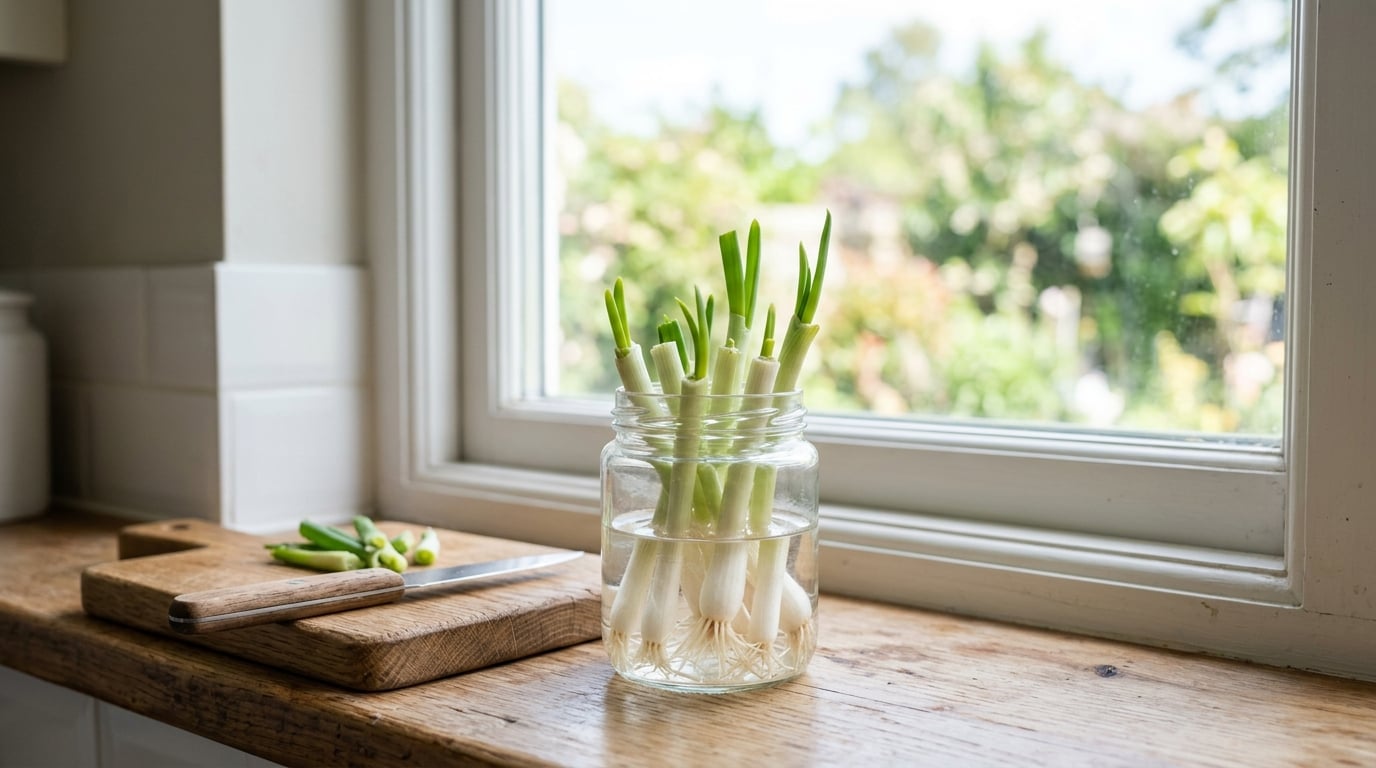
Learning how to regrow green onions in water takes two minutes of setup and one clear windowsill. Save 1 to 2 inches of the white root base, stand it upright in a glass with about an inch of water that touches the roots and nothing else, and swap the water every 2 to 3 days. New green shoots usually show up within 5 to 10 days.
That is the entire method. No soil, no fertilizer, no garden. The base still has living roots and a growing point in the middle, so it keeps pushing up new leaves using stored energy and the water you give it.
The catch is that plain water carries no nutrients, so a single base gives you one to three harvests before it slows down or gives out. Start a fresh base every time you finish a bunch, keep three or four going at once, and one store trip turns into a few weeks of garnishes.
Last checked: October 2026
Table of Contents
- What You Need
- Step-by-Step: How to Regrow Green Onions in Water
- Common Mistakes
- Frequently Asked Questions
- How many times can green onions regrow in water?
- Is it better to regrow green onions in water or soil?
- Do store-bought green onions regrow in water?
- How much water should I put in the jar when I regrow green onions in water?
- How long do green onions take to regrow in water?
- Do you have to change the water every day?
- Conclusion
What You Need
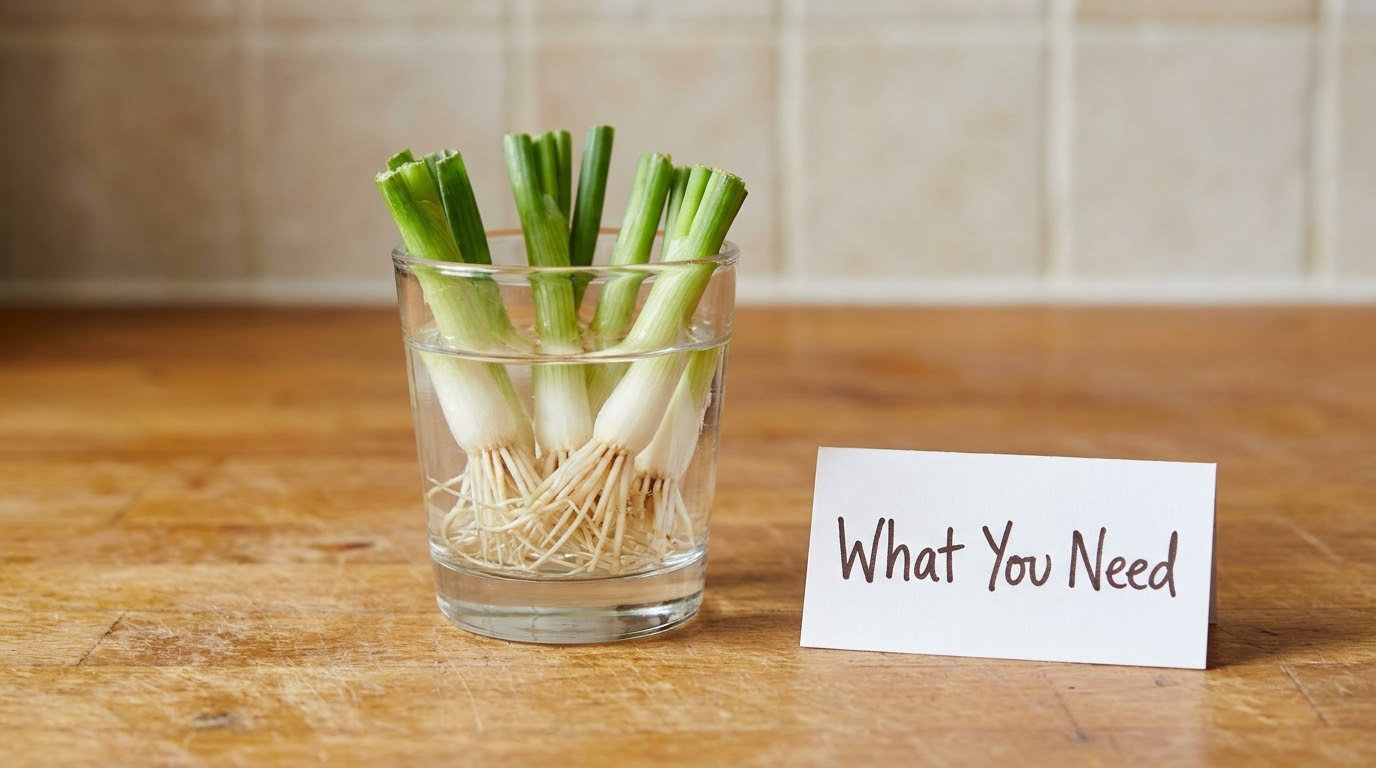
The list is short, and you already own every item on it. No special equipment, no garden bed, no grow lamp.
- A container with a mouth wide enough to stand the base up. A drinking glass fits one or two bases, a wide-mouth jar fits four or five, and a small cup or an egg cup works for a single scrap. Skip shallow dishes, because the base has to sit upright to grow straight shoots.
- Cool fresh tap water. Filtered or mineral water is not needed. Ordinary tap water is what these roots were living in a few days ago.
- A bright window. Indirect light is ideal. A dim shelf slows growth so much that most people assume the scrap is dead when it is simply dark.
- A few healthy scraps. Choose a bunch with firm, bright white bases and roots still attached. Leave out anything slimy, soft, or grey at the root.
Bagged green onions sold in plastic sleeves usually arrive with their roots trimmed off, and bunches that have sat dry on the shelf for a week often fail because the roots died first. Thick, freshly bunched scallions with a small tuft of white root give you the odds you want. A two-inch stub is enough to work; one gardener in a Facebook small-vegetable-garden group posted a five-day photo from exactly that.
Step-by-Step: How to Regrow Green Onions in Water
Step 1: Save a Healthy Green Onion Base
Cut the green tops off about 1 to 2 inches above the point where the white base ends, then trim the leftover base to 1 to 2 inches tall with its roots attached. The white part and the root crown are the living sections; the hollow green stalk above them is finished and will only rot in water.
Rinse the cut face under cold water and leave the base cut side up. Peel off any loose papery outer skin. If the base feels spongy or gives way under your thumb, put it in the compost rather than the jar.
Step 2: Place the Roots in Water
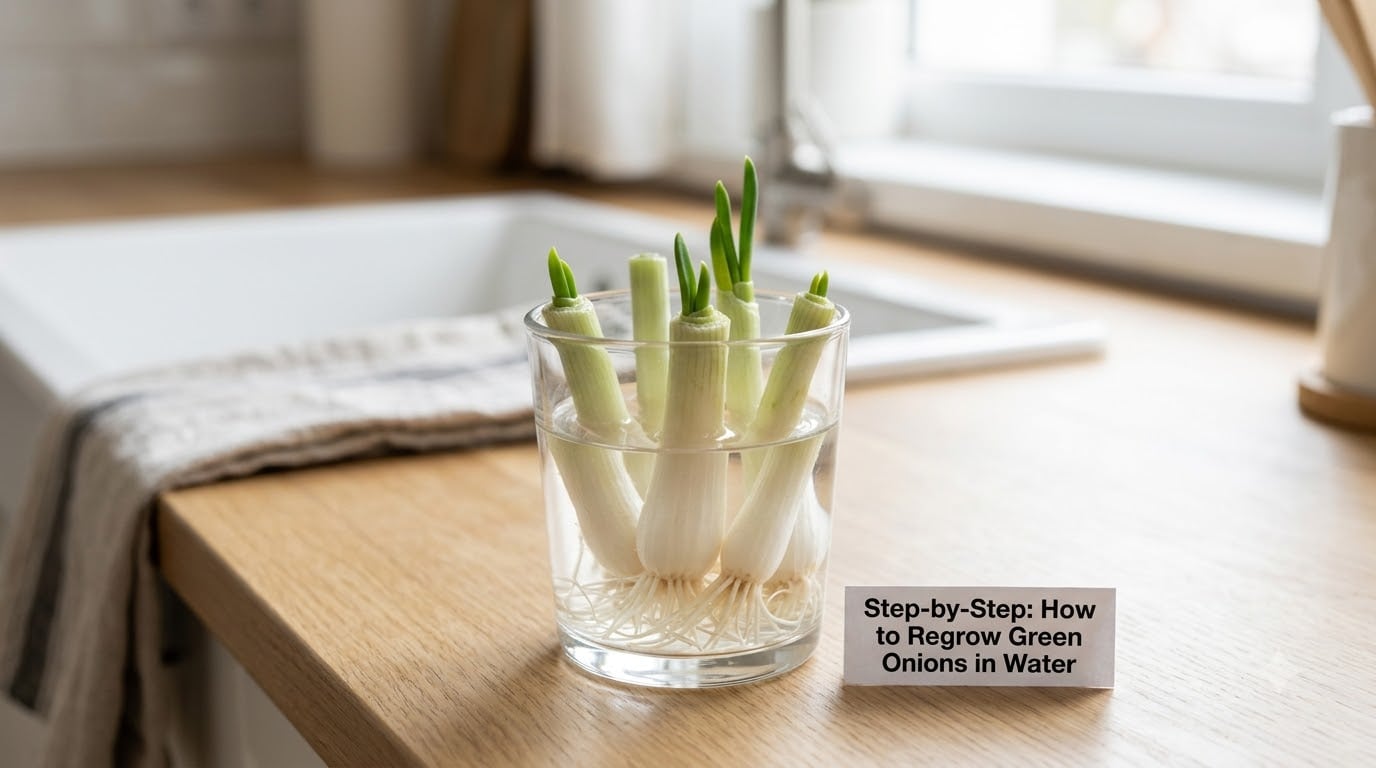
Stand the base in the container roots down, then add just enough water to cover the roots and reach the very bottom of the cut stem. Not past it. That single line is the difference between a base that grows for weeks and one that turns to mush by the weekend.
Too much water is the most common way this method fails. A long Reddit thread on regrowing green onions is essentially a complaint that every version of this tip comes with far too much water, and that you should only cover the roots. Water sitting above the cut stem keeps an open wound wet, bacteria move in, and the base softens within days.
Several bases can share one jar as long as they do not touch each other and each set of roots reaches the water. A drinking glass takes two, a wide-mouth jar takes four or five with a bit of space between them.
Step 3: Give the Scraps Light and Fresh Water
Put the jar on a bright windowsill out of harsh direct sun. Strong sun through glass can scorch new shoots, while a dark corner is usually the real reason nothing happens.
Change the water every 2 to 3 days, and rinse the roots under cold running water each time you empty the jar. A long-time grower on r/rootporn credits a roughly five-day change cadence plus rinsing the roots for keeping the bases from rotting for years. Check the jar every day or two and top it up between full changes, since a shallow glass loses water fast in a warm kitchen.
Within a few days the roots thicken and pull the base upright, then a pale green shoot pushes out of the centre. That shoot is the proof the scrap took.
Step 4: Harvest the Regrown Green Onions
Snip the leaves from the top once they reach 4 to 6 inches, cutting about an inch above the white base. Never cut into the base itself, because that removes the growing point and ends the regrow.
The same base sends up a second shoot, and often a third, from the centre. Snip again when those reach harvest height. By the third cut you will notice the leaves coming out thinner, paler, and a few days slower each time.
Use regrown leaves within a few days. Keep cut stalks standing in a jar with an inch of water in the fridge and change the water every couple of days, or wrap the bundle in a damp paper towel inside a bag in the crisper.
Here is what a normal jar looks like as the days pass:
| Time | What to expect | Water routine | Ready to harvest? |
|---|---|---|---|
| Day 1 to 2 | Nothing visible. The base sits still while the roots settle. | Check daily, top up as needed | No |
| Day 3 to 5 | Roots thicken and a pale green shoot, under an inch tall, pushes from the centre. | First full change, then every 2 to 3 days | No |
| Day 6 to 8 | Shoot reaches 2 to 4 inches, often with a second shoot beside it. | Every 2 to 3 days, rinse roots | Soon |
| Week 2 to 3 | Leaves reach 4 to 6 inches and the plant is full size. | Every 2 to 3 days | Yes, and again after each cut |
| After 2 to 3 harvests | New shoots are thinner, paler and slower. | Same, or move the base to potting mix | Weakly |
Common Mistakes
Nearly every failure comes down to water, light, or roots that were already dead. Find your symptom and take the fix.
| Symptom | Likely cause | Fix |
|---|---|---|
| Base turns mushy and smells sour | Water sits above the cut stem, or the base was soft to begin with | Discard the water, trim back to firm white, restart in a clean jar with only the roots submerged |
| Water clouds over within a day | Stale water, or too many bases packed into one jar | Change every 2 to 3 days, rinse the roots under cold water, and space the bases so they do not touch |
| Nothing happens after two weeks | Dead roots from a dried-out bunch, or a spot that is too dim | Move the jar to the brightest window you have, or start again with a fresh bunch |
| Shoots come up yellow and thin | The base has spent its stored energy over several harvests | Start a new base and move the old one into potting mix |
| Leaves snap off at the waterline | Stale water weakened the stem right at the waterline | Change the water and cut back to an inch above the base, then wait for a new shoot |
| Base shrivels and dries out | The jar was topped up too rarely, or emptied and forgotten | Check the water level every day or two, not just on change days |
A few habits turn a single jar into a steady supply:
- Stagger your batches. Start a new base the week after the previous one. Overlapping harvests beat a single big crop followed by nothing.
- Run several bases in one jar rather than one base per cup, and rotate the position on the sill so nothing leans.
- Move to soil after the second harvest. Soak the base for about 30 minutes in room temperature water, plant it in potting mix, and bury the bulb plus roughly an inch of stem. That is the approach gardeners on r/gardening describe, and the start-in-water-then-small-pot pattern gets the same recommendation on r/EatCheapAndHealthy, where people report the plants grow wonderfully once potted.
- Compost a spent base. It is full of fresh roots and breaks down quickly instead of going slimy in the jar.
Frequently Asked Questions
How many times can green onions regrow in water?
Expect one to three harvests from a base sitting in plain water, and expect most jars to stop after the second cut. Each snip costs the plant stored energy and water carries no nutrients, so later shoots come out thinner and milder. When the third cut looks pale, move the base into potting mix or compost it and start a fresh one.
Is it better to regrow green onions in water or soil?
Water is the easier start: no soil, no pot, and you can watch the roots take hold. Soil gives the longer result, because the base gets nutrients and can crop for months. The common route is both, starting in water for a week until the roots re-establish, then transplanting into a small pot of potting mix.
Do store-bought green onions regrow in water?
Yes, most supermarket bunches do. Thick, freshly bunched scallions with roots still attached give the best results, while bagged pre-soaked onions have already been trimmed and come back slower. Check that the roots are firm and white rather than brown and dry, and skip any base that feels soft.
How much water should I put in the jar when I regrow green onions in water?
Enough to cover the roots and just reach the bottom of the cut stem, which is usually about half an inch to an inch. Never let the water sit above the cut end. That open wound is what rots, and it is the mistake described again and again in regrowing forum threads.
How long do green onions take to regrow in water?
The first shoot usually shows up in 5 to 10 days, though a healthy base can push green in as little as 48 hours and a slow one can take close to two weeks. Leaves are worth snipping at 4 to 6 inches, usually one to two weeks after the first shoot appears.
Do you have to change the water every day?
No. Every two to three days is enough, and daily changes are fine if you would rather do them. The part that matters is rinsing the roots under cold water when you empty the jar, because the film of slime that builds up on the roots is what turns a healthy base into a smelly one.
Conclusion
Save a fresh white base the next time you cook with green onions, stand it in a glass with an inch of water covering the roots only, and put the jar on a bright sill. Check it every two or three days and rinse the roots whenever you change the water.
Growth varies with how fresh the base was and how much light you give it, so a slow start is not a failure. Start another base with each bunch you buy and you will have regrown scallions on hand without a garden, a trip to the store, or anything wasted.