
Spirulina is the better everyday pick for most people: it absorbs more readily, needs fewer pills for the same dose, and carries a stronger protein and antioxidant profile. Chlorella earns a place when a milder taste and higher chlorophyll and iron content matter more, or when your goal is training performance. Both are safe in the general population at typical doses, and neither is a replacement for real food.
Updated for 2026. This is general information, not medical advice. If you take medication or have a health condition, talk to your doctor or a registered dietitian before adding either algae to your routine.
Table of Contents
- Spirulina vs Chlorella for Everyday Use at a Glance
- What Are Spirulina and Chlorella?
- How Do Their Nutrient Profiles Compare?
- Which One Has More Protein?
- Which Is Easier to Digest?
- How Do Taste and Texture Change Everyday Use?
- Which Is Easier to Use in Smoothies and Meals?
- Are Spirulina and Chlorella Safe for Everyday Use?
- How Do Cost and Availability Compare?
- Which Should You Choose?
- Frequently Asked Questions
- Bottom Line
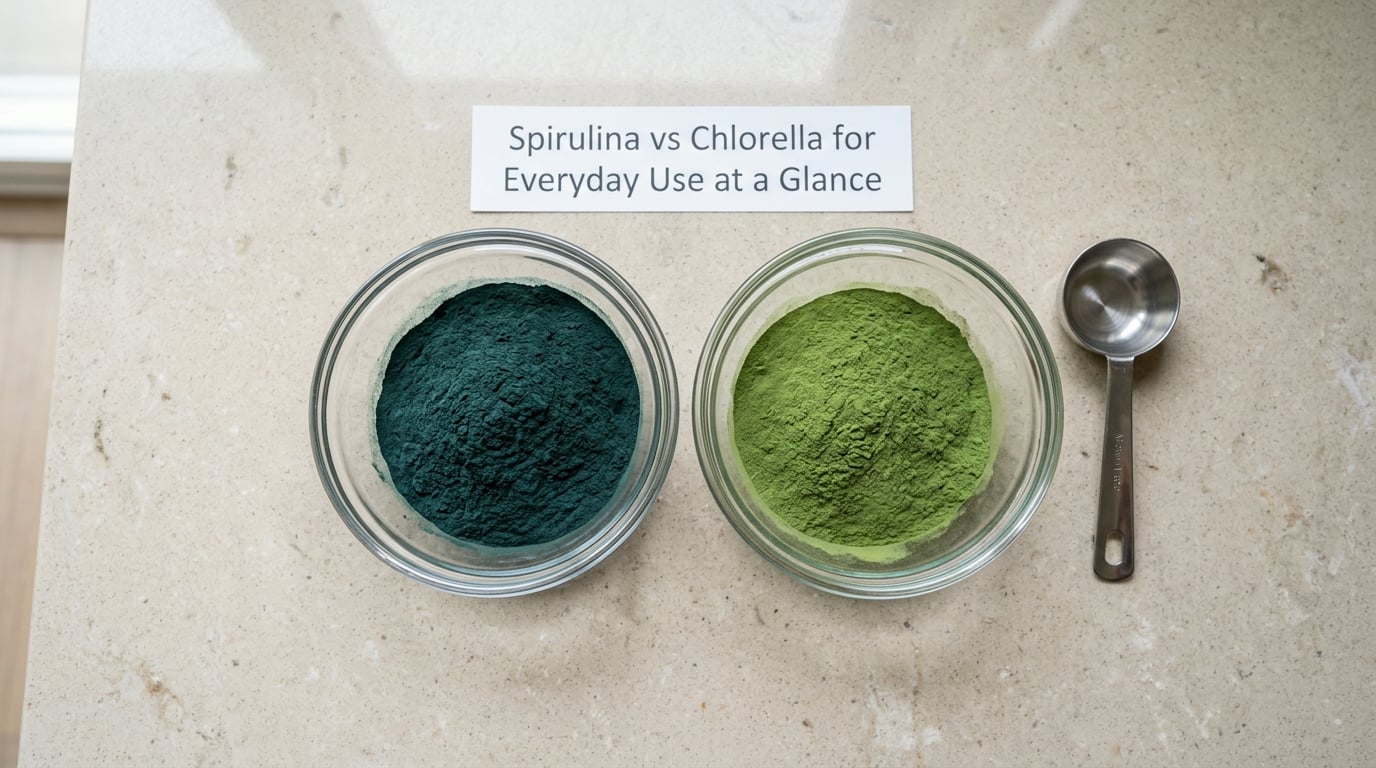
Spirulina vs Chlorella for Everyday Use at a Glance
| Factor | Spirulina | Chlorella |
|---|---|---|
| Organism | Filamentous cyanobacterium, Arthrospira platensis | Single-celled green alga, Chlorella vulgaris |
| Appearance | Deep blue-green | Bright grass green |
| Cell wall | None, so it digests as harvested | Tough cellulose wall that must be cracked |
| Protein by dry weight | Up to about 70 percent | Roughly 50 to 59 percent |
| Signature nutrients | Protein, phycocyanin, thiamin, copper, GLA | Chlorophyll, iron, vitamin A precursors, omega-3, zinc |
| Taste | Earthy, marine-like and mildly salty | Grassy and vegetal, less intense than spirulina |
| Daily pill count | Often 3 to 6 tablets or one scoop | Often 10 to 15 tablets |
| Best for | Everyday protein and antioxidant baseline | Chlorophyll, iron, and training support |
If you take only one, take spirulina. Pick chlorella instead if you find strong ocean-like flavors hard to swallow, or if you are training hard and willing to count more tablets.
What Are Spirulina and Chlorella?
Spirulina is a photosynthetic cyanobacterium. Despite the label on most bottles, it is not a true algae, and calling it blue-green algae is a leftover from older taxonomy. It grows in alkaline saltwater in bright sun, which is why the commercial product is often described as cultivated rather than harvested from open water.
Chlorella is a genuine single-celled green alga and it grows in freshwater. Every cell is a self-contained sphere wrapped in a cellulose wall. That wall is the single most important practical difference between the two, and it explains almost everything you will notice as a daily user.
Both are eaten in small quantities, so think of them as a nutrient-dense seasoning rather than a food group. Neither one can replace a varied diet, and anyone marketing them as a multivitamin substitute is overselling.
Spirulina vs chlorella for everyday use: the essential differences
For everyday use, spirulina generally delivers more protein per gram and carries a distinctive earthy, marine flavor. Chlorella usually reads as a milder vegetal note at the same strength, packs more chlorophyll and iron, and requires a broken cell wall to be of any use.
There is one more cultural note worth knowing, because it comes up in searches more often than you would expect. Chlorella was heavily promoted in Japan after the Second World War as a solution to a national protein shortage, and a whole movement grew around it calling itself green water. It is still sold as a staple there, which is a large part of why chlorella has a more established reputation in parts of Asia.
How Do Their Nutrient Profiles Compare?
Every number below is a typical value that shifts with strain, growing conditions, harvest time, drying temperature and processing. Read the nutrition panel on your own tub rather than treating these figures as a promise.
| Nutrient | Typical in spirulina | Typical in chlorella |
|---|---|---|
| Protein, dry weight | Up to about 70 percent | About 50 to 59 percent |
| Iron | Moderate, often poorly absorbed | Higher per gram |
| Vitamin A precursors | Present | Notably high in some strains |
| Thiamin | Higher | Lower |
| Copper | Higher | Lower |
| Fatty acids | Mostly omega-6 including GLA | Higher share of omega-3 |
| Signature pigment | Phycocyanin, blue | Chlorophyll, green |
| Vitamin B12 | Mostly pseudovitamin B12 | Somewhat more available, still unreliable |
The B12 row is the one people most often get wrong. Spirulina contains a compound that assays read as B12 but which your body cannot use, often called pseudovitamin B12, a finding documented by Watanabe and colleagues in 1999. Chlorella is a little better in this respect, with small studies suggesting some usable B12, but the amounts remain unpredictable and lab assays on different batches disagree.
Neither one is a reliable B12 source. If B12 matters to you, that comes from fortified foods or a supplement that states a real dose.
Iron is the other nutrient people assume they are getting and mostly are not. Algal iron is non-heme and often sits in forms that are poorly absorbed, so a high number on the label does not translate cleanly into blood markers. That is a label problem and a bioavailability problem at the same time.
Which One Has More Protein?
Spirulina. By dry weight it runs up to about 70 percent protein, while chlorella usually sits between 50 and 59 percent. That gap is the main nutritional reason spirulina wins the everyday-use comparison.
The practical version looks like this. A single teaspoon of spirulina powder gives you roughly 3 to 4 grams of protein. A teaspoon of chlorella gives you closer to 2 to 3. To get 10 grams of protein, you are looking at a few tablespoons of spirulina powder or a noticeably larger scoop of chlorella.
Quality is a more interesting story than quantity. Analyses of amino acid availability have found spirulina protein compares reasonably well against milk protein for growth and maintenance, which is unusual for a plant source, and chlorella is respectable too, just lower in total amount.
None of this makes either one a protein substitute for a person eating a normal varied diet. On a plant-based diet with low protein intake, spirulina is a useful top-up, not a meal.
Which Is Easier to Digest?
Spirulina is easier to digest because it has no cell wall. Chlorella cells are sealed behind a cellulose layer that your digestive enzymes cannot break, so unless the manufacturer has cracked it, a good share of what you swallow passes straight through.
That is why you will see broken cell wall, cracked cell or split cell printed on chlorella labels. Whole-cell chlorella is cheaper to make and considerably less useful, which is one of the clearest cases in the whole supplement aisle where the cheapest option is not the best one.
People who tolerate spirulina well report nausea, headache or an upset stomach at larger doses, most often when it is taken on an empty stomach. Chlorella more often produces gas, bloating and cramping in the first weeks, and the usual culprit is the cellulose and polysaccharide material rather than the nutrients.
Start low rather than solving this with willpower. Take half the label serving for the first three days, once a day, with food. Move to a full serving by the second week, and only then consider a second daily serving.
If you skip the titration, the first week is the reason most people quit these powders.
How Do Taste and Texture Change Everyday Use?
Spirulina tastes earthy and slightly salty, with a marine note that some people describe as fishy. Its powder is fine enough to disappear into a thick smoothie. That same pigment is also the most common source of a distinct smell when a container sits open, because it oxidizes, so an old tub reeking of the sea is a freshness problem rather than a personal preference problem.
Chlorella tastes grassy and vegetal, usually less intense than spirulina, though some strains lean nutty or bitter. The texture is coarser, and that grittiness is the giveaway that you are tasting it rather than blending it.
Several ways to make either one easier to live with. A frozen fruit base masks earthy notes far better than juice does. Nut butter, cacao, vanilla and mint all pull attention away from strong flavors. Mixing chlorella into oatmeal or a savory bowl of soup works better than forcing it into a drink.
Tablets sidestep flavor entirely at the cost of swallowing ten of them. Capsules are the easiest format to travel with and the most expensive per serving.
Which Is Easier to Use in Smoothies and Meals?
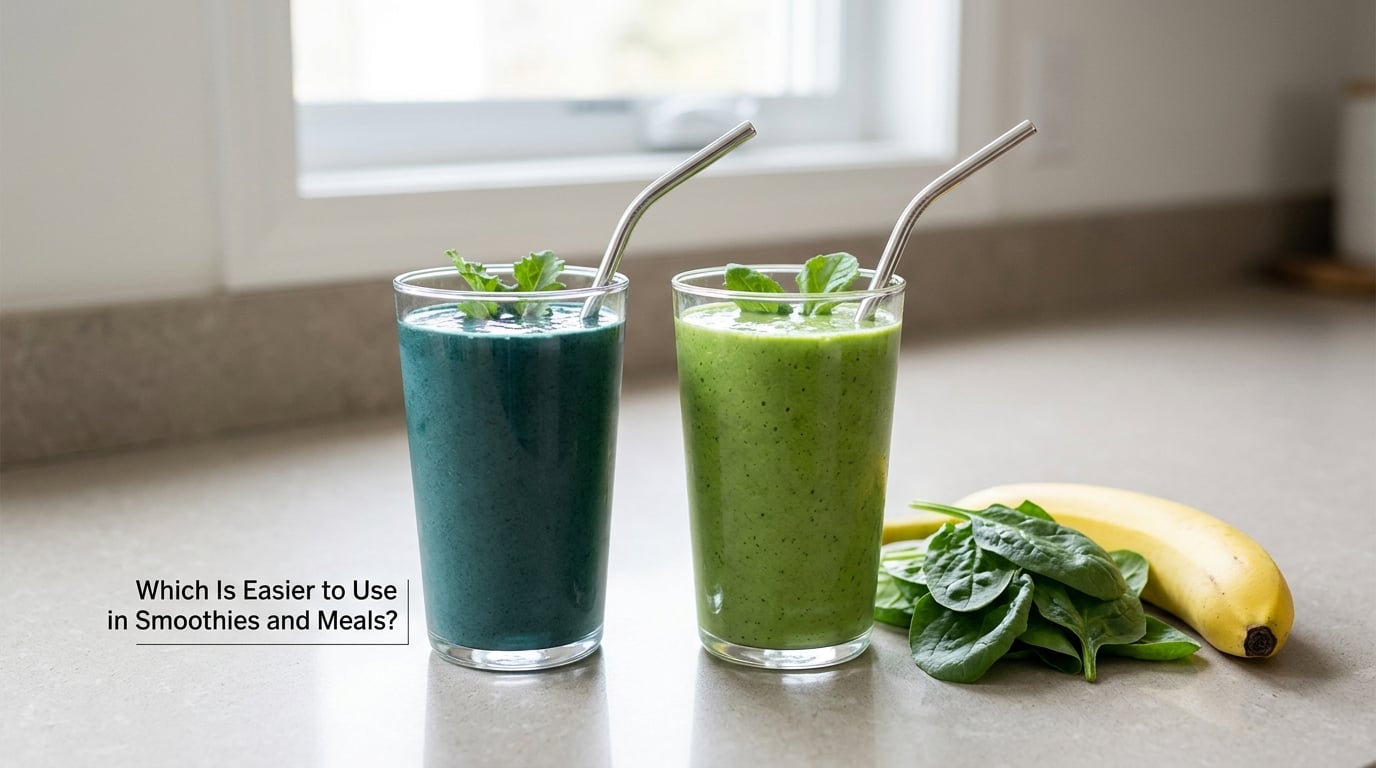
Spirulina is easier in food. One teaspoon per serving disappears into a smoothie made with a banana or mango, and the flavor reads as a faint earthiness in the background. The powder also blends into overnight oats, energy bites, hummus and savory sauces without fighting the dish.
Chlorella works too, but expect a slightly greener, grittier result in the same applications. Some people prefer it in savory dishes, where a vegetal note reads as an ingredient rather than an error.
Form changes the routine more than people expect. Powder is cheapest per serving and gives you the most control over the dose. Tablets are the most convenient and chlorella needs roughly three times as many of them as spirulina to reach a comparable amount. Capsules sit in the middle. Fresh frozen forms have the least oxidation but need a cold chain and a short shelf life.
Whatever the format, follow the directions on your own product. Recommended serving sizes and powder concentrations vary enough that doubling a scoop based on someone else’s advice is how people end up with stomach trouble.
Are Spirulina and Chlorella Safe for Everyday Use?
For most healthy adults, yes, at typical doses and with a product that has been tested by an independent lab. The real risks sit in product quality and in specific health conditions, not in the algae themselves.
Contamination is the first thing to understand. Open-pond spirulina is grown where cyanobacteria naturally bloom, and those ponds can carry microcystin, a cyanotoxin. Independent testing has also turned up trace aluminum, mercury, nickel and lead in retail products, along with pharmaceutical residues in some samples. A 2022 survey of protein supplements found significant mineral label inaccuracy, which is a warning about trusting front-of-pack numbers in general.
Look for third-party certification from USP, NSF or ConsumerLab, and check that the species is named on the label, either Arthrospira platensis or Chlorella vulgaris. A single ingredient is easier to verify than a microalgae blend that may contain undisclosed botanicals.
Some caution applies to particular groups. Anyone on warfarin should avoid chlorella unless their clinician approves, because it carries meaningful vitamin K. People with phenylketonuria should skip spirulina because it contains phenylalanine. Both algae can raise uric acid, which matters if you have gout. Kidney disease, autoimmune conditions and pregnancy or breastfeeding are all cases where you want a doctor’s input first.
Reactivity to mold or pollen allergies can also cross-react with chlorella. Rare reports describe kidney inflammation, photosensitivity and a single case of liver injury, none of them common, all of them worth knowing about.
For anyone asking whether chlorella or spirulina pulls heavy metals out of the body: no good human evidence shows that either one does. Laboratory work shows antioxidant protection in animals, and you should read animal results as animal results. Your liver and kidneys already do the job.
How Do Cost and Availability Compare?
Both are sold as powder, tablets, capsules and blends, in most health food stores and online, and neither is hard to find. Price varies far more within each category than between the two, driven by strain, drying method, whether the cell wall is cracked, whether a lab tested the batch, package size and brand.
Compare cost per serving rather than container price. A large bag of cheap chlorella that needs fifteen tablets a day can cost more per day than a smaller bag of cracked-cell-wall chlorella, and the cheap one may be doing less for you.
Third-party certification is where cost is worth paying. Testing is a real cost that some brands absorb and others pass on, and it is the single clearest quality difference you can actually check before buying.
Which Should You Choose?
Choose spirulina if you want more protein per gram, fewer pills, and the strongest daily antioxidant baseline of the two. It suits plant-based eaters topping up protein and anyone who would rather blend a scoop than count tablets.
Choose chlorella if you prioritize chlorophyll content and iron, if spirulina’s ocean-like flavor is a turn-off, or if your goal is athletic performance, where the available evidence leans in its favor. Expect to swallow more tablets and to start slowly to avoid gas.
Stack both if you want the broader spread of nutrients and enjoy the routine, since a 50/50 blend tablet is the most common combined format. You pay for the convenience and the pill count goes up.
Whichever you pick, buy a third-party tested product with a named species, start at half the label serving, and give it two weeks before you judge it.
Frequently Asked Questions
Can you take spirulina and chlorella every day?
Most healthy adults can take either one daily at typical label doses, and combined 50/50 tablets exist for exactly that purpose. What decides whether daily use suits you is product quality and your own health context. Start at half a serving for the first few days, take it with food, and get a clinician’s advice first if you take warfarin, have kidney disease, or are pregnant or breastfeeding.
Which has more protein, spirulina or chlorella?
Spirulina, by a clear margin. It reaches up to about 70 percent protein by dry weight, while chlorella usually falls between 50 and 59 percent. A teaspoon of spirulina powder delivers roughly 3 to 4 grams, against about 2 to 3 grams for a teaspoon of chlorella. Amino acid quality is respectable in both, so the gap is about total amount rather than how well your body uses what is there.
Is spirulina or chlorella better for weight loss?
Neither has a convincing direct claim. What the human evidence does show is modest movement in cholesterol, blood pressure and fasting blood sugar for both, which can help indirectly if you are also eating well and training. Chlorella is frequently used as a short course rather than a daily driver, and there is no good evidence that one of them burns more fat than the other. Judge any product on the label and the testing, not the weight-loss promise.
Does spirulina or chlorella provide vitamin B12?
Do not rely on either for B12. Spirulina contains mostly pseudovitamin B12, a compound that lab tests read as B12 but that the body cannot use, a problem documented by Watanabe and colleagues in 1999. Chlorella appears to contain a small amount of more usable B12, but the quantities are inconsistent between batches. Vegans and anyone with a deficiency should get B12 from fortified food or a supplement with a stated dose.
Can you mix spirulina and chlorella together?
Yes, and many people do. Combined 50/50 tablets are the most common blended format, and taking them together simply gives you the union of both nutrient profiles. The trade-offs are practical rather than safety related: pill counts add up quickly, since chlorella already needs many more tablets than spirulina, and the cost per serving goes up. If you only want one, pick spirulina for protein or chlorella for chlorophyll and iron.
How do I choose a high-quality spirulina or chlorella product?
Check five things. The species should be named, either Arthrospira platensis or Chlorella vulgaris. For chlorella, the label must say broken or cracked cell wall, or the nutrients may pass through undigested. Look for third-party certification from USP, NSF or ConsumerLab, which covers heavy metals and microcystins. Prefer a single ingredient over a blend. And buy smaller packages more often, because oxidation is what creates that old fishy smell.
Bottom Line
Spirulina wins the everyday-use comparison on practicality. It digests without needing a cracked cell wall, delivers more protein per serving, and needs far fewer tablets. Chlorella is the pick when chlorophyll and iron matter most, when spirulina’s marine flavor is a problem, or when training performance is the goal and you can handle a larger pill count.
Two things are non-negotiable either way. Neither is a B12 source, and chlorella only earns its keep if the label says the cell wall is broken. Buy a third-party tested product with a named species, start with half the label serving for the first few days, and ask a doctor or registered dietitian about your specific situation.