
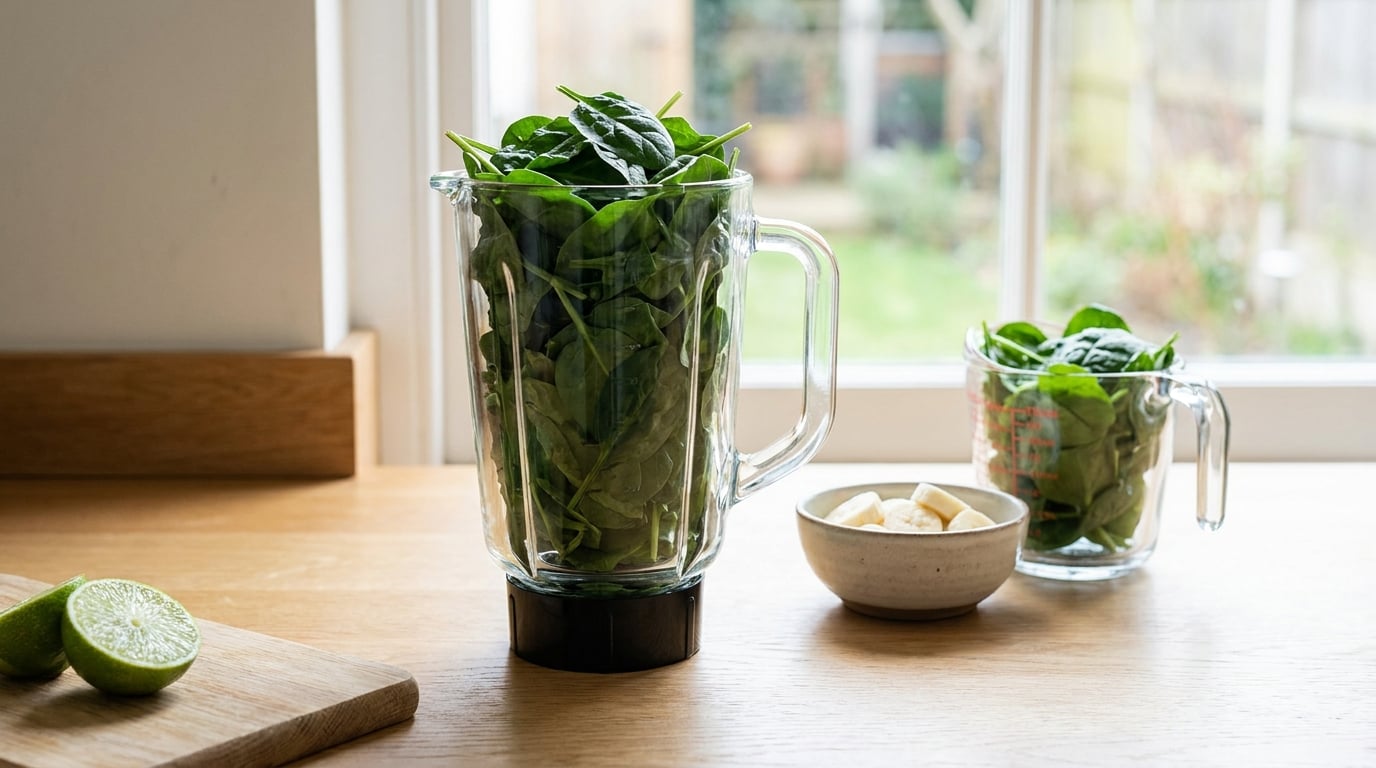
For most healthy adults, about 1 to 2 cups (30-60 g) of raw spinach in a single smoothie is a well-tolerated amount, and the point where how much spinach is too much stops being a taste question becomes 4 cups (120 g) or more in one drink. That line exists because of oxalate, not because spinach itself becomes poisonous. Read on for the numbers, the reasoning behind them, and the handful of people who should ask a clinician before they start pouring greens.
Table of Contents
How Much Spinach Is Too Much in a Smoothie?
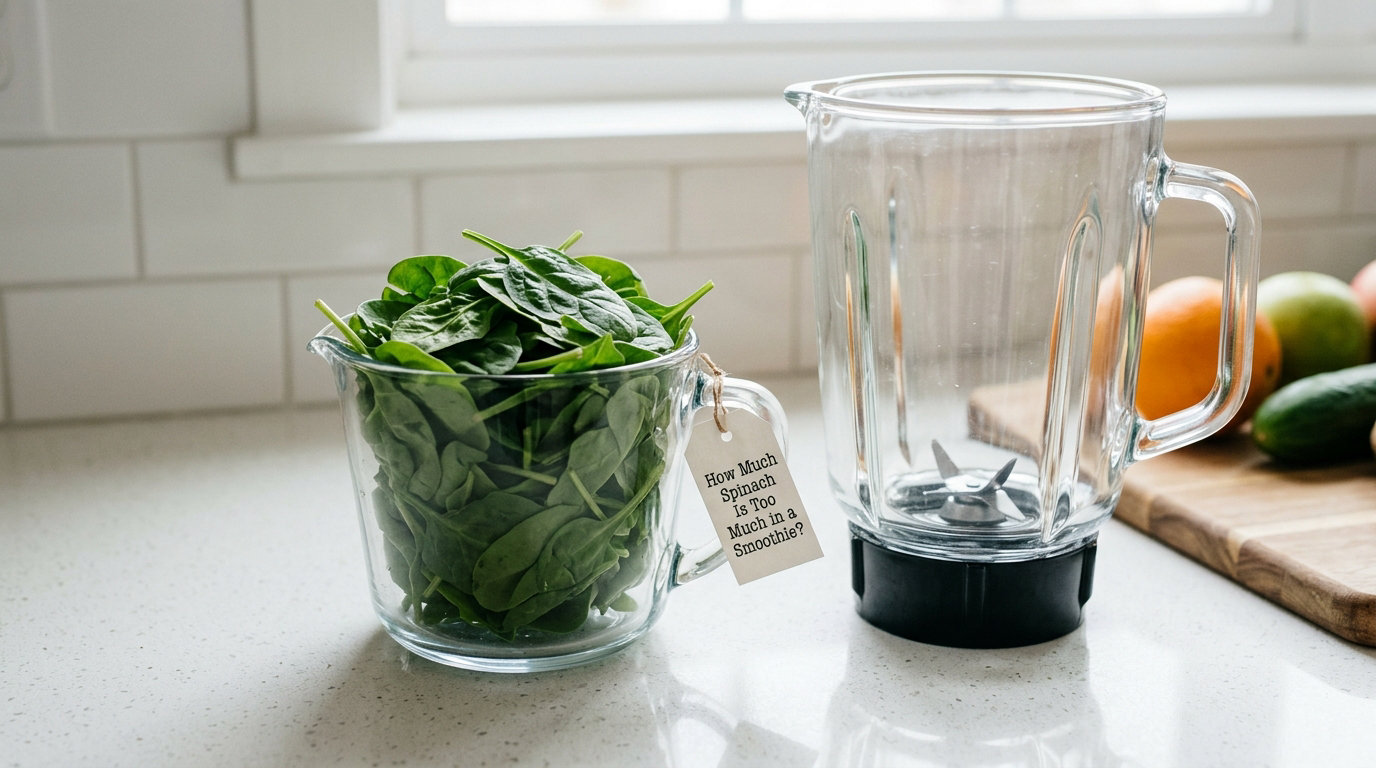
One to two cups of raw spinach per smoothie is a normal, everyday amount for most adults. Four cups or more in a single drink is where the oxalate load stops being trivial, and a raw amount that large is rarely worth it for taste reasons alone anyway.
Spinach sits near the top of the dietary oxalate list. One cup of raw leaves is commonly cited at roughly 650 mg of oxalate, and a half cup of cooked spinach has been reported at about 755 mg. A smoothie delivers that whole raw volume at once, with no cooking step and no second helping, which is why portion size carries more weight here than it does for a cooked side dish.
| Spinach per smoothie | Approximate oxalate load | Verdict for most adults |
|---|---|---|
| Handful, about 1/2 cup (15 g) | Roughly 300 mg | Easy going. Fine as an accent, not worth counting. |
| 1 cup packed raw (30 g) | Roughly 650 mg | Comfortable. This is what most home recipes land on. |
| 2 cups packed raw (60 g) | Roughly 1,300 mg | Still fine for healthy kidneys, but you will taste it. |
| 3-4 cups raw (90-120 g) | Roughly 2,000-2,600 mg | Overkill. Benefit stops climbing, flavour turns grassy. |
| 6 cups and up (180 g+) | Roughly 3,900 mg and above | The genuinely excessive zone. Common in juice cleanses, not in daily cooking. |
Two caveats on those figures. They are drawn from food-composition data that varies by cultivar, soil and cooking method, so treat them as order-of-magnitude rather than lab precision. And a mixed smoothie dilutes them: the other ingredients are not all high-oxalate, and pairing with calcium changes what your gut absorbs.
For orientation, dietitians usually frame high oxalate intake as roughly 250 mg per day or more, low-oxalate plans at about 40-50 mg per day, and some clinical advice for people with a stone history aims to keep intake under 500 mg per day. Those thresholds are for total daily oxalate from all foods, not for spinach alone, and they are not a personal prescription. They exist mainly to show that a large raw spinach serving clears every one of those markers in a single glass.
What Is a Normal Spinach Serving in a Smoothie?
A normal serving in smoothie practice is one packed cup of baby spinach, roughly 30 g. That is the number most home recipes cluster around, including the green ratios people share in r/fitmeals and r/Smoothies.
The trouble is that “a handful,” “a cup,” and “a serving” mean three different things depending on who says them. A loose handful is closer to a quarter cup. A packed cup is a gentleman’s fistful with the leaves pressed down. A loose cup is closer to half of that. The same recipe can move from 15 g to 40 g without changing a single word.
Here is the translation that saves arguments:
- A loose handful: about 15-20 g, roughly 1/2 cup unpacked.
- A packed cup: about 30 g raw baby spinach.
- 2 ounces: about 56 g, somewhere between 1 and 2 packed cups.
- 5-8 ounces: 140-225 g, the practical ceiling people in comment sections report before a blend tastes or thickens unpleasantly.
One thing worth naming: a blender load is not automatically a nutrition-label serving. FDA and USDA serving conventions for leafy greens were built around boiled or canned portions, not raw blended leaves, so a “1 cup of spinach” on a nutrition panel is not the same object as a “1 cup of spinach” in a blender jar.
Baby spinach and mature flat-leaf spinach also behave differently in the glass. Baby leaves are milder, which makes them easier to run past a cup without the drink turning grassy, and most home blenders now sell exclusively as baby. Mature leaves carry a stronger earthy flavour and are not interchangeable in volume, because a cup of mature leaves is a denser, more fibrous, more oxalate-forward handful than a cup of baby.
How Much Spinach Can You Drink per Day?
There is no single number that fits every person, which is the honest answer to “how much spinach is too much per day.” For a healthy adult with normal kidney function, two cups of raw spinach in a daily smoothie is a common habit and not inherently a problem.
Two cups of raw spinach a day, which is the amount people most often ask about, sits above the 250 mg high-oxalate marker and well above the 40-50 mg low-oxalate target. For most people that is a trade rather than a danger: they are choosing a nutrient-dense green in exchange for accepting an oxalate load their kidneys filter without fuss. For someone who has already formed calcium oxalate stones, the same two cups is a different conversation entirely.
Reference guidance for dark leafy greens generally lands around 1.5 to 2 cups a day, rotated across different greens. Rotation is the practical move that lowers your average oxalate intake without lowering your overall green intake, and it also solves the flavour boredom that makes people quit green smoothies in week three.
Powder changes the arithmetic. A spoonful of spinach powder represents a far larger amount of leaf than its volume suggests, and concentrated powders have been the subject of the clearest caution in the brand and clinic guidance that circulates on this topic. Follow the label serving rather than the free-scoop instinct, especially if you already eat fresh greens elsewhere that day.
Culinary quantities and supplement quantities are not the same category. Two cups of spinach in a smoothie is food. A gram-scale dose of a greens concentrate is a supplement, and supplement dosing is a question for whoever prescribed or recommended it.
Does Too Much Spinach Cause Side Effects?
The effects of a very large spinach intake are mostly digestive, and the serious concern is not spinach poisoning at all. It is oxalate meeting calcium in the wrong place.
Digestive effects from a sudden jump
Spinach carries fibre and a fair amount of magnesium, and going from no greens to several cups overnight is a real change for a gut that has not adapted. Bloating, gas, cramping and looser stools are the common complaints, and they usually settle as tolerance builds. A very large raw amount can also fill a blender with so much leaf that the drink turns thick and gritty rather than smooth, which is a texture problem more than a health one.
Oxalates and calcium oxalate stones
Oxalate binds calcium in the gut. Some of that binding is helpful, because it reduces how much oxalate gets absorbed at all, and pairing spinach with calcium-rich foods has been reported to cut oxalate absorption by roughly 30-40 percent. What is not absorbed is the part that travels to the kidneys, where it can meet calcium and, for people whose kidneys do not clear it efficiently, form calcium oxalate stones.
This is worth saying plainly, because the fear runs ahead of the evidence: healthy kidneys filter dietary oxalate without drama, and for the overwhelming majority of people large intakes are not automatically harmful. The risk concentrates in a specific group.
Vitamin K and blood thinners
Spinach is very high in vitamin K1, and vitamin K works against warfarin and similar anticoagulants. This is not a side effect of volume so much as a consistency issue: the guidance for people on warfarin is that vitamin K intake stays steady day to day, rather than swinging between no greens and a large spinach smoothie on Monday. If you take a blood thinner, that is a conversation to have with the prescriber before you change your routine, not after.
The green cleanse case that is worth knowing about
The one scenario that genuinely deserves caution is the multi-day green juice or smoothie cleanse built on very large raw spinach intakes, sometimes with low calcium and low fluid. There is a documented history of acute oxalate nephropathy in people who went on high-oxalate juice diets, and it has been discussed in a Hacker News thread on green smoothie cleanses precisely because the pattern is so counter-intuitive: a plan marketed as a reset ended with a hospital visit. Short, ordinary smoothies are not that scenario. Weeks of nothing but juice is a different activity.
Who should ask a doctor or dietitian first
- Anyone with a history of calcium oxalate kidney stones, or with chronic kidney disease.
- People on warfarin or another anticoagulant, before making greens a daily habit.
- Pregnant or breastfeeding people, especially around vitamin K and iron needs.
- Parents making high-volume green drinks for toddlers, whose intake is far smaller and whose kidneys are still developing.
- Anyone whose green intake is part of a multi-day cleanse or who already drinks several large juices daily.
What you actually get from the spinach
Worth keeping in the frame, because fear tends to erase the reason people drink these things. Spinach delivers folate, lutein and zeaxanthin, nitrates, and non-heme iron. The iron point is routinely misread: non-heme iron from plants is absorbed less efficiently than heme iron from meat, so spinach alone is not an iron delivery system, and pairing it with vitamin C such as citrus, kiwi, strawberries or bell pepper improves absorption. Adding calcium at the same time is the useful move for oxalate, and vitamin C is the useful move for iron. Nothing conflicts here.
How to Balance Spinach Taste and Nutrition
Past about one cup, spinach starts to assert itself. The colour shifts, the flavour turns grassy, and the drink separates. Adjusting the recipe is usually a better answer than cutting the spinach out.
- Banana, mango or pineapple: sweetness and acidity that carry the taste, plus pectin that fixes a thin or watery blend.
- Citrus, kiwi, berries: brightness that cuts the earthiness, and vitamin C that helps with non-heme iron absorption.
- Ginger or mint: both cut the grassy note specifically rather than just sweetening over it.
- Coconut, nut butter or seeds: fat and body that mellow the flavour and add the calcium that binds oxalate in the gut.
- Lower-oxalate green swaps: kale, romaine, bok choy, chard and cucumber all bring volume and colour at a fraction of spinach’s oxalate load, and rotating them across the week is the simplest way to lower your average.
Two more adjustments that cost nothing. Put the spinach in with the liquid first and blend before adding frozen fruit, which gives the leaves time to break down instead of surviving as flecks. And if a blend is too thin to drink, add ice or more fruit rather than more greens.
Scaling up for two people is where people accidentally double their intake. A double batch is fine, but split the spinach between two jars rather than pouring the full doubled amount into one, and use the second half of the batch on a lower-oxalate green.
Tips for Using Spinach Safely in Smoothies
Handling matters more than most recipe pages admit, particularly for a raw green that gets blended rather than cooked.
Wash fresh spinach under running water before it goes anywhere near the blender jar, and buy it pre-washed if you are short on time. Keep it chilled and use it within the window the packaging states, because spinach is a leafy green and wilts quickly at room temperature.
Blanching changes the picture more than people expect. Boiling spinach for a couple of minutes and discarding the water removes a meaningful share of soluble oxalate, and it is the standard advice for anyone managing oxalate intake. That does not make a cooked spinach smoothie remotely appealing, but frozen blanched spinach is easy to find and easy to blend.
Frozen is the most convenient form and a perfectly safe one when it comes from a reputable source, and frozen spinach is typically blanched before freezing, which is why it blends so much more smoothly than raw leaves. I would still skim any package that says uncooked or unblanched and give it a smell and a look before blending it.
Blend in small batches and do not overfill the jar. Blenders expand greens, and an overfilled jar can blow the lid off the next time you hit the button.
Drink the smoothie promptly rather than leaving it sitting on the counter, and refrigerate anything left over and drink it within a day. The usual food-safety rule applies: perishable smoothies should not sit out for more than two hours, and one hour if the room is hot.
Updated for October 2026. This is general information about food and nutrition, not individual medical advice. If you have kidney disease, a history of kidney stones, take blood thinners, are pregnant or breastfeeding, or are simply unsure, talk to your doctor, pharmacist or a registered dietitian before changing how much spinach you drink.
Frequently Asked Questions
Is one cup of spinach too much in a smoothie?
No, one packed cup of raw spinach, about 30 g, is a normal serving for most adults and is where most home recipes land. It carries a substantial oxalate load, roughly 650 mg, so it is worth pairing with something containing calcium rather than drinking it on its own. Kidney function and any blood-thinner medication are the two factors that would change that answer.
How much spinach should I put in a smoothie?
Start at one packed cup, about 30 g, and add more only if the taste works for you. Community recipes and video comment consensus tend to cluster between 5 and 8 ounces of greens per blender load as a practical maximum. Beyond about two cups the drink turns grassy and you gain very little that a cup does not already provide.
Is spinach good to drink every day?
For most healthy adults, yes, a daily spinach smoothie is a reasonable habit and daily use is not automatically harmful. Keep the amount moderate, rotate in lower-oxalate greens such as kale or romaine on some days, and pair it with a calcium source. If you have a history of kidney stones, take warfarin, or are pregnant, get individual guidance before making it a daily routine.
Can spinach cause kidney stones?
Spinach cannot cause kidney stones on its own, but it is among the highest-oxalate foods in the diet, and oxalate that binds with calcium in the kidneys can contribute to calcium oxalate stones in people who form them. Most people with healthy kidneys filter dietary oxalate without trouble. If you have had calcium oxalate stones, ask your doctor how much spinach is appropriate for you.
What happens if I drink a smoothie with a lot of spinach?
For most people, nothing serious. You may notice bloating, gas or looser stools, especially if you jumped from little fibre to a very large amount quickly, and the drink will probably taste grassy and drink thick. The number that matters is context rather than the single glass: a large serving on top of a high-oxalate diet is different from the same serving alongside calcium-rich foods and plenty of water.
Is spinach safe during pregnancy?
Spinach is a nutritious food and is not something to avoid during pregnancy. It provides folate, which matters in pregnancy, along with iron and vitamin K. The points to raise with your doctor or midwife are vitamin K if you take blood thinners, iron supplementation alongside your prenatal vitamin, and your personal history with kidney stones. General pregnancy nutrition advice is worth following over any single food rule.
What to Do First
Measure before you pour. If your current recipe is a generous handful, put it in a measuring cup once and see where it lands, because most people are guessing high.
Aim for one packed cup, about 30 g, as your default. Add a calcium source in the same drink, and swap in kale, romaine or cucumber on some days of the week so spinach is a rotation rather than a fixed ingredient.
If you have kidney stones, kidney disease, take blood thinners, are pregnant or breastfeeding, or are making smoothies for a toddler, take your number to a doctor, pharmacist or registered dietitian instead of using a general guideline. That conversation is quick, and it turns a vague worry into a number you can actually plan around.