
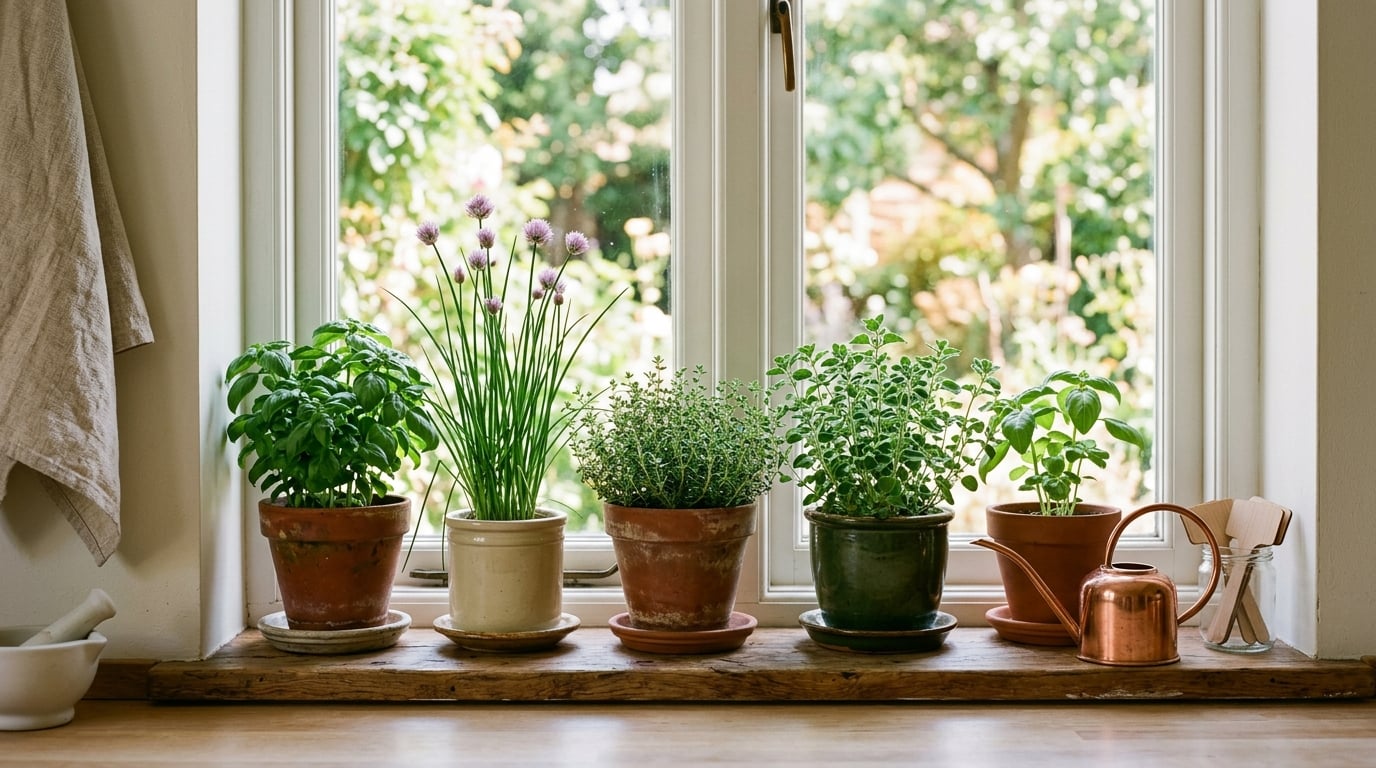
Yes, you can grow herbs indoors year round. The whole thing comes down to one factor: light. Give your plants 6 to 8 hours of bright light, or 12 to 16 hours under a full-spectrum grow light, and a sunny windowsill will keep handing you fresh basil, chives and thyme through every month of the year. The setup takes an afternoon, and the weekly care is a two-minute check with a finger in the soil.
That said, plenty of people try this and watch it collapse within six weeks. Usually it isn’t a lack of effort. It’s a pot with no drainage hole, or a north-facing window that never delivers what the plant needs, or basil that was pinched too hard and never grew back.
This guide walks through the whole routine, including the half of the question nobody covers: what to do in January versus July, when to repot, and what to replace. It works for a single windowsill or a full shelf setup.
Table of Contents
- What You Need
- Step-by-Step: How to Grow Herbs Indoors Year Round
- Common Mistakes
- Frequently Asked Questions
- What is the easiest herb to grow indoors for beginners?
- How much light do indoor herbs need each day?
- Can I grow herbs indoors without a grow light?
- Why are my indoor herbs turning yellow?
- Should I use potting soil or regular garden soil indoors?
- How often should I harvest indoor herbs without killing them?
What You Need
You can start with almost nothing. A sunny sill, a few terra-cotta or plastic nursery pots, a bag of potting mix, and a watering can will carry you a long way.
Light. Find the brightest window in your home before you buy anything. South-facing gives the strongest light and is worth the most, east- and west-facing are good, and north-facing is genuinely hard. If the only window you have points north, plan on a grow light from the start rather than watching plants fail for a month first.
Containers with drainage holes. This is the item people skip and then blame the plant for. Four- to six-inch pots suit most single herbs; go eight inches for basil, rosemary or anything you want to keep for a couple of years. Wide, shallow trays work well for thyme, oregano and marjoram, which stay small. Clear plastic pots are useful in winter because the wet soil is visible instead of hidden.
Potting mix. Buy an indoor potting mix formulated to hold air, not a bag of garden soil scooped from the yard. Garden soil compacts, drains badly and brings insects in with it. For rosemary, thyme, sage and oregano, blend roughly one part potting mix to one part cactus mix or perlite so water moves through fast.
A watering method. A small can with a fine rose spout, or a squeeze bottle for dense pots. A wooden chopstick or a moisture meter is a nice extra, but your finger works and costs nothing.
Feeding. A liquid houseplant or vegetable fertilizer used at half strength, once or twice a month in the growing season. Skip it in midwinter, when the plant is barely moving.
Labels and shears. A marker and a lot of labels, because parsley and cilantro look identical when small and you’ll forget which is which. Clean scissors or snips for pinching and cut-backs.
Step-by-Step: How to Grow Herbs Indoors Year Round
Choose Your Herbs and Growing Spot
Start with three or four herbs, not a dozen. Most beginners do best with basil, chives, mint, parsley, thyme, oregano, sage or lemon balm, all of which tolerate indoor conditions and recover from mistakes.
Match the herb to the light you actually have. Basil, rosemary and sage want the most. Chives, parsley and mint are more forgiving. Mint is aggressive enough to spread from a single pot, so give it a pot of its own rather than sharing a tray.
| Herb | Light need | Water need | Easiest way to start |
|---|---|---|---|
| Basil | Bright, 6-8 hours | Evenly moist | Nursery plant or seed |
| Chives | Bright, 6-8 hours | Evenly moist | Seed or division of an outdoor clump |
| Thyme | Bright, 6-8 hours | Let dry between waterings | Cuttings or nursery plant |
| Rosemary | Brightest available | Let dry between waterings | Cuttings |
| Oregano | Bright, 6-8 hours | Let dry between waterings | Cuttings or nursery plant |
| Sage | Bright, 6-8 hours | Light, let dry | Cuttings or seed |
| Parsley | Medium to bright | Evenly moist | Nursery plant, not seed |
| Mint | Medium to bright | Moist | Cuttings rooted in water |
| Lemon balm | Medium to bright | Evenly moist | Seed or cuttings |
| Marjoram | Bright, 6-8 hours | Light, let dry | Seed or cuttings |
Some herbs are simply a bad bet indoors. Cilantro, dill and French tarragon are cool-season plants that need a distinctly cool period to stay sweet, and indoors they bolt within weeks of flowering, at which point the leaves turn bitter and stop being worth the pot. Parsley from seed is notoriously slow to germinate and often fails; buy a nursery plant instead. Chives will grow indoors, but they sulk in a warm, dim room, so give them the best light you have.
Place pots where you will actually notice them. Herbs on a windowsill in an unused spare room get forgotten; herbs beside the sink where you stand every morning get harvested and watered.
Prepare Containers and Potting Mix
Check every pot for a drainage hole before you fill it. If it’s a decorative cachepot with no hole, keep the plant in its nursery pot and use the outer pot as a tray, emptying it after each watering.
Fill with loose indoor potting mix, leaving about an inch of headroom so watering doesn’t push mix over the rim. Tap the pot down gently to settle the mix and firm the surface lightly, but don’t compact it with your fingers.
Size matters more than people expect. A cramped root system causes a plant to dry out in days, go pale, and bolt early. When roots circle the bottom of the pot or push water out of the drainage hole every time you water, move up one size rather than two.
Plant or Transfer Herbs to Grow Indoors Year Round
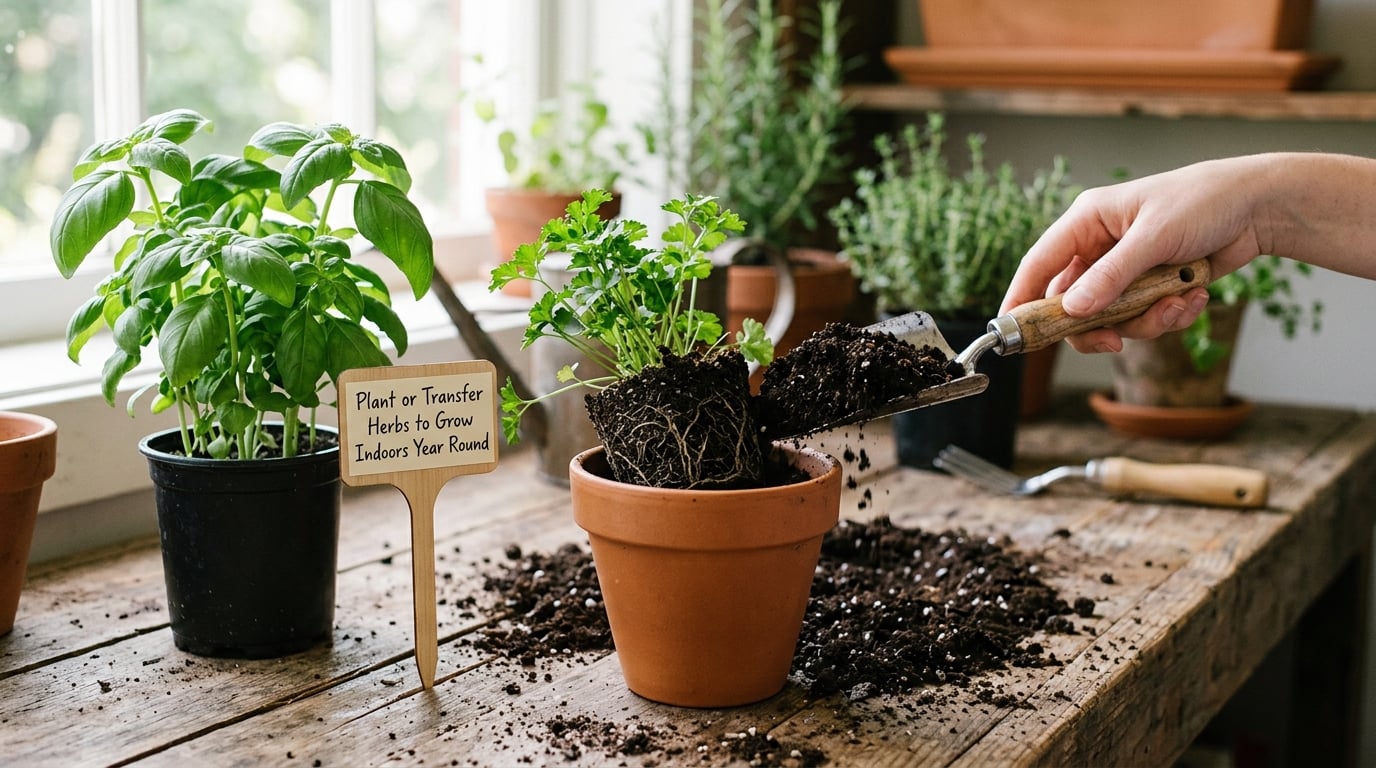
There are four ways to start, and they suit different budgets and levels of patience.
Seed. Best for basil, marjoram, lemon balm and chives. Sow shallow, barely covering the seed, and keep the surface damp until germination, which takes about a week for basil. Seed gives you more plants than you need, which is useful given how many annuals you’ll replace.
Nursery plants. The fastest route and the one I’d pick for a first attempt. You see exactly what you’re getting, and you can taste the plant in the shop by rubbing a leaf.
Cuttings. Snip a 4 to 6 inch soft tip of basil, mint or rosemary, strip the lowest leaves and stand it in a glass of water. Roots usually appear within a week or two. Mint is close to impossible to fail with this method; rosemary takes longer but works.
Division or repotting. Chives and parsley from an outdoor clump can be lifted and split in spring, taking a piece of root with each section.
Whichever route you take, quarantine anything new for three to seven days in a room away from your existing plants. Aphids and spider mites hide on undersides of leaves, and a supermarket basil plant is a common carrier. Check with a soapy-water spray, isolate, and only merge the plant into your setup once it’s clean.
Give Herbs the Right Light
Most culinary herbs want 6 to 8 hours of bright light a day. Bright indirect light, several feet back from a south-facing window, counts. A dim corner six feet from the glass does not, no matter how many hours it is technically daytime. Light is the one variable you can’t fudge, which is why it decides whether how to grow herbs indoors year round works for you or ends in a row of pale sticks by February.
A south-facing window is the best free light. East and west windows are usually fine, with the east giving gentler morning sun that suits leafy herbs like parsley and chives. North-facing windows rarely sustain basil or rosemary; put mint, lemon balm or parsley there and accept a smaller harvest.
Grow lights are worth it when your only light is dim, when you’re in a northern climate where winter days are short, or when you want to grow herbs in a room with no window at all. A full-spectrum LED positioned within about a foot of the plant, on for 12 to 16 hours a day, will outperform a mediocre window hands down.
Run a simple photoperiod rather than leaving the light on around the clock. Plants need dark hours to rest, and a constant bath of light encourages leggy growth and pests. Turn the light on in the morning and off at night with a plug-in timer, and rotate your pots a quarter turn each week so growth stays even.
Water Without Overwatering
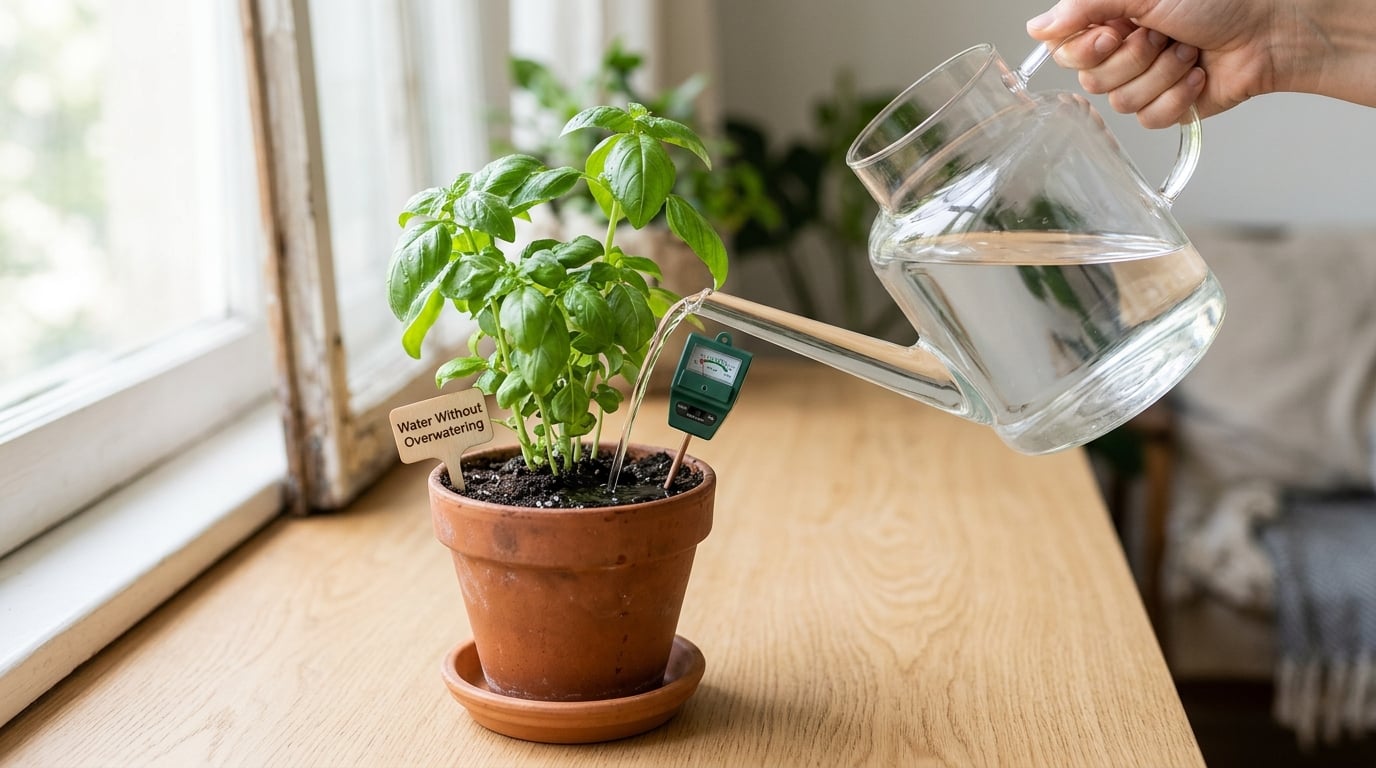
Check before you water, every time. Push a finger about an inch into the soil: if it’s damp, wait. If it’s dry at that depth, water. Herbs die indoors far more often from too much water than too little.
When you do water, be thorough. Pour slowly and evenly until water runs out of the drainage hole, which flushes salts and wets the whole root ball rather than just the surface. Then empty the saucer ten minutes later, because a pot sitting in water is the fastest route to root rot.
Adjust the rhythm to the plant, the pot and the season. A terracotta pot in a sunny summer window might need water twice a week; the same pot in January might go ten days. Mediterranean herbs like rosemary, thyme and oregano want the soil to dry out between waterings, while basil, mint and parsley prefer it kept lightly and evenly moist. Group pots by need so you can move the dry-loving herbs together on one tray and the thirsty ones on another.
Support Healthy Growth
Feed once or twice a month through spring and summer at half the strength printed on the bottle. Container soil has no reserve, and an un-fed plant that’s been harvested four times is running on nothing. Skip fertiliser in midwinter when growth has slowed.
Rotate pots weekly for even light, and check that leaves aren’t pressed against a cold pane. Indoor herbs do best around 65 to 70°F; a drafty window or a vent blasting straight onto the leaves will stress them and can cause leaf drop.
Prune regularly. Cut leggy shoots back to a leaf node and let the plant regrow from the point where the leaves join the stem. Repot once a year in spring into a pot one size larger. Keep air moving across the leaves, because still, damp air is how powdery mildew starts, and rosemary in particular needs that airflow.
Accept that annuals have a shelf life. Basil and chives in particular will decline after a year indoors no matter how well you treat them, because they are annuals by nature. Start a new plant before the old one fades, and keep a rooted basil cutting in a glass of water on the counter as an insurance policy. That’s the honest answer to year round: a small, steady replacement routine rather than one immortal plant.
Harvest Herbs Throughout the Year
Harvesting is not a one-time event. Regular picking is what keeps a windowsill herb garden producing, because cutting tells the plant to branch rather than stretch.
Pinch above a leaf node, where a leaf joins the stem, taking the growing tip and the leaf or two below it. Two shoots then grow from that point, and the plant gets bushier instead of taller. Never strip more than a third of a plant’s foliage at one time; removing a little more than that can finish it off.
Basil responds best to a hard cut-back, and unlike most herbs it grows back from bare stem. Once it has six leaf pairs, cut the top few pairs and it will branch hard. For woody herbs like rosemary, sage and thyme, harvest sprigs from the tips and never cut back into old bare wood, which often won’t resprout.
When you get more than you can cook, use it rather than letting it spoil. Hang small bunches to dry, mince leaves into oil and freeze them in an ice cube tray, or steep them in vinegar. Whatever you bring in from the windowsill, rinse it under cold running water before it goes near the plate.
Common Mistakes
Nearly every indoor herb problem shows up as a change in leaf colour or shape, and the fixes are usually simpler than people expect. Most of the reasons beginners struggle with how to grow herbs indoors year round trace back to one of the entries below, so work through the table before buying anything new.
| Symptom | Likely cause | Fix |
|---|---|---|
| Long, thin, pale stems with wide leaf spacing | Not enough light, or grow light too far away | Move to the brightest window; add a grow light within about 12 inches; pinch back leggy growth |
| Lower leaves yellow, soil stays wet for days | Overwatering, poor drainage, or roots crowded in the pot | Stop watering until the top inch dries; check for a drainage hole and empty saucers |
| Sudden wilt with wet soil | Root rot from constant saturation | Unpot, trim away dark mushy roots, repot in fresh dry mix, water far less often |
| Tiny white insects under leaves, sticky residue | Aphids | Isolate the plant, rinse leaves, treat with insecticidal soap, repeat weekly until clear |
| Fine webbing, stippled or bronzed leaves | Spider mites | Isolate, wash both sides of leaves, raise humidity, treat with insecticidal soap or neem |
| Small flies rising from the soil surface | Fungus gnats, from constantly wet soil | Let the top inch dry fully, cut watering back, top-dress with sand or perlite |
| White powdery coating on leaves | Powdery mildew in still, damp air | Remove affected leaves, increase airflow, reduce crowding and avoid wetting foliage |
| Flowers and bitter-tasting leaves appearing | Bolting, from heat, stress or short days | Pinch flower stems early; if already bolted, remove the plant and resow |
| Soil dries out every two days, roots circling the base | Root-bound plant in a pot that’s too small | Move up one pot size and refresh the potting mix |
| Leaves pale and growth stalled in winter | Too little light in short days | Add a grow light on a 12-16 hour timer, or pause feeding until spring |
Two habits prevent most of this. Check soil moisture instead of watering on a fixed schedule, and inspect leaf undersides whenever you water, which takes about five seconds and catches an aphid outbreak early. Chewing on herbs is a bad idea regardless of how clean your setup is.
Frequently Asked Questions
What is the easiest herb to grow indoors for beginners?
Chives and parsley are usually the most forgiving, because they tolerate a range of light and watering conditions and rarely need daily attention. Mint is even easier if you give it a pot of its own, since it spreads aggressively and resists neglect. Basil is a good second choice if your spot gets at least 6 hours of bright light, since it grows fast and shows you quickly whether your light and watering are working.
How much light do indoor herbs need each day?
Most culinary herbs need 6 to 8 hours of bright light. Bright indirect light a few feet from a south-facing window counts, as does 12 to 16 hours under a full-spectrum grow light placed within about a foot of the plant. A dim corner several feet from the glass will not sustain basil or rosemary, no matter how many daytime hours it gets.
Can I grow herbs indoors without a grow light?
Yes, if you have a genuinely bright window. South-facing is best, east and west are usually fine, and a north-facing window suits only the more tolerant herbs like mint, parsley and lemon balm. If your only light is dim, or you live somewhere with short winter days, a grow light is cheaper than replacing a windowsill of stretched, pale plants every few months.
Why are my indoor herbs turning yellow?
The usual causes are overwatering, a pot without a drainage hole, or roots crowded in a container that’s too small. Check the soil: if it stays wet for days, stop watering until the top inch dries out. Yellowing that starts on the oldest lower leaves usually means water. Yellowing across the whole plant with dry soil usually means it’s depleted and needs feeding or a repot.
Should I use potting soil or regular garden soil indoors?
Use a potting mix formulated for containers. Garden soil compacts, holds water too long and brings insects and pathogens in with it, which is why outdoor soil kills so many indoor plants. For rosemary, thyme, sage and oregano, blend about one part potting mix with one part cactus mix or perlite so water drains quickly and the roots sit in air rather than mud.
How often should I harvest indoor herbs without killing them?
Harvest regularly, but never remove more than a third of a plant’s foliage at once. Pinch above a leaf node to take the growing tip and the pair of leaves below it, and do this whenever the plant has six or more leaf pairs. Basil can be cut back hard and will branch again, while rosemary and sage should only be trimmed at the tips, never down into old bare wood.
Start with two or three easy herbs in the brightest spot you have, and pick pots with drainage holes. Give them a finger test before every watering, pinch them regularly, and accept that you’ll replace the annuals once a year. Add a grow light only when you’ve hit a limit that more light solves, and you won’t need much beyond that to keep fresh herbs coming through every month of 2026.