
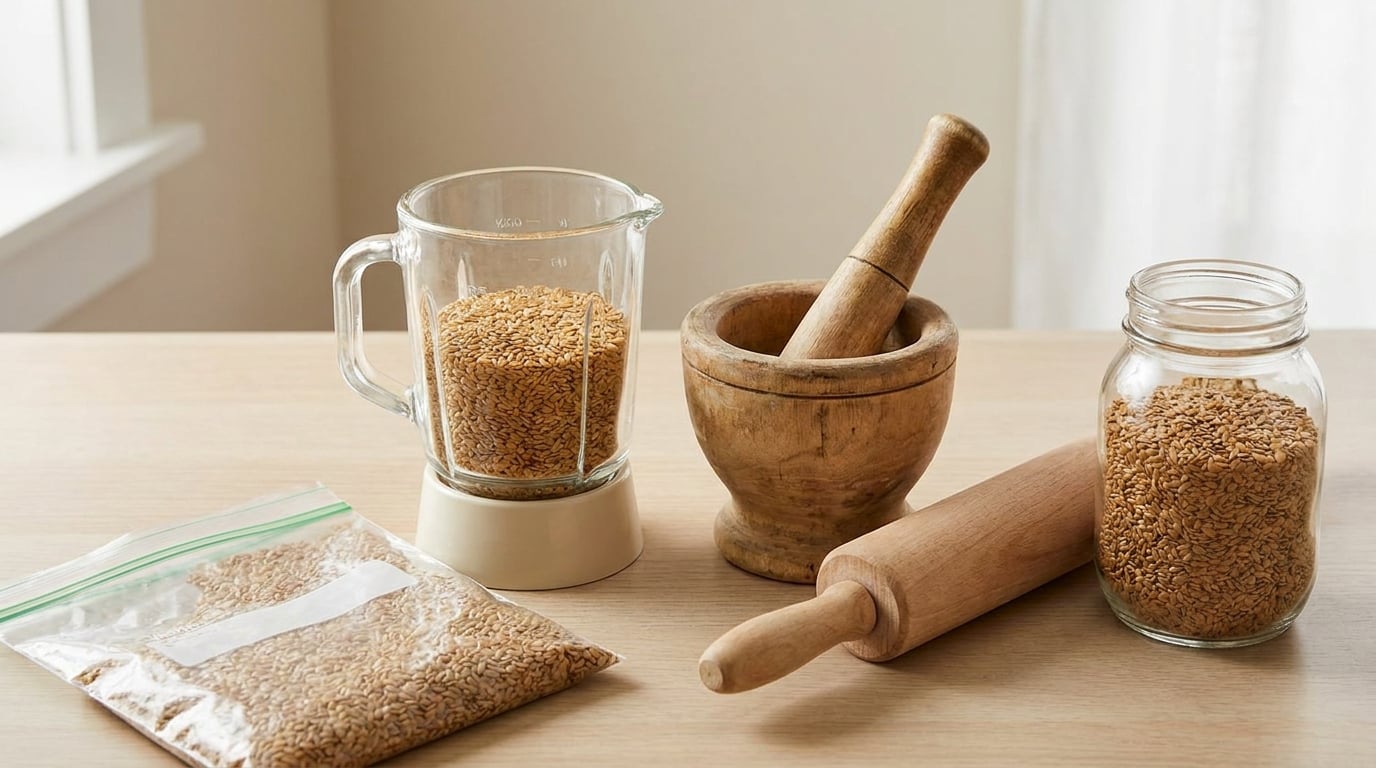
Grinding flaxseed without a coffee grinder takes about a minute. Pulse a regular blender for 10 seconds at a time with the seeds loaded high enough to sit above the blades, lift and shake the jar between pulses, and repeat three to five rounds. A food processor or mini chopper works nearly as well, and a rolling pin or mortar and pestle gets you a coarse meal with no motor at all.
That first detail, seeds sitting above the blade line, is the whole trick. Blades grind by impact, so if the seeds sit in the bottom of the jar in a thin layer, they spin under the blade untouched and you get the same disappointing result people describe on cooking forums. Load enough that the pile is higher than the blade, and the seeds fall into the path of something spinning fast.
If you own a coffee grinder, there is a fair argument for skipping it. Flax is oily, and the oil gums up burrs, carries a strong nutty flavor into your beans, and works blades dull over time. Plenty of home bakers have burned through more than one grinder on oily nuts alone. A small spice grinder handles flaxseed without any of that, and if you would rather not buy another appliance, the hand methods below work.
Updated for 2026. This is general nutrition information, not medical advice. If you have a condition or take medication, talk to your doctor or a registered dietitian about adding flax to your routine.
Table of Contents
- What You Need
- Step-by-Step: How to Grind Flaxseed Without a Coffee Grinder
- Common Mistakes
- Frequently Asked Questions
- What is the best substitute for a coffee grinder when grinding flaxseed?
- Can I grind flaxseed in a regular blender?
- How fine should flaxseed be ground for smoothies?
- Is a mortar and pestle enough to grind flaxseed?
- How long does ground flaxseed stay fresh?
- Should I grind flaxseed immediately before using it?
- Get Your Flaxseed Grind Right
What You Need
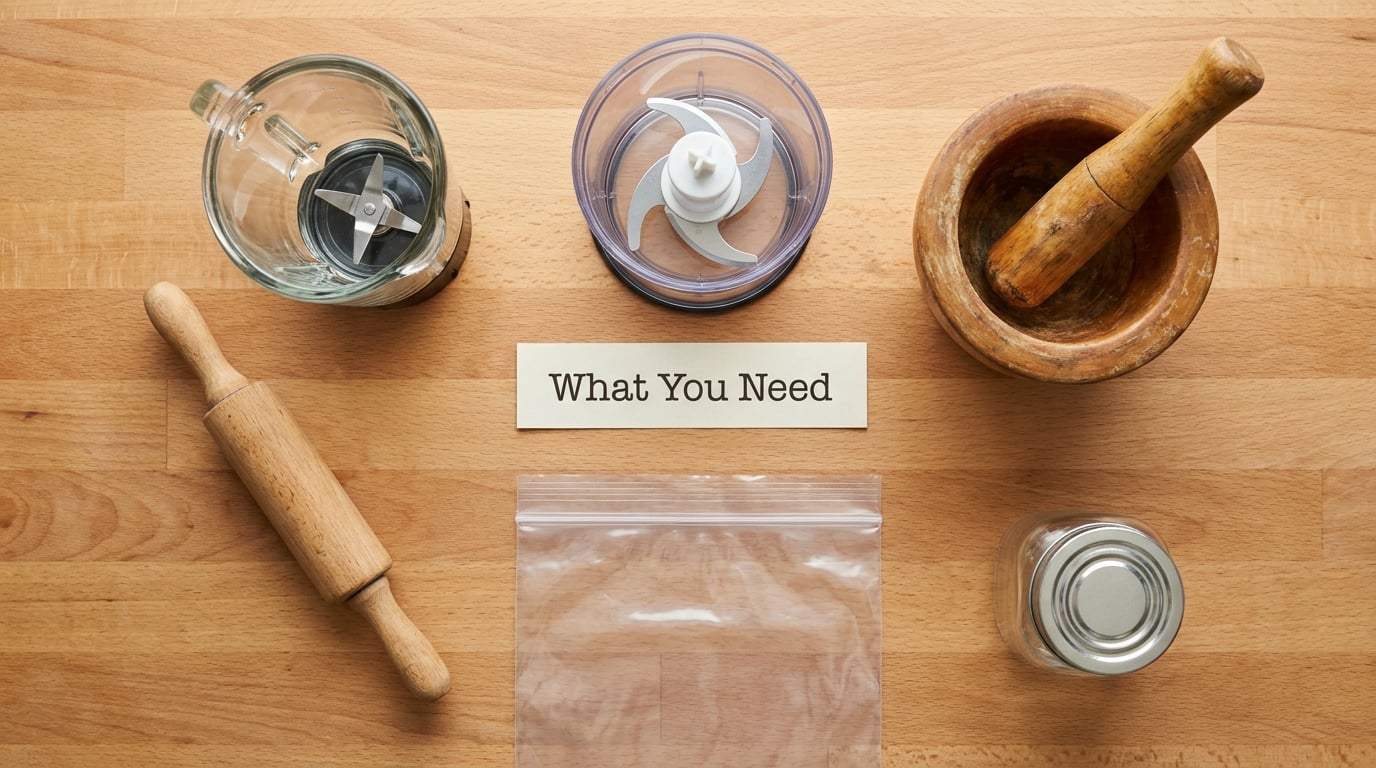
You do not need a dedicated grinder. What you need depends on which method you pick.
- Blender method: any blender with a dry jar, a measuring spoon, and 2 to 5 tablespoons of whole flaxseed per batch.
- Food processor method: a food processor bowl or mini chopper, a spatula for scraping the sides, and no more than a quarter of the bowl filled.
- Spice grinder method: a small spice grinder plus a baking sheet, if you plan to toast the seeds first. Most people already own a wooden spoon to clear the jar.
- Hand methods: a mortar and pestle, or a rolling pin, a clean zip-top bag, and the flat of a heavy knife.
Also worth having: a small airtight glass jar with a lid, and a small dish or the flat of your palm to test texture against. A fine mesh sieve or a coarse strainer helps separate powder from stray hull fragments if you want the smoothest result for smoothies.
Start with whole seeds and grind your own. Whole flaxseed keeps for months in a cool pantry because the hull protects the oils inside, and you can grind exactly what a recipe needs. Flaxseed already ground as flax meal is convenient, but it costs more per pound, and the oils are exposed from the moment it hits the shelf.
Step-by-Step: How to Grind Flaxseed Without a Coffee Grinder
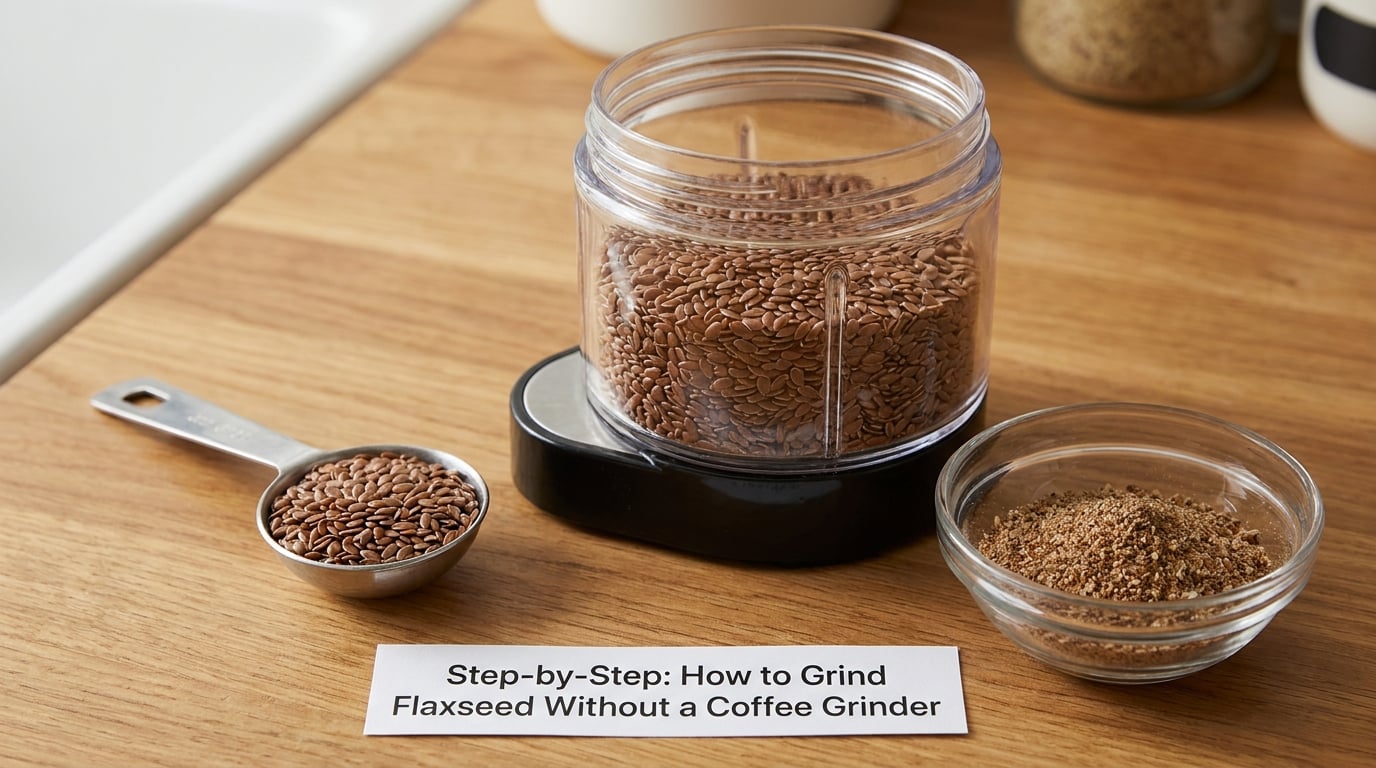
Every method below produces the same thing, a coarse brown powder, and the difference is how fine it gets and how long it takes. The blender wins on speed and fine texture. The hand methods are slower and give you a coarser meal that works well in oatmeal and baking.
| Method | Time needed | Fineness | Equipment | Best for |
|---|---|---|---|---|
| Blender, pulsed | About 1 minute total | Fine to medium meal | Blender you already own | Smoothies, flax eggs, baking |
| Food processor or mini chopper | 1 to 2 minutes | Medium meal | Processor you already own | Larger batches, oatmeal, yogurt |
| Spice grinder | 30 to 60 seconds | Fine flour-like powder | Small spice grinder | The smoothest texture, no blender grit |
| Mortar and pestle | 5 to 15 minutes per tablespoon | Coarse cracked seed | Mortar and pestle | Small amounts, baking |
| Rolling pin in a bag | 3 to 5 minutes per batch | Coarse cracked seed | Rolling pin, zip-top bag | No appliances at all |
| Toasted seeds, any method | Adds 5 to 8 minutes | Crushes more easily | Baking sheet or skillet | Hand methods that struggle |
You do not need to add any liquid. Dry grinding works, and water is only relevant if you are chasing flaxseed milk or paste rather than dry meal.
Using a Blender: How to Grind Flaxseed Without a Coffee Grinder
This is the fastest method, and the technique that makes it work is a load amount and a shake. The load-and-pulse pattern is the one most people copy, and the reason is simple: a dry blade grinder only catches what falls into its path.
- Measure 2 to 5 tablespoons of whole flaxseed. The pile should sit above the blade line, so check before you start. In a small single-serve cup you may need the smaller end of that range.
- Secure the lid and pulse on high for 10 seconds.
- Take the jar off the base and shake it so seeds that parked against the wall fall back onto the blades. Reseat it on the base.
- Repeat the pulse, lift, and shake cycle three to five times, checking the texture between rounds.
- Stop when the powder is evenly coarse with no whole seeds left. A little texture is fine and expected.
Do not add water for dry grinding, and do not run the jar continuously for a full minute. Continuous blending heats the seed and starts working the released oil into a paste, which clings to the walls and pulls the motor harder. Short bursts with a shake in between keep things dry and loose.
One safety note, since a blender jar is designed to run liquid: never operate it dry with nothing in the jar, and stay on low speed for the very first second so the seeds get pulled into the blade rather than fired at the wall. Keep the lid on and your hand off the blade assembly.
Using a Food Processor or Mini Chopper
A food processor handles flaxseed well, though the disappointing results people post about usually come from two mistakes: overfilling the bowl and running it too long. Short bursts with frequent checks are the fix, specifically to avoid overheating the seed.
Fill the bowl no more than a quarter full. Seeds need room to fall, and a full bowl packs them into a dense layer the S-blade just pushes around. Pulse for 5 to 10 seconds, then scrape the sides down with a spatula so material stuck on the wall returns to the blade path. Repeat three or four times, or until no whole seeds remain when you tilt the bowl.
Stop the moment the texture is even. A minute of solid running is what turns ground flax into a gummy paste, and cleaning that out of the bowl takes longer than the grinding did.
Using a Small Spice Grinder
A spice grinder is the compromise people land on when they do not want to use a coffee grinder, and it is the only method here that produces a genuinely fine, flour-like powder with no coarse grit left.
Toast the seeds first if you have a baking sheet. Spread them in a single layer at 350°F for 5 to 8 minutes until they smell nutty. Cool them completely, then grind for 30 to 60 seconds, shaking the grinder partway through. Toasting dries the hull out and makes it brittle enough to crumble, which cuts grinding time and helps any method, not just this one.
Two things to plan for. The aroma sticks. A spoon wiped through the jar afterward clears most of it, but a dedicated grinder means your next batch of cinnamon will not taste like a nutty warehouse. And ground flax is more intense in flavor after a few days, so grind smaller amounts and use the powder sooner than you would with whole seed.
Using a Mortar and Pestle or Rolling Pin
These are the no-appliance routes, and they are genuinely useful for a tablespoon in a bowl of oatmeal. Just be realistic about the endpoint: you are crushing seeds, not making flour.
For a mortar and pestle, work with about a tablespoon at a time. Grind in slow circles, then use the pestle to press and roll the crushed seed against the bowl wall, which breaks the pieces further. Expect this to take real time, and expect some intact seeds even after a solid ten minutes on one tablespoon, which is a fair warning rather than a failure. Toast the seeds first and the job gets noticeably easier.
For a rolling pin, put 2 to 3 tablespoons into a zip-top bag, seal it, and press firmly with the pin, rotating the bag often so you crush new sections rather than hammering the same spot. For stubborn seeds, put the bag on a cutting board and tap the whole thing with the flat of a heavy knife. Stop when the bag feels sandy rather than lumpy. You will get a coarse cracked seed, which is ideal for oatmeal, yogurt, and quick breads, and fine for smoothies if you sift out the hull pieces.
Common Mistakes
Most failed flaxseed grinds come down to the same handful of problems, and all of them are fixable without a new appliance.
| What went wrong | Why it happened | Fix |
|---|---|---|
| Seeds came out whole | They sat below the blade line in a thin layer | Load enough that the pile rises above the blades, then pulse and shake |
| Grit with some powder mixed in | Seeds stuck to the jar wall between pulses | Lift and shake the jar each round, or scrape the sides down |
| Paste stuck in the bowl | Over-blended, and heat worked the oils into a gummy paste | Stop as soon as the texture is even, use short bursts |
| Motor running hot or straining | Too much seed for the jar, or a long continuous run | Grind 2 tablespoons at a time, 10 seconds on, then pause |
| Seeds refuse to break down | Fresh seed still has a tough, oily hull | Toast at 350°F for 5 to 8 minutes, cool, then grind |
| Bitter or paint-like smell after storage | The oils have oxidized and gone rancid | Toss it, grind a fresh small batch, and store properly |
That last row matters more than it looks. Whole seeds keep well because the hull seals the oils inside. Grinding breaks that seal, and the alpha-linolenic acid in flax starts oxidizing, which is the rancid, crayon-like smell people describe. Ground flaxmeal keeps in an airtight container in the refrigerator for about a week, or several months in the freezer.
Grind no more than a week’s supply at a time, label the jar with the date, and use a clean dry spoon every time. Scooping with a wet spoon introduces water and speeds up spoilage.
One more route worth knowing: you do not have to grind flaxseed at all if you are blending it into a drink. Soak 2 tablespoons of whole seeds in 1 cup of water overnight, then blend for 30 seconds and strain. The result is flaxseed milk with the fiber already broken down, and it needs no grinder. The same seeds, soaked instead of ground, thicken into a paste you can stir into oatmeal or spread on toast.
Frequently Asked Questions
What is the best substitute for a coffee grinder when grinding flaxseed?
A blender is the best substitute, and you probably already own one. Load 2 to 5 tablespoons of seeds high enough to sit above the blades, pulse on high for 10 seconds, then lift the jar, shake it, reseat it, and repeat three to five times. A food processor or mini chopper is the second choice, and a small spice grinder gives the finest powder if you want to buy one small appliance.
Can I grind flaxseed in a regular blender?
Yes, and the method is widely used. The only condition is that the seeds must sit above the blade line, since blades work by impact and seeds lying flat under them will simply spin in place. Use 10-second high-speed bursts rather than one continuous run, shake the jar between bursts so seeds fall back onto the blades, and never add liquid unless you are making flaxseed milk.
How fine should flaxseed be ground for smoothies?
Finely enough that no whole seeds remain and the powder feels sandy, not like gravel. Medium-coarse meal works fine in oatmeal, yogurt, and baking, where some texture disappears anyway. For smoothies, a spice grinder or a second full blender round gets you closer to flour. If coarse hull pieces bother you, pass the powder through a fine mesh sieve and keep the powder for your drink.
Is a mortar and pestle enough to grind flaxseed?
It works for small amounts, but expect a coarse cracked seed rather than a fine powder, and expect it to take real effort. Budget 5 to 15 minutes per tablespoon, and press the crushed seed against the bowl wall with the pestle to break the pieces down further. Toasting the seeds at 350°F for 5 to 8 minutes first dries out the hull and makes the job noticeably easier.
How long does ground flaxseed stay fresh?
About a week in the refrigerator, or several months in the freezer. Grinding breaks the hull that seals the oils inside the seed, and those oils start to oxidize, which is what produces a bitter or paint-like smell. Store the meal in an airtight container, use a dry spoon each time, and label the jar with the date. If it smells sharp or crayon-like, toss it.
Should I grind flaxseed immediately before using it?
Grinding right before use gives you the freshest flavor and the least oxidation, so it is ideal if you have the time. In practice, grinding a few days’ supply and keeping it refrigerated is the better trade for most kitchens. Avoid grinding a month at once, since the meal darkens and the flavor intensifies as the oils oxidize, and it is easy to grind a small batch on a Sunday.
Get Your Flaxseed Grind Right
For most kitchens, a blender pulsed in 10-second bursts with a shake between rounds is the fastest way to get a usable flax meal, and the load amount matters more than the machine. A food processor is the runner-up and takes a little more patience, since you need to stop before the meal turns to paste. A spice grinder gives the finest result if you already have one or would rather keep oily seeds away from your coffee beans.
When no appliance is involved, toast the seeds at 350°F for 5 to 8 minutes first, then crush them with a rolling pin in a zip-top bag or a tablespoon at a time in a mortar. That combination turns a frustrating ten-minute job into something closer to three.
Whatever method you pick, start small, pulse in short intervals, and stop when the texture suits the recipe. Two tablespoons, three rounds, and a jar in the fridge beats a big batch that turns bitter in a month.