
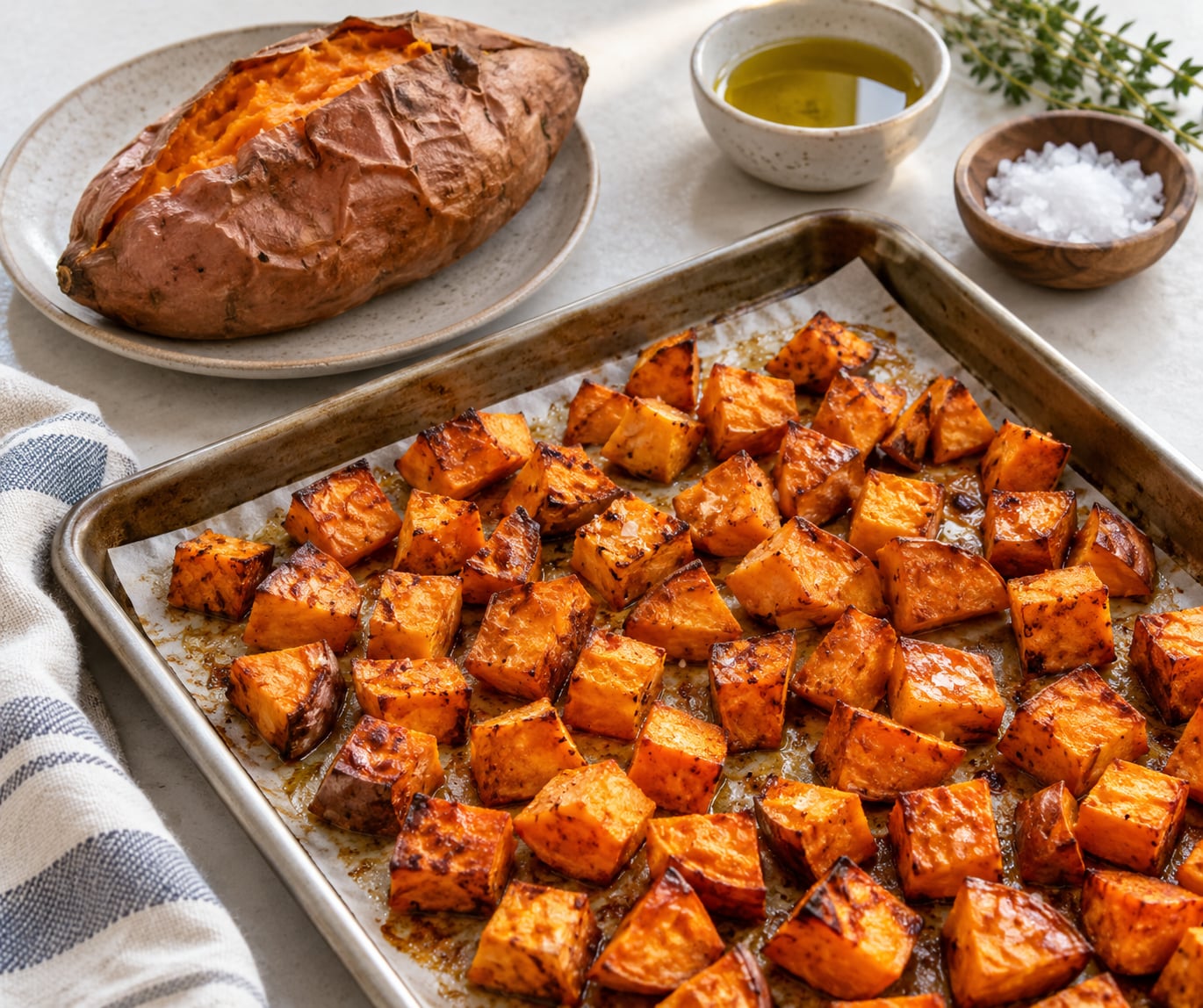
To cook sweet potatoes in the oven, set the oven to 425°F (200°C) and give the potatoes 25 to 30 minutes if you cut them into cubes, 35 to 45 minutes for halves or wedges, and 45 to 60 minutes for a whole one. That is the short version. The difference between a good tray and a disappointing one comes down to three things: even cuts, a hot pan with space between the pieces, and enough oil for the edges to actually brown.
Sweet potatoes hold more natural sugar and less starch than white potatoes, so high dry heat caramelizes them rather than just cooking them. Get that right and the outside goes deep golden while the middle turns soft and creamy, the kind of texture that works for a weeknight side, a breakfast base, or a meal-prep batch. Get it wrong and you get a watery center, a limp skin, or a pan bottom coated in burnt sugar syrup.
Below is the method I actually use, plus the size-to-time numbers, the temperature comparison, and fixes for the soggy results people complain about most.
Table of Contents
- What You Need
- Step-by-Step: How to Cook Sweet Potatoes in the Oven
- Common Mistakes
- Frequently Asked Questions
- What’s the best temperature for baking sweet potatoes?
- Is it better to bake sweet potatoes at 350°F or 400°F?
- Should you wrap sweet potatoes in foil when baking?
- How do I keep roasted sweet potatoes from turning soggy?
- How do I know when a sweet potato is done baking?
- How long do sweet potato cubes and wedges take in the oven?
- Conclusion
What You Need
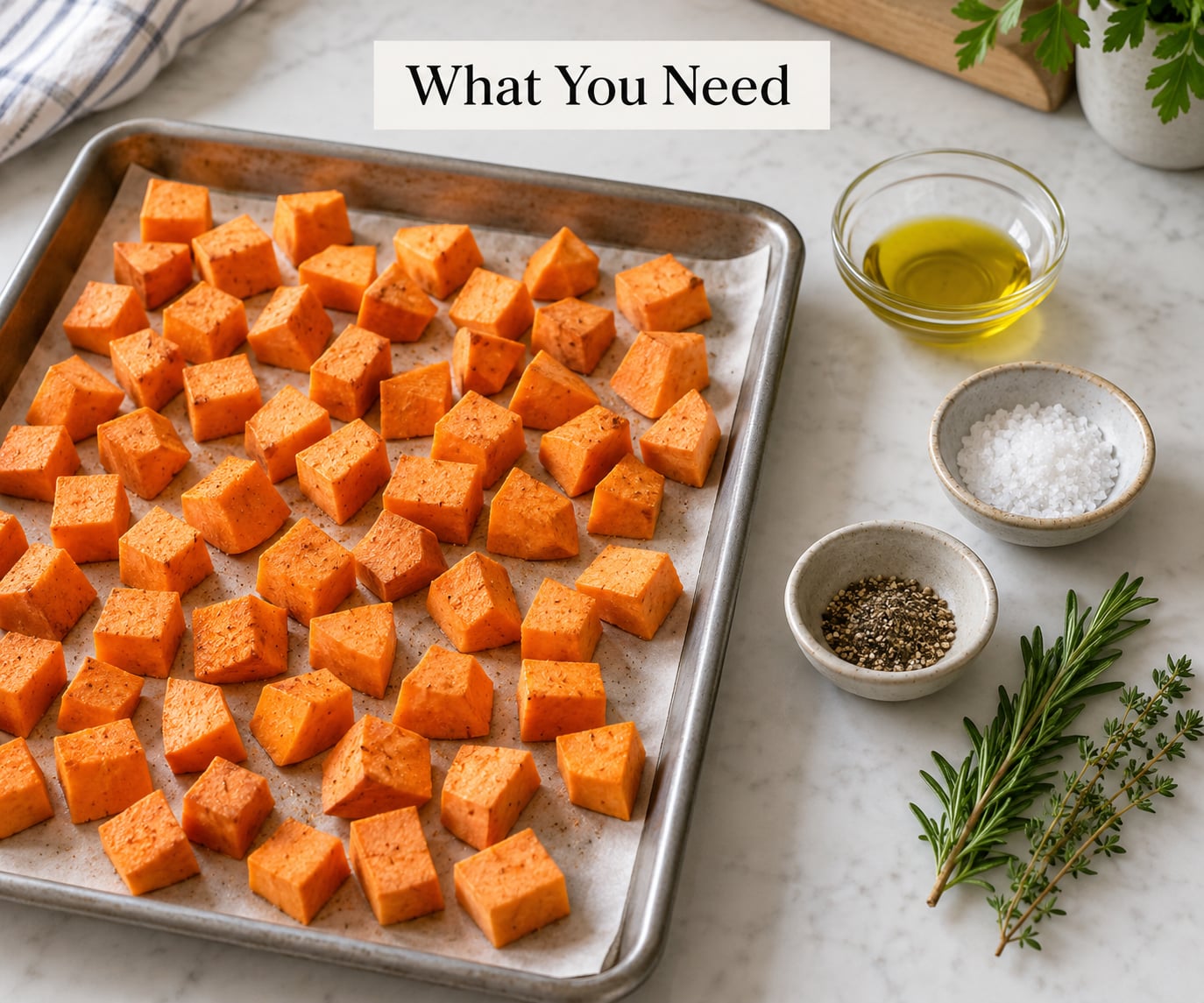
The ingredient list is short: sweet potatoes, oil, salt. Everything else is a decision about how you cut them and how hot you go. Pick firm potatoes with smooth skin and no soft spots or deep bruising. Soft, wrinkled or bruised areas turn watery in the oven, and that is where most bad trays start.
Equipment and ingredients
- Sweet potatoes: medium ones (about the size of a closed fist) roast evenly. Very large jumbos need 60 minutes or more and are the least forgiving cut.
- Rimmed baking sheet: a rim matters because the released sugar and moisture need somewhere to go instead of pooling under the potatoes.
- Wire rack: optional, but it lifts the pieces off the pan so the underside cooks instead of steeping in syrup. This is the single best trick against burnt sugar on the bottom.
- Oil: olive oil is the everyday default. Avocado oil and refined coconut oil are better if you are pushing the oven to 450°F, since they are less likely to taste bitter.
- Seasoning: kosher salt and cracked black pepper are enough. Smoked paprika, cinnamon, cayenne, curry powder, taco seasoning and pumpkin pie spice all work depending on the dish you are building.
- A fork or instant-read thermometer: the fork is the traditional test, the thermometer is the precise one.
Evenly cut pieces versus a whole potato
This is the decision that shapes everything else. A whole potato roasts in its own steam, so the flesh turns creamy and soft but the skin stays soft and slightly moist. Cut pieces have exposed flat faces, and those faces contact the hot pan, which is where browning happens. Cut your pieces for caramelized edges, and leave it whole for a fluffy breakfast potato.
Cubes go on at 425°F for 25 to 30 minutes. Halves and thick wedges take 35 to 45 minutes. A whole medium potato takes 45 to 60 minutes. Small ones finish 10 minutes sooner than large ones, which is why a single number never quite works for a whole potato.
Step-by-Step: How to Cook Sweet Potatoes in the Oven
- Heat the oven to 425°F. Put the rack in the middle and let the oven come to temperature fully, which takes 15 to 20 minutes. Result cue: an oven thermometer reads 425°F, not 400°F.
- Preheat the sheet while you prep. Slip the empty baking sheet into the hot oven. A hot pan gives the cut faces an instant jump in heat, which speeds up caramelization. Result cue: the pan is hot enough that a drop of water skitters and vanishes.
- Scrub, pierce and cut. Scrub the skin under cold water. For a whole potato, poke it 8 to 10 times with a fork so steam can escape and the skin does not split. For cut pieces, trim the ends and cut into even 1/2 to 3/4 inch cubes, or halve them lengthways. Result cue: every piece is about the same size, so they finish together.
- Dry the pieces thoroughly. Pat them with a towel or spread them out for 10 minutes. Surface water has to evaporate before browning can start, and this step is more reliable than any soak people swear by. Result cue: the cut faces feel dry, not tacky.
- Coat with oil and season. Toss the pieces with 1 to 2 tablespoons of oil, then salt generously. Oil is the carrier for heat, and it is what turns the edges from baked to browned. Result cue: every piece has a faint sheen.
- Spread in a single layer. Use a second pan if the pieces are touching. Crowding drops the pan temperature and traps steam, which is the most common cause of soggy roasted sweet potatoes. Result cue: you can see the pan surface between the pieces.
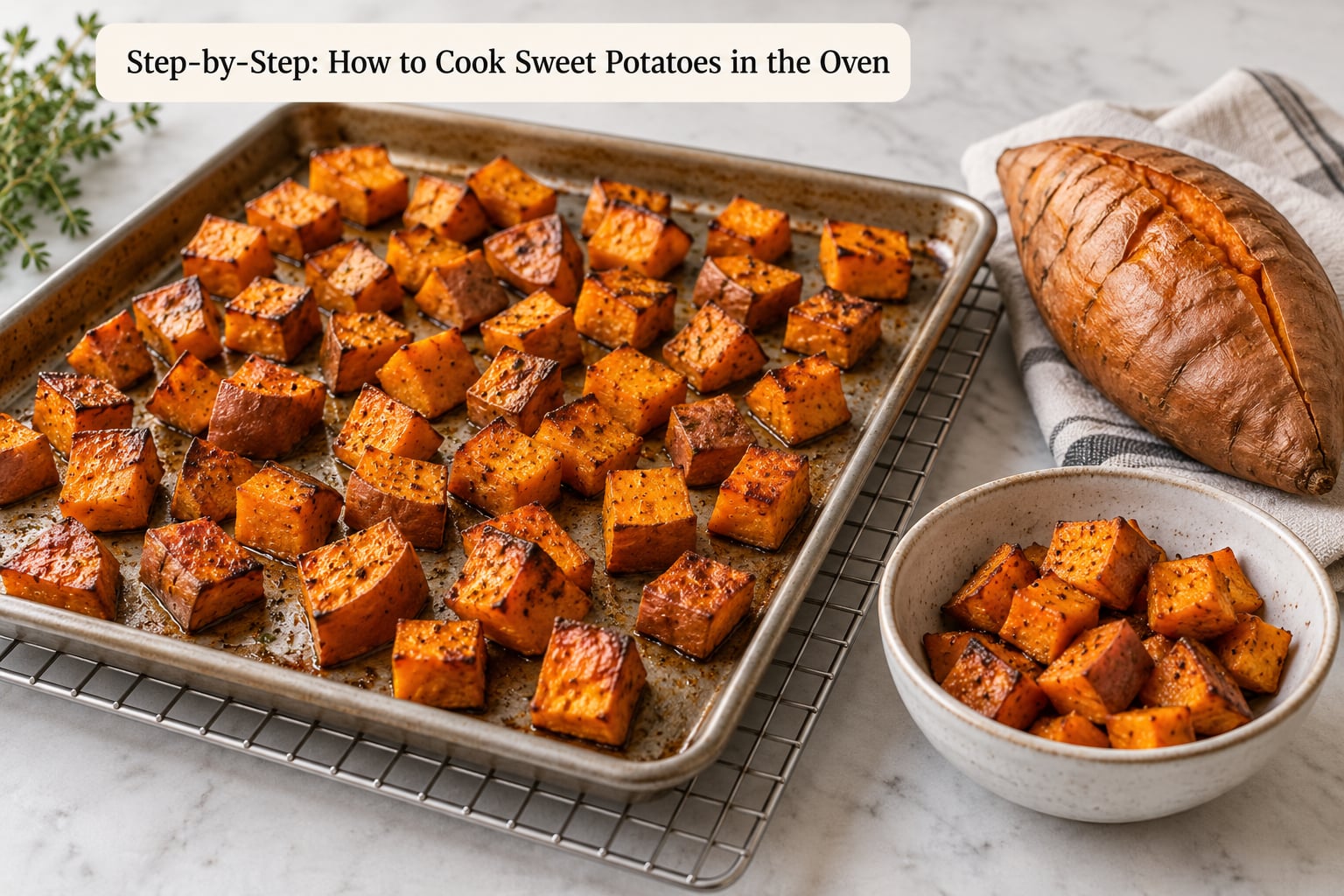
- Roast without touching them for the first 20 minutes. Leave the pan alone so the cut faces can form a crust. Result cue: the bottom faces are deep golden and the edges look dry rather than wet.
- Turn and test at the halfway mark. For cubes and wedges, toss once at 15 minutes. For halves, flip cut-side up after about 20 minutes. Bake until a fork slides into the thickest piece with no resistance, and the center reads close to 200°F on an instant-read thermometer. Result cue: a whole potato’s skin puffs up and wrinkles slightly.
Rest the finished tray for five minutes before serving. The flesh is looser and sweeter at that point, and it firms up just enough to hold a topping without splitting.
How to Cook Sweet Potatoes in the Oven at 425°F
425°F is the number to use if you only remember one. It is hot enough to drive off moisture and start browning within the first 15 minutes, and cool enough that the outside will not scorch before the center is creamy. Here is the repeatable version.
Heat the oven and one rimmed baking sheet to 425°F. Scrub two medium sweet potatoes, cut them into even 1/2-inch cubes, and pat them dry. Toss with olive oil and kosher salt, spread the cubes in one uncrowded layer, and roast for 25 to 30 minutes, turning once at 15 minutes. They are done when the edges are caramelized and a fork meets no resistance in the center.
If you use a convection oven, drop the temperature about 25°F to 400°F and start checking five minutes early, since the fan dries the surfaces faster.
| Cut and method | Temperature | Time | What you get |
|---|---|---|---|
| 1/2 inch cubes | 425°F | 25-30 min | Caramelized edges, creamy center |
| Wedges or sticks | 425°F | 30-40 min | Crisp outside, soft inside |
| Halves, cut side up | 425°F | 35-45 min | Sweet, custardy, one cut per serving |
| Whole, skin on | 425°F | 45-60 min | Soft fluffy flesh, soft skin |
| Microwave, then finish in oven | 425°F | About 1 hour total | Creamy flesh without waiting on the oven |
Why 425°F beats a hotter oven
Once the center of a sweet potato passes roughly 200°F, the pectin in the cell walls breaks down and the starches gelatinize. That is the point where the flesh turns silky instead of stringy or watery. It happens faster at 425°F than at 350°F, and it happens without the outside burning.
Cranking the oven to 450°F usually backfires. The sugar-rich surface scorches and the center is still steaming, which is exactly how you get burnt edges around a raw middle. Save 450°F for small cubes you want browned quickly, and use a wire rack so nothing sticks to the pan.
350°F or 400°F, and what about 450°F?
At 350°F a whole potato takes 60 to 75 minutes and a cube takes 35 to 40, and the skin never crisps, because there is not enough heat drive to evaporate moisture from the surface. At 400°F you land in a useful middle: 50 to 60 minutes whole, 30 to 35 for cubes. 425°F is the sweet spot for browning. At 450°F cubes and wedges take 20 to 25 minutes, but they go from done to charred quickly, so check them early.
Worth saying plainly: 350°F is the right choice only if you are cooking something else in the oven alongside them and want the timing to be forgiving.
Foil or no foil
Bake sweet potatoes bare. Foil traps steam against the skin, so you get a soft, sometimes slimy skin instead of a caramelized one, and that is the single most repeated tip in cooking forums.
Foil earns its place in two cases: whole potatoes you want extra moist, or the last 10 minutes of a whole bake if the skin is splitting. For cubes and wedges, skip it entirely. Parchment paper works well too and keeps sugar off the pan, though a little oil on bare metal gives you slightly better browning.
Storage, make-ahead and reheating
Cooked sweet potatoes keep about 5 days in the fridge, covered. For longer storage, cut them into cubes, spread on a tray to freeze solid, then move to a bag where they will hold up to a month.
Reheat in a toaster oven or air fryer at 375°F for 5 minutes rather than in the microwave. The microwave heats the water in the flesh and leaves you with exactly the rubbery, damp texture you were trying to avoid, while dry heat pushes that moisture back out and re-crisps the edges. If you are cooking a large batch for the week, this is the step most people skip and the one that matters most. Our guide to batch cooking without getting bored has a few rotation ideas for it.
Air fryer, microwave and toaster oven
In an air fryer at 400°F, cubes take 15 to 20 minutes with a toss halfway, and they crisp better than most ovens because of the tight airflow. In a microwave, a whole potato takes 5 to 8 minutes, but the skin will not crisp at all, so use it for speed and finish the potato in a hot oven if texture matters. A toaster oven at 400°F does nearly everything a full oven does for a single tray of cubes, in about half the preheat time.
Common Mistakes
Most disappointing trays trace back to one of five things. Each fix is small, and together they are the difference between roasted and merely cooked.
1. Crowding the pan
Pieces touching each other steam each other, and steam is the opposite of browning. Space them by at least a finger’s width, use two pans if you have to, and rotate the sheet position halfway through. This is the most common cause of soggy roasted sweet potatoes, and more soaking in baking soda and vinegar will not fix it.
2. Cutting pieces unevenly
A batch with one thin wedge and one thick chunk will always disappoint, because the thin piece burns and the thick one stays firm. Measure against a half-inch reference on the first potato of each batch and copy it. If the potatoes are wildly different in size, cut the large ones down further so the sizes converge.
3. Skipping the oil or going too light
Dry surface means dry heat burns what is there, and sweet potato surface sugar burns quickly. Use 1 to 2 tablespoons per pound of potato, and toss rather than pouring so every face gets coated.
4. Roasting at the wrong temperature
Too low and the potatoes cook without browning. Too high and the sugar crust scorches before the center is creamy. 425°F holds the narrow band where both happen inside the same cook time.
5. Leaving them until they fall apart
Sweet potatoes keep cooking after you pull the tray, and they lose water the whole time. Test a few minutes before you think they are ready, and pull at 200°F internal. Overcooked flesh goes stringy, then grainy, and no amount of butter fixes it.
Seasoning variations
- Classic: olive oil, kosher salt, cracked pepper.
- Smoky: add smoked paprika and a little garlic powder.
- Southwestern: taco seasoning or chili powder, lime juice after roasting.
- Curry: curry powder with a pinch of cayenne, served with yogurt or cilantro.
- Sweet breakfast: cinnamon, a small amount of maple syrup in the last 10 minutes, or pumpkin pie spice.
Try the smoky and curry versions as a rotating base if you are cooking for a mixed table, and keep portions sensible alongside them. The plan for cooking for a family with different diets covers how to build one base potato that everyone can share with different toppings.
How to serve them
A baked whole potato with butter, salt and a fried egg makes a fast breakfast. Cubes fold into burrito bowls with black beans, tacos with slaw, or a grain bowl with tahini. Halves work as a side for roast chicken, and a twice-baked version split down the middle, filled with butter and cinnamon, and returned to the oven for 15 minutes is worth the extra step every autumn.
Frequently Asked Questions
What’s the best temperature for baking sweet potatoes?
425°F is the best temperature for most methods. It drives off surface moisture fast enough for the natural sugars to caramelize, and it still gives the center time to pass 200°F and turn creamy. Whole potatoes take 45 to 60 minutes at that temperature, halves 35 to 45 minutes, and 1/2-inch cubes 25 to 30 minutes.
Is it better to bake sweet potatoes at 350°F or 400°F?
400°F is the better of the two. At 350°F a whole potato takes 60 to 75 minutes and the skin never crisps, because the oven cannot evaporate surface moisture fast enough. At 400°F you get a whole potato in 50 to 60 minutes and cubes in 30 to 35, with browning you can actually see. If you need 350°F for something else, bake uncovered on a wire rack.
Should you wrap sweet potatoes in foil when baking?
Skip the foil for anything cut into cubes, wedges or halves. Foil traps steam against the surface, so the skin and cut faces turn soft and sometimes slimy instead of caramelized. Bake bare on a rimmed sheet, adding a small splash of water to the pan if the sugar starts to catch. Foil is only useful for a whole potato, and only if you want extra-moist flesh.
How do I keep roasted sweet potatoes from turning soggy?
Space the pieces in a single uncrowded layer, use a second pan if needed, and pat the cut surfaces completely dry before oiling them. Space stops the pieces steaming each other, and dryness gives the hot pan a surface it can actually brown. Cut every piece to the same size, use 1 to 2 tablespoons of oil per pound, and roast at 425°F rather than cranking the heat.
How do I know when a sweet potato is done baking?
Push a fork into the thickest part with no resistance. For a whole potato, the skin should puff up and wrinkle slightly and the flesh gives way with very little pressure. An instant-read thermometer is the precise version of the same test: aim for about 200°F in the center, which is where the pectin breaks down and the flesh turns creamy rather than watery.
How long do sweet potato cubes and wedges take in the oven?
At 425°F, 1/2-inch cubes take 25 to 30 minutes and thicker wedges take 30 to 40 minutes. Turn them once at the halfway mark so the underside browns, and expect the pieces to firm up slightly after they come out of the oven as the moisture settles. For closer-to-crisp results, spread them on a wire rack and give them 5 minutes in a 375°F toaster oven afterward.
Conclusion
Start with a fully preheated 425°F oven, cut the potatoes into even 1/2-inch pieces, pat them dry, and give them 25 to 30 minutes. The cues you are watching for are simple: golden, dry-looking edges and a fork that slides through the center with no resistance.
That same tray works for breakfast, lunch bowls, tacos, or a side dish, and it reheats in 5 minutes in a toaster oven so the texture survives. If you are cooking a big batch, cool the cooked pieces uncovered before you cover them, and you will still have good edges two days later.