

Knowing how to rebuild healthy habits after falling off comes down to three moves: shrink the routine until it feels almost too easy, attach it to something you already do every day, and restart at the very next opportunity instead of waiting for a perfect Monday. Progress after a setback is dormant, not destroyed.
Most people do not lose their habits to a lack of willpower. They lose them to a bad month, a hospital stay, a work stretch that swallowed every evening, or a stretch of social plans that made cooking feel impossible. The routine breaks because the cue disappeared and the effort got heavy.
That is why the restart has to be small and immediate. Both of those details matter more than willpower, and the process below takes maybe fifteen minutes to set up.
Table of Contents
What You Need
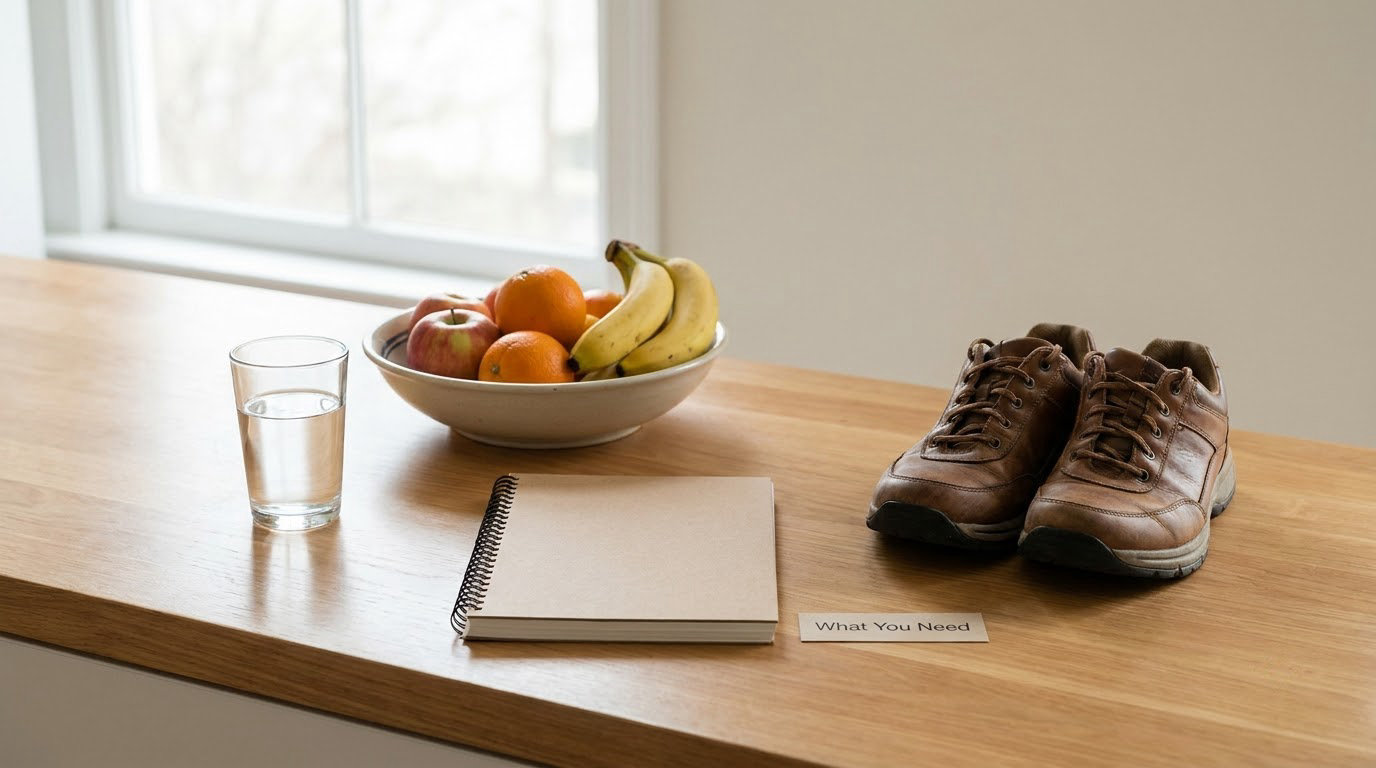
You need far less than most reset plans imply. A restart is not a lifestyle overhaul, and it does not require supplements, expensive equipment, a specific diet, or a cleanse.
- A realistic schedule. Look at a normal week, including the messy parts, and find two windows where twenty minutes of attention is genuinely possible.
- One manageable health goal. A single anchor habit beats a list of six. Pick the one that makes the other five easier.
- Basic food and movement options. Ordinary groceries and a ten-minute walk count. Nothing here needs to be special.
- A way to track it. A paper notebook, a calendar with checkboxes, or a simple app. The format matters far less than using the same one.
- Support when it is warranted. A doctor, physical therapist, or registered dietitian if illness, injury, pregnancy, medication, or a diagnosed condition is part of the picture.
If you only have two of those five, start anyway. The most common question on r/getdisciplined is how to get out of a rut after completely losing your routines, and the answer that keeps coming back is smaller than people expect.
Step-by-Step: How to Rebuild Healthy Habits After Falling Off
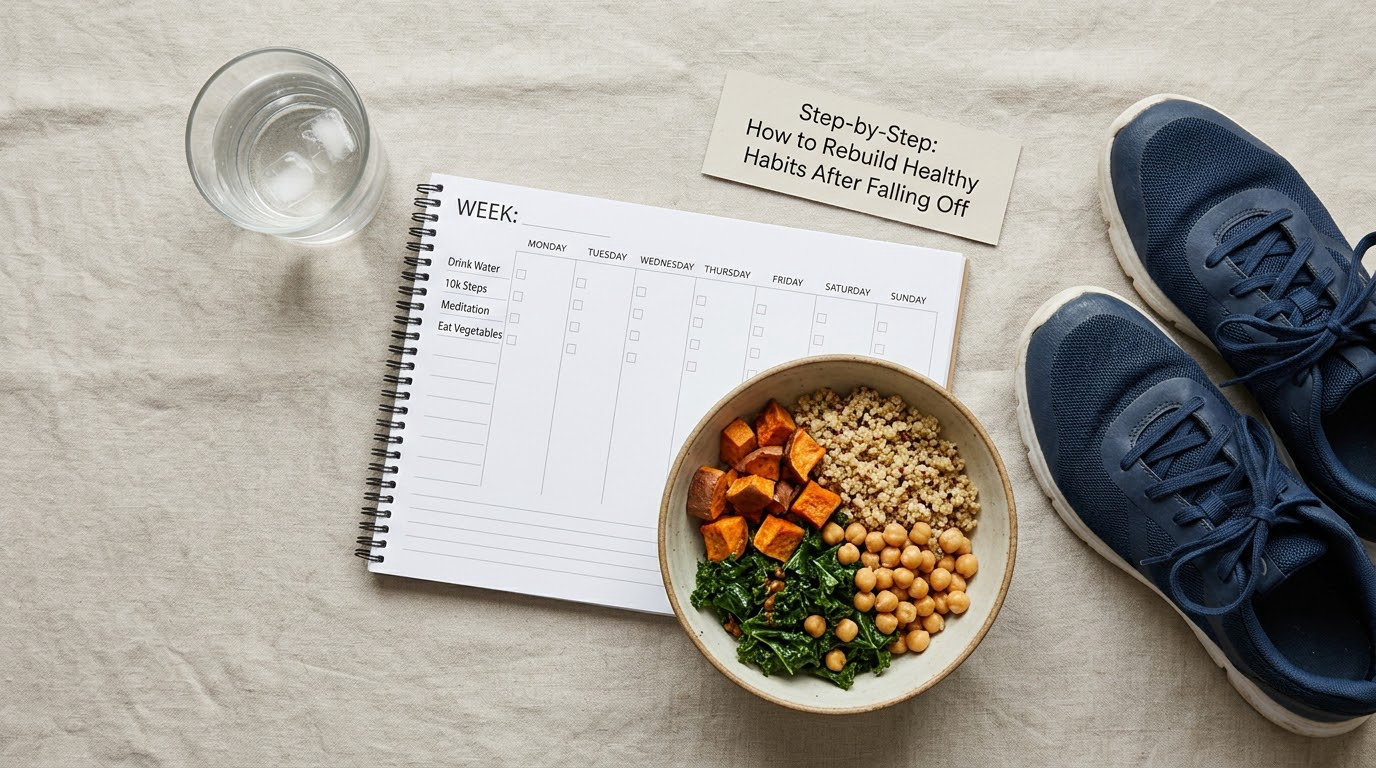
Six moves, in this order. Work through them at your own pace, and give each one a couple of weeks before moving to the next.
How to Start With One Small Healthy Habit
Choose the habit that supports the most other things. Eating a real breakfast, taking a short walk, drinking water with meals, and keeping a consistent bedtime all qualify.
Then make it specific enough to do on your worst day. “Eat better” fails. “Put eggs and toast in front of me before I open my laptop” survives a hard morning. A useful test: could a stranger watch you do it and know whether you did it?
Now attach it to something that already happens. After I pour my first coffee, I take a ten-minute walk. Before I shower, I put two pieces of fruit on the counter. Stacking a new habit onto a reliable old one removes the decision of when, which is the decision that quietly kills most restarts.
You will know it is working when three weeks pass and the habit happens on roughly three days out of four without any negotiation.
Make the Habit Easier to Repeat
Friction is the real opponent. Reduce the time, the effort, and the number of decisions the habit requires, and it starts running on its own.
- Decisions. Keep two easy breakfast options in the house so there is no 7 a.m. choice to make. If you like yogurt, our label guide for choosing yogurt at the store takes the guesswork out of that one.
- Visibility. Fruit on the counter at eye level gets eaten more often than fruit in a crisper drawer. Water you can see gets drunk.
- Time. A ten-minute walk is a walk. Ten minutes of stretching is a workout. Ramping duration before intensity is the difference between a restart and a setback.
- Timing. Schedule movement before the point in the day when fatigue makes it a hard sell. Morning movement survives better than 9 p.m. movement for most people.
People posting in r/selfcare repeat the same thing: the setup does most of the work. Shoes by the door, bottle filled the night before, food visible, tracker already open.
Reconnect With Everyday Nutrition
Return to a flexible pattern rather than a rulebook. Regular meals, vegetables, fruit, whole grains, protein foods, water, and the foods you actually grew up eating all fit.
Aim for a protein source at most meals, something from every food group across the day, and water with most meals instead of sugary drinks. Portions and satisfaction matter. A restart built on hunger is a restart that collapses, usually loudly and usually on a Tuesday.
Skip the detoxes, 72-hour fasts, and juice cleanses. After a few weeks of inconsistent eating, they tend to trigger the very binge they promise to prevent, and readers in health forums describe that cycle as the reason they stopped dieting entirely. If you want a snack that carries some staying power, here is how to tell if a granola bar is actually healthy before you buy one.
One more thing worth planning: what you eat after a long session or a hard workout. Having that answer in advance removes the weakest-decision moment of the day. Our ideas for eating after a workout without a shake cover the practical options.
Bring Movement Back Gradually
Start with whatever you used to enjoy and can do without suffering. Walking, mobility work, a short strength session at home, or a class you used to like all count.
Raise the duration before the intensity. Ten minutes becomes twenty minutes becomes two 20-minute sessions, and each step is boring enough to repeat. The people who get stuck are usually the ones who try to return to their former volume in week one and end up sore enough to quit.
Stop and talk to a clinician first if you have pain, an old injury, are pregnant, or live with a heart, joint, or metabolic condition. That is a safety step, not a cop-out.
You will know movement is back when you look forward to it slightly more than you dread it. That shift usually shows up in the third or fourth week, not the first.
Common Mistakes
These are the habits that keep people off track, paired with the correction that actually works.
- Changing everything at once. Six new habits in January is how you end up with zero in February. Fix: one anchor habit for thirty days.
- Waiting for Monday, the 1st, or a birthday. The fresh start effect is real, and it works both ways. Research out of the Wharton School and Penn shows a clean calendar date nudges a restart, but only once things are already going well. Fix: name a real date, then start tomorrow anyway.
- Waiting for motivation. Motivation follows action far more reliably than it precedes it. Fix: commit in advance to doing it on a day you would rather not.
- Calling a lapse a failure. Psychologists call the pattern the what-the-hell effect, studied for years at USC: one slip creates so much guilt that people abandon the whole plan. Fix: name it a lapse. A relapse means the plan was abandoned, and a lapse is not that.
- Going extreme to compensate. Punishing workouts, extreme restriction, and aggressive cleanses after a bad stretch are the most reliable way to end up needing a doctor. Fix: return to a boring baseline for two weeks.
- Tracking weight only. Weight moves for a dozen reasons, none of which are effort. Fix: track the behaviors you control.
- Abandoning the tracker after one missed day. Fix: use the never-miss-twice rule, described below.
- Trying to rebuild a whole routine at once. Morning, gym, meal prep, and journaling all restarting Monday is a burnout schedule. Fix: sequence them two weeks apart.
- Tracking ten habits. Obsessive tracking of a long list becomes its own kind of failure. Fix: three trackers maximum.
- Ignoring sleep. Readers consistently report that irregular sleep ends every other effort. Fix: fix the bedtime before the gym schedule.
Here is the recovery protocol for the critical window. One missed day is noise. Two in a row is the moment people quit, and never miss twice is the most repeated piece of advice in the discipline communities.
- Day one missed. Do nothing special. Keep the habit at its minimum size if you can.
- Day two missed. Restart the smallest version that same day. Two minutes counts as a completed rep.
- Day three. Look at what caused the miss and remove one obstacle: a late meeting, a travel day, an empty kitchen.
If the gap is longer than that, do not try to make up the lost time. Restart at the current level and ramp from there.
Quick Tips for a Sustainable Restart
- Use the two-minute version. Two minutes of movement, one glass of water, one page of notes. The point is to keep the loop alive.
- Track consistency, not perfection. A week of five out of seven beats a perfect Monday followed by nothing.
- Plan for the busy day. A three-meal week needs a backup option ready: a frozen meal, a soup, eggs on toast. Decide it now, not at 6 p.m.
- Reward with something that is not food. A bath, a film, a new walking route, a call with a friend.
- Adjust when life changes. A new job, a new baby, or a move means the old routine no longer fits. Rewrite it rather than failing against it.
- Use rough numbers as anchors. Seven to nine hours of sleep, water at most meals, a protein source at most meals, ten minutes of movement most days. Adjust with your doctor if you have a condition that calls for it.
- Start on a date that means something. The first of the month, a birthday, the day you decide to read this. Then start again tomorrow.
- Keep one thing already working. Do not rebuild the parts that never broke. That is the fastest way to burn out and quit again.
Progress counts even when it looks like maintenance. Returning to a walk you used to enjoy is a win, not a plateau.
Frequently Asked Questions
How long does it take to rebuild a habit after falling off?
Expect three to four weeks for the easy version to feel automatic again, and closer to eight to twelve weeks for a full version, though the timeline varies a lot by habit and person. A habit you already built once usually returns faster than a brand-new one, because the memory is still there. Judge the first month by whether it happens most days, not by how it feels.
What should I do after missing several days or weeks?
Do not try to recover the lost time and do not restart from your old level. Resume at the smallest version that feels almost too easy, for one week, then add a little. Longer gaps usually mean something in your environment changed, so fix the setup first: sleep, groceries, and the time of day you will actually use.
Should I restart from scratch or continue where I left off?
Continue where you left off, at a lower level. Starting from scratch throws away the associations you already built, and a brand-new plan means learning everything again. Keep the same habit and the same cue, but shrink the routine until you can do it on a bad day. That is a restart, not a reset to zero.
What is the 3-3-3 rule for habits?
The 3-3-3 rule is a popular shorthand, not a validated research finding, so treat it as a rough guide rather than science. It is usually described as about three weeks to repeat something reliably, three months for it to start feeling automatic, and three months for a missed habit to fade. When rebuilding, use the first three weeks as your working window.
What is the 5 2 1 0 rule?
There is no established habit-formation rule called the 5 2 1 0 rule, so anyone presenting it as a proven framework is overstating the evidence. It circulates in short-form video and habit content, usually as a way to format goals rather than as a science-backed model. Stick with frameworks that have names behind them, like the habit loop and the never-miss-twice rule.
When should weight loss not be the focus of a restart?
Not as the focus if you are pregnant or breastfeeding, managing a history of disordered eating, recovering from an illness or surgery, or training for a sport where weight matters for performance. A scale is also a poor measure of whether your eating, movement, and sleep habits are back. Talk to a doctor or registered dietitian about the specifics of your situation.
Conclusion
Falling off is common, and the plan that was working for you has not disappeared. You lost the cue, the setup, and maybe the mood, and all three are rebuildable with much less effort than the habit itself took to build.
Start with one small habit, attach it to something you already do, and keep it easy enough to survive a bad week. Then look one month out. Do not wait for a better version of yourself, and do not treat one missed day as evidence that the plan failed.