
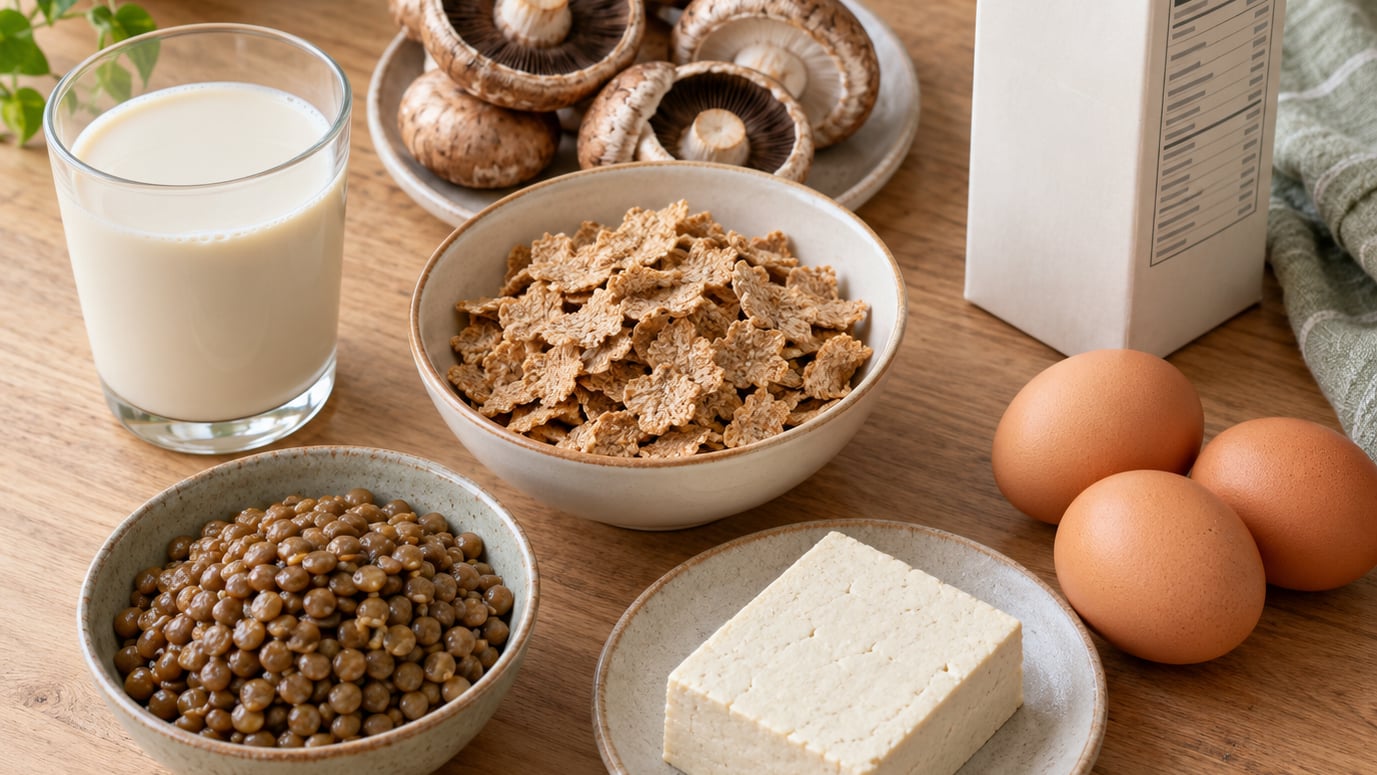
If you eat vegetarian, the honest answer is that only three routes deliver meaningful vitamin D: fortified plant milks, UV-exposed mushrooms, and eggs if you eat them. Everything else on the popular lists contributes a trace at best. This guide sorts foods high in vitamin D for vegetarians by what a real serving actually delivers, so you can shop and cook with the numbers in front of you rather than a vague idea.
Vegetable-based diets cut out the biggest natural sources, which are oily fish and, to a lesser extent, dairy and eggs. That leaves you relying mostly on fortified foods plus whatever your skin makes from sunlight. That can work, though it takes deliberate label reading, and most people fall short without noticing. I have gone through the labels and nutrition databases behind these foods so you do not have to, and I will flag plainly where a food is more marketing than nutrient.
One thing to say up front: this is general nutrition information, not personal advice. Vitamin D needs shift with age, pregnancy, skin tone, medication and blood results, so talk to your doctor or a registered dietitian about your own intake, and ask about a blood test if you have reason to suspect a shortfall.
Table of Contents
- Foods High in Vitamin D for Vegetarians at a Glance
- 1. Fortified Plant-Based Milk
- 2. UV-Exposed Mushrooms
- 3. Fortified Cereal and Oatmeal
- 4. Fortified Orange Juice
- 5. Eggs From Vitamin D-Fed Chickens
- 6. Fortified Tofu
- 7. Fortified Yogurt
- 8. Lentils and White Beans
- 9. Spinach and Other Dark Leafy Greens
- 10. Fortified Energy Bars
- 11. Fortified Plant-Based Spreads
- 12. Vitamin D-Fortified Nutrition Shakes
- Frequently Asked Questions
- Conclusion
Foods High in Vitamin D for Vegetarians at a Glance
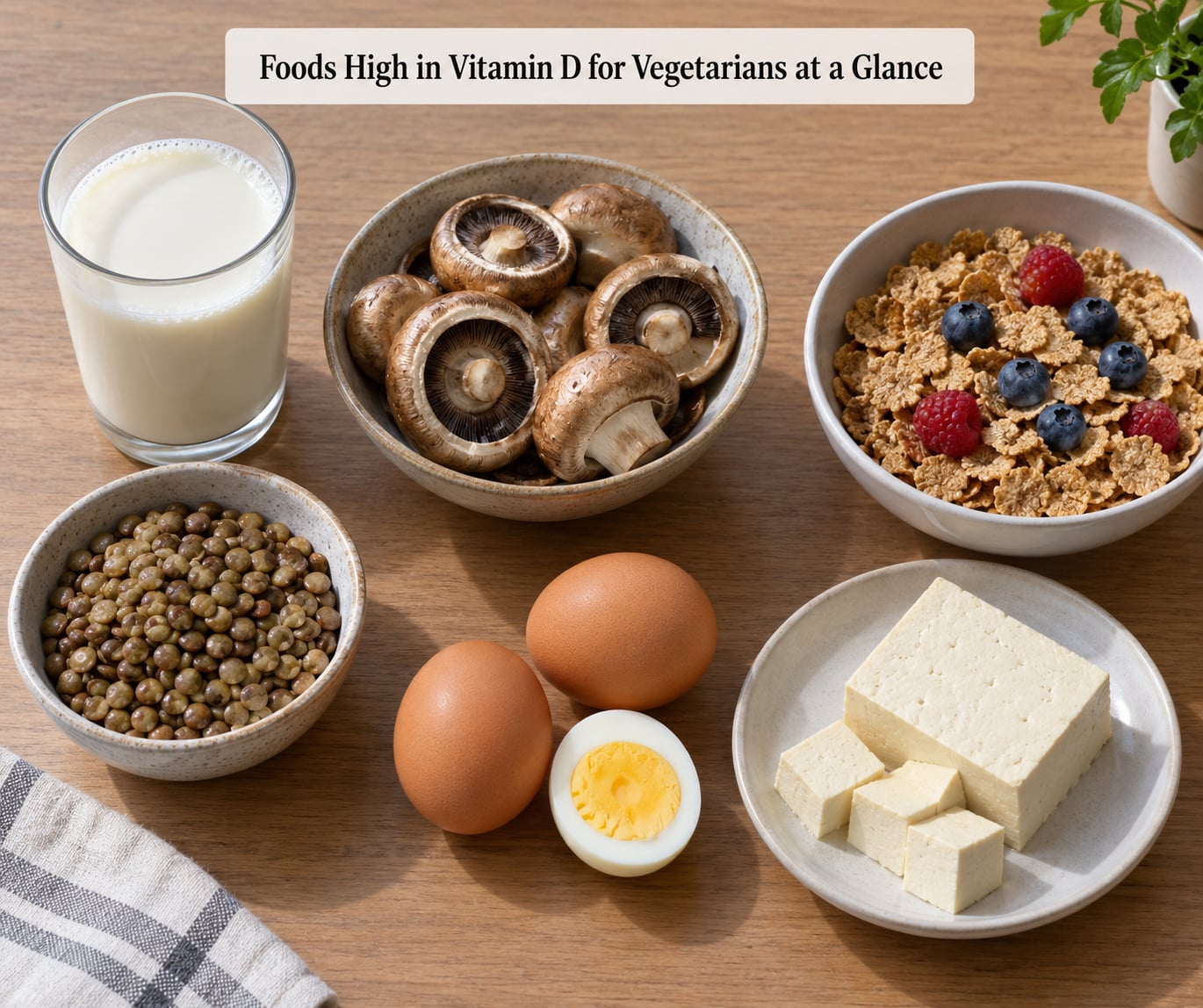
The table below lists what a typical serving gives you, whether the vitamin D is naturally there or added by the manufacturer, and who can eat it. Figures come from USDA and manufacturer nutrition panels, and they vary a lot by brand, so treat them as ranges you should confirm on the label in front of you.
| Food | Vitamin D per serving | Natural or added | Fits a vegan diet |
|---|---|---|---|
| UV-exposed mushrooms, sliced (1 cup) | 400 to 700 IU | Natural, created by UV light | Yes |
| Fortified soy milk (1 cup) | 100 to 120 IU | Added by fortification | Yes |
| Maitake mushrooms, cooked (3 oz) | 400 to 500 IU | Varies with UV exposure | Yes |
| Fortified plant milk, almond or oat (1 cup) | 90 to 120 IU | Added, when fortified | Yes |
| Fortified breakfast cereal (1 serving) | 80 to 150 IU | Added by fortification | Check, some use milk solids |
| Egg, large whole with yolk (1 egg) | Around 40 IU | Natural, feed-dependent | No, lacto-ovo only |
| Fortified orange juice (1 cup) | Around 100 IU | Added by fortification | Yes |
| Fortified yogurt (3/4 to 1 cup) | 90 to 140 IU | Added by fortification | Plant versions only |
| Sun-dried shiitake, rehydrated (1/2 cup) | Highly variable, often 200 IU or more | Natural, from drying in sun | Yes |
| Fortified tofu (3 oz) | Often 80 to 150 IU when fortified | Added, not automatic | Yes |
| White beans or lentils, cooked (1 cup) | Trace, near zero | Not a meaningful source | Yes |
| Raw spinach or kale (1 cup) | Trace, near zero | Not a meaningful source | Yes |
Two things stand out. Mushrooms are the only plant food that produces vitamin D in meaningful quantity, and only when they have seen ultraviolet light. Everything else on this list is manufactured, which is not a criticism: fortification works, and it works because manufacturers add a stable form of the vitamin to a food people eat regularly.
Adults aged 19 to 70 need 600 IU (15 micrograms) a day, and adults over 70 need 800 IU (20 micrograms). A cup of fortified soy milk plus a serving of UV-exposed mushrooms gets you most of the way there on a normal day, which is the practical shape of this diet.
1. Fortified Plant-Based Milk
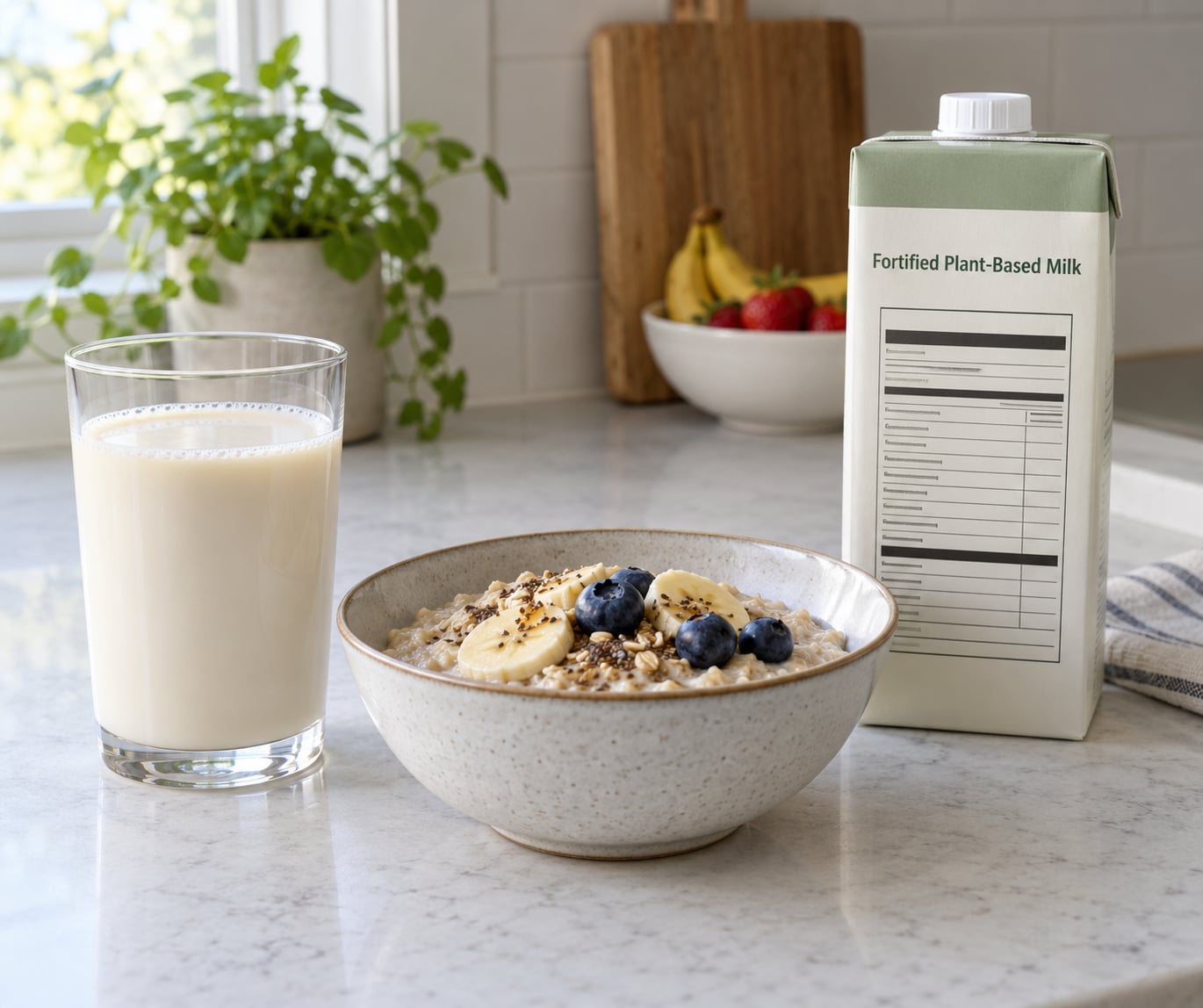
Fortified plant milk is the single most useful everyday item for a vegetarian or vegan. A single cup of fortified soy, almond or oat milk typically supplies around 100 to 120 IU, roughly a sixth of what an adult needs in a day. Soy milk is the most consistently fortified of the plant milks in US and European markets, and it is the one I would reach for first if you have a choice.
The catch is that fortification is entirely voluntary by brand and product. Coconut milk, many almond milks and a good share of oat milks carry no added vitamin D at all, which is the trap that catches people out. Turn the carton and look for Vitamin D on the nutrition panel with a percentage next to it. If there is no line for vitamin D, it is not there. That check takes about four seconds and it is the most useful habit in this entire guide.
Serve a cup in oatmeal in the morning, blend it into a smoothie with banana and spinach, or use it in place of dairy when cooking curry, custard or soup. One cup poured over breakfast cereal stacks two fortified foods into a single serving.
Our guide to spotting hidden sugar on labels covers the rest of the panel, which is worth reading once because plant milks often hide sugar behind flavourings and concentrated juices.
2. UV-Exposed Mushrooms
Mushrooms are the only plant food that generates vitamin D itself. Wild and cultivated mushrooms contain a vitamin D precursor, and ultraviolet light converts it into active vitamin D2, or ergocalciferol. Mushrooms grown in the dark, indoors and in low light produce very little. Exposed to UV, they can reach several hundred IU per serving.
Portobello caps sliced into a cup give one of the larger plant servings, commonly in the 400 to 700 IU range when UV-treated. Maitake, or hen of the woods, is the other one nutrition databases quote frequently, at roughly 400 to 500 IU per 3 ounces cooked. Shiitake dried in sunlight and then rehydrated can go very high, though the number swings wildly with drying time and sunlight intensity, so treat any figure as an estimate.
For home cooks: you can place washed mushrooms gill-side up in direct afternoon sun for 15 to 60 minutes before cooking, though the amount produced is not something you can control precisely. Retail UV-treated mushrooms carry a label saying so, and they are worth the price difference if mushrooms are a regular part of your week.
Roast portobello caps whole with olive oil and salt, saute maitake until the edges crisp, or slice them raw into grain bowls. A roasted portobello burger with a fortified milk bun does the work of a beef burger and lands a few hundred IU in the process.
3. Fortified Cereal and Oatmeal
Breakfast is where fortified vitamin D stacks up fastest, because two or three fortified foods often land in the same bowl. A single serving of a fortified breakfast cereal supplies roughly 80 to 150 IU depending on the brand, and some oat cereals reach the higher end of that.
How to choose foods high in vitamin D for vegetarians at breakfast
Look at three things on the label: the serving size, the vitamin D in micrograms, and whether milk or whey is in the ingredient list if you eat vegan. Vitamin D is listed in micrograms on US panels and the conversion is simple: 1 microgram equals 40 IU. A cereal showing 2.5 micrograms per serving gives you 100 IU.
Serving sizes are where people get caught. One cereal lists a serving as half a cup and another as one and a half cups, so two bowls of one product can hand you three times the vitamin D listed on the side of the box. Weigh the first serving into a bowl once, learn what it looks like, and stop guessing.
Instant oatmeal packets are hit or miss. Some are fortified with several hundred IU per packet, which would be exceptional, and many contain none. Again, the panel tells you in a second. A fortified packet plus a cup of fortified plant milk is a solid breakfast start on its own.
4. Fortified Orange Juice
Certain orange juices are fortified with vitamin D, and a cup delivers around 100 IU. Not all of them are. The category is narrow, the carton changes between products, and a familiar-looking juice from a familiar brand is often unfortified. Read the specific carton in your hand rather than assuming.
Juice has other drawbacks that vitamin D does not fix. A cup of juice is a meaningful amount of free sugar without much fibre to slow it, so it fits comfortably as an occasional drink rather than a daily habit. Some fortified varieties also use vitamin D3 from lanolin, which matters if you are vegan, so check the ingredient list for the D3 source.
Use it on days when getting fortified cereal and fortified milk into your routine feels like too much. Treat it as a bonus on top of whole foods, never as a replacement for them.
5. Eggs From Vitamin D-Fed Chickens
Eggs sit in an awkward spot: perfectly suitable for lacto-ovo vegetarians, off the table for vegans. A large whole egg with its yolk contains roughly 40 IU, which sounds disappointing until you notice that US hens are fed vitamin D, and eggs from those hens sit at the higher end of the natural range. Eggs from hens whose feed is not supplemented contain considerably less, and this is why the number moves from database to database.
Two eggs a day gives you roughly 80 IU, about 13 percent of an adult requirement. That is a helpful contribution rather than a solution, and it is worth being honest about that, because plenty of online lists treat eggs as a complete answer. They are not.
Two boiled eggs with breakfast and a fortified cereal moves you further. For a vegetable scramble, soften onions and peppers in olive oil, add spinach, then fold in eggs, and serve with a slice of fortified toast. If you read our B12 guide for plant-based diets, you will notice eggs cover that nutrient more comfortably than vitamin D.
6. Fortified Tofu
Tofu is a genuinely useful vegan option because it absorbs seasoning, holds its shape in a hot pan and appears in enough recipes to be a habit rather than a novelty. When a tofu is fortified, a 3-ounce serving often lands somewhere around 80 to 150 IU.
Here is the detail that trips people up: calcium-set tofu, the firm kind made with calcium sulfate, is not automatically fortified with vitamin D. Setting with calcium does not add vitamin D. You need to find Vitamin D on the nutrition panel, and plenty of tofu, including most calcium-set varieties, does not have it.
For stir-fries, cube firm tofu and let it crisp in a hot pan before adding sauce. Noodle bowls, soups and salads all work. A serving of fortified tofu with sauteed mushrooms and fortified rice is a meal that quietly covers both the calcium and vitamin D bases.
7. Fortified Yogurt
Some yogurt is fortified, including plant-based versions, and a standard serving gives roughly 90 to 140 IU. Plain varieties are the safer bet, since flavoured yogurt blends often come from a different production run.
Check whether it is dairy or plant-based first, then read the vitamin D line. Yogurt is one of the foods where the label most often shows nothing at all, so it is another place where assumption beats you.
Use it as a breakfast base topped with fortified cereal and berries, or as a snack with a spoon of tahini. Greek yogurt tends to carry more protein and, from what I have seen, more added vitamin D, though that varies by brand. A bowl of fortified yogurt with fortified cereal can carry a few hundred IU in one sitting.
8. Lentils and White Beans
Let me correct a widespread belief before it costs anyone money: lentils and white beans are not vitamin D sources. A cooked cup contains a trace amount, effectively nothing against a 600 IU target. If a list online tells you beans are rich in vitamin D, that list has confused vitamin D with iron, protein or folate, all of which beans deliver in abundance.
They still belong on the plate. Combining beans with a vitamin D-rich food is a solid vegetarian strategy, because vitamin D helps your body absorb calcium and beans bring a lot of calcium to the table. Beans with fortified tofu, beans under a pour of fortified milk in a soup, or white bean and kale stew with a fortified yogurt on the side give you both halves.
Our guide to iron in plant foods covers the pairing logic for that nutrient in detail, and the same habit of combining categories pays off here.
9. Spinach and Other Dark Leafy Greens
Spinach is frequently listed as a top vitamin D food. It is not. A cup of raw spinach contains only a small trace, far too little to move your daily total. Kale, collards and chard are in the same category. They are outstanding foods loaded with vitamins A, K and folate, and vitamin D is not one of them.
There is a related trap here: spinach also contains oxalates, which bind calcium and reduce how much of it your body absorbs. So spinach delivers very little vitamin D and very little usable calcium, while kale delivers a good amount of both with much better calcium availability. If calcium absorption matters to your plate, favour kale, bok choy and Chinese cabbage over spinach.
Eat greens for everything they do well, and put the vitamin D job on a fortified ingredient beside them: milk, yogurt or tofu in a salad, kale sauteed and topped with a fried egg, or a spinach and tofu soup built on fortified broth.
10. Fortified Energy Bars
A portion of energy bars on the shelf now carry added vitamin D, and a listed amount of around 100 to 150 IU per bar is typical. It depends entirely on the product, and the bar you grab on impulse is often not the fortified one.
Two things to weigh. Serving sizes differ, so a bar you eat whole may be one and a half servings according to the label, which cuts the per-bar figure. And the vitamin D number sits alongside calories, added sugar and sodium that can be substantial in these products, so a 200 IU bar is not automatically a good trade.
Use them as a fallback when a fortified yogurt or cereal is not practical. They are a convenience food first, and vitamin D is a bonus rather than the reason the bar earns its place.
11. Fortified Plant-Based Spreads
A small number of plant-based spreads, including some vegan cheeses and margarine-style products, carry added vitamin D. A serving is small, so the total per tablespoon or two tends to be modest rather than dramatic, but it adds up over a week.
Read both panels. The ingredient list tells you whether the vitamin D source is plant-based or from lanolin, and the nutrition panel gives the amount. Brands vary widely here, which is exactly why the general advice on fortified spreads is to check rather than assume.
Toast for breakfast, crackers with soup at lunch, or a sandwich filling work fine. It is a supporting player in a week that already includes a proper fortified milk and some mushrooms.
12. Vitamin D-Fortified Nutrition Shakes
Fortified plant-based nutrition shakes can supply somewhere around 100 to 250 IU per serving, which makes them useful when meals are genuinely impossible rather than merely rushed. They are a tool, not a strategy.
Compare the label across shakes for vitamin D amount, added sugars, sodium and protein. Many taste fine but carry a lot of sugar, and a shake with 30 grams of added sugar is a poor substitute for food when food is available. Pick one with a short ingredient list and a meaningful protein number if you intend to use it regularly.
I want to be clear about what these are not for. Shakes are not a treatment for anything, and they are not a weight-loss product. If you need vitamin D because of a diagnosed deficiency or a medical condition, that is a conversation with a doctor, not a label decision.
Frequently Asked Questions
Which vegetarian food is the highest in vitamin D?
UV-exposed mushrooms come out on top for a plant-based diet. A cup of sliced, UV-treated portobello caps can deliver roughly 400 to 700 IU, and cooked maitake about 400 to 500 IU per 3 ounces. Ordinary supermarket mushrooms grown in the dark contain very little. For lacto-ovo vegetarians, fortified milk is the more reliable daily option at around 100 to 120 IU a cup.
What drink is high in vitamin D if I do not drink dairy?
Fortified plant milks are the answer, and soy is the most consistently fortified. A cup of fortified soy, almond or oat milk gives roughly 90 to 120 IU. Fortified orange juice delivers around 100 IU a cup. Check the nutrition panel every time, because many coconut and almond milks carry no added vitamin D at all and nothing on the front of the carton will tell you.
Is 2 eggs a day enough vitamin D?
No. Two large eggs with yolks give about 80 IU in total, roughly 13 percent of what most adults need daily at 600 IU. Hens fed vitamin D lay eggs at the higher end of the natural range, but content varies with feed and season. Eggs are a useful addition to a lacto-ovo vegetarian diet, not a solution on their own.
How do vegetarians get enough vitamin D without supplements?
Most people who manage it rely on three things at once: a cup of fortified plant milk daily, UV-exposed mushrooms several times a week, and fortified cereal, yogurt or juice on top. Sunlight contributes too, though it varies with season, latitude, skin tone and how much of your day is outdoors. Food alone gets many people close to the target but short of it, which is why a supplement is common practice.
Are UV-exposed mushrooms worth the extra cost?
If you like mushrooms and would not buy them otherwise, yes. A serving of UV-treated portobello or maitake delivers several hundred IU, more than most fortified foods combined. If mushrooms are not part of your diet, the money is better spent on fortified milk or yogurt, which you will actually eat regularly. Sun-drying shiitake at home raises vitamin D too, though the amount is unpredictable.
How much vitamin D should an adult get per day?
Adults aged 19 to 70 need 600 IU, which is 15 micrograms, per day. Adults over 70 need 800 IU, or 20 micrograms. For converting labels, 1 microgram equals 40 IU. One microgram is also 40 percent of the adult daily value, so any fortified food showing 2.5 micrograms per serving is giving you 100 IU.
Conclusion
Start with the label, not with a list. Pick one fortified milk you actually enjoy, confirm the vitamin D line on the panel, and use a cup every day. Add UV-exposed mushrooms a couple of times a week if you like them, and let fortified cereal, yogurt or juice cover the rest of the gap. That combination of foods high in vitamin D for vegetarians gets most adults most of the way to their daily target without much fuss.
What it will not do, on its own, is close the gap for everyone. Plenty of vegetarians who track their intake come up short, especially through winter at northern latitudes, and a vegan D3 supplement made from lichen is a normal, unremarkable part of the routine rather than an admission of failure. If you are tired often, ache in your bones, or your doctor has mentioned vitamin D at all, ask for a 25-hydroxyvitamin D blood test and let them guide the dose.