
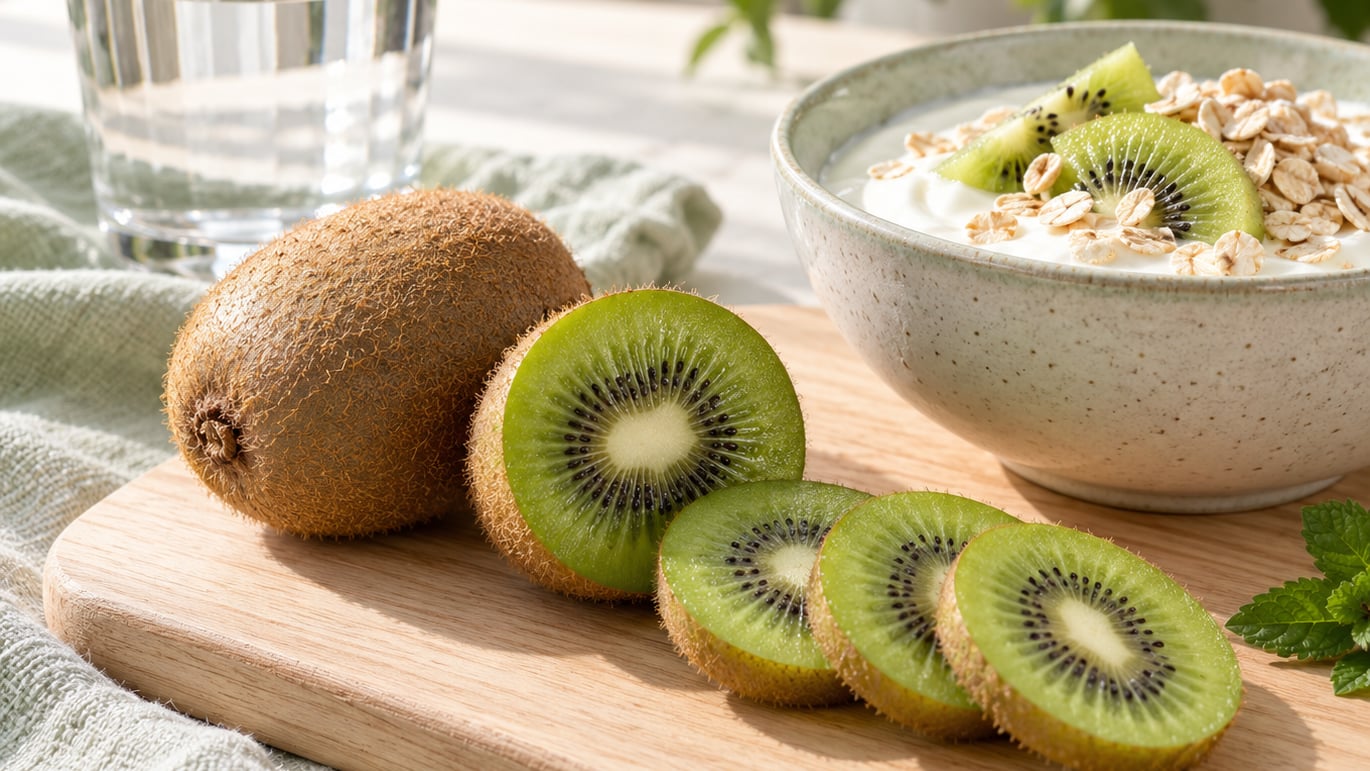
Kiwi helps digestion mainly through fiber that adds bulk and holds water in the stool, plus an enzyme called actinidin that starts breaking down dietary protein. In the research most often cited, eating two kiwifruits a day improved stool frequency and abdominal comfort in adults with constipation. Two medium kiwis give you roughly 4 to 5 grams of dietary fiber and about 120 calories, which is a lot of gut-friendly food for a small fruit.
There is no magic here, and it is worth saying so early. Kiwi is a food, not a treatment, and the trials were modest. But it is one of the better-evidenced fruits for bowel regularity, and it tends to cause far less gas than the other fruits people reach for when constipated.
Table of Contents
- What Are the Benefits of Kiwi Fruit for Digestion?
- Why Does Kiwi Fruit Support Digestion?
- How Does Kiwi Fruit Help with Constipation?
- Can Kiwi Fruit Improve Gut Health and Bloating?
- How Much Kiwi Fruit Should You Eat for Digestion?
- How Can You Eat Kiwi for Better Digestion?
- Are There Any Risks or Side Effects?
- Frequently Asked Questions
- A Simple First Step for Better Digestion
What Are the Benefits of Kiwi Fruit for Digestion?
The benefits of kiwi fruit for digestion come down to four things working together: bulk-forming fiber, an enzyme that helps break down protein, fermentable fiber that feeds gut bacteria, and very high water content. Each of those does something different, and that is why kiwi keeps showing up in digestive research even though it is not an exotic food.
- More regular bowel movements: Two kiwifruits daily increased stool frequency in adults with constipation in an international multicenter randomized trial, a result that held up when compared with other high-fiber fruits used in the same kind of study.
- Softer, easier-to-pass stool: The fiber in kiwi holds water rather than pushing everything along dry, so consistency improves alongside frequency. On the Bristol stool scale, that tends to move people off the hard end.
- Less straining and abdominal discomfort: Trials that tracked comfort scores reported improvement in abdominal discomfort alongside the bowel changes, which matters more to most people than the number itself.
- Support for protein-heavy meals: Actinidin is a cysteine protease, a natural enzyme that begins digesting protein in the stomach. That is the reason kiwi is often paired with meat meals.
- Food for beneficial bacteria: A share of the fiber is fermentable, so it acts as a prebiotic, giving resident lactobacilli and bifidobacteria something to metabolize.
- Low gas for the fiber it delivers: Roughly 3 grams of fiber per 100 grams, but with far less flatulence than apple or prunes at a similar fiber load.
Why Does Kiwi Fruit Support Digestion?
Kiwi is roughly 90 percent water, and the rest is a mix of fiber types, a proteolytic enzyme, and a modest amount of sugar. Water plus fiber is the simplest explanation for why stool softens. The fiber swells, binds water in the colon, and gives the intestinal muscle something to push against instead of a dry, compacted mass.
Kiwi carries both soluble and insoluble fiber, and that mix is the point. Insoluble fiber adds structure and bulk and speeds transit time through the colon. Soluble fiber, including pectin, forms a gel that holds water and slows gastric emptying slightly, which flattens the post-meal spike that makes some people feel sluggish after eating.
Actinidin is the part most articles get wrong. It is not a digestive aid in the way a supplement claims to be. It is an enzyme already present in the fruit that begins breaking down dietary protein in the upper stomach, so less undigested protein reaches the lower gut where it would otherwise ferment and produce gas.
That last point explains why kiwi tends to be gentle. Left-over protein in the colon is a common fuel for gas-forming bacteria. Fruit with less intact protein to ferment tends to produce less gas, and fruit with more fermentable fiber produces more. Kiwi sits in a useful middle position.
| Nutrient | Per 100 g | One medium kiwi (about 75 g) |
|---|---|---|
| Dietary fiber | about 3 g | about 2.4 g |
| Calories | about 61 | about 46 |
| Vitamin C | about 93 mg | about 70 mg |
| Water | about 90 g | about 68 g |
| Potassium | about 312 mg | about 234 mg |
Golden kiwi (Actinidia chinensis) is sweeter and somewhat softer, and the fiber per 100 grams is a little higher. For digestion, the practical difference between green and golden is small enough that the one you actually like eating is the better choice.
How Does Kiwi Fruit Help with Constipation?
Kiwi appears to have a mild laxative effect that comes from fiber and water rather than from stimulant chemistry. In the multicenter trial, participants eating two green kiwis daily reported more frequent and easier bowel movements, and in a smaller IBS cohort, weekly bowel movements rose from roughly three to four over four weeks of consistent daily intake.
Fluid matters as much as the fruit. Fiber without water can make a sluggish colon work harder, not less. Most of the people I know who tell me kiwi did nothing for them were eating it dry, on the run, without drinking anything with it.
Kiwi is also gentler than the usual constipation fruit. Prunes work largely through sorbitol and high fiber, and the combination reliably produces gas and cramping in sensitive people. Apple has similar fiber but more fermentable sugars, which is why it is the fruit most often named as a bloat trigger. Kiwi delivers comparable fiber with less of that fermentable load.
One honest caveat worth keeping in mind: the effect looks cumulative. People who eat kiwi daily tend to find the improvement holds while they keep it up and fades within about a week of stopping. That is a food habit, not a one-off dose.
Persistent constipation is a different problem. Blood in the stool, unexplained weight loss, severe pain, or constipation that does not respond to dietary change needs a clinician, not a fruit.
Can Kiwi Fruit Improve Gut Health and Bloating?
The prebiotic side is real but modest. Fermentable fiber in kiwi gives beneficial bacteria a substrate to ferment, and the short-chain fatty acids that result are part of normal colon function. What we do not have is strong evidence that kiwi produces measurable, lasting changes to the gut microbiome in most people.
For bloating specifically, kiwi is often better tolerated than other fiber sources, which is why it comes up so often in IBS discussions. It still can cause bloating, mainly because any jump in fiber produces gas while the gut adjusts. Bloating that shows up in the first one to two weeks of increasing intake is a common and usually temporary adjustment.
How Much Kiwi Fruit Should You Eat for Digestion?
Two medium kiwis a day is the dose used in the trials, and it is a reasonable everyday target for most adults. That is roughly 5 grams of fiber, about a fifth of the daily fiber recommendation for an adult woman and around a sixth for an adult man.
If your gut is sensitive, start lower rather than higher.
- Days 1 to 3: Half a kiwi with breakfast. Drink a full glass of water alongside it.
- Days 4 to 7: One whole kiwi with breakfast. Keep your other fiber intake steady so you can tell what changed.
- Days 8 to 14: Two kiwis daily, one with breakfast and one with dinner or as an afternoon snack.
- After that: Two a day as a habit if it is working for you. Three or more adds fiber but also adds sugars and mouth irritation for many people.
Any increase in fiber is easier on the gut when you add it gradually and increase your fluid intake at the same time. Going from almost no kiwi to four fruits in one sitting is the most reliable way to end up with cramping and loose stools.
How Can You Eat Kiwi for Better Digestion?
Preparation changes the fiber content more than most people expect. Whole or lightly processed forms keep the most fiber and the most actinidin.
- Eat the skin. A meaningful share of the fiber sits in the fuzzy outer layer. Scrub it rather than peeling it, and slice it thin if the texture bothers you.
- Slice it into breakfast. Half on oatmeal with oats and yogurt, or alongside eggs, gives you fiber plus a prebiotic pairing in one bowl.
- Blend it into a smoothie. Blending does not remove fiber, but go slowly if you are not used to it, since the volume arrives all at once.
- Add it to savory meals. Sliced kiwi works as a salsa-style topping for fish or grilled meat, which is the most direct way to pair actinidin with protein.
- Use frozen kiwi. It softens the texture and often has slightly more fiber per 100 grams. It is useful in overnight oats and chia puddings.
On timing, there is no proven best hour. Many people eat it on an empty stomach in the morning or about 30 minutes before a meal, and if that works for you it is a fine habit. What matters far more is that you eat it consistently and that you drink water with it.
Are There Any Risks or Side Effects?
Kiwi is a food with a long safety record, and adverse effects are mostly about quantity rather than the fruit itself.
- Mouth and throat irritation: Actinidin is an enzyme, and it is the same reason kiwifruit is one of the more common triggers of oral allergy syndrome, especially in people already sensitive to pollen or latex.
- Gas, bloating and cramping: Most common in the first weeks of increasing intake, and the main reason people stop.
- Loose stools or urgency: Possible at high intakes, particularly with existing IBS-type symptoms.
- Acid and reflux: Kiwi is acidic, so some people with reflux find that it triggers symptoms, particularly late at night or on an empty stomach. If that is you, a small serving earlier in the day is an easy test.
- Kidney disease: Kiwi is high in potassium, which matters for people on a potassium-restricted diet or certain medications.
- Blood thinners: Kiwi is vitamin C rich, and vitamin C intake interacts with warfarin dosing. If you take warfarin, keep your intake consistent and tell your prescriber.
Children under one should not be given kiwi in whole or semi-whole form, because it is a choking risk in that age group.
This is general information, not medical advice. If constipation, bloating or reflux is persistent, painful, or accompanied by blood, weight loss or vomiting, talk to a doctor or a registered dietitian rather than adding more fruit to the problem.
Frequently Asked Questions
Does kiwi fruit really help digestion?
Yes, for most people it is a gentle, food-based way to improve bowel regularity. Kiwi combines soluble and insoluble fiber that holds water in the colon, water-rich flesh that softens stool, and fermentable fiber that feeds beneficial gut bacteria. Trials using two kiwifruits a day reported more frequent, easier bowel movements and less abdominal discomfort. It is a food rather than a treatment, so results vary with diet and hydration.
Is kiwi good for constipation, and how should it be eaten?
It appears to help, mainly through fiber and water rather than stimulant action. In an international multicenter randomized trial, adults eating two green kiwifruits daily reported increased stool frequency and improved abdominal comfort. For best results eat it with the skin on, drink a full glass of water alongside, and increase intake gradually rather than jumping straight to several fruits a day.
How much kiwi fruit should I eat per day?
Two medium kiwis a day is the studied dose and a sensible everyday target for most adults, giving roughly 5 grams of fiber. If you rarely eat fruit, start with half a kiwi at breakfast for a few days, then one whole kiwi, then build to two. Going straight to four or more often brings cramping and loose stools, especially if your fiber intake is otherwise low.
Is it better to eat kiwi with or without the skin?
With the skin. A meaningful share of the fiber sits in the fuzzy outer layer, so peeling throws away part of the benefit. Scrub the skin well under running water, then slice the fruit thin or blend it if the texture is the problem. If you genuinely cannot tolerate the texture, peeled kiwi still gives you water, vitamin C and most of the soluble fiber.
Can eating too much kiwi cause bloating or stomach upset?
It can, especially when you jump from very little fruit to several kiwis in a day. Gas, bloating and cramping are the usual early symptoms and they normally settle as the gut adjusts, provided you increase fiber gradually and drink enough fluid. Loose stools and urgency are more likely at higher intakes, and anyone with IBS-type symptoms should ramp up slowly and note how their body responds.
When should I see a doctor about digestion problems?
Seek medical advice if constipation, bloating or reflux persists for more than a few weeks despite dietary change, or if you notice blood in the stool, unexplained weight loss, ongoing pain, vomiting or difficulty swallowing. Persistent constipation can signal an underlying condition that needs diagnosis rather than more fiber. Kiwi is a food and cannot replace assessment or treatment from a doctor or registered dietitian.
A Simple First Step for Better Digestion
Eat one kiwi with breakfast tomorrow, with the skin on and a glass of water beside it. Then add a second later in the day once that feels normal.
If you are starting from a low-fiber diet, the sequence matters more than the fruit: small amount, extra fluid, hold steady for three days, then increase. Regular eaters tend to notice the bowel benefit build over a week or so and fade once the habit stops, so the useful question is not whether kiwi works but whether you will keep eating it.
And if your symptoms are persistent, painful or worrying, that is a conversation to have with a doctor rather than a puzzle to solve with fruit.