

Some foods do trigger acne in some people, and high-glycemic drinks plus dairy are the two categories with the strongest research behind them. Food is one factor among several, though: hormones, skincare, stress and genetics all shape breakouts too, so the only trigger that truly counts is the one you can reproduce in your own diary.
I spent years assuming my breakouts were bad luck until I kept a photo log next to a food diary for eight weeks. Two things showed up that no one had explained to me before: a weekday pattern around a specific drink, and a monthly pattern that had nothing to do with food at all. That second discovery is why this guide is framed as observation rather than a ban list.
Below is what the research actually supports, what is mostly speculation, and how to test your own triggers without wrecking your diet. For anyone curious about the skin side of things, I also wrote about why coconut oil breaks out some skin, which is a useful example of a food that helps some people and causes problems for others.
Table of Contents
- Foods That Cause Acne for Some People at a Glance
- 1. High-Glycemic Sugar Drinks
- 2. Candy and Other Added Sugars
- 3. White Bread and Refined Grains
- 4. Milk
- 5. Yogurt With Added Sugar
- 6. Whey Protein Powders
- 7. Whey-Free Casein-Rich Products
- 8. Chocolate With Added Sugar
- 9. Energy Bars With Sugars or Whey
- 10. High-Glycemic Breakfast Cereals
- 11. Fried Foods and Some Highly Processed Snacks
- 12. Very Large Servings of High-Glycemic Foods
- Frequently Asked Questions
- Conclusion
Foods That Cause Acne for Some People at a Glance
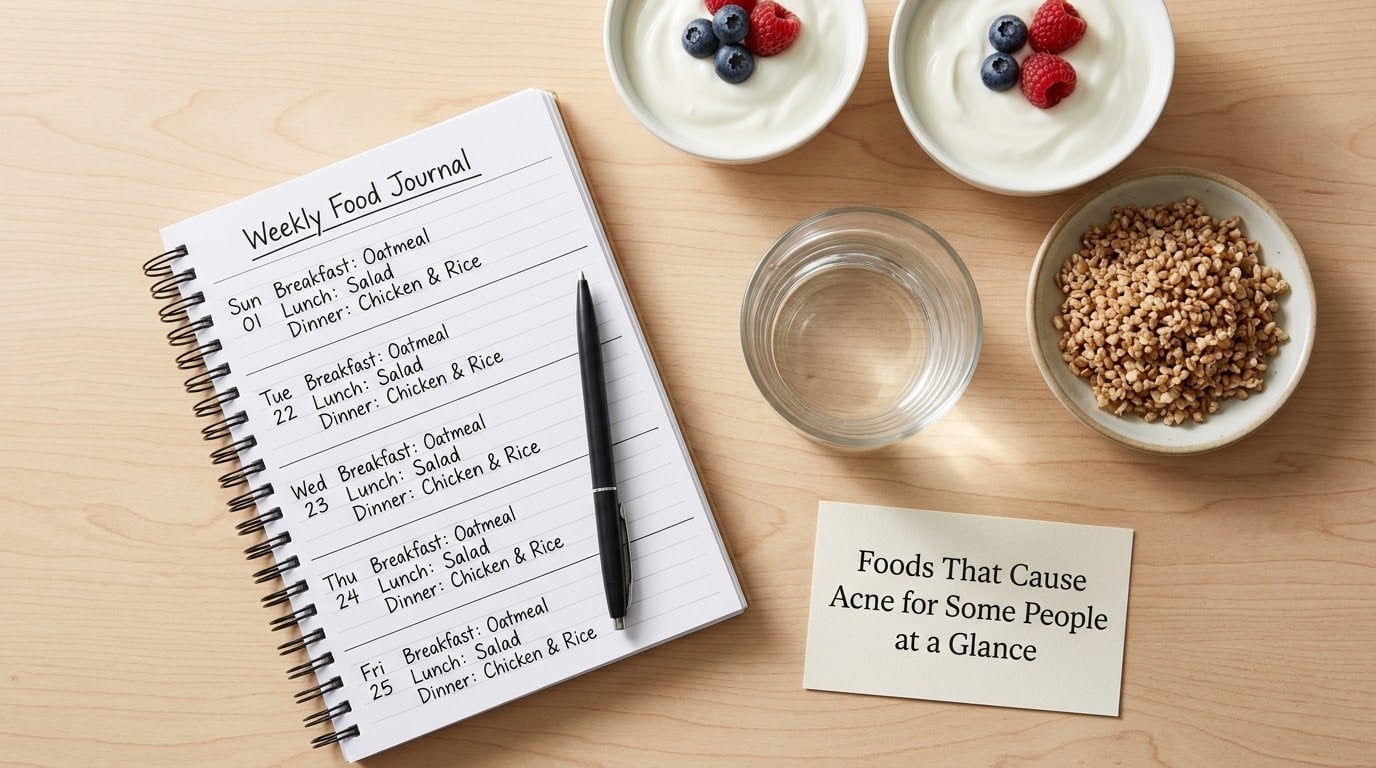
The table below ranks the twelve patterns covered here by how well the research holds up. Read the last column as your starting checklist, not a verdict on your skin.
| Food or pattern | What the evidence suggests | Where it tends to show up | What to watch |
|---|---|---|---|
| Sugar-sweetened drinks | Strongest category of support | Daily or near-daily consumption | Timing between drink and flare-up |
| Candy and added sugars | Strong, usually via glycemic load | Large or frequent servings | Portion size and repeat servings |
| White bread and refined grains | Moderate to strong | Breakfast and lunch staples | Whether a swap changes the pattern |
| Milk, especially skim | Moderate to strong | Cereal, smoothies, daily pours | Which type and how much |
| Sweetened yogurt | Moderate | Flavored cups and yogurt drinks | Added sugar per serving |
| Whey protein | Mixed, moderate at best | Daily shakes and bars | Cystic flares after consistent use |
| Casein-rich products | Weaker signal than whey | Puddings and shakes | Whether switching protein helped |
| Chocolate with added sugar | Limited and mixed | Frequent candy-bar snacking | Sugar content, not cocoa alone |
| Energy bars | Indirect, several triggers combined | Habitual desk-drawer snack | Label: sugar plus milk protein |
| Sweetened breakfast cereals | Moderate, daily repeat dose | Every single morning | Breakouts on the chin and jaw |
| Fried and processed snacks | Weak and indirect | High combined glycemic load | Frequency, not the oil itself |
| Very large servings | Emerging, portion-driven | Holiday meals and long weekends | Size of the portion, not the food |
1. High-Glycemic Sugar Drinks
Yes, sugary drinks are the first category to test. Soda, sweetened tea, energy drinks and fruit punch deliver a large amount of sugar in liquid form, so glucose rises quickly and insulin follows.
That spike matters because insulin and insulin-like growth factor 1 (IGF-1) both nudge sebaceous glands toward more oil and faster cell turnover, which is the basic set-up for a clogged follicle. The effect shows up most clearly in people drinking these daily.
A single can on a birthday is not going to be the reason you break out next week. A 500ml bottle every weekday is a different experiment, and it is a reasonable one to run.
2. Candy and Other Added Sugars
Gummy candy, cookies and chocolate-coated sweets are usually grouped with drinks as a sugar problem, and the mechanism is the same even though the format is different.
What changes is quantity. A single small treat rarely does much; a large serving, or the same serving several days in a week, adds up to a meaningful glycemic load each time.
Readers on the r/acne forum commonly report the same sequence: reduce added sugar for six to eight weeks, skin flattens, then a birthday cake brings it straight back. That rebound is usually the most convincing evidence anyone gets.
3. White Bread and Refined Grains
White sandwich bread, white pasta and white rice rank high for glycemic load, which is why they turn up so often in personal trigger lists.
Gluten itself is not proven to cause acne in most people, so switching to gluten-free bread does not necessarily solve anything. Swapping white for whole grain is the change worth testing, because the fiber changes how the meal is digested.
Convenience is the thing that kills this experiment. If the swap makes breakfast take ten extra minutes, it will not survive week three. A whole-grain wrap that tastes fine on the go is a better bet than a perfect loaf you skip.
4. Milk
Dairy is the most debated category, and the studies lean in an uncomfortable direction: milk intake, particularly skim milk, has been associated with acne in several observational studies.
A common theory is that naturally occurring hormones in milk, plus the processing that concentrates some of them in skim milk, may raise androgen activity. Association is not proof, and these studies cannot tell us whether the people drinking the most milk were already acne-prone for other reasons.
Skim milk vs whole milk: what the studies show
When researchers separate dairy by type, skim milk comes up most often. Some work also suggests fermented dairy behaves differently from milk, and that yogurt with live cultures is not interchangeable with a glass of milk.
Cheese is harder to place. It is lower in milk protein per serving and shows a weaker signal, so logging a bag of shredded cheese next to a daily cereal bowl of milk treats two very different exposures as one.
Worth knowing: high-glycemic diets also often include a lot of milk. When someone changes both at once, there is no way to know which one did the work.
5. Yogurt With Added Sugar
Plain yogurt and flavored yogurt drinks are often treated as the same food, and that is where the confusion starts. The unflavored version has no added sugar; a fruit-on-the-bottom cup can carry a surprising amount.
So if yogurt shows up in your trigger list, the more useful question is which version, how large a serving, and how often. A small plain cup eaten a few times a week is a different test from a large flavored one every morning.
Fermented dairy is also worth separating from unfermented milk in the diary, because the bacteria change how the product behaves in the gut and the live cultures are not present in a milkshake-style drink.
6. Whey Protein Powders
Whey protein has the most anecdotal support of anything on this list among people who lift, and the most confusing evidence. Reviews on r/SkincareAddiction often describe cystic flares that started a few weeks after adding daily shakes and settled after switching to plant protein.
Whey is a dairy protein, so it overlaps with the milk signal rather than adding an independent one. Concentrated forms such as whey isolate deliver a large protein dose in a small serving, which is a bigger exposure than a glass of milk.
That said, gaining or losing weight, changing training volume and adjusting sleep usually happen at the same time as introducing a supplement. None of those are acne triggers in the classic sense, but they move hormones, and hormones matter.
If you want to test it, hold the shake constant and change one thing at a time, and talk to a clinician before adding any supplement to an already unbalanced routine.
7. Whey-Free Casein-Rich Products
Casein is the other major milk protein, and it is the protein in cottage cheese, some puddings and many plant-based milks that use a casein-derived ingredient.
The research signal is weaker for casein than for milk and whey, so switching from whey to casein is not a guaranteed fix. It is still a reasonable experiment for someone whose breakouts improved after dropping whey.
Casein digests slowly, which is part of its appeal as a protein, and that slow release is exactly the kind of detail that makes people suspicious. The suspicion is not proof, so treat the swap as a question rather than a conclusion.
If a few weeks on the new protein changes nothing, you have learned something useful and you can stop paying attention to it.
8. Chocolate With Added Sugar
Chocolate is where the evidence is weakest and the belief is strongest. Some studies have found acne worsening after chocolate, others have not, and the ones that did find effects had trouble separating cocoa from everything that came with it.
High-sugar candy bars are a different proposition from a square of 85% dark chocolate. The bar combines sugar, milk and often a large portion size, so it falls into several of the earlier categories at once.
For diary purposes, log dark, milk and candy-coated chocolate in separate columns. Readers who find a pattern usually find it with the coated bars, not with a small piece they eat occasionally.
9. Energy Bars With Sugars or Whey
Energy and protein bars are the most underrated item on this list because they are eaten habitually, often twice a day, and rarely questioned.
Read the label and many of them contain two or three flagged items at once: added sugar for the glycemic load, milk protein such as whey or casein, and a blend of syrups standing in for grains.
The habit matters as much as the label. A bar in a desk drawer gets eaten during a stressful afternoon, and stress eating and the bar itself are tangled together in a way that is genuinely hard to untangle.
One honest test is to keep the bar but move it to a time of day when you are not stressed, and see whether the chin breakouts change.
10. High-Glycemic Breakfast Cereals
Breakfast repeats more than any other meal, which is why a daily high-glycemic cereal can matter more than an occasional dessert.
Frosted flakes, sweetened cereal and honey granola often deliver refined carbs with little fiber, then get you moving on a blood sugar curve that stays elevated for hours.
Oats with fruit and nuts is the standard suggestion, and it works partly because the protein and fat blunt that curve. Oats with dried fruit and brown sugar is a dessert wearing a breakfast hat.
Chin and jaw breakouts that show up on a predictable monthly cycle are worth checking against what you ate most days of the previous week, rather than the last meal before they appeared.
11. Fried Foods and Some Highly Processed Snacks
The evidence for fried food on its own is weak, and the greasy-food-acne myth does more harm than good because it pushes people toward low-fat substitutions that do nothing for their skin.
What actually shows up in the research is the combined package. Chips, crackers and packaged snacks tend to be refined starch plus added fat plus salt, eaten in sizeable portions, which makes them a high total glycemic load.
Fast food is the clearest example. People rarely blame the oil; they blame the burger bun, the fries, the soda and the late hour, and the drink is often doing more than the fried part.
Check the ingredient list before you check the cooking method. That single habit catches more real triggers than any amount of oil-watching.
12. Very Large Servings of High-Glycemic Foods
Portion size may matter as much as the food itself, and it is the item most people never log. A bowl of rice at a normal serving and a bowl at a birthday-table serving are not the same event for your skin.
This is where the recent work on glycemic load is most useful, because it counts the whole serving rather than the food in isolation.
How to test portion size without going extreme
Do not cut everything at once. Pick the single food you eat most often, serve yourself about half the usual amount, and leave everything else alone for three weeks. Keep a note of how the skin behaves around your period, since hormonal timing can easily be mistaken for a food effect.
Some people find a few specific changes hold, while others notice nothing at all. Both are good outcomes, because the second one ends the guesswork.
If you do want to test a trigger properly, the order that tends to work is: baseline for two weeks, one change for four to six, then reintroduce for another two. Most people in the forums report needing six to eight weeks before results are clear, and much of that is simply skin turnover speed.
One caution about cutting dairy while also cutting sugar, gluten and oil: if the skin improves, you will have no idea which change did it, and the usual result is that people give up the whole approach. The same goes for restrictive diets that go on for months without supervision, especially since the reports of acne returning after stopping are common enough to be predictable.
Frequently Asked Questions
Can food really cause acne?
Yes, for some people. Diet is one of several contributing factors, alongside hormones, genetics, skincare and stress. High-glycemic foods and dairy have the strongest research behind them. Food rarely acts alone, which is why testing one change at a time gives clearer answers than a full elimination diet.
What foods are most likely to trigger acne?
Sugar-sweetened drinks, candy, white bread and refined grains, and milk, especially skim milk, come up most often in both studies and personal accounts. Whey protein shakes, sweetened yogurt drinks and high-sugar energy bars are also common triggers. The response is individual, so treat these as the first things to log rather than a list of forbidden foods.
How long does it take to know if a food is causing breakouts?
Most people need six to eight weeks of consistent logging, because skin cells take time to turn over and breakouts rarely appear overnight. Keep a baseline for two weeks, change one thing for four to six, then reintroduce the food for two weeks. Changing several things at once usually means learning nothing at the end.
Does dairy always cause acne?
No. Observational studies link milk, particularly skim milk, with acne, but dairy is not an automatic cause and plenty of people eat it without noticing breakouts. Fermented dairy such as plain yogurt may behave differently from milk. If you suspect it, log the type and portion for six weeks before drawing a conclusion.
Should I stop eating chocolate to prevent acne?
The evidence on chocolate alone is weak and inconsistent, and much of it cannot separate cocoa from the sugar and milk in the same product. High-sugar candy bars are the ones more likely to fit other triggers on this list. A small piece of dark chocolate now and then rarely needs to be given up; a daily coated bar is worth testing.
When should acne breakouts see a doctor instead of changing my diet?
See a doctor or dermatologist if acne is painful, is leaving scarring or dark marks, is spreading, or is not improving after a consistent eight to twelve weeks of tracking. Also seek help if you are cutting out whole food groups, if breakouts appear suddenly, or if acne comes with other symptoms. Diet is an add-on to care, not a substitute for it.
Conclusion
Start with a record, not a rule. Two weeks of logging what you eat alongside your breakouts, sleep, stress, skincare changes and cycle will usually tell you more than any list of foods to avoid.
Then make one manageable change at a time, starting with the most common pattern you find, and give it six to eight weeks. Acne is multifactorial, and persistent, painful or scarring breakouts are a good reason to stop experimenting and talk with a doctor or dermatologist. While you are reading labels anyway, our guide to how to spot hidden sugar in packaged foods is useful for the first item on the list.