
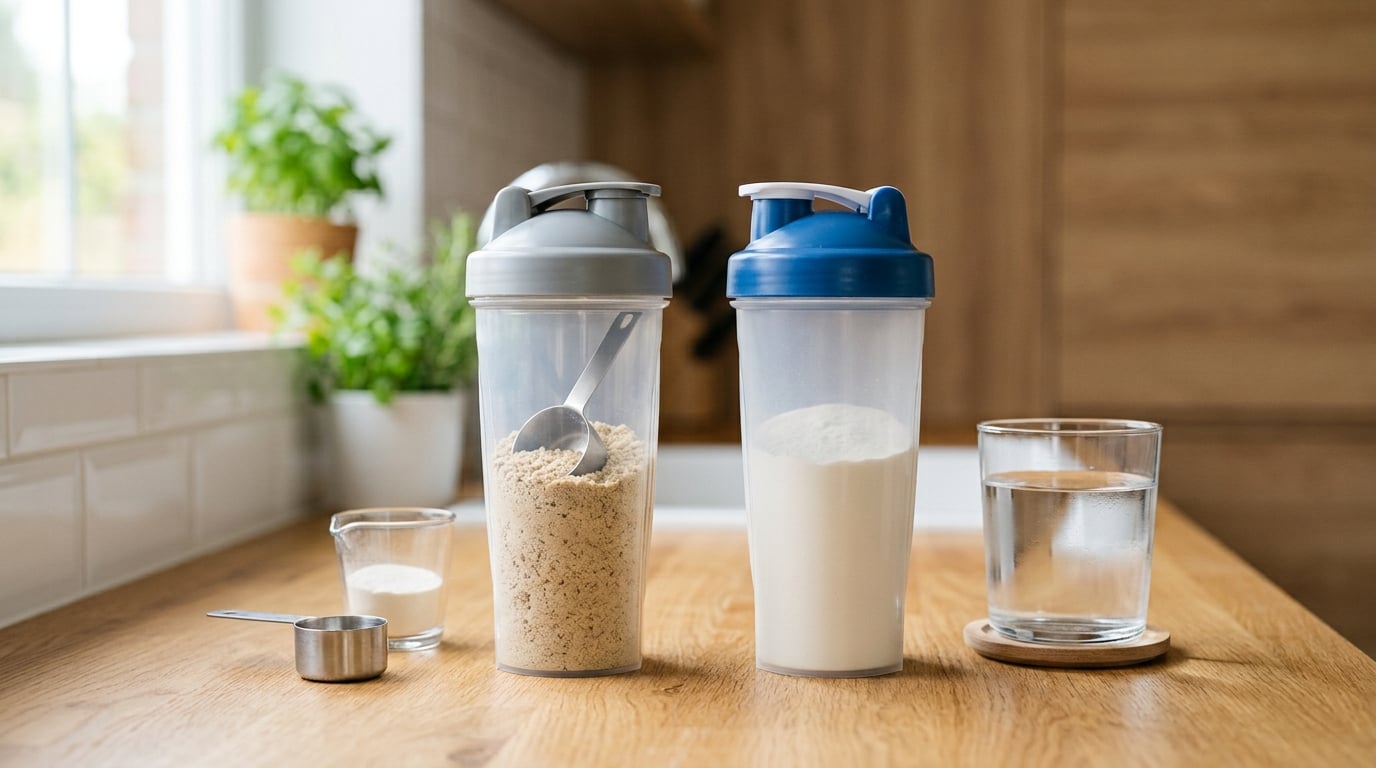
Plant protein vs whey protein for beginners comes down to a short version: whey is a complete dairy protein that is easy to digest and quick to absorb, while plant protein is made from peas, soy, rice and other sources, usually blended to round out its amino acid profile. Neither one is better for everyone. Your stomach, your diet, your budget and your training decide.
Most beginners get stuck on the same question, and it is almost never the right one. They ask which powder is higher quality, when what they actually need is how much protein they eat in a day and whether their body tolerates the powder sitting on the shelf. Get those two answers first and the label comparison takes five minutes.
I want to be clear about what follows: this is general nutrition information, not personal advice. If you have a diagnosed condition, take medication, are pregnant, or have a history of disordered eating, talk to a doctor or a registered dietitian before changing how you eat. That conversation takes ten minutes and saves a lot of guessing.
Table of Contents
- Plant Protein vs Whey Protein for Beginners at a Glance
- What Is Plant Protein?
- What Is Whey Protein?
- Which Has More Protein and Better Amino Acids?
- Which Is Easier to Digest?
- Plant Protein vs Whey Protein: Ingredients to Check
- Which Protein Fits Your Goals and Routine?
- Which Is More Affordable?
- Which Should You Choose?
- Frequently Asked Questions
- Is plant protein as good as whey protein for building muscle?
- How much protein does a beginner need each day?
- Can I use plant protein after workouts?
- Is whey protein bad for weight loss?
- Can I switch from whey to plant protein without a meal plan?
- How do I choose a protein powder with few added ingredients?
- The Short Version
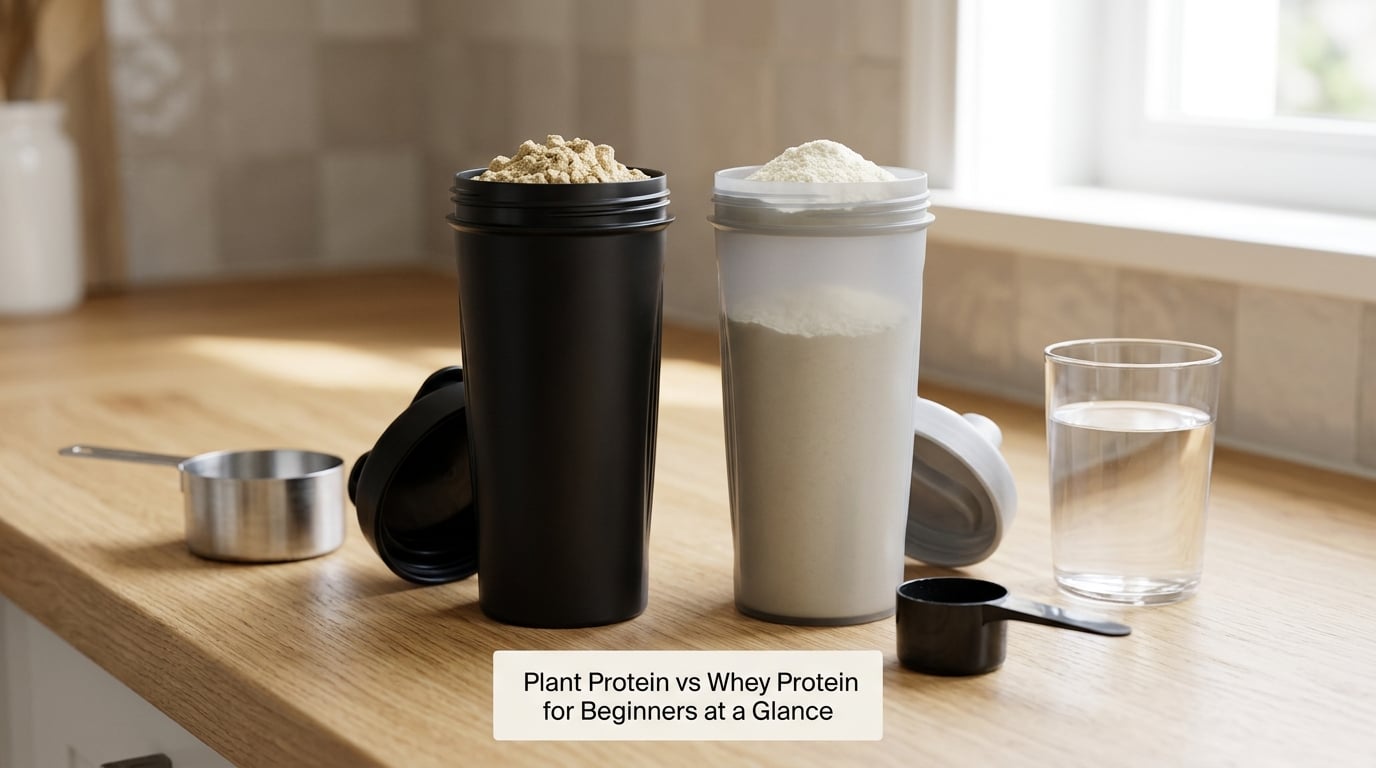
Plant Protein vs Whey Protein for Beginners at a Glance
| What to compare | Plant protein | Whey protein |
|---|---|---|
| Where it comes from | Pea, soy, rice, hemp, pumpkin seed, or a blend of them | Milk protein left over from cheese making |
| Typical protein per serving | About 20 to 27 g, with larger scoops to match a whey dose | About 24 to 30 g per scoop |
| Amino acid profile | Complete when blended; single sources are usually low in one or two amino acids | Naturally complete, with high leucine |
| Digestibility | Slower; fiber and some fermentable sugars can cause gas | Fast; lactose content varies by concentrate or isolate |
| Lactose | None | Present in concentrate, near absent in isolate |
| Fiber per serving | Often 1 to 5 g depending on the source | Near zero |
| Common added ingredients | Flavor systems, some gums or fiber for texture | Flavor systems, sweeteners, sometimes thickeners |
| Taste and texture | Earthy or beany for pea, mild and grainy for rice, gritty if under-blended | Generally the category favorite, especially in milk |
| Best for | Dairy-free eating, vegan diets, people who react to milk | Convenience, post-workout use, people who tolerate dairy well |
Two columns of numbers never tell the whole story, which is why the rest of this guide walks through each row in plain language. If you read nothing else, read the amino acid and digestibility sections, because those are the two that actually change results.
What Is Plant Protein?
Plant protein is powder made from plants rather than animal milk. The most common sources are pea, soy, rice, hemp and pumpkin seed, and most powders on the shelf are blends of two or three of them.
Pea protein comes from yellow split peas and is the backbone of most plant powders today. It dissolves reasonably well and costs less than soy, but on its own it is low in methionine, one of the nine essential amino acids your body cannot make itself. Rice protein is mild in flavor and low in lysine, the other classic gap, which is why pea and rice appear together so often: each covers the other’s weak spot.
Soy protein is the odd one out. It is a complete protein on its own, it has a solid amino acid profile, and decades of research support its use for building muscle. The catch is that soy is a common allergen, and it is the one plant source most likely to cause digestive complaint in sensitive people. Hemp protein contains all nine essential amino acids and adds a little fiber, but its flavor is earthy and it rarely makes up more than a fraction of a blend.
How does it become powder? Seeds or legumes are milled into a flour, mixed with water, and the protein is separated out, often by a precipitation step. What is left gets dried, sometimes hydrolyzed into smaller peptides for better mixing, then flavored. Some powders keep the fiber, some remove it, and that choice is one of the biggest reasons two plant powders with identical protein percentages feel completely different in your stomach.
How Does Plant Protein Compare With Whey Protein for Beginners?
Here is the honest bottom line. Whey is usually more convenient and more leucine-dense per serving, and it wins on taste for most people. Plant protein can absolutely meet a beginner’s needs, it suits anyone avoiding dairy or eating fully plant-based, and modern blends close most of the quality gap. What decides it is your tolerance, your goal, and whether your total daily protein adds up, not the label on the tub.
For a beginner lifting three times a week, both will work. The person who quits after two weeks because the shake tastes like grass or sits heavy in their stomach is the one who fails, and that happens more often with plant powder simply because the category is newer and the formulas vary more.
What Is Whey Protein?
Whey protein is the milk protein that stays liquid after cheese is made. During cheesemaking, casein coagulates and forms the curd, and what remains is whey, which is then filtered and dried into a powder. It is naturally complete, meaning it supplies all nine essential amino acids in useful amounts without any blending.
Within whey, the form you buy matters more than beginners expect. Whey concentrate is roughly 70 to 80 percent protein by weight, with the remaining 20 to 30 percent being lactose, milk fat, and other milk solids. Whey isolate is around 90 percent protein or higher, with most of the lactose and fat filtered out. Hydrolysate is pre-broken into smaller peptides, mixes very smoothly, and is the most expensive of the three.
For a beginner, concentrate is a sensible first buy if dairy sits well with you. Isolate is the one to try if you are sensitive to lactose or watching calories closely, and people who report that isolate is easier on their stomach tend to be right. Hydrolysate is mostly worth it for people who need it for absorption reasons under a clinician’s guidance, and it is not a beginner upgrade.
Whey is also the more varied category nutritionally. Beyond plain powder, you will see blends with added collagen, MCTs, digestive enzymes, and pre-workout versions with caffeine. Those additions cost you money and complicate the label, so plain unflavored concentrate or isolate is the smarter starting point.
Which Has More Protein and Better Amino Acids?
Whey usually wins the per-serving number because scoop sizes are smaller. A typical whey scoop delivers 25 or 30 g of protein, while plant powders often use a 30 to 35 g scoop to hit 20 to 25 g, since plant ingredients carry more fiber and carbohydrate by weight. Neither number tells you anything about quality on its own, so read the amino acid story next.
There are twenty amino acids in your body, and nine of them are essential, meaning food has to supply them. A complete protein contains all nine in sufficient amounts. Whey is complete naturally. Most single plant sources are not: pea is low in methionine, rice and most grains are low in lysine, and that is precisely why blends exist rather than single-source powders.
Leucine is the amino acid that gets the most attention for a reason. It acts as a signal that triggers muscle protein synthesis, the process that repairs and builds muscle tissue after training. Whey delivers leucine efficiently in a normal scoop. A pea-based powder often delivers noticeably less per scoop, so matching a whey dose usually means a larger serving of plant protein or a blend with added leucine.
That is why the honest adjustment is roughly a 20 to 30 percent larger plant serving to hit a comparable leucine load, rather than a claim that plant protein is watered down. A powder built on a pea and rice blend with a leucine boost can land close to whey per serving, and so can soy, which is complete on its own. Read the amino acid panel if the brand publishes one, and treat published quality scores like PDCAAS or DIAAS as one signal rather than a verdict.
Over a full day, though, this gap shrinks to almost nothing, because most people eat a mix of foods across the day. A beginner who eats lentils, chickpeas, tofu, beans or whole grains alongside their shake rarely needs to do arithmetic on leucine at all. Total daily protein, spread across three meals, does far more for you than any single shake.
Which Is Easier to Digest?
For most people who tolerate dairy, whey is the easier option to digest. It digests fast, it is already broken into readily absorbed amino acids, and it is low in fiber. That speed is also why some people feel hungry again an hour later, which is a real drawback if you were counting on the shake to hold you over.
Whey carries lactose in concentrate form, since lactose is a milk sugar. People with lactose intolerance often tolerate concentrate poorly and isolate much better, because the lactose content drops sharply during filtration. A milk protein allergy is a different situation entirely and is not something to test your way through. If you have ever had a reaction to milk, talk to a clinician before trying any dairy protein.
Plant protein has its own predictable complaint, and it is gas. Pea protein and many blends contain fiber and fermentable carbohydrates that feed gut bacteria, which produce gas and bloating, especially if your gut is not used to them. This is the part most guides leave out: people switch from dairy to plant to escape bloating and quietly trade one problem for another.
Soy deserves its own note, because it is the plant source most likely to cause a stomach ache, and some people react to it as an allergen rather than just finding it heavy. Hemp and rice are generally the gentlest options, and blends that have had their fiber partly removed tend to sit lighter than whole-source powders.
The practical fix is a self-test rather than guesswork. Drop dairy protein and any sweetened products for two weeks, drink plenty of water, and keep your other meals and training the same so you are only changing one variable. Then reintroduce your first shake on an empty stomach and note how you feel over the next few hours. Repeat on a different day. Most people know within a week whether their gut is the deciding factor for them, and you can skip a long trial if your answer is immediate.
Small habits help either way. Sip rather than gulp, do not replace every meal with a shake in the first month, and never try a new powder the night before a heavy training day.
Plant Protein vs Whey Protein: Ingredients to Check
Turn the tub over and read the back, not the front. The front is marketing; the back is the only place that tells you what you are actually buying. Here is the checklist I use.
Start with the serving size and the protein number together. A powder advertising 25 g per serving is only impressive if the serving is realistic. If it takes two heaped scoops to hit that number, your cost per gram and your stomach comfort are both worse than the label implies. Divide by the serving weight to get protein per 100 g, which is the only figure that lets you compare two products fairly.
Then count the ingredients. A short list of protein, a sweetener, some flavor, and a thickener is normal and fine. A 20-item list with several different sweeteners, oils, and free-form flavor compounds is something to skip, especially for a beginner who will be drinking it daily for months.
Next, look at what was added for sweetness. Sucralose, stevia, monk fruit and sugar alcohols all appear constantly. Sugar alcohols such as erythritol and maltitol can loosen stools in some people, which is worth knowing if you are switching to plant powder hoping to fix digestive issues.
Check allergens next, and read the whey section for milk and the plant section for soy, and be careful with blends that combine several sources. If you avoid gluten, pea and rice are naturally gluten-free, but cross-contamination statements are worth a look.
Finally, look for third-party testing. Seals from independent programs such as NSF Certified for Sport, Informed Sport, or USP indicate the batch was tested for banned substances and heavy metals. That matters most for competitive athletes, but it is a reasonable quality signal for anyone. Whey is more prone than plant powder to picking up contaminants because dairy is an animal product, and third-party testing is a reasonable safeguard for both categories.
None of this is glamorous, and it takes about four minutes per product. It is also the difference between a powder you finish in eight weeks and one still in the cupboard in March.
Which Protein Fits Your Goals and Routine?
Match the powder to the job rather than the marketing. These are the situations beginners actually run into.
If your goal is hitting a daily protein number with minimal fuss, whey is the easier tool, because one scoop does the job, mixes clean in water or milk, and sits well after training. It is the lowest-friction option for a person who wants protein handled and nothing else to think about.
If you eat vegetarian or fully plant-based, plant protein is not a compromise here, it is the obvious choice, and so is eating a varied diet of legumes, soy, whole grains and seeds alongside it. Soy, seitan, lentils and tofu are cheap, effective and better for satiety than a shake.
If you avoid dairy because it makes you feel rough, plant protein solves a real problem. Just expect a two-week adjustment period for fiber and gas, and consider starting with a rice or pea blend that has been partly defibered.
If your goal is weight loss or weight management, pick based on satiety and calories rather than protein source. Both are low-calorie compared with most snacks, and both are satiating when they replace something less protein-dense. Whey is slightly lower in fiber, so a plant powder contributes a little more to daily fiber intake. Neither choice drives fat loss on its own, and the overall calorie picture does that work.
If you want a meal replacement breakfast rather than a workout add-on, a plant blend with some fiber is often the more satisfying option, since you are replacing a meal instead of topping one up. You will also get more staying power, which is the point.
And if you are a beginner who lifts three times a week and eats a varied diet, you may not need powder at all. The most common question on the beginner fitness forums is whether food alone is enough, and for most new lifters it genuinely is. Powder earns its place when protein is hard to get from food, not before that.
Which Is More Affordable?
Cost is the reason most beginners end up on plant protein, and the comparison is more useful than it first looks. Do not compare sticker prices or container sizes. Compare cost per gram of protein, which is the only number that survives contact with a real diet.
Here is the math. Take the price you paid, divide it by the total grams of protein in the tub, and you have your real cost per gram. Do the same for the other powder. If a plant tub looks cheaper but delivers 20 g per 32 g scoop while a whey tub delivers 28 g per 30 g scoop, the whey may still win once you count protein rather than scoops.
Two things distort the comparison, and both are common. The first is serving size, which I covered above. The second is fiber: some plant powders list total grams that include fiber and carbohydrate, so a label reading 25 g of protein per serving may split that across protein and fiber, and a beginner trying to hit a target can come up short without realizing it.
Sales, subscriptions, bulk sizes and warehouse-style brands move the real number far more than the source does. If cost is your main constraint, a plain unflavored bulk tub of either type beats a small specialty one, and buying a container you will actually finish is cheaper than buying a big one that goes stale on the shelf.
One more honest angle: food is often the cheapest protein there is. Eggs, dried beans, lentils, tofu, canned tuna, plain yogurt and chicken thighs deliver more protein per dollar than most powders. A shake makes sense when it replaces or supplements those foods, not when it adds a second protein source on top of a diet that already meets its target.
Which Should You Choose?

For anyone still weighing plant protein vs whey protein for beginners, the deciding factors are unglamorous. Choose plant protein if you avoid dairy, eat vegetarian or vegan, want a powder with some fiber in it, or simply find whey out of reach financially. Choose whey if dairy sits well with you, you want the least fuss and the most protein per scoop, and you will drink it in milk because that is where it tastes best.
Here is the short version for a first purchase. If you have never used protein powder, buy one small plain tub of the type you think suits you, use it for three to four weeks, and only then decide whether to commit to a bulk size. Flavor matters more than any chart, because a shake you enjoy is one you will keep making.
Aim for total daily protein spread across your meals, use the powder to fill a specific gap in that total, and change one variable at a time so you know what is working. Give any new powder two to three weeks before judging it, and keep training consistent so you can tell whether the change is helping.
If your needs are complicated by a medical condition, kidney or liver issues, a history of disordered eating, pregnancy, or multiple medications, a registered dietitian can take the guesswork out of it in a single visit. That is not an upsell, it is the fastest route to an answer you can trust.
Frequently Asked Questions
Is plant protein as good as whey protein for building muscle?
Yes, for most beginners it is close enough that the choice matters far less than your daily total. Studies comparing plant and dairy proteins find similar gains in lean mass and strength when total protein and training are matched. Plant servings are often larger, and single-source pea protein delivers less leucine per scoop, so a blend plus a slightly bigger serving closes the gap. Over a full day of varied meals, the difference largely disappears.
How much protein does a beginner need each day?
A common starting point for new lifters is roughly 1.6 grams of protein per kilogram of body weight per day, spread across three or four meals. A 70 kg person lands near 112 g. You do not need to hit it perfectly, and most beginners see results well before they hit it. Whole food counts too, and powder is simply the easiest way to close a remaining gap.
Can I use plant protein after workouts?
Yes. Plant protein works well post-workout, and a pea and rice blend with added leucine is a sensible choice. It digests somewhat more slowly than whey, so it suits a meal an hour or two after training even better than an immediate shake. The practical difference is small enough that total daily protein still matters more than what you drink in the first thirty minutes.
Is whey protein bad for weight loss?
No. Whey is a high-protein, low-calorie food that can help with fullness when it replaces a snack rather than adding to your day. It contains no fat and no cholesterol, which sometimes worries people unnecessarily. What drives fat loss is your overall calorie balance and consistency, not the protein source, and both whey and plant powders fit a weight loss plan equally well.
Can I switch from whey to plant protein without a meal plan?
You can, though a simple plan makes the switch easier. Expect slightly larger servings and, for the first week or two, more gas or bloating from fiber and fermentable carbohydrates in pea and soy blends. Keep your total daily protein the same, start with one serving a day rather than two, and sip it with plenty of water. Most people adjust within two weeks.
How do I choose a protein powder with few added ingredients?
Look for a short ingredient list where protein is first, then a sweetener, flavor, and a thickener or gum if needed. Divide the protein per serving by the serving weight to get protein per 100 g, which makes products comparable. Avoid anything with several different sweeteners or a long flavor compound list, and check for third-party testing if you care about purity.
The Short Version
Both protein types will get a beginner to their goal. Whey is faster, more compact, and usually tastes better, so pick it if dairy is fine for you. Plant protein suits anyone avoiding dairy or eating plant-based, and a blended powder with a slightly larger serving does the same job. Start small, read the back of the label, track your total daily protein, and give the choice two weeks before you judge it.