
To read a protein powder label, start at the serving size, work out how much of the tub that serving really is, then read protein, sugar, fat and the ingredient list in that order. Most comparisons fall apart because two brands use different serving sizes, so the label alone looks like a tie.
It takes about ten minutes per tub with a calculator, and honestly less. By the end you know how much protein you are actually paying for in weight terms, whether the sweetener suits your stomach, and whether the “tested” badge on the front means anything at all.
The whole label really comes down to three parts: the Supplement Facts panel, the ingredient list, and the allergen and certification statements underneath them. Everything else on the tub is marketing, and some of it is good marketing that makes your job harder.
Table of Contents
- What You Need Before You Read the Panel
- How to Read a Protein Powder Label, Step by Step
- Common Mistakes When Reading Protein Labels
- Frequently Asked Questions
- What should I look at first on a protein powder label?
- How many grams of protein per serving should a label show?
- Should I be concerned about heavy metals in protein powder?
- How can I check if a protein powder is third-party tested?
- What are the red flags on a protein powder ingredient list?
- What does proprietary blend mean on a protein powder label?
What You Need Before You Read the Panel
You need very little, and none of it is specialist equipment. The tub itself, a calculator on your phone, and two minutes of honest thinking about what you are buying it for.
It helps to know three numbers before you start comparing anything. The protein you want in a serving, roughly 20 to 30 grams a day for most people who train. The calories you are willing to spend on a shake. And whether you avoid dairy, soy, gluten or nuts entirely, because that choice narrows the shelf fast.
Then check the net weight on the bottom of the tub, in pounds and ounces, and the scoop size. Write both down. That combination is what lets you catch an understated serving, which is the single most common trick in this category.
One more habit pays off: have the tub in your hand and ignore the front. Claims like “25 grams of protein” and “sugar-free” are headline numbers pulled from one place on the panel. The back of the label tells you what that number costs you in calories, carbohydrate and sweetener.
How to Read a Protein Powder Label, Step by Step
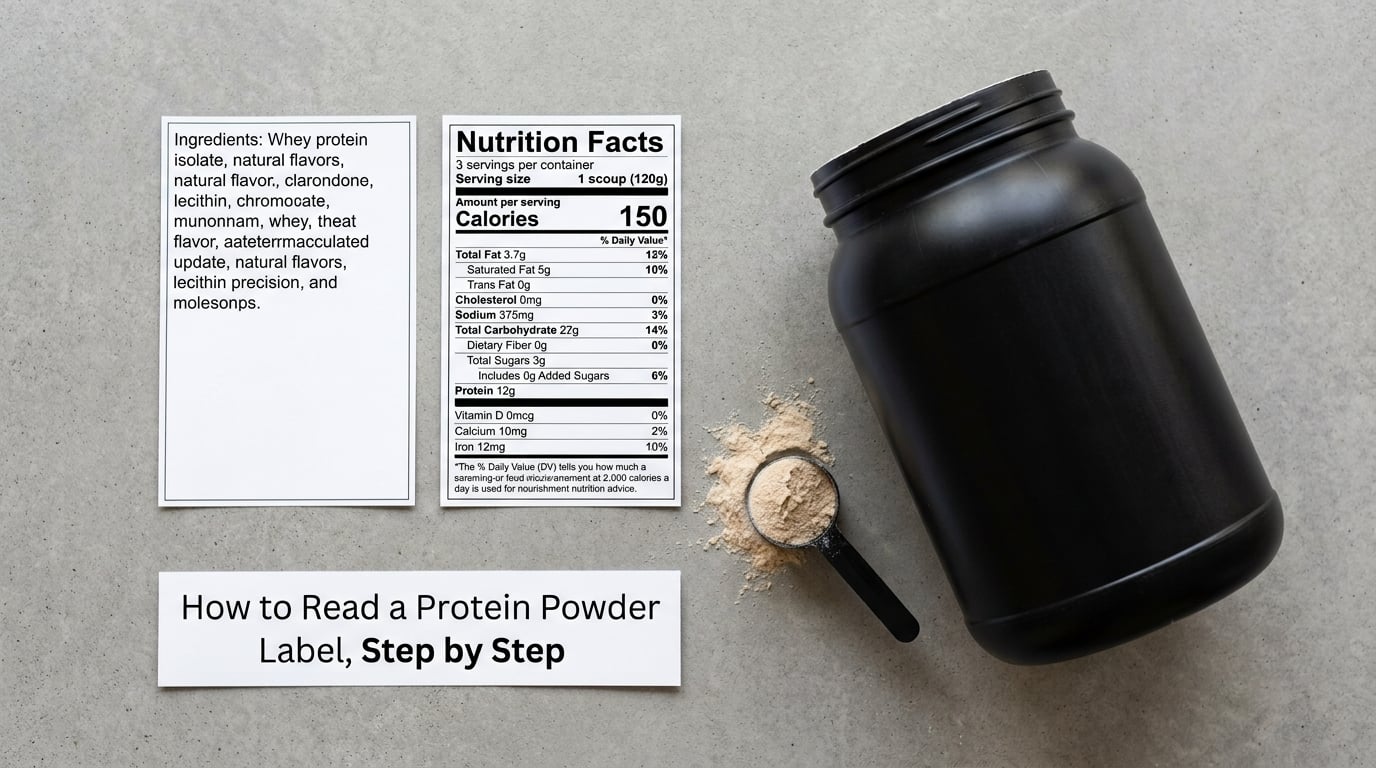
The panel reads in a fixed physical order, and that order is the reading order. Follow it top to bottom:
- Serving size and servings per container
- Calories
- Total protein
- Carbohydrate, then sugars and fiber within it
- Total and saturated fat
- Sodium and the rest of the micronutrients
- Percent daily value figures down the right-hand side
- Then leave the panel and read the ingredient list
Each step below explains what to do with that line, and what to do next once you have the answer.
Step 1: How to Read the Serving Size and Servings Per Container
Read the serving size and the number of servings per container first, because every other number on the panel depends on them. A protein powder serving is usually one or two scoops, but scoop size varies more than people expect. A 40 gram serving and a 90 gram serving can both look impressive on the front of the tub.
Here is the check I use. Take the net weight and divide it by the number of servings. For a 2 lb (907 g) tub claiming 30 servings, that works out to about 30 grams of powder per serving. Now compare that to the serving size printed on the panel. If the panel says 34 g, the number checks out. If it says 24 g, the brand is counting a smaller scoop than you would fill.
Servings per container is also the most useful number for planning. Thirty servings in a 2 lb tub is 30 real shakes. If your scoop is bigger than theirs, the tub runs out sooner than the label promises, and the serving count is the only place that tells you.
Step 2: Compare Protein per Serving and Protein Density
Compare protein per serving next, then convert it to a percentage of the powder by weight. Protein percentage is the number that makes two tubs comparable no matter what serving size each one chose. It is not printed anywhere, so you calculate it: grams of protein divided by grams of serving, times 100.
A product delivering 25 g of protein in a 30 g serving is about 83 percent protein by weight, which is very strong. Another showing 20 g of protein in a 90 g serving is about 22 percent, and most of that scoop is filler, carbohydrate or flavouring. Same headline claim on the front, very different tubs.
Two more calculations are worth doing. Total protein for the container, which is the serving size multiplied by the servings per container, tells you how much protein is in front of you overall. And calories per 25 g of protein, which is calories divided by protein grams, times 25. The second number is the fairest way to compare a high-calorie concentrate against a lean isolate.
| Number on the label | How to work it out | What a solid value looks like |
|---|---|---|
| Protein as percent of powder by weight | Protein grams divided by serving grams, times 100 | 70 percent or higher for a filtered product; 80 percent and up for whey isolate |
| Protein per serving | Printed on the panel | 20 to 30 g for a full-size shake |
| Calories per 25 g of protein | Calories divided by protein grams, times 25 | Around 120 to 150 for a typical whey protein |
| Total protein per container | Protein per serving times servings per container | 600 g or more in a 2 lb tub |
| Sugars per serving | Inside the carbohydrate line on the panel | Under 3 g unless the product is meant to taste sweet |
Now the part most shoppers skip: free-form amino acids. Some labels list taurine, glycine, L-glutamine, creatine or BCAAs separately near the top of the ingredient list. Those count toward the total protein figure on the panel, but they are cheap amino acids rather than protein from milk or peas. Subtract them from the total and you get a fairer estimate of the real protein in the scoop.
A 25 g protein claim that includes 4 g of separately listed free-form amino acids is closer to 21 g of dairy or plant protein. That is not a scandal, but it is the difference between a label that reads honestly and one that reads generously.
Step 3: Identify the Protein Source
The ingredient list runs in descending order by weight, so the first ingredient is the largest single component of the tub. If whey protein is not first, the product is mostly something else, whatever the front of the container claims.
The main sources differ in ways a label can tell you about. Whey protein comes from milk and digests quickly. Casein is also from milk but digests slowly, which is why it turns up in overnight and bedtime formulas. Soy, pea and rice proteins are the plant options, usually blended because a single plant source is low in one essential amino acid or another. Egg protein shows up less often.
The wording after the source name tells you how it was processed, and that matters more than most shoppers realise.
| Label wording | How it is made | Protein percent by weight | Lactose | Best for |
|---|---|---|---|---|
| Protein concentrate | Milk protein filtered to remove most fat and carbohydrate | 70 to 80 percent | Noticeable amount | Everyday use when calories and cost matter more than precision |
| Protein isolate | Further filtered, often ultra-filtered | 85 to 90 percent | Trace amounts | Cutting periods, and people who react to lactose in concentrate |
| Protein hydrolysate | Enzymatically broken into smaller peptides | 85 to 95 percent | Very low | Digestibility, though it is bitter and usually heavily sweetened |
| Protein blend | Two or more sources combined | Varies | Varies | Plant-based diets, where pea and rice or pea and soy are blended for a fuller amino acid profile |
Isolate is worth paying more for calorie control and lactose tolerance, not for better muscle outcomes. That is the general read from people who log their scoops, and it matches what the panel shows: fewer calories and carbs per gram of protein, not a different kind of protein.
Step 4: Review Added Sugar, Sweeteners, and Other Ingredients
The carbohydrate line tells you most of what you need about sugar. Total carbohydrate includes sugars, added sugars and fiber, and a shake with more than 10 g of carbohydrate per serving is carrying more than protein powder needs to.
Then read the sweetener names. They fall into three groups, and they are not equivalent. Nutritive sweeteners such as sugar, honey, corn syrup solids and crystalline fructose are sugars in the plainest sense. Artificial sweeteners include sucralose, aspartame, acesulfame potassium and saccharin. Sugar alcohols such as erythritol, sorbitol, maltitol and xylitol sit in between.
Sugar alcohols are the ones that cause the most complaints. Large amounts can produce bloating, gas and, above roughly 20 g per serving, a laxative effect that catches people out. Reviewers on r/Supplements describe this as the reason they moved off a powder that otherwise worked well for them.
| Ingredient | What it does | Why it is added | Worth worrying about? |
|---|---|---|---|
| Whey protein, milk protein | The protein itself | Protein content, flavour and texture | No, especially when it is the first ingredient |
| Sucralose, acesulfame potassium | High-intensity sweetener | Sweetness without sugar or calories | Mostly a taste preference; some people avoid them |
| Erythritol, sorbitol, maltitol | Sugar alcohol | Sweetness and a smoother mouthfeel | Worth checking if you are sensitive, since high amounts cause gut distress |
| Xanthan gum, guar gum | Thickener | Stops protein settling at the bottom of the glass | Not at normal doses |
| Lecithin | Emulsifier | Makes powder mix smoothly in liquid | Not at normal doses |
| Carrageenan, carboxymethylcellulose | Stabiliser and texture agent | Thickens and smooths the mix | Discussed more than proven as a problem; the amount is tiny |
| Natural flavour, artificial flavour | Flavouring | Makes vanilla taste like vanilla | Neither term tells you what is actually in there |
| Sodium silicate, silicon dioxide | Flow agent | Keeps powder from clumping in dry mixers | Not at normal doses |
| Proprietary blend | An unnamed mixture | Hides the ratio of each ingredient | Yes, this one is a genuine red flag |
A named additive at the bottom of the list is not the problem. The problems are unnamed mixtures, amino acids listed as if they were protein, and hydrogenated oils used as texture agents.
Step 5: Check Allergens, Claims, and Product Quality
The allergen statement tells you what the powder contains and what it may have touched. Milk, soy, wheat and tree nuts are the usual ones, and the language matters: “contains milk” is a different statement from “made in a facility that also processes milk”. If you have a dairy allergy rather than lactose intolerance, the facility statement is the one that decides whether you can use it.
Next, check the claims against the panel. “Sugar-free” on a tub sweetened with erythritol is technically accurate and tells you nothing about carbohydrate. “25 grams of protein” might be two small scoops. “Natural” is not a regulated term on supplements and means very little.
Then look for a certification logo. NSF Certified for Sport and Informed Sport both test every batch for banned substances and publish results you can look up. USP and ConsumerLab verify label claims and contaminant levels but do not screen for sport bans. A Certificate of Analysis is a batch report; a good brand publishes one with a lot number you can match to the tub.
Heavy metals are the reason that matters. Independent testing has found lead, arsenic, cadmium and mercury in a meaningful share of protein powders sampled, mostly traced to plant-based and cocoa-containing formulas. Nobody claims one scoop a day is dangerous for most people, but the label alone will not tell you either way. FDA registration is not approval either, so a registered facility is not a quality statement.
For anything beyond general label reading, talk to a doctor or a registered dietitian rather than taking my word for it. This is general information, not personal nutrition advice.
Common Mistakes When Reading Protein Labels
These are the errors I see most often, each with the fix that stops it.
- Comparing serving sizes directly. Two tubs with different serving sizes cannot be compared by the protein number alone. Fix: convert both to protein percent by weight, or to calories per 25 g of protein.
- Trusting the scoop count without checking net weight. Divide net weight by servings per container to get the real grams per serving. Fix: do this before anything else.
- Assuming the protein source is first. Front-of-tub claims carry no legal weight on ingredient order. Fix: find the ingredient list and read the first line.
- Ignoring free-form amino acids. Separately listed glycine, taurine, L-glutamine or creatine count toward total protein. Fix: subtract them for a truer figure.
- Reading “blend” as a single source. A proprietary blend gives no ratios at all. Fix: put it back on the shelf if the protein amount depends on it.
- Treating natural flavour as informative. Natural and artificial are both marketing terms with no defined content. Fix: judge the product on named ingredients instead.
- Reading “sugar-free” as carbohydrate-free. Polyols and bulk fibres still register. Fix: read the carbohydrate line, not the claim.
- Assuming a tested logo means certification. “Tested for quality” on its own means nothing. Fix: look for a named certifier with a searchable database.
- Ignoring allergen facility statements. Cross-contact language matters for allergies, not just preferences. Fix: read the statement in full, including the fine print under it.
If you want the fast version while standing in the aisle, this is the whole sequence: check serving size against net weight, calculate protein percent by weight, confirm the protein source is the first ingredient, subtract separately listed amino acids, scan the carbohydrate and sweetener lines, and confirm the allergen statement and a named certifier. Sixty seconds, and you will know more than the marketing on the front.
Two smaller habits are worth keeping. Write the protein percent and calories-per-25 g on the back of your phone when you shop, so the next comparison takes seconds. And give a new tub a week before judging the flavour, because taste is partly what you expect and partly what you get.
Frequently Asked Questions
What should I look at first on a protein powder label?
Start with the serving size and servings per container, because every other number depends on them. Divide the net weight by the servings count to find the real grams per scoop, then check whether that matches the serving size on the panel. After that, work out protein as a percentage of powder by weight so you can compare tubs with different serving sizes fairly.
How many grams of protein per serving should a label show?
For a standard 8 ounce shake, 20 to 30 grams of protein per serving is the useful range. A 24 gram scoop is plenty for most people. The total matters less than the percentage, though: 25 grams of protein in a 30 gram scoop is an 83 percent protein powder, while the same 25 grams in a 90 gram scoop means most of the scoop is something else.
Should I be concerned about heavy metals in protein powder?
Independent testing has found lead, arsenic, cadmium and mercury in a meaningful share of protein powders sampled, with plant-based and cocoa-containing formulas most often involved. Nobody claims one scoop a day is dangerous for most healthy adults, but the risk depends on the source of the protein and the batch, so certified testing is the sensible precaution rather than skipping powder entirely.
How can I check if a protein powder is third-party tested?
Look for a named certifier on the tub rather than a self-description. NSF Certified for Sport and Informed Sport test batches for banned substances and both let you search a public database using the lot number on your container. USP and ConsumerLab verify label accuracy and contaminants. A Certificate of Analysis should list the lot number, the panel tested and the lab that ran it.
What are the red flags on a protein powder ingredient list?
The main red flags are a proprietary blend that hides ratios, free-form amino acids such as glycine or taurine listed high up while inflating the total protein claim, hydrogenated oils used as texture agents, and long unnamed flavour systems. A short ingredient list with a named protein source first is the opposite of all of these, and is what experienced buyers look for.
What does proprietary blend mean on a protein powder label?
A proprietary blend means the manufacturer declares the ingredients but not how much of each one is used. So a blend might contain two grams of the source on the front of the label or twenty, and the label cannot tell you which. It is used most often for expensive components such as creatine, glutamine or herbal extracts, which makes it worth asking the brand directly or moving on.
Start with the serving size and the ingredient list, then do the protein-percentage calculation before you compare anything. Those three steps take a couple of minutes and they settle most comparisons on their own. Pick a powder with a named certifier and an allergen statement you can live with, and treat the flavour as the last thing you decide.