
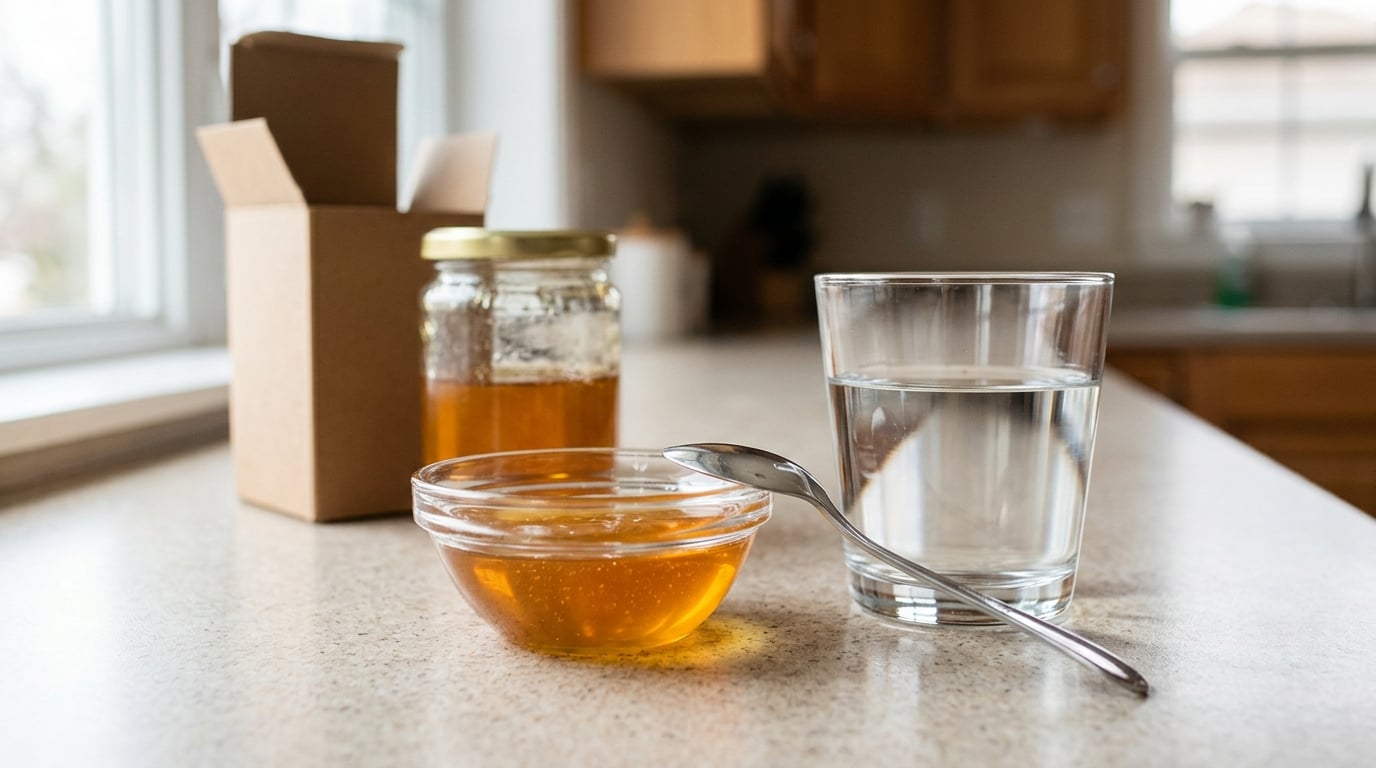
There is no single kitchen test that can prove a jar of honey is pure, so the honest answer to how to tell if honey is real is that you combine clues instead of trusting one. Read the label, look at the aroma and texture, watch how it settles in water, and check whether it crystallizes over a few weeks.
None of those checks is a verdict on its own, and anyone who sells a test that settles the question in thirty seconds is selling something. Lab analysis is the only conclusive route, which is why the five steps below are framed as screening, not proof. I checked the details below against what the National Honey Board, the FDA, and published lab survey work actually support, and updated for 2026.
Table of Contents
What You Need
None of this needs equipment, and most of it needs about ten minutes of attention plus a little patience.
- A clean spoon and a small dish for the pour and thumb checks.
- A clear glass or tall tumbler filled with room-temperature water for the settling test.
- The original package, not just the jar. The back of the bottle and the box carry the origin and grade information you need.
- A phone camera or a magnifier to read the small print and look at sediment and pollen at the bottom of the jar.
- A week or two of patience, plus a spot on a shelf away from the stove, because crystallization is a timed observation rather than an instant one.
Do all of the checks in a normal-lit kitchen rather than under a strong bulb, and keep the honey at room temperature. Chilled honey thickens up and makes the texture test meaningless.
Step-by-Step: How to Tell If Honey Is Real
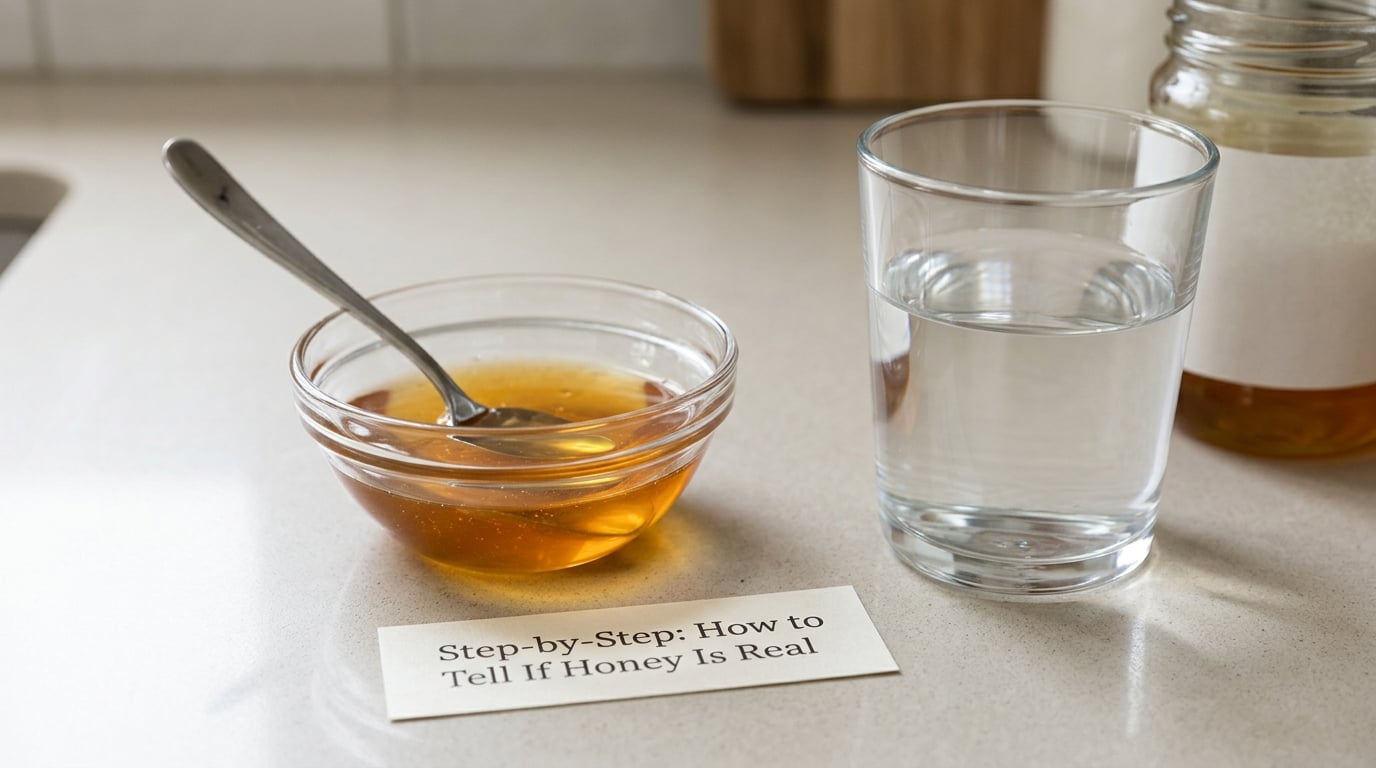
Work through these in order. The first two cost nothing and eliminate the most obvious problems, the last one is the one that actually tells you something, and everything in the middle is supporting evidence.
1. Read the ingredient and labeling details
Start with the label, because it is the only source of objective information in the entire process. The ingredient list on real honey reads honey, sometimes with nothing else at all, and anything resembling a sweetener listed alongside it is a reason to put the jar back.
Then check four more things on the same package: net weight, the country of origin, the grade, and any claim about being raw or unfiltered. Genuine imported honey is required to state where it came from, and US grades run from A to C based on clarity, moisture, and how much defect is present, with most grocery honey sitting at A.
Watch the wording rather than hunting for a specific format. A jar that says nothing about origin, or that leans on vague language about natural goodness, tells you nothing you can act on. And note what is missing: the FDA has never established a pollen requirement for honey, so a jar without pollen is not illegal, it is simply untraceable.
2. Examine the color, smell, and texture
Real honey smells specific to its flowers, and that smell is the fastest read you will get in under a minute. It changes completely depending on the crop, which is exactly why a jar from a different region will not smell like the one in your cupboard, and that difference is not evidence of anything.
Pour a spoonful onto a plate and let it settle. Pure honey sits where you put it, holds a slow ribbon, and does not run flat across the surface within a minute or two. Thinner syrup spreads quickly and keeps moving, and this is a genuine signal of dilution.
Then look for the things processing leaves behind. Cloudiness from fine air bubbles, a little sediment or pollen settled at the bottom, and crystals in the jar all point toward a minimally processed product. Watery clarity is the more telling warning sign, not richer color, since dark honeys like buckwheat and manuka are legitimately dark.
3. Use the water test as a basic clue
Drop a spoonful of honey into a glass of water and watch what happens. Honey sinks because it is denser than water, and pure honey tends to go down as a compact lump that holds together near the bottom.
Adulterated honey behaves differently because syrup-heavy blends disperse instead, and can leave a cloudy trail through the water. This is the single most repeated test online, and beekeepers on r/Beekeeping are blunt about why it does not settle the argument: syrup behaves differently enough to notice, but not differently enough to prove, and the honest use of this test is ruling out a badly diluted product rather than certifying a good one.
Treat it as a screening clue, nothing more. If the honey holds its shape cleanly, you have eliminated one failure mode. If it disperses, you have learned something worth acting on. Neither outcome identifies a floral source or a country of origin.
4. Check crystallization over time
Put the jar somewhere out of direct light and look at it again in two to three weeks. Real honey that is still free-flowing at month four is less common than people expect, and crystallization is a normal, healthy result rather than a warning sign.
The National Honey Board attributes it to the balance of glucose to fructose in a given batch, which shifts with the season, the region, and the weather the bees flew in. That is why your spring jar set solid while the autumn one stayed loose, and it is also why crystallization says more about the honey’s origin than its purity.
To loosen it back up, stand the jar in a bowl of warm water for a few minutes and stir gently. Skip the microwave, which creates hot spots that degrade the product unevenly, and skip any advice to bake or boil it.
5. Consider the seller and source
This is the step that carries the most weight, and it is the one most people skip. A jar you bought from someone who keeps bees, with a name on the label and a rough idea of where the hives sat, is a different proposition entirely from an unlabelled tub at a roadside stand.
For packaged honey, look for traceability rather than adjectives. A named producer or importer, a stated country of origin, a grade, and a lot or batch number all tell you who stands behind the contents. Programs like True Source Certified exist specifically to audit that chain, and single-origin or protected designation of origin labels are worth paying more for because someone has committed to the claim.
Be fair about one thing: a pollen profile that does not match the stated origin is not proof of fraud. Migratory beekeeping moves hives across state lines for pollination contracts, so a jar labelled for one crop can legitimately carry pollen from somewhere else. That mismatch is a reason to ask questions, not to accuse anyone.
Common Mistakes
Most bad honey decisions come from a test that cannot support the claim being made for it. Here are the errors I see most often, and the correction for each.
- Believing the ant test. The claim that real honey repels ants and fake honey attracts them is folklore with no basis. Ants respond to sugars, and both products are mostly sugar. Put a drop on your counter, ignore what happens, and move on.
- Using the paper towel test. Rubbing honey on a paper towel and reading the mark as proof of purity measures absorbency, not authenticity. Every syrup on the shelf does the same thing.
- Reading the color as a verdict. Buckwheat is nearly black and clover is pale gold, both entirely legitimate. Legitimate honey varies more widely by floral source and processing than any single home test can account for.
- Treating clear honey as clean honey. Ultra-filtration makes a product look uniform by stripping out pollen, which is both the visual clue and the traceability link. A perfectly clear jar is not automatically a good jar.
- Buying from unlabeled bulk containers. Dispensed honey from a tub with a handwritten sign gives you no grade, no origin, and no way to trace a problem later. If a seller cannot tell you where it came from, that is the finding.
- Assuming crystallization means spoilage. It is glucose forming crystals, and the National Honey Board treats it as an expected change. Freezing and thawing, or contamination from a wet spoon, is what actually spoils honey.
One more worth naming: the recurring claim that most honey on grocery shelves is fake. A 2023 blind survey by RQA tested 74 retail samples across 11 brands and 11 markets using carbon isotope ratio analysis, hydrogen nuclear magnetic resonance profiling, and high resolution mass spectrometry, and 70 of those samples passed all three methods, with 10 of 11 brands completely pure. The older alarmist headlines and that data are both out there, and only one of them is recent enough to lean on.
Frequently Asked Questions
Does real honey float or sink in water?
Real honey sinks, because it is denser than water. When you drop a spoonful into a glass, pure honey usually falls as a compact lump that holds together near the bottom. Adulterated honey, which is often cut with corn or rice syrup, tends to disperse and leave a cloudy trail instead. Even a clean sink is only a screening clue, since syrup blends vary widely and no water test can confirm a country of origin or a floral source.
Why does my honey crystallize, and does that mean it is real?
Honey crystallizes because of the ratio of glucose to fructose in a given batch, which shifts with the season, the region, and the weather the bees flew in. The National Honey Board treats crystallization as a normal change rather than spoilage, and many people consider it a sign of an unprocessed product. To liquefy it, stand the jar in warm water and stir gently instead of microwaving it, which heats unevenly and degrades the honey.
Is grocery store honey real honey?
Most of it is. A 2023 blind survey by RQA tested 74 retail samples from 11 brands across 11 markets using carbon isotope ratio analysis, hydrogen nuclear magnetic resonance profiling, and high resolution mass spectrometry. Seventy of the 74 samples passed all three methods, and 10 of the 11 brands came back completely pure. That is not a claim that every jar is perfect, but it is far better evidence than the older headlines suggesting most store honey is counterfeit.
Can I test honey for high-fructose corn syrup at home?
Not reliably. Home checks can sometimes show that a product has been diluted with syrup, since it behaves differently in water and pours thinner, but they cannot measure how much syrup is present or which type was used. Identifying adulterants at that level means carbon isotope ratio analysis, since corn and cane sugar come from different plant sources and leave a different signature. For a definitive answer you need a laboratory, not a kitchen counter.
How do I know whether honey is raw?
Look for the claim on the label, then back it up with what you can see. Raw honey is unheated and unfiltered, so it usually carries a little sediment or pollen at the bottom, looks slightly cloudy, and crystallizes within a few months. A label claiming raw, unfiltered, or minimally processed is a good start, and a jar that is perfectly clear and stays liquid for a year has probably been filtered and heat treated. Certified single-origin labels add a further layer of accountability.
When is laboratory testing worth paying for?
Worth it when the stakes are higher than a single jar at the supermarket. A bakery or cafe screening a bulk delivery, a buyer committing real money to a single-origin jar, and anyone filing a complaint with a seller all justify sending samples to a contract lab. The standard panel runs carbon isotope ratio analysis, hydrogen nuclear magnetic resonance profiling, and high resolution mass spectrometry. For a home cook, a phone call to the beekeeper is a cheaper and usually more useful first step.
Conclusion
Start with the label, because it is the only objective evidence in front of you. Then smell the honey, pour a spoonful to watch the ribbon, drop some in water, and leave the jar alone for a couple of weeks to see whether it sets.
Read the results as a pattern rather than a score. A jar that fails several checks at once deserves a second look or a return. A jar that passes all of them is a reasonable buy, not a certified one.
For anything that matters beyond dinner, ask the producer directly or send a sample to a qualified laboratory. That is the only way to know for certain, and the person who sells you honey should be glad you asked.