
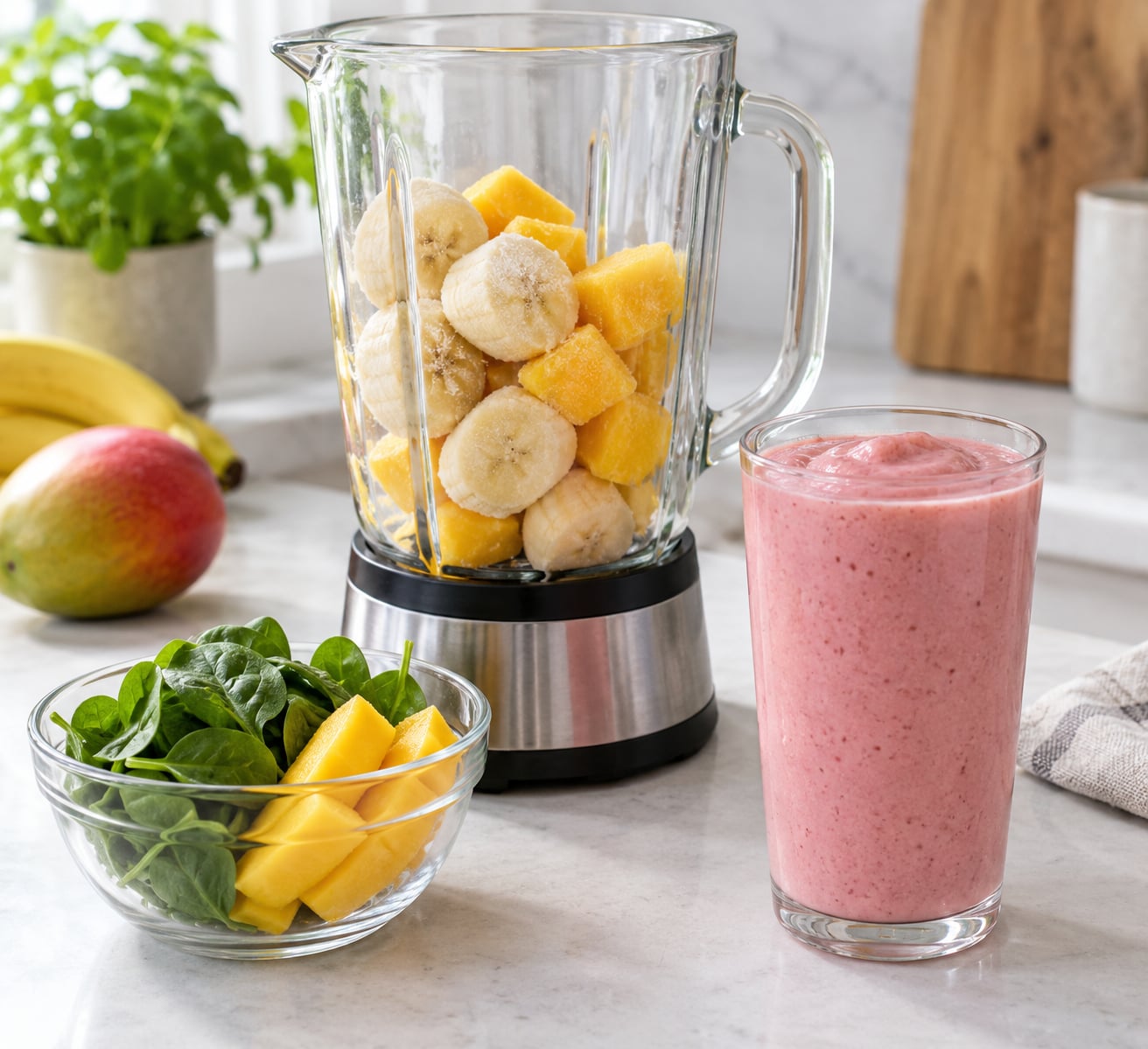
You can make a smooth, creamy smoothie with frozen fruit and no yogurt at all. The formula is 2 cups of frozen fruit to 1 to 1.5 cups of liquid, and frozen fruit supplies both the cold and the body that yogurt and ice usually handle separately. Frozen banana, avocado, nut butter and coconut cream are the fastest ways to add the creamy weight people miss most.
- 2 cups frozen fruit — banana, mango, berries, pineapple, or a mix
- 1 to 1.5 cups liquid — plant milk, dairy milk, water, coconut water, or juice
- 1 natural thickener (optional) — half a frozen banana, a quarter avocado, 1 tablespoon nut butter, or 2 tablespoons coconut cream
- Flavour additions (optional) — 1 teaspoon honey or maple syrup, a squeeze of lime, 1 scoop protein powder, 1 tablespoon chia or hemp seeds, or a handful of spinach or kale
That is the whole recipe. Total time is about five minutes, most of it waiting for the blender.
Table of Contents
What You Need
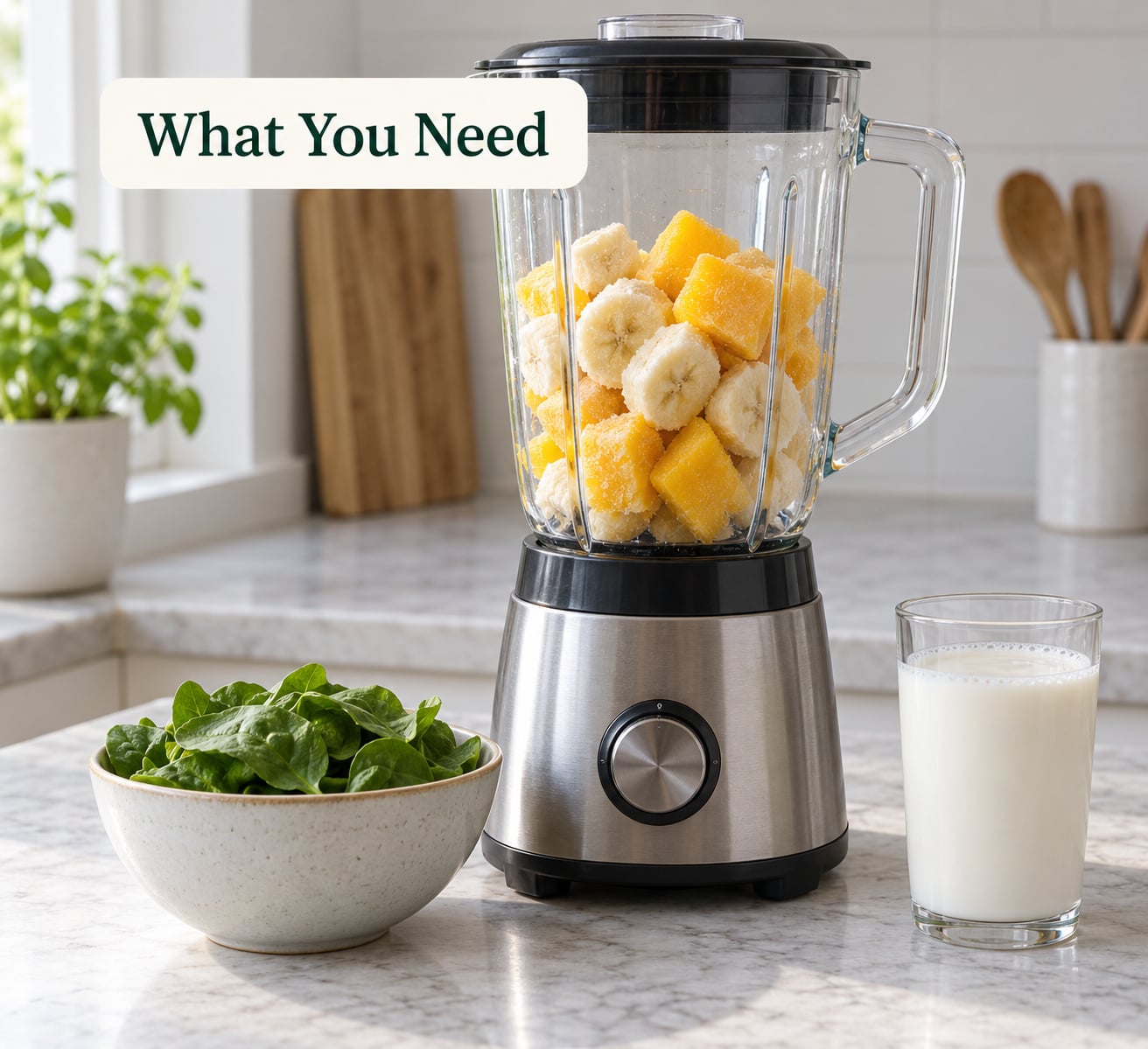
A blender with real power matters more here than in almost any other recipe. Frozen fruit is hard work, and a weak blender leaves you with a watery drink and chunks of ice-coloured fruit rattling around the bottom. Look for roughly 1000 watts or more, or any blender whose manual specifically lists frozen fruit in its approved list.
Check that manual before you start, and do not ignore it. Blenders are the one appliance in the kitchen that people routinely void the warranty on by feeding it something harder than the blades were designed for, and rock-solid frozen fruit straight from the back of the freezer is the usual culprit. If your blender is temperamental, let the fruit sit on the counter for five to ten minutes, or pulse it in short bursts first to knock the edges down.
A tamper — the stick that pushes food down toward the blades — is worth having. So is a wide-mouth jar, which is easier to clean and gives the blades room to work. Beyond that you need a measuring cup, a cutting board for anything you want to cut fresh, and freezer bags or containers for freezing your own fruit.
The frozen fruit that works best
Mango and banana are the smoothest. Both go creamy almost on contact with the blades, and frozen banana is also the best all-purpose thickener because its starch softens as it blends. Berries work too, but raspberries and blackberries carry tiny seeds that leave a grit you can feel on your tongue, so blend a full minute longer or push the finished drink through a fine sieve if that bothers you.
Pineapple blends well but is fibrous, and its skin and core need to be off first. Melons and grapes are soft and easy, though they add a lot of water and less body, so pair them with something creamy. Leafy greens barely register once blended; how much spinach is too much in a smoothie is worth knowing before you start adding handfuls.
Skip the ice. Frozen fruit is cold enough to serve straight from the jar, and adding ice dilutes the flavour and can make a blender work harder than it needs to.
Step-by-Step
Step 1: Choose Your Fruit and Liquid
Start at two parts fruit to one part liquid and adjust from there. Two cups of frozen fruit to one cup of liquid gives a thick, spoonable smoothie close to a bowl. Two cups of fruit to one and a half cups of liquid gives you something closer to a drinkable one. If you are working with watery fruit such as melon or grapes, start at the lower end of the liquid.
The liquid sets the character of the finished drink more than most people expect:
- Oat milk — the creamiest everyday plant milk, and it holds body longest on ice
- Coconut milk (beverage) — rich and lightly sweet, excellent with mango and pineapple
- Almond milk — mild and neutral, so the fruit tastes brighter
- Dairy milk — still completely fine with no yogurt; it just adds dairy back in
- Coconut water — very light, low in calories, thin rather than creamy
- Water — the cleanest option, and it works if your thickener is doing the work
- Fruit juice — sweet, but it concentrates sugars and flattens the flavour of fresh fruit
Aim for 1 to 1.5 cups. Too little and the blades stall; too much and you have a fruit-flavoured drink instead of a smoothie.
Step 2: Load the Blender in the Right Order
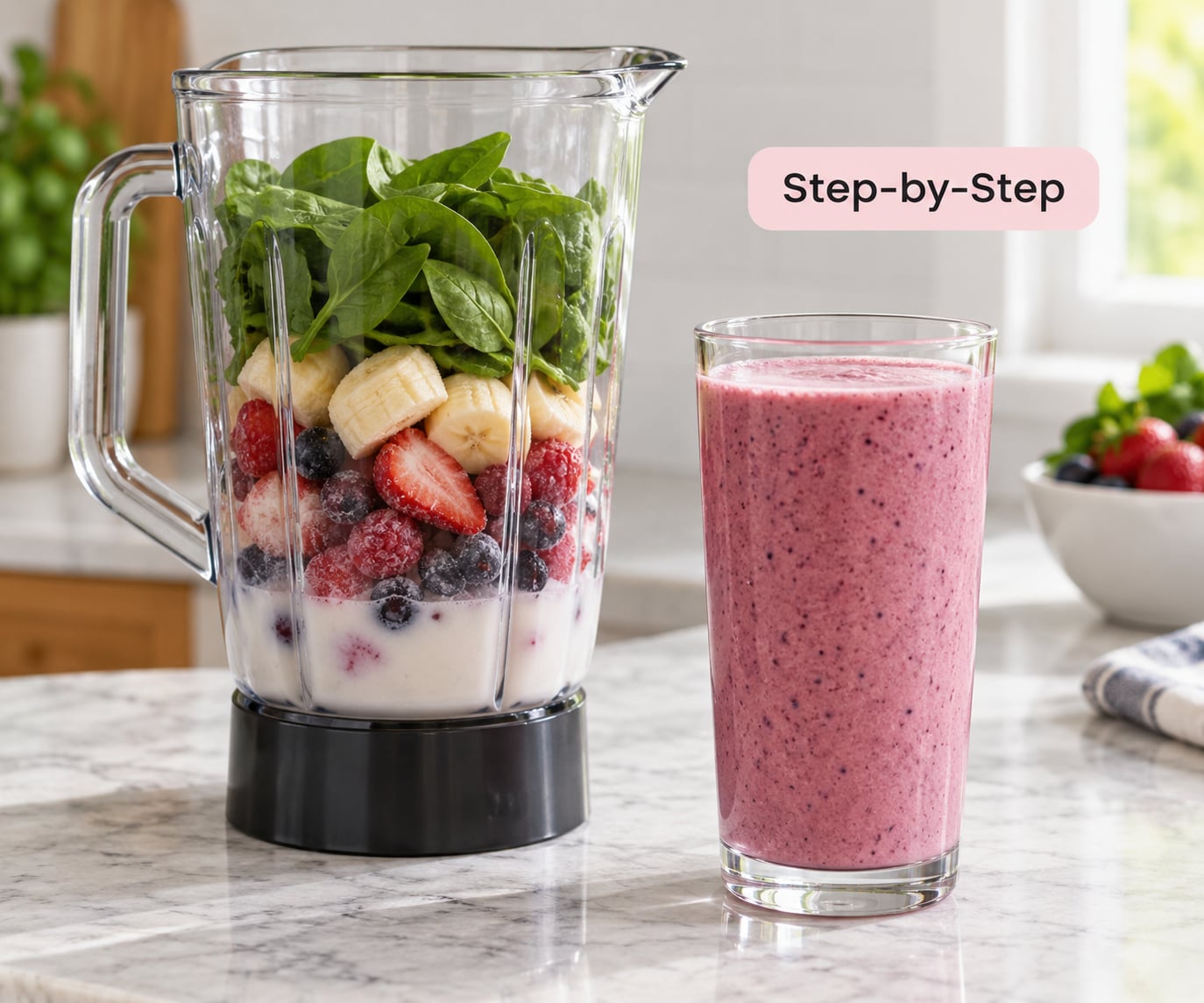
Order changes everything in a frozen smoothie. The liquid has to reach the blades first so the blades are spinning in something before the heavy frozen mass lands on them, and the frozen pieces need to be above the liquid rather than buried under it.
- Pour in the liquid first.
- Add soft, fresh or low-density items next — spinach, kale, mint, protein powder, nut butter, seeds.
- Add frozen fruit after that, filling the rest of the jar.
- Put small, light items on top last, so they fall into the vortex rather than sitting motionless against the wall.
Nut butter and protein powder clump if they sit in liquid too long, so tip them in ahead of the milk and let them disperse immediately. Once the jar is loaded, put the lid on firmly and check that the centre cap is seated.
Step 3: Blend Until Smooth
Start on low for five to ten seconds to get the mass moving, then turn it up high. Most frozen fruit smoothies finish in 45 to 60 seconds on high. Two minutes is enough for the fibrous ones, like pineapple or a large quantity of greens.
Stop halfway and scrape the sides down with a spatula or the tamper. Frost on the walls is a sign that you need to do this; a smooth vortex with no air pocket means you are nearly done.
You know it is ready when the mixture moves like thick paint, there is no free liquid at the top, and there are no visible flecks when you tilt the jar. A watery swirl that pours like juice is under-blended and thin.
Step 4: Adjust and Serve
Taste it and adjust before you pour. Too thin? Add a few more pieces of frozen fruit and blend for 20 seconds. Too thick to drink? Splash in more liquid a tablespoon at a time. Missing sweetness? Half a banana, a spoonful of maple syrup, or a squeeze of lime, blended through.
Pour and drink it straight away, because a smoothie separates within about 30 minutes of sitting out. If you are making it for someone who is fussy about green things, start mild with mango and half a banana and build up from there.
For storage, refrigerate the jar or a sealed container and drink it within 24 to 48 hours. Blended fruit keeps its flavour best in that window. To freeze it, leave a finger of headspace in the container because the mixture expands as it freezes, and use it within about two months. If it separates after thawing, that is not spoilage — put it back in the blender for 20 seconds and it comes right together. Separating in the fridge is the same story, and the fix for a separated smoothie is basically the same.
To keep kids drinking them, smoothie ideas that kids actually drink are mostly a matter of sweetness and colour, not complexity.
Common Mistakes
- Watery smoothie — the usual cause is too much liquid, or frozen fruit that never broke down because it was sitting on top of the milk instead of in it. Fix: drop to 1 cup of liquid and blend on high for a full 60 seconds.
- Smoothie too thick to drink — you went past the ratio, usually 2 cups of fruit with a thickener on top of it. Fix: add liquid a little at a time and pulse briefly.
- Weak or flat flavour — the fruit was bland rather than the recipe. Fix: use ripe fruit before freezing, add a squeeze of lime to sharpen it, and skip juice, which flattens rather than lifts.
- Grainy or seedy texture — raspberries, blackberries, or under-blended greens. Fix: blend longer and push it through a fine sieve if the grit stays.
- Blender labouring and stalling — the jar was overloaded, or the fruit was rock hard. Fix: work in smaller batches, add liquid a little earlier, and pulse rather than running continuously.
- Thin, watery result with no body — you left out the thickener and your fruit was low in starch. Fix: add half a frozen banana, a quarter avocado, or two tablespoons of coconut cream.
One thing worth understanding is why frozen fruit carries a yogurt-free smoothie on its own. Yogurt does two jobs: the casein protein network gives it that thick, creamy emulsion that holds air, and the cold keeps it thick. Without it you need those two jobs done separately. The frozen fruit handles the cold, and whole fruit, nut butter, or coconut cream handles the creaminess. That is why a yogurt-free blend with no ice at all still comes out thick rather than like juice.
Frequently Asked Questions
Can I make a smoothie without yogurt?
Yes. Yogurt adds creaminess, protein, and tang, but none of it is structurally necessary. Use 2 cups of frozen fruit to 1 to 1.5 cups of liquid, then add a thickener such as half a frozen banana, a quarter avocado, or two tablespoons of coconut cream. Most people cannot tell the difference once it is blended, and the flavour comes out cleaner with no tangy aftertaste.
What can I use instead of yogurt to make a smoothie creamy?
The best substitutes are frozen banana, mango, avocado, coconut cream, and nut butters such as almond or peanut. Frozen banana and mango thicken and sweeten, avocado and nut butter add fat for a silky texture, and coconut cream adds richness without fruit flavour. Start with one tablespoon of nut butter or a quarter of an avocado and increase from there.
What can I use instead of a banana to thicken a smoothie?
Avocado is the best no-banana option, since its neutral flavour and fat give body without adding a banana note. Mango works nearly as well and reads as a tropical fruit. You can also use two tablespoons of coconut cream, a tablespoon of nut butter, or a tablespoon of chia or hemp seeds, which thicken over about five minutes in the jar.
Do I need ice if I am using frozen fruit?
No. Frozen fruit is cold enough to serve straight from the blender, and adding ice mostly dilutes the flavour while making the blades work harder. If you want it colder or thinner, freeze some of your liquid instead: pour almond milk or coconut water into ice cube trays and add two or three cubes. Skip ice entirely if your blender has a weaker motor.
What fruits should not be mixed in smoothies?
Nothing is unsafe, but some pairs taste worse than others. Pineapple and papaya taste better on their own or with coconut, because their acidity flattens berries. Kiwi turns everything seedy and green-tasting within a small blend. Very ripe banana can overpower lighter fruit, and pairing dairy milk with pineapple or mango can taste curdled to some people. Choose blends where two fruits share a similar sweetness.
How long can a homemade smoothie be kept?
Refrigerate it in a sealed container and drink it within 24 to 48 hours, which is when blended fruit tastes its freshest. For freezing, leave about an inch of headspace and use it within two months. If it separates in the fridge or after thawing, that is fruit and fibre settling rather than spoilage, and a 20-second blend brings it back together.
Start tonight, before anything else: freeze two bananas and a handful of mango, then tomorrow blend two cups of that fruit with one cup of oat milk and a tablespoon of nut butter. Once that ratio feels normal, everything else is a variation on it.