
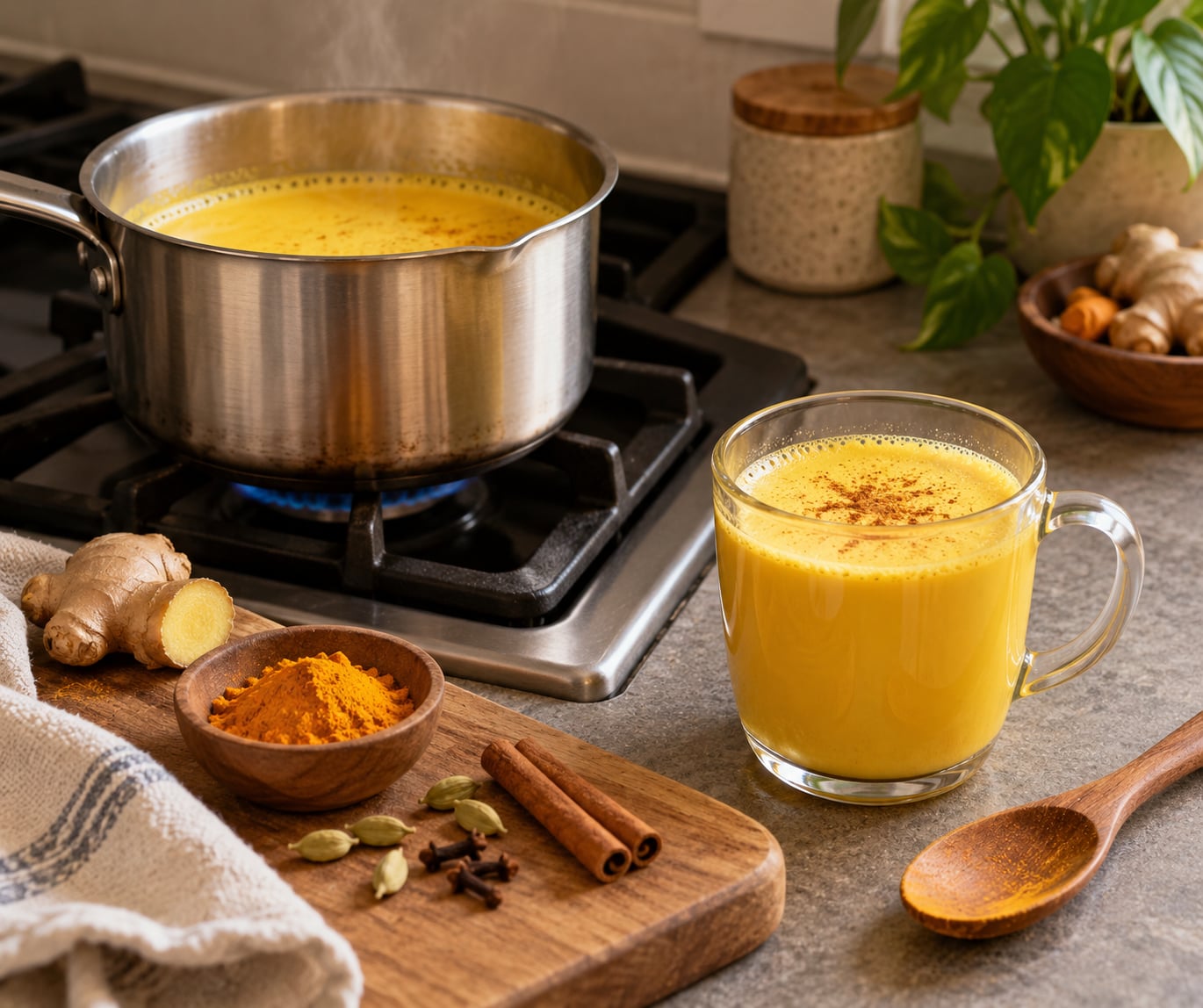
Golden milk takes about 10 minutes on the stovetop: you bloom ground turmeric and warm spices in a little fat, whisk in the milk, and simmer gently until it steams and turns deep orange. Learning how to make golden milk with turmeric at home is far easier than most recipes suggest, and the whole thing happens in one small saucepan with a whisk.
The trick is that two ingredients people consider optional are the ones doing the work. A pinch of black pepper and a teaspoon of coconut oil or ghee both raise how much curcumin your body actually absorbs, and neither one registers as a strong flavor. If you have been curious about the drink but worried it will taste like a stir-fry, that is the part worth knowing before you start. Our guide to how to use turmeric so your body absorbs it better covers the reasoning in more detail.
Prep time is 5 minutes, cook time is 10 minutes, and the recipe below makes one creamy serving.
Table of Contents
What You Need
The base is milk, turmeric, and a short list of warming spices. Everything else is optional.
- 1 cup (240 ml) milk, or a plant-based milk of your choice
- 1 teaspoon (about 3 g) ground turmeric
- 1/2 teaspoon ground cinnamon
- 1/2 teaspoon fresh or ground ginger
- 1/4 teaspoon fresh ground black pepper
- 1 teaspoon coconut oil, ghee, or neutral cooking oil
- 1 to 2 teaspoons maple syrup, honey, or your preferred sweetener
- 1/4 teaspoon vanilla extract, plus a pinch of salt
Fresh root works in place of powder: 1 teaspoon of ground turmeric is roughly equal to 1 tablespoon of freshly grated root. Fresh root is brighter and less bitter, but it takes a little longer to cook and it stains everything it touches, so use a separate grater.
A small saucepan and a whisk are the only tools. A frother works too, and a fine mesh sieve catches sediment if your ground spices are coarse.
For a thicker, less sweet drink, choose a barista-style oat milk rather than a thin carton variety. Barista blends are formulated to emulsify and stay creamy instead of splitting, and our piece on oat milk that is not slimy explains why texture varies so much between brands. If you skip sugar entirely, add one or two soaked Medjool dates in with the milk and let them soften, or leave it unsweetened and lean on the vanilla.
Step-by-Step: Heat, Simmer, and Finish
Five stages, about 10 minutes total. The cues matter more than the clock, so watch the surface rather than the timer.
How to Make Golden Milk with Turmeric Without a Blender
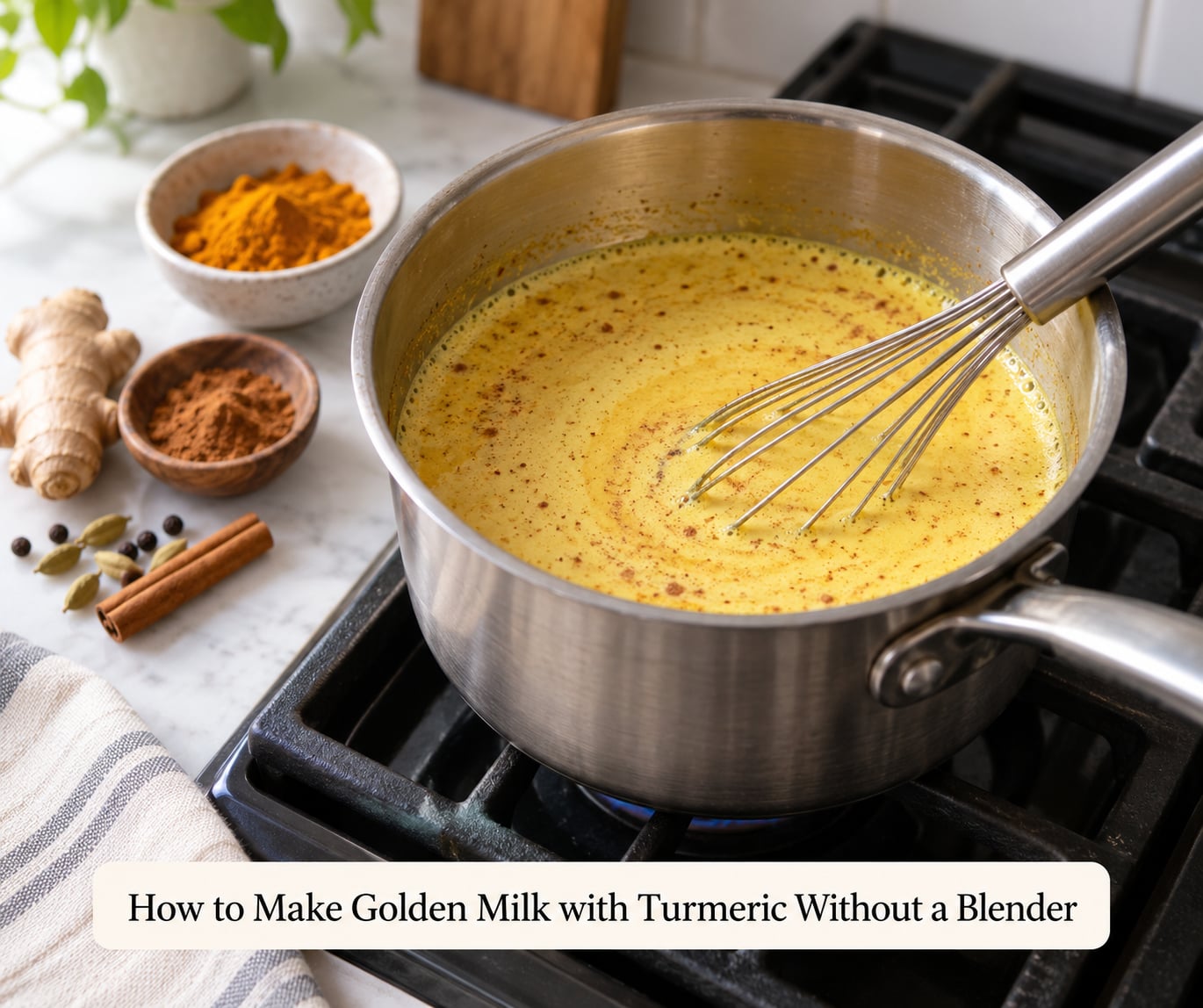
Most countertop blenders exist to break up what a whisk can barely touch: the fine, sandy grit of ground turmeric.
You do not need one. Set the saucepan over medium-low heat, add the coconut oil, and let it melt and shimmer without smoking. Stir in the turmeric, ginger, cinnamon, and black pepper and keep the mixture moving for 30 to 45 seconds until it turns a deep orange and gives off a warm, toasty smell.
That step is called blooming, and it does two useful things. It releases the aromatic oils from the dry spices, and it coats every particle in fat so the grit has nowhere to clump. Skim it if you skipped the fat, but a thin layer of oil is the difference between smooth and sandy.
Add the Milk and Simmer Gently
Pour the milk in a slow stream while whisking, aiming for a liquid-to-spice ratio of one cup of milk per teaspoon of ground turmeric.
Add the milk a little at a time and keep the whisk moving. Pouring the whole cup in at once drops the pan temperature fast enough to bake a thin layer of spiced milk onto the bottom, and that is where scorching starts.
Turn the heat up just enough to get the first lazy bubbles within two minutes, then drop back to low. You are after a gentle steaming surface with a ring of fine foam around the edge, not a rolling boil. Hold that temperature for 5 to 6 minutes, whisking every 30 seconds or so, until the milk thickens slightly and coats the back of a spoon.
Turmeric does not need to be boiled in milk to work. Boiling scorches the milk proteins, dulls the aroma, and makes the drink harder to digest, so a gentle simmer is the right endpoint.
Balance the Sweetness and Spice
Start with 1 teaspoon of sweetener, then taste before adding more.
Honey and maple syrup are the usual choices, agave works, and pure liquid stevia suits anyone avoiding sugar. Raw honey also adds a faint floral note that plays well with cinnamon, while maple keeps the cup vegan and leans slightly more toward caramel.
Stir in the vanilla and a small pinch of salt at this point. The salt is not for seasoning in the savory sense; it rounds off the bitterness in the turmeric, and most people do not notice it as salt at all.
If the drink tastes flat, the usual culprit is undissolved spice rather than too little sweetener. Give it another good whisking before you reach for more sugar.
Whisk in Black Pepper and Finish
Black pepper is not a garnish, and a scant 1/4 teaspoon per cup is plenty.
The active compound, piperine, makes curcumin dramatically more available to the body, and the fat from the coconut oil or ghee helps carry it through. Our explainer on why black pepper is added to turmeric for absorption goes into the mechanism.
Always use freshly ground pepper. Pre-ground supermarket pepper has lost most of its aromatic oils within a few months, and the sharp bite you are looking for will not be there.
Taste again once more. If the warmth from the pepper and ginger is competing with the milk, stir in another half teaspoon of milk or a small splash of cream rather than reaching for the honey.
Serve It Warm or Chill It

Pour the finished milk through a fine mesh sieve if you used fresh root, and drink it while it is still steaming hot.
The finished consistency should be loose and silky, closer to cream than to a smoothie. If it thickens too much while resting, whisk in a splash of warm milk to loosen it.
Chilled golden milk works well poured over ice, and it also makes a decent base for frozen ice pops if you pour it into molds. For storage, cool leftover cooked milk quickly and refrigerate it in a covered container for up to three days, which is shorter than the week or so you would give an unopened carton because the cooked spices already sit in it.
Reheat only what you need, gently and in small amounts, and stir constantly. If it splits, take it off the heat and whisk hard; the curdled look often means it got too hot, not that it is ruined.
Common Mistakes
Almost every disappointing cup traces back to one of six fixable mistakes.
Gritty or sandy texture
Whisk the spices into the fat before the milk goes in, and keep whisking through the whole simmer. If grit survives anyway, strain through a fine mesh sieve before serving.
Scorched flavor from the bottom of the pan
Add milk slowly while whisking and keep the heat low once it is in. Scorching leaves a burnt, acrid note that no amount of honey will hide.
Turmeric flavor that is too strong
Reduce it by diluting with more milk rather than by cutting back on everything else. If you also need a fix for a different, unrelated drink problem, the same dilution logic applies to any spice-forward recipe.
Thin, watery, or split-looking milk
Thin milk is usually a fat-free or very low-fat plant milk that has nothing to emulsify with. Pick a barista blend or a full-fat dairy option. Add a teaspoon of coconut oil and whisk hard off the heat to bring it back together.
Too sweet
Use less sweetener from the start and rely on vanilla, cinnamon, and a pinch of salt for roundness. A very ripe banana blended in at the end adds sweetness without tasting like syrup.
A full rolling boil
A boil is the most common heat mistake and the least visible in a photo. Aim for a low simmer with a fine foam ring at the edge and no large bubbles breaking the surface.
One last serving note: golden milk is naturally caffeine-free, which makes a cup in the afternoon or evening a reasonable swap for a second coffee.
Frequently Asked Questions
Can I make golden milk without dairy milk?
Yes, and most readers do. Oat, almond, soy, and coconut milk all work in this recipe, and each behaves a little differently. Oat gives the closest creamy texture, coconut is richest, almond is thinnest, and soy is the closest in protein to dairy. Choose a barista-style blend if you want the fewest lumps, since thinner carton varieties sometimes split when heated. Keep the coconut oil in the fat step even with coconut milk, since it carries the curcumin along.
What is the best milk for golden milk with turmeric?
Whole or 2% dairy milk gives the richest, most traditional cup, and it is what haldi doodh is classically made from. Among plant milks, barista oat milk is the most convincing replacement because it is formulated to stay stable under heat. Almond is a good lighter pick, coconut milk is the richest but the highest in calories, and soy holds up well nutritionally. Avoid very thin rice and almond milks if grit and splitting bother you.
Why is my homemade golden milk gritty?
Grit happens when turmeric powder settles instead of being fully dispersed. Two habits fix it almost every time. First, bloom the ground spices in melted coconut oil, ghee, or neutral oil for 30 to 45 seconds before adding any liquid, so each particle gets coated in fat. Second, add the milk slowly in a stream while whisking, then keep whisking every 30 seconds during the simmer. If you used fresh root, pass the finished drink through a fine mesh sieve.
Does golden milk need black pepper?
It is not needed for flavor, but it matters for absorption. Piperine, the compound that gives black pepper its bite, substantially increases how much curcumin your body can take up, and a little dietary fat helps carry it through. Use a scant 1/4 teaspoon per cup and buy it freshly ground, since pre-ground pepper loses its aromatic oils quickly. The amount is small enough that most people register only a gentle warmth rather than a peppery punch.
How long does homemade golden milk last?
Cooked golden milk keeps in the fridge for up to three days when you cool it quickly, cover it, and refrigerate it promptly. That is shorter than plain milk because the spices are already sitting in the liquid. Reheat only the amount you need, over low heat, whisking constantly, and skip the microwave if you can because reheating unevenly is what makes milk split. Discard it if it smells sour or sits out for more than two hours.
Conclusion
Start with the plain formula: one cup of milk, one teaspoon of turmeric, half a teaspoon each of cinnamon and ginger, a quarter teaspoon of freshly ground black pepper, and a teaspoon of fat. Simmer it gently rather than boiling, taste before you add more sweetener, and adjust the sweetness, warmth, and thickness from there.
Golden milk is a simple drink used traditionally in Ayurveda and enjoyed today mostly because it tastes good and warms you up. It is not a treatment for any condition, and anyone who is pregnant, has gallbladder disease, reflux, a bleeding disorder, or takes blood thinners or diabetes medication should check with a doctor or pharmacist before making it a daily habit.