
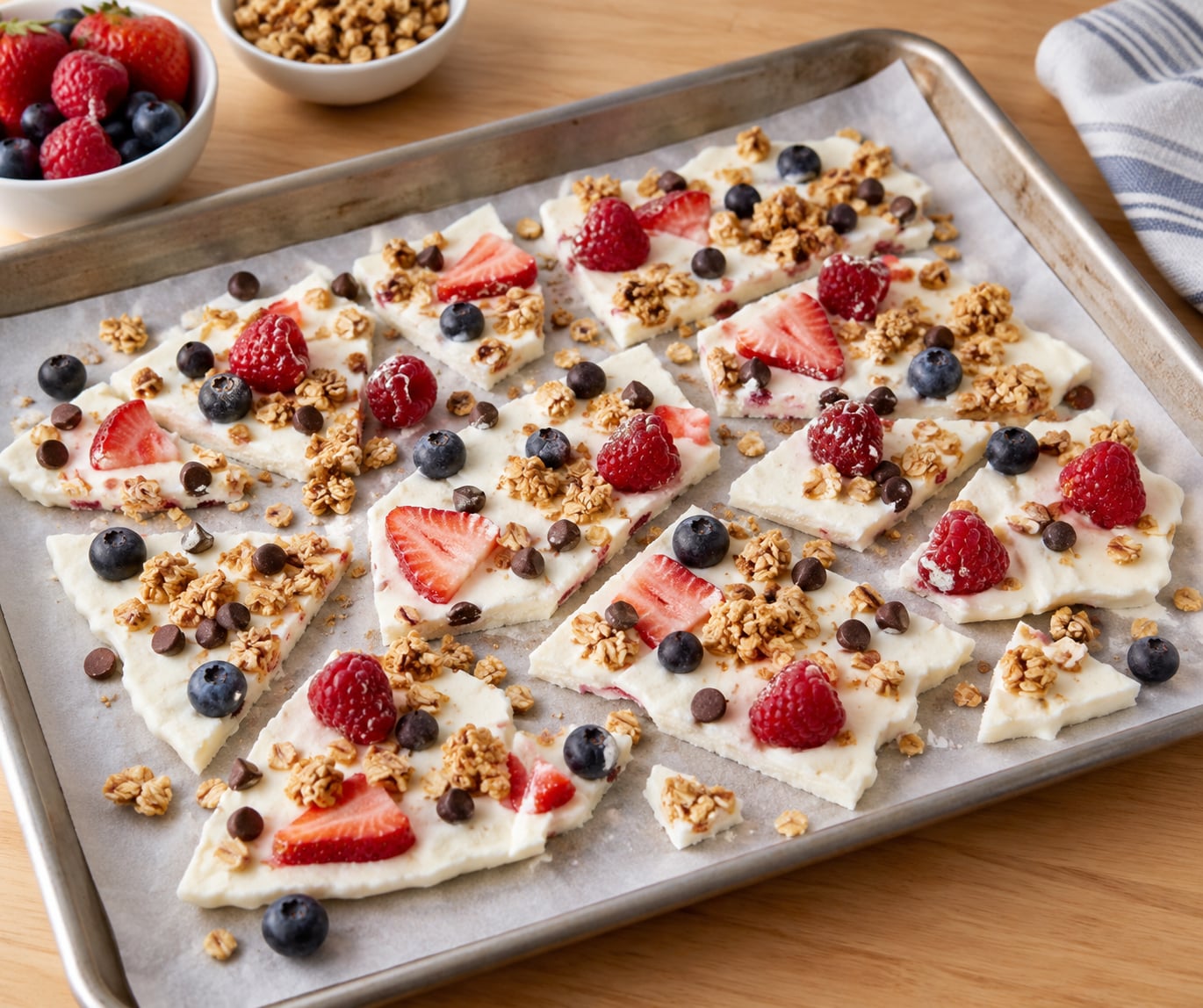
Frozen yogurt bark takes about ten minutes of prep and three hours in the freezer. Stir a sweetener into plain yogurt, spread it about 1/4 inch thick on a parchment-lined baking sheet, scatter fruit and granola over the top, then freeze until solid and snap it into pieces.
- Prep time: 10 minutes
- Freeze time: about 3 hours, or overnight
- Yield: roughly 12 pieces from one rimmed baking sheet
There is no baking and no cooking. The whole thing happens in one pan and one bowl, which is exactly why it has become my go-to freezer staple for hot afternoons when the kids want something cold and I do not want to turn on the oven.
The texture is the one thing worth thinking about before you start, because that is where most batches go wrong. Thinner spreads snap clean. Thick spreads freeze solid in the middle and stay tacky. Getting that middle ground takes one measurement and a steady hand, and I will walk you through it step by step.
Table of Contents
What You Need
You do not need any special equipment for this. If you own a rimmed baking sheet, a sheet of parchment paper, and a spatula, you have everything.
Equipment
- A rimmed baking sheet, half sheet or quarter sheet size
- Parchment paper or wax paper, cut to fit
- A mixing bowl and a spoon or whisk
- A spatula or offset spatula for spreading
- Your hands, or a sharp knife, for breaking the frozen sheet
Base ingredients
- 2 cups plain or vanilla yogurt, whole-milk or full-fat Greek
- 2 to 3 tablespoons honey or maple syrup
- 1 teaspoon vanilla extract
- A pinch of salt, optional, to sharpen the flavor
Toppings
A quarter cup to half a cup works well in total. Too much and the layer gets heavy and freezes into a brick.
- 1/2 cup diced strawberries
- 1/4 cup blueberries
- 1/4 cup granola
- Dark chocolate chips, chopped nuts, shredded coconut, or mini marshmallows
Before you buy anything, it helps to know what to look for on the tub. I keep a longer guide on how to pick a healthy yogurt at the store, but the short version is that fat content matters more here than anything else on the label.
How to Make Frozen Yogurt Bark Step by Step
Step 1: Choose Your Yogurt and Toppings
Full-fat and whole-milk yogurt freeze the creamiest. Lower-fat versions have less fat to trap the air and water in place, so they come out noticeably icier and harder to bite through. Greek yogurt is thicker and higher in protein, which makes it easier to spread thin and gives the bark a denser, less fragile snap.
Dairy-free options work too. Coconut yogurt freezes soft and smooth, almond and soy varieties freeze a little firmer. If you are picking a tub for this recipe specifically, fat is the characteristic that changes the finished texture most.
For toppings, pick two or three that you know your kids will eat rather than five that sound good in theory. Fruit, granola, and chocolate chips is the classic trio and it never fails.
Step 2: Prepare the Baking Sheet
Lay the parchment paper flat on the baking sheet and press the corners down so it does not spring back. If you have ever peeled bark off a sheet and taken half the paper with it, this step is the fix.
Leave an inch of bare metal around the edges. The yogurt should not touch the rim, and that gap keeps the edges of the sheet from welding themselves to the pan.
If your parchment is stubborn, chill the lined sheet in the freezer for 10 minutes first. A cold sheet also speeds up the first minutes of freezing, which helps the layer set before it slumps.
Step 3: Mix the Yogurt Base
Whisk the honey or maple syrup into the yogurt with the vanilla until there are no streaks left. Two tablespoons sweetens a standard batch without making it taste like candy. Taste it with a clean spoon and decide from there.
The one mistake to avoid is pouring in a heavy liquid sweetener and hoping it evens out. Agave and honey both need real mixing time to disappear. Stir for a full 30 seconds, scrape the sides of the bowl, and stir again.
Step 4: Spread the Yogurt Evenly
Scoop the yogurt onto the center of the parchment and spread it outward with the spatula. Aim for a layer roughly 1/8 to 1/4 inch thick, about the height of two stacked quarters.
You do not need a ruler. Spread until you can just barely see the parchment through the yogurt in a few spots. That is the right thickness.
Keep scraping the spatula flat and drag it toward yourself from the far edge. Leave the surface slightly uneven if you have to. A thin spot is better than a thick one, because thick spots never set all the way through and stay squishy in the middle.
Step 5: Add Fruit and Extra Toppings
Scatter the fruit first, spread it out so every piece gets some, then add granola and chocolate chips on top. Press each piece down gently with your fingertips so it sits in the surface rather than resting on it.
Toppings that are only sitting on top pop off the moment you break the sheet. Pressed in, they stay locked to the shard. This is the single most common complaint I see, and it takes about 20 extra seconds to prevent.
Diced fresh fruit releases water as it thaws, so keep it small and spread it out rather than dropping in large chunks. For a similar cold treat with no freezing involved, my banana ice cream without an ice cream maker takes five minutes and freezes the same way.
Step 6: Freeze Until Firm
Slide the sheet into the freezer uncovered and set a timer for 3 hours. Overnight is fine and often better if your freezer runs warm or you packed it with something else that day.
It is ready when the sheet is solid all the way through and no longer dents under a light touch at the center. The edges will look set well before the middle does, so test the middle, not the edge.
Step 7: Break and Store the Bark
Hold the sheet at both ends and flex it gently until the parchment releases. Peel the paper back slowly rather than pulling straight up. If a corner sticks, wait a minute and try again.
Break the sheet with your hands along natural fault lines instead of cutting it. Pieces come out irregular, which is the whole appeal, and a sharp knife tends to press down and crumble the edge.
Store the pieces in an airtight, freezer-safe container with a sheet of parchment paper between layers so they do not fuse together. Kept frozen, bark stays good for up to 3 months, though most batches disappear well before that.
Common Mistakes
Every failure I have had with yogurt bark traces back to thickness, fat content, or rushing the freeze. Here is how to correct each one.
How to Make Frozen Yogurt Bark Less Icy
If your bark tastes cold and hard rather than creamy, four fixes usually do it:
- Use full-fat or whole-milk yogurt. Fat is what keeps frozen dairy smooth instead of grainy.
- Spread closer to 1/8 inch than 1/4 inch. Thinner layers freeze through faster and the ice crystals stay small.
- Do not rush the freeze. Three hours minimum, or overnight, gives the water time to freeze into small crystals rather than one big mass.
- Stir the base smooth first. Uneaten lumps of sweetener freeze as hard pockets.
Other Problems and Their Fixes
- The bark sticks to the pan. You skipped the parchment, or the paper was loose. Press the paper down flat and leave a bare inch of metal at the edges.
- Toppings fall off when broken. They were resting on the surface instead of pressed into it. Push them in with your fingertips.
- The sheet snaps into tiny unusable shards. The layer is too thin. Spread a bit more yogurt and aim for the upper half of the 1/8 to 1/4 inch range.
- The middle never sets. Too thick. Thin it out with the back of the spatula before freezing, or transfer to a second lined sheet.
- The surface looks grainy after thawing. It sat uncovered too long. Bark melts fast at room temperature, so serve it straight from the freezer or within a few minutes of taking it out.
- Some pieces have no fruit. Fruit clustered before freezing. Spread it out in a single layer first, then add the rest.
Tips for the Best Frozen Yogurt Bark
A few small choices take you from good bark to the version people ask about.
Use up what you have. Overripe bananas, soft berries, and the last few spoonfuls of yogurt are the best possible reason to make this. Mashed banana stirred into the base is a natural sweetener, and it is exactly what makes my smoothies kids actually drink work so well. If a berry is on its way out, dice it small and use it the same day.
Try four flavor combos. Chocolate banana is mashed banana plus cocoa powder and a few chocolate chips. Tropical is coconut yogurt with mango chunks and shredded coconut. Berry balsamic is vanilla yogurt with strawberries, blueberries, and three drops of balsamic vinegar. Peanut butter banana is a swirl of peanut butter thinned with a teaspoon of honey, dragged through the layer with a toothpick, then scattered with banana coins.
Skip the added sweetener when you want to. Very ripe fruit alone will sweeten the bark, especially banana or mango. That version works well alongside cinnamon or a little citrus zest.
Scale for a group. Double the recipe for about 24 pieces, and use two sheets rather than one thicker layer. Thicker is where problems start. Freezing in single portions also makes it easy to pull out exactly what you need later.
Pack for lunchboxes. Break the bark into palm-sized shards and separate each layer with parchment. It holds its texture better in small pieces than in one big sheet, and there is less melt damage on the way to school.
Skip choking-hazard toppings for young toddlers. Whole nuts and large nut pieces are a choking risk. Ground nuts blended into the base, or simply left out, are the safer swap. Skip raw nut butter swirls for the same reason and use a smooth stirred-in version instead.
Frequently Asked Questions
Can you just freeze plain yogurt to make frozen yogurt?
You can freeze plain yogurt on its own, but it will come out hard, dense, and noticeably icier because there is nothing to smooth the texture. Adding a sweetener, vanilla, and full-fat or Greek yogurt gives you a far better result for the same five minutes of work. Freezing does not turn yogurt into anything else; it simply sets the yogurt you started with, so the quality of that yogurt is the whole ballgame.
How long should I freeze yogurt bark for?
Three hours is the minimum that works in a normal home freezer. Test the center of the sheet rather than the edges, since the edges set first. If you have room in the freezer, leaving it overnight gives the most even texture and the smallest ice crystals. Rush the freeze and the middle stays slushy long after the outside feels solid.
What yogurt is best for frozen yogurt bark?
Full-fat or whole-milk yogurt gives the creamiest result, and Greek yogurt is a close second because it spreads thin and holds together well. Lower-fat yogurt freezes harder and icier because it has less fat to keep the texture smooth. Coconut yogurt also works and freezes softer, which some people prefer for a lighter bite. Whichever you pick, vanilla or plain both take added sweetener well.
How thick should frozen yogurt bark be?
Aim for roughly 1/8 to 1/4 inch, or about the height of two stacked quarters. Thin spreads freeze through quickly and snap into clean shards, while thick spreads freeze solid on the edges and never set in the middle. A good visual test is that you can just barely see the parchment through the yogurt in a few spots before you add toppings.
How do I stop frozen yogurt bark sticking to the parchment paper?
Press the parchment flat onto the baking sheet before you pour anything on it, and leave an inch of bare metal around the edges. Freeze uncovered rather than wrapped. To release the sheet, hold both ends of the pan and flex it gently until the paper lifts, then peel the paper back slowly from one corner. Waiting a minute before pulling helps more than yanking ever will.
How long does frozen yogurt bark keep in the freezer?
Stored in an airtight, freezer-safe container with parchment paper between the layers, frozen yogurt bark stays good for up to 3 months. It loses a little creaminess after the first month, so freeze only what you expect to eat. It also melts quickly at room temperature, so move it from the freezer to the table last and put leftovers straight back.
Conclusion
Start by lining a rimmed baking sheet with parchment paper, mixing 2 cups of full-fat yogurt with 2 tablespoons of honey, and spreading it to about a 1/4 inch. Press your fruit and granola into the surface, freeze for at least 3 hours, then flex the pan and break the sheet into shards.
That is the whole recipe. Everything after it is just picking new toppings.