
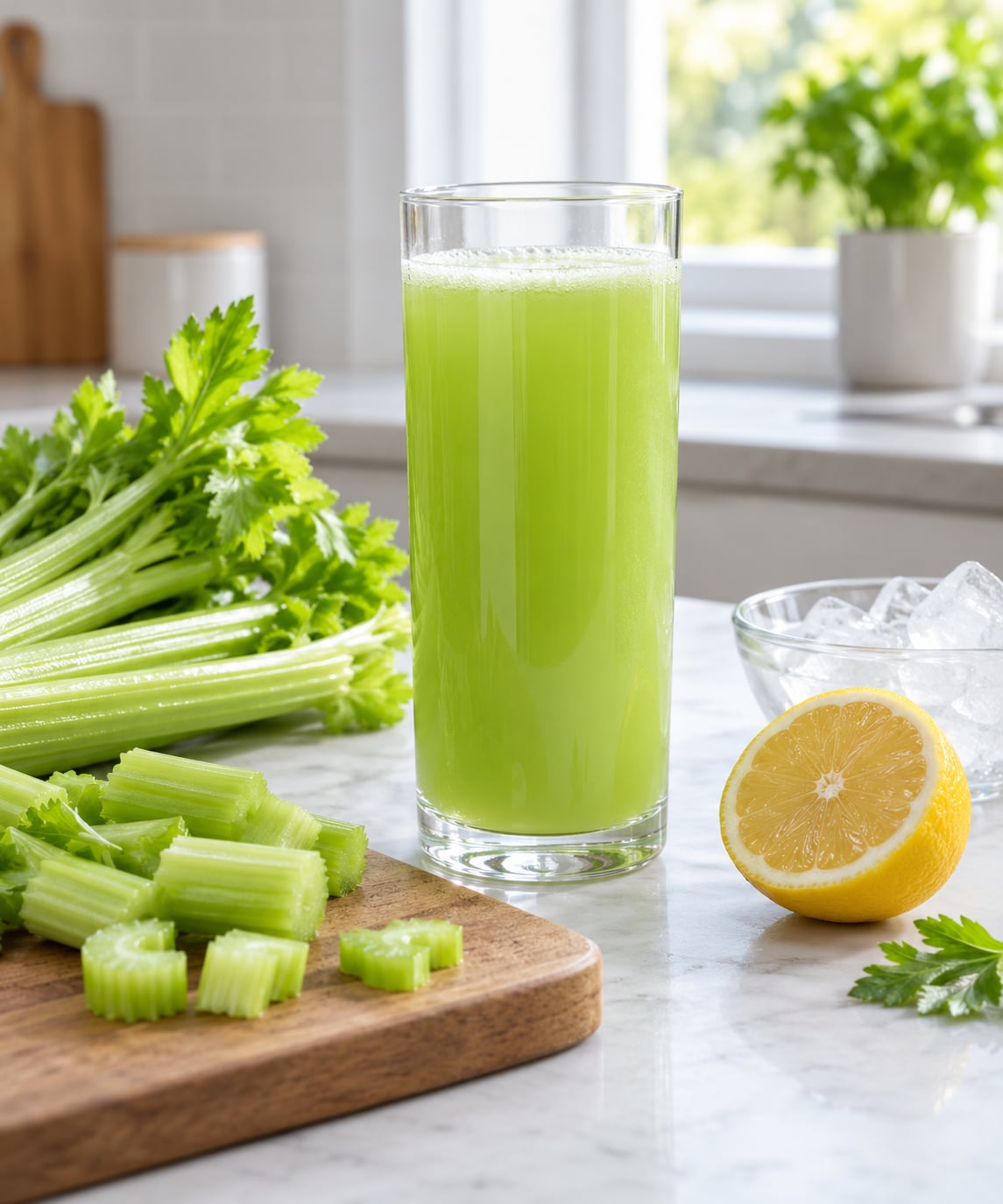
You can make celery juice in a blender by chopping fresh celery, blending it with a small amount of water until smooth, then straining the liquid through a nut milk bag or fine-mesh sieve. No juicer needed, and it takes about five minutes from cutting board to glass.
The straining step is the whole trick. Skip it and you have a fibrous celery smoothie; do it and you have something that pours like true celery juice. About half a large bunch goes into the jar, and you get roughly three-quarters to one cup of finished juice.
Most people drink it straight with nothing in it. A squeeze of lemon, a small knob of ginger or a small apple is enough to round out the grassy edge, and a cup of ice keeps the motor from heating the juice while it works.
What You Need
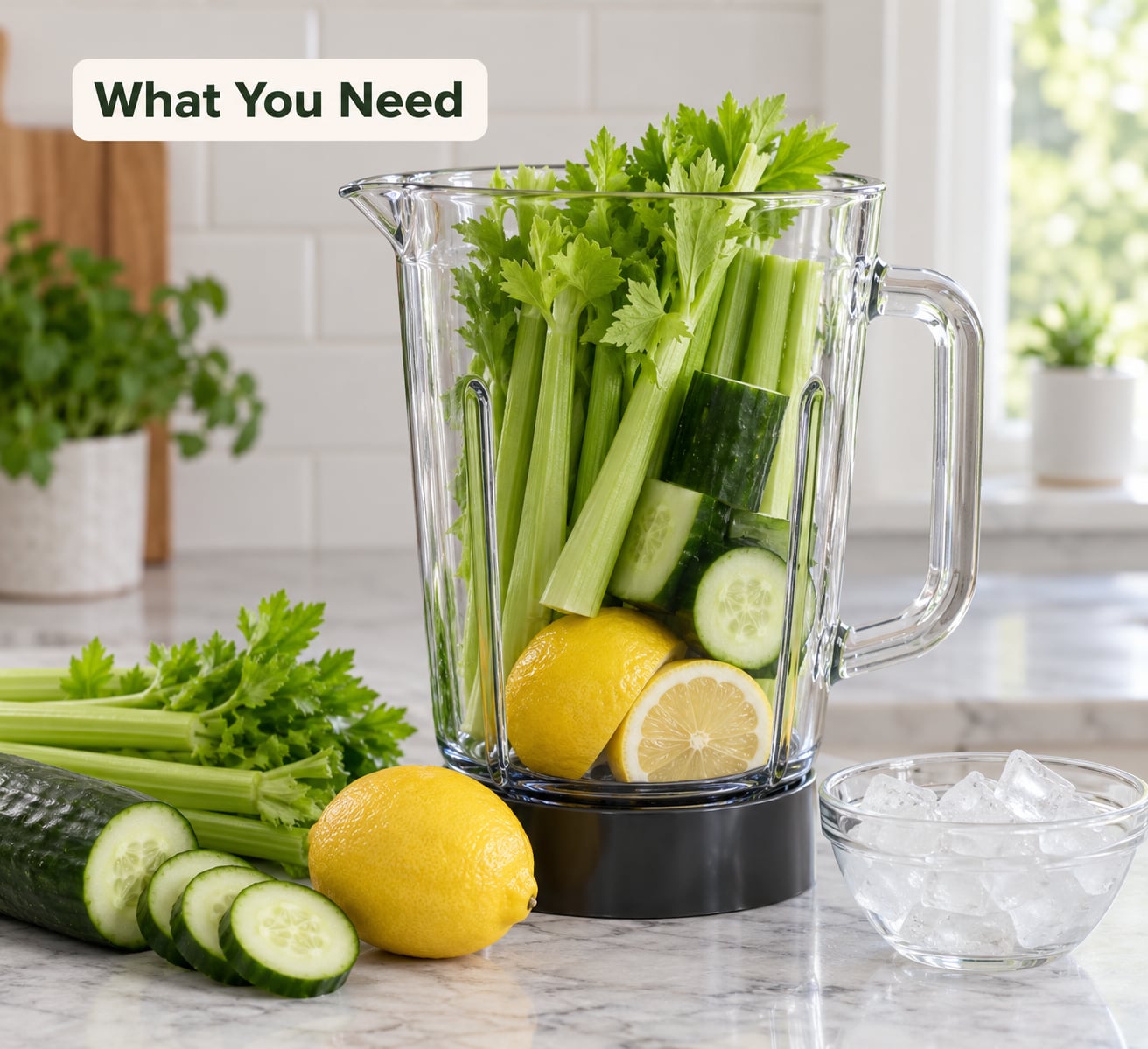
Celery juice takes one real ingredient and one helper ingredient. Everything else is a tool or an optional flavor adjustment.
Equipment
- A blender. Any blender that can handle frozen fruit will work. A high-speed machine gets smoother in less time, but a standard one just needs more pulses.
- A nut milk bag or fine-mesh sieve (40-mesh or finer) if you want pulp-free juice. Optional if you like fiber in your drink.
- A cutting board, a sharp knife, and a colander for washing.
Ingredients
- 1 bunch celery, about 8 to 10 stalks. You only need 5 or 6 stalks per batch.
- Half a cup of cold water, enough to get the blades moving. A single ice cube works too.
- Optional: half a lemon or lime, a one-inch piece of ginger, one small green apple, a cucumber, or a few sprigs of mint.
A standard blender and a high-speed blender both do the job here. The standard one relies on longer blending and more scraping down; the high-speed one gets there in about a minute with less heat. A strainer is genuinely optional, but if you want a drink that goes down like juice rather than a smoothie, you want one.
Step-by-Step
Step 1: Wash and Prep the Celery
Rinse the stalks under cool running water and rub the ribs with your fingers. Celery holds grit in the grooves near the base, so give those a proper scrub.
Snap off the leafy tops and any stalks that are floppy or brown. Trim the stringy outer layer off the first and last stalk of the bunch with a peeler if it looks tough, then cut everything into one-inch pieces.
That one-inch cut matters more than people expect. Bigger chunks stall the blades and leave you picking fiber out of your teeth later.
Step 2: Add the Ingredients
Pour the half cup of water or drop the ice cube into the jar first. Liquid first, then the soft ingredients like lemon and ginger, then the hard celery on top. This order stops the blades from jamming on an empty jar.
Fill the jar roughly two-thirds full. If it will not hold five or six stalks, work in two smaller batches rather than packing it solid and forcing the lid to vent steam.
Step 3: How to Make Celery Juice in a Blender
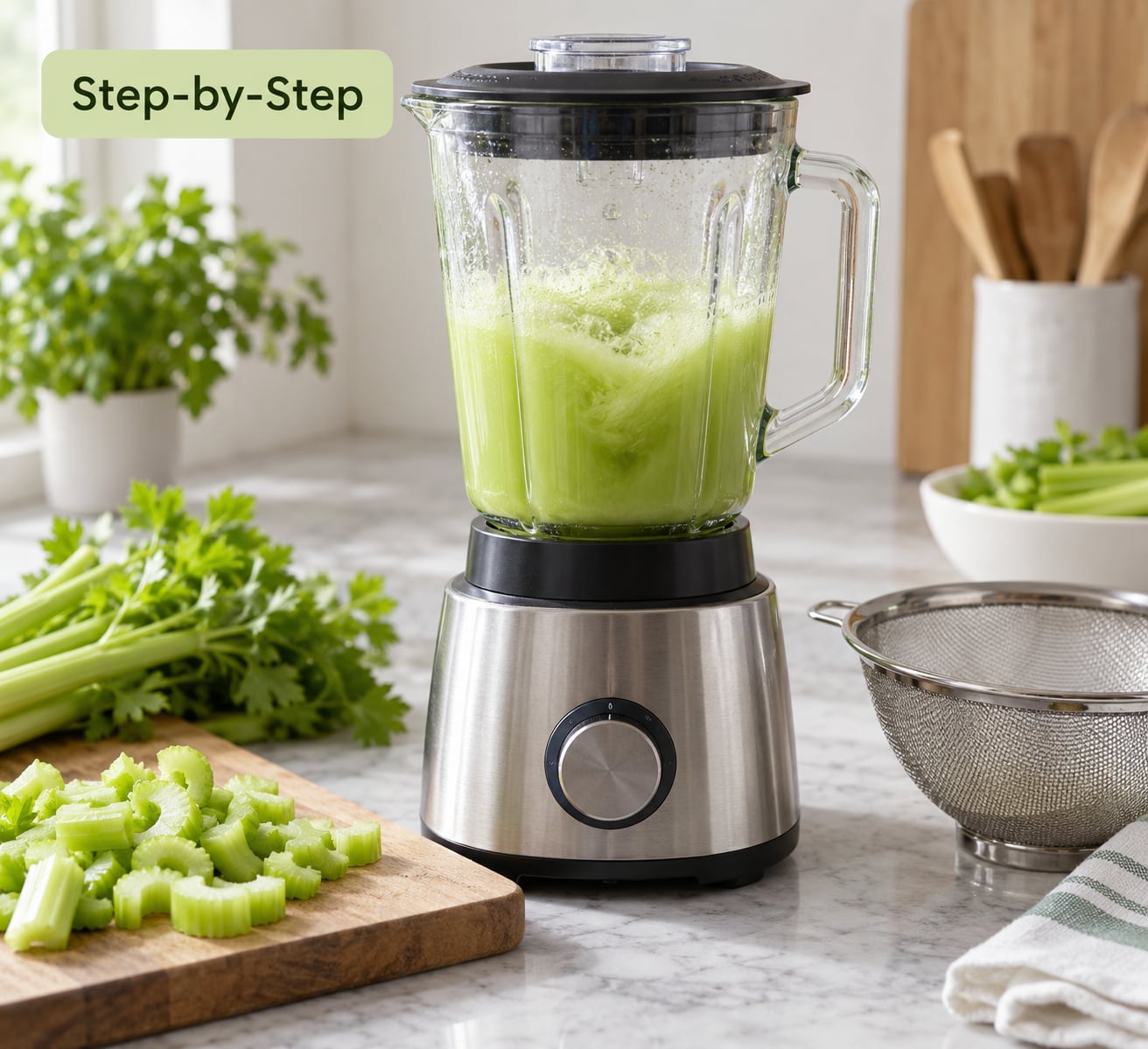
Start on the lowest speed or the smoothie setting for about 15 seconds to break the pieces down. Then move up to high and pulse: three or four seconds on, two seconds off, repeated.
Pulsing gives you control. A single continuous high run heats the juice and pushes the last of the fiber past the blades, and celery that has been sitting near a hot motor turns bitter fast.
Stop after about 60 to 90 seconds, drop the tamper through the lid opening, and push the pulp down off the walls. Then blend another 20 seconds. The target is a consistency like thick cold-pressed juice, with no visible flecks of fiber in the foam.
If the jar feels hot on the base, stop and let it cool for a minute. Never reach in with a spoon while the blade is spinning, and keep the lid on whenever the tamper is in.
Step 4: Strain It, If You Prefer
Strain when you want a light, clear drink, when you are drinking a large glass on an empty stomach, or when fiber bothers you. Skip it when you want the full nutrition and a thicker drink that sits like a smoothie.
Here is how the options compare:
- Nut milk bag: the smoothest result and the community favorite. Pour the blend in, then squeeze the pulp hard with your hands. You can put the squeezed pulp back in the blender with a splash of water for a second, weaker pass.
- Fine-mesh sieve: faster and easier to clean, but the juice stays slightly cloudy and a little of the finer pulp slips through.
- Cheesecloth: gives a very clear finish, though it is slow and fiddly for more than a cup.
- No strain: all of the fiber, a thicker body, and no washing up afterward.
The pulp is not waste if it is not stringy. Stir it into smoothies, sauces, or soup. If it is fibrous, the compost bin is the better call.
Step 5: Taste, Adjust, and Serve
Taste it before it leaves the glass. Straight celery juice is savory and grassy rather than sweet, so if it needs something, add a squeeze of lemon or lime for brightness, a thin slice of ginger for heat, or a small spoon of apple juice for roundness.
If it is too sharp, a few ice cubes or a splash of cold water fixes it in a way that more celery will not. Drink it within minutes if you can. If you are making it ahead, pour it into a sealed glass jar and refrigerate right away.
Common Mistakes
The juice comes out chunky. Usually a cutting problem. Pieces were too big, or the batch was packed too full. Cut to one inch, work in smaller batches, and give the second pass another 20 seconds.
It tastes bitter. Two causes: the motor heated the juice, or the celery sat chopped while you got everything else ready. Blend in short pulses, keep the jar cool, and cut the celery last so it is not sitting out.
It tastes watery. You added too much liquid. Half a cup is the ceiling for a standard jar, and less is fine because the celery releases its own water. Add a cube of ice instead of more water for a thicker drink.
Foam on top and a thin liquid underneath. That is normal, especially with ice. Stir it back together with a spoon, or top the glass with the froth rather than skimming it off.
The blender runs hot and smells like cooked celery. Stop the machine and cool it down. A cool-down minute between batches keeps the flavor clean and is kinder to the motor than one long run.
The juice separates in the glass within minutes. Also normal. Celery contains natural starches that settle. Shake or stir it, and shake it again before every sip.
You threw out half the pulp. Squeeze the pulp in the bag properly before you give up on it, and run the spent pulp through a second short blend with a little water. A bunch of celery gives noticeably more juice that way.
On the water question that comes up constantly: celery-only juice, straight from the stalk with nothing added, is a real tradition, and a blender will not reproduce it on its own. Without liquid the blades stall and you end up with puree. The water is there to do mechanical work, so keep it to the smallest amount that blends smoothly.
Frequently Asked Questions
Do I need to strain celery juice made in a blender?
No, straining is optional. Leaving the pulp in gives you a thicker, fiber-rich drink closer to a green smoothie, and many people prefer it. Strain it through a nut milk bag or fine-mesh sieve when you want a light, clear juice, or when a large glass of fiber on an empty stomach does not sit well with you.
Can I make celery juice with a regular blender?
Yes. A standard countertop blender handles celery as long as you cut the stalks to one-inch pieces, work in batches that fill the jar only two-thirds, and pulse rather than run continuously. A high-speed blender reaches a smoother result in roughly a minute, while a regular one usually needs two or three minutes and a scrape-down partway through.
What is the best way to cut celery for blending?
Cut the stalks into one-inch pieces after trimming the leafy tops and any stringy outer layer. Even pieces are what matters: oversized chunks stall the blades and leave fiber behind. If a batch is not blending smoothly, stopping the machine, scraping the pulp off the walls, and blending again for another 20 seconds usually solves it.
Can I add fruit or other vegetables to celery juice?
Yes, and it is the easiest way to make the drink palatable. Half a lemon or lime adds brightness, a one-inch piece of ginger adds bite, and a small green apple or cucumber rounds out the grassy flavor. Keep additions small, since more produce means less celery per glass and a thinner, sweeter result than plain celery juice.
How long should homemade celery juice be stored?
Drink it the same day if you can. Otherwise, pour it into a clean sealed glass jar, leave headroom for expansion, and refrigerate right away, where it keeps about 24 to 72 hours. Separation and a cloudy layer are normal. Discard it if it smells fermented or vinegary, fizzes when shaken, or has grown a slimy texture.
Conclusion
How to make celery juice in a blender comes down to four things: celery cut small, half a cup of water, short pulses, and a nut milk bag if you want it clear. That is the whole method, and it takes about as long as washing the stalks.
If you are making it for the first time, start with plain celery and nothing else so you know what the flavor actually is. Then add the water in stages, decide whether you want the fiber, and only reach for the lemon or the ginger once the base version is smooth. The juice is best within a few hours, so blend it when you are about to drink it rather than as a big Sunday batch. Anyone with a medical condition or taking medication should check with a doctor or registered dietitian before making celery juice a daily habit.