
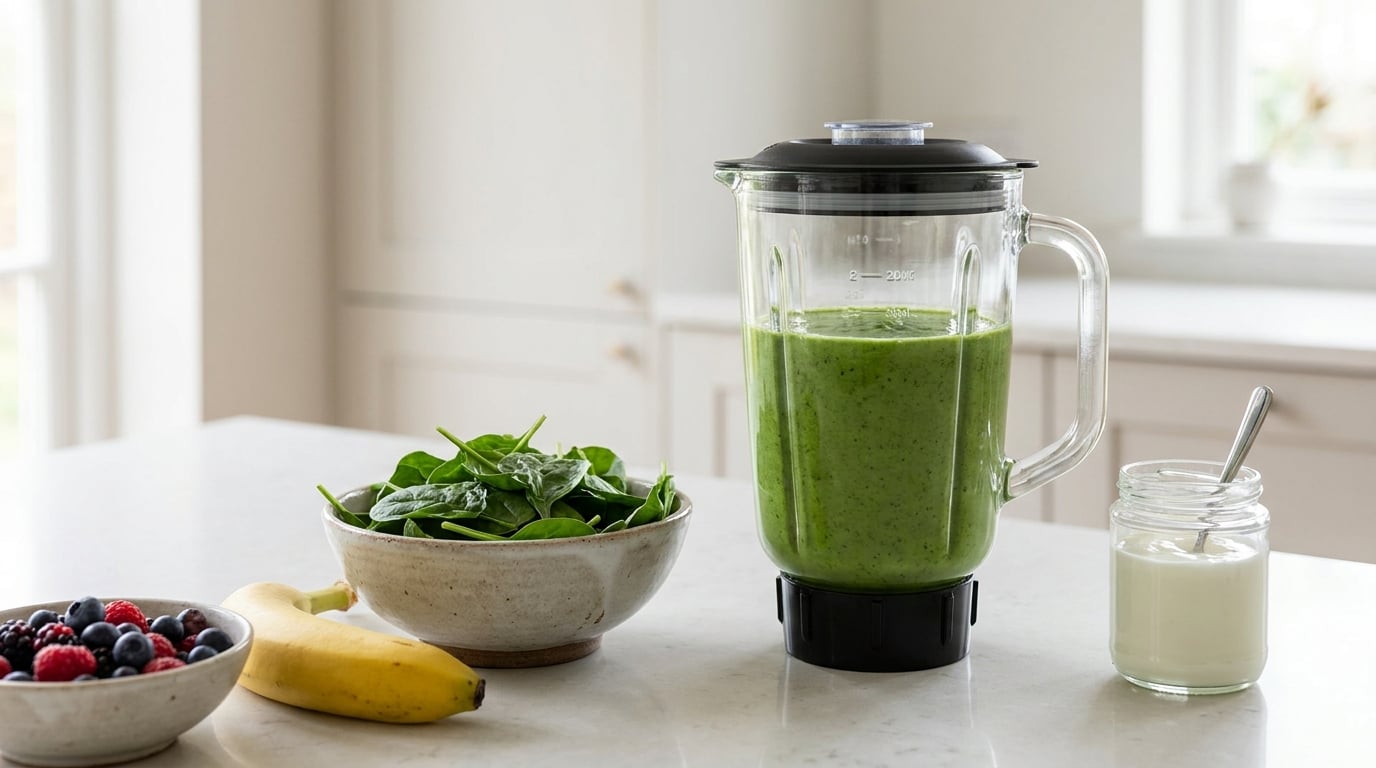
To add greens to food without tasting them, make the pieces small enough to disappear and cover them with a flavor strong enough to dominate. Particle size and masking flavors are the two levers, and once you get comfortable with both, the method works in smoothies, sauces, soups and baking alike. Prep time is about 10 minutes and the difficulty is beginner.
I do most of this with frozen spinach, because the flavor is milder and it blends smoother than fresh leaves. The rest comes down to picking a green you actually tolerate and giving it a vehicle that already tastes good on its own.
Table of Contents
- What You Need
- Step-by-Step: How to Add Greens to Food Without Tasting Them
- Common Mistakes
- Frequently Asked Questions
- What is the easiest way to hide the taste of leafy greens?
- Can I add greens to oatmeal, soup, or pasta without making them taste grassy?
- What is the best green to use when I do not want to taste vegetables?
- Will blending spinach or kale make a smoothie taste healthier?
- Should I cook greens before adding them to recipes?
- How can I add more greens gradually without getting tired of the flavor?
- A Simple Place to Start
What You Need
You do not need a special kitchen for this. Everything below is either a mild green, something strong enough to bury it, or a tool that changes how big the pieces are.
Mild greens to start with
- Baby spinach, raw or frozen, for smoothies, sauces and baking
- Romaine lettuce for blending into fruit bases
- Swiss chard, stems removed, for soups and curries
- Zucchini and cauliflower, grated or riced, for pasta and rice dishes
Flavors that do the masking
- Sweet fruit: banana, pineapple, mango, berries, and pineapple or orange juice
- Dairy and fat: yogurt, milk, parmesan, cream cheese, butter, nut butter, avocado
- Savory staples: canned tomatoes, pesto, garlic, ginger, smoked paprika, curry powder, stock
- Baking: cocoa powder, vanilla, melted chocolate, cinnamon, almond extract
For acidic ingredients, treat vinegar with care. Plenty of people who dislike vegetable flavor also find sharp vinegar unpleasant, so lemon juice is often the gentler option.
Tools that shrink the greens
- A blender for smoothies and cold sauces
- A food processor for soups and doughs
- A microplane or fine grater for zucchini and cauliflower
- A spiralizer if you want vegetable noodles that hold their shape
- An immersion blender for puréeing straight from the pot
Pantry staples that carry greens well
Oatmeal, pasta, rice, mashed potato, pancakes and brownies all absorb blended greens without fighting them. Frozen greens are worth keeping on hand; they are cheaper per serving and blend to a smoother purée than fresh.
Step-by-Step: How to Add Greens to Food Without Tasting Them
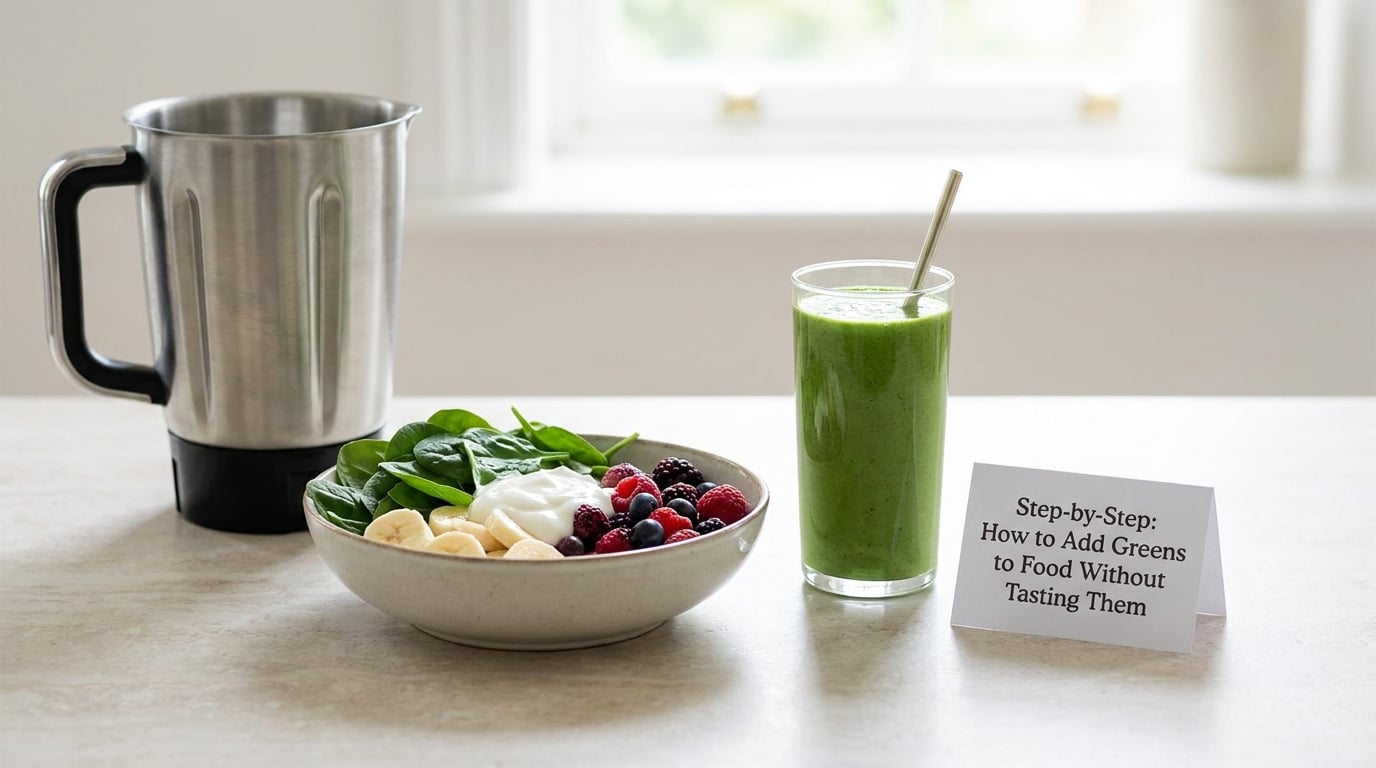
Step 1: Choose Mild Greens
Mild greens are the reason some people never notice greens in a meal. Spinach has a mild, slightly mineral note, romaine is watery and neutral, and chard turns savory and soft when cooked. Kale, collards and dandelion are a different story: they are bitter enough that you will taste them no matter what you add.
Start with a quarter cup of baby spinach per serving and work up from there. If you want the color of kale without the bitterness, use frozen kale in a small amount inside a strongly spiced dish, or blend a teaspoon of spirulina powder into a fruit base for color only.
Step 2: Hide the Flavor in a Familiar Base
The base decides whether the greens disappear. Build a flavor you already like first, then fold the greens into it, which is the opposite of adding greens and hoping to cover them afterward.
In smoothies, the reliable pairing is fruit plus something creamy: half a frozen banana, half a cup of berries or mango, a handful of spinach, and yogurt or milk for body. Pineapple and mango are the most forgiving fruits because their sweetness is strong enough to blunt bitterness.
In savory food, dairy and acid do the work. A spoonful of parmesan into a tomato sauce, pesto blitzed into cream sauce, or spinach wilted into a curry at the end all work because the sauce is already loud. Garlic, ginger, smoked paprika and cumin give you more masking power per spoonful than any green does.
In baking, cocoa and melted chocolate are the strongest covers there are. Spinach and zucchini are the usual choices, added to brownies, muffins, pancakes and quick breads where vanilla and chocolate carry the flavor.
Step 3: Blend for a Smoother Texture
Most people can taste greens because they chew a distinct leaf, not because they detect a molecule. Break the leaf structure down and the flavor disperses instead of arriving in one concentrated bite.
Frozen greens blend smoother than fresh, so freeze leafy greens in portions if you can. Blend for 30 to 60 seconds on high, adding liquid a splash at a time until it moves. A spoon of nut butter, coconut oil or avocado gives fat that coats the particles and softens the edge of the flavor.
Warm food works the same way. Simmer greens into a soup and blend the whole pot, or purée them and stir the puree through a sauce. Grate zucchini and cauliflower by hand for texture, and spiralize when you want strands that look like pasta.
One thing to watch is color. Kale and spinach will bleed green into pale dishes like pasta and mashed potato. Add them off the heat at the last second, keep the rest of the dish strongly colored, or blend the greens into something dark such as a pesto or chocolate batter where the color disappears.
Step 4: Start Small and Increase Gradually
The most common mistake is treating this as all or nothing. Nobody graduates from zero greens to a full handful in a day, and the attempt usually ends with a bad experience and a week of no greens at all.
A workable ladder looks like this: one teaspoon of powder or one tablespoon of finely chopped greens, then a quarter cup, then half a cup, then a full handful. Spend two or three days at each level and only move up when the current level genuinely tastes like nothing.
Keep eating some vegetables you can see and identify alongside the hidden ones. That habit matters more in the long run than any single trick, since it keeps a full range of textures in your diet while you work on the ones you currently avoid.
Common Mistakes
Adding a huge amount on day one
One r/Smoothies user planned a single drink with 100g each of spinach, kale, carrot and cauliflower, and asked how much fruit and protein powder would cover it. No blend does that well. Split the greens across two or three servings instead, or start at a quarter cup and build.
Skipping fat and acid
Greens taste sharper without them. A spoonful of nut butter, avocado, olive oil or cream in a smoothie, and a squeeze of lemon or a spoon of tomato paste in a savory dish, do more for the flavor than doubling the amount of fruit.
Not blending long enough
A ten second pulse leaves flecks of leaf that your tongue finds instantly. Give it the full 30 to 60 seconds, scrape the sides down, and check for a fully uniform texture before you pour.
Adding greens to food that is already very hot
Boiling greens for a long time turns them grey and can leave a cooked, earthy note behind. Wilt them briefly instead, or add them in the last minute off the heat so they stay bright and keep less of their own flavor.
Expecting the flavor to disappear completely
In a plain salad, no technique hides greens. In a chocolate brownie, a fruit smoothie or a heavily spiced sauce, they can be genuinely undetectable. Pick vehicles with strong flavor and aim for invisible, not absent.
Ramping up fiber too fast
Fiber is a good thing, but doubling your intake in a day can cause gas and bloating, and fiber in baked goods can make them gummy and dense. Puréeed spinach keeps this manageable, and a slow increase over two weeks avoids the problem entirely.
Frequently Asked Questions
What is the easiest way to hide the taste of leafy greens?
Blending a small amount of spinach into a sweet fruit base is the easiest method. Half a frozen banana, a handful of berries or mango, yogurt or milk, and a quarter cup of spinach will not read as a vegetable. The two ingredients doing the work are the blender, which breaks down the leaf, and the fruit, which covers what is left.
Can I add greens to oatmeal, soup, or pasta without making them taste grassy?
Yes, as long as the dish has a strong flavor of its own. Cook greens into a tomato, curry or potato soup and blend it, stir wilted spinach into a pesto or butter sauce, or top savory oatmeal with a fried egg and spices. A quarter cup per serving is usually enough, and adding it off the heat keeps the flavor mild.
What is the best green to use when I do not want to taste vegetables?
Baby spinach is the safest starting point because it is mild and slightly sweet. Romaine is close behind, and Swiss chard works well once it is cooked into a savory dish. Kale, collards and dandelion are noticeably bitter, so they need a strong vehicle like a fruit smoothie or a heavily spiced sauce, and they are better used in small amounts.
Will blending spinach or kale make a smoothie taste healthier?
Blending does not change what is in the glass, so no, the smoothie does not become healthier because of the blender. Blending does make the greens easier to eat, which matters, because a drink you finish every morning is worth more than a salad you push aside. The nutrient content stays essentially the same.
Should I cook greens before adding them to recipes?
It depends on the recipe. Cook greens briefly in soups, curries and sauces to soften their flavor, and add them in the last minute so they stay bright. In smoothies, sauces and baking, use them raw and frozen for the smoothest texture. Long boiling is the one approach to avoid, since it can leave a cooked, earthy taste.
How can I add more greens gradually without getting tired of the flavor?
Move up a dosage ladder slowly: one tablespoon of chopped greens, then a quarter cup, then half a cup, then a full handful, spending a few days at each step. Rotate the vehicle so greens appear in a smoothie one day and a sauce the next, and keep eating some visible vegetables you enjoy alongside the hidden ones.
A Simple Place to Start
Put a quarter cup of frozen spinach, half a frozen banana and a half cup of mango in a blender with a splash of milk, blend for a minute and taste it. That is the whole method, and it takes less time than most people spend deciding what to eat.
Once that drink is boring to you in the best possible way, move the same spinach into a tomato sauce or a chocolate brownie, where the flavor is savory or sweet instead of fruity. Keep the quantity low at first, raise it every few days, and adjust the fruit, fat and acid until each dish tastes like itself and not like a vegetable.
Nutrition advice is personal, and leafy greens carry real amounts of folate, vitamins A, C and K, so it is worth talking to a registered dietitian if you are managing a health condition, are pregnant, or want to plan a large change. Raw leafy greens also carry a small food safety risk, so wash them well under running water, and cook them instead if you are pregnant, older, or managing a weakened immune system.