
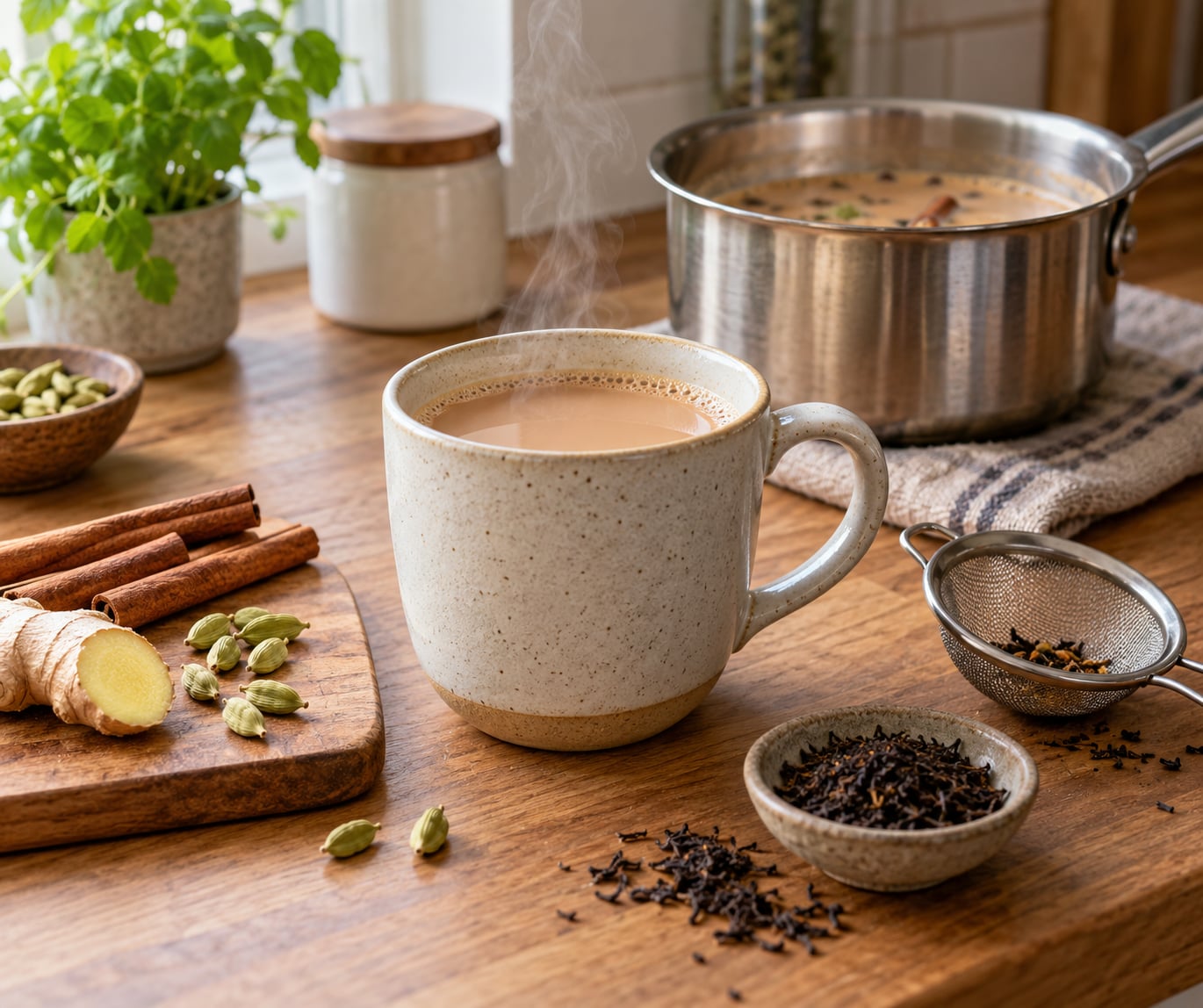
To make chai tea from scratch, you boil water, simmer it with crushed whole spices for 10 to 15 minutes, add black tea for the last 3 to 5 minutes, then strain and finish with milk and sweetener. From that point you can adjust the sweetness, the milk, or the spice intensity without any store-bought concentrate in the way.
The whole pot takes about 25 minutes and yields two generous mugs. The order of operations matters more than any single ingredient: milk goes in at the very end, off the boil, or it scorches and turns grainy, and tea goes in last, or it turns bitter.
Coffee-shop chai is sweetened heavily and usually thinner than people expect once you taste it made properly at home. If you have ever bought a bottle of chai concentrate and thought it tasted like candy rather than tea, this recipe is the fix.
Table of Contents
- What You Need for How to Make Chai Tea From Scratch
- Step-by-Step: How to Make Chai Tea From Scratch
- Step 1: Crush the spices (2 minutes)
- Step 2: Bring the water to a boil (4 to 6 minutes)
- Step 3: Simmer the spices (10 to 15 minutes)
- Step 4: Add the tea and steep (3 to 5 minutes)
- Step 5: Strain (1 minute)
- Step 6: Finish with milk and sweetener (3 to 4 minutes)
- Step 7: Pour and serve (immediately)
- How to Make Chai Tea From Scratch: Choose Your Tea
- How to Make Chai Tea From Scratch: Build the Spice Base
- How to Make Chai Tea From Scratch: Simmer and Finish the Drink
- Common Mistakes and Easy Fixes
- Frequently Asked Questions
- Conclusion: Start With a Simple Basic Chai
What You Need for How to Make Chai Tea From Scratch
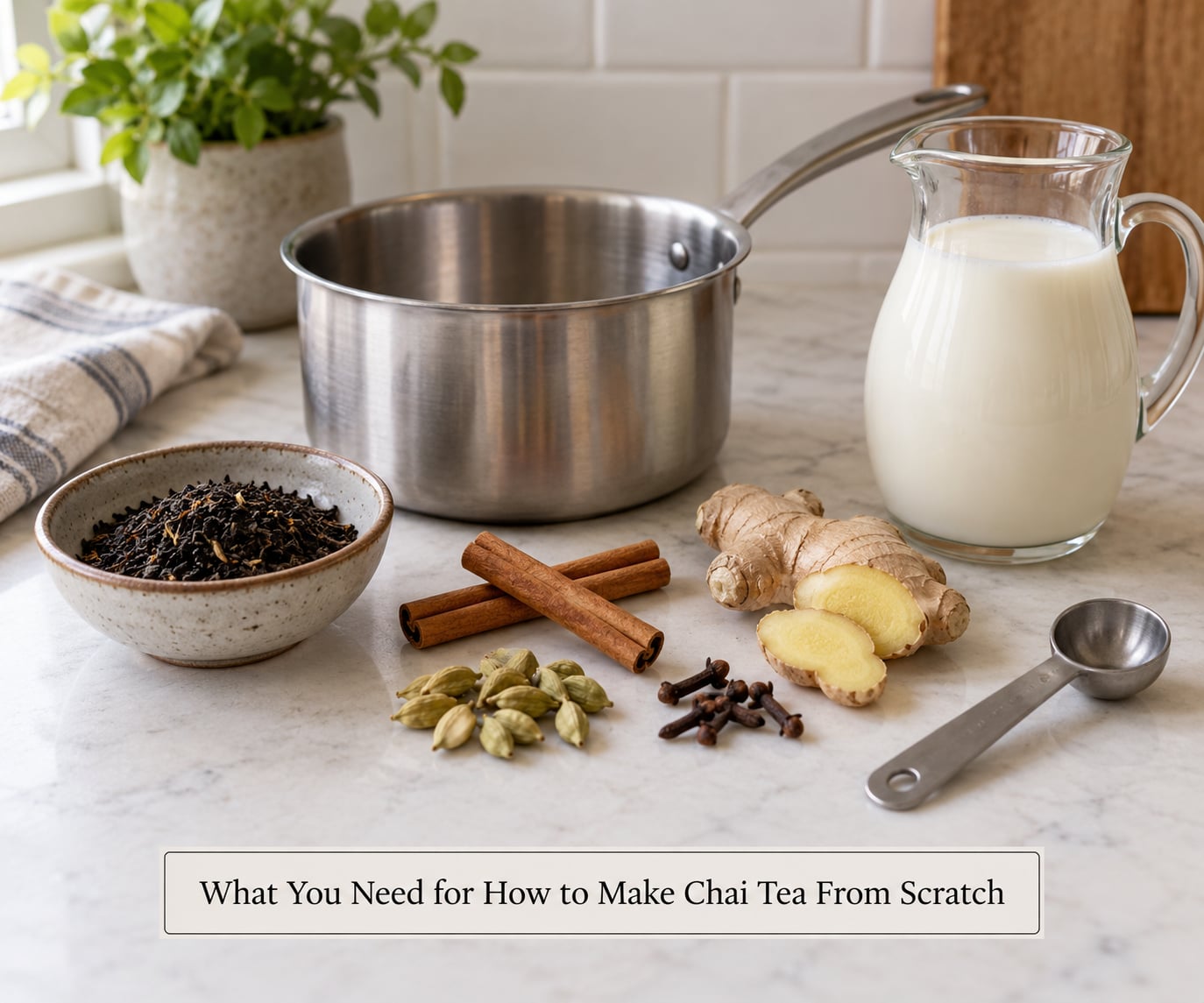
Everything below comes from a spice shelf and a grocery aisle. You do not need a special masala chai blend to start, though a pre-made blend works fine as a shortcut.
The essentials
- 2 cups (500 ml) water — the base of the brew. Reduce it slightly and the finished chai tastes more concentrated.
- 3 to 4 cardamom pods, lightly crushed — the backbone of the blend, floral and slightly sweet.
- 1 cinnamon stick, roughly 2 inches (5 cm) — warmth and a sweet, woody note.
- 4 to 5 whole cloves — strong and numbing. More than six tastes medicinal.
- 1-inch (2.5 cm) piece of fresh ginger, sliced or smashed — heat without sharp heat.
- 4 to 5 black peppercorns, cracked — peppery depth that most people do not expect but love once they taste it.
- 2 teaspoons (2 g) loose-leaf black tea, ideally Assam or CTC — or 2 strong tea bags if you have no loose leaf.
- 1 cup (240 ml) milk, plus more per serving — whole milk has the most flavor, oat milk is the closest plant-based match.
- 2 teaspoons sugar, honey or jaggery, plus more to taste — add it at the end so you can actually measure it.
Optional spices and additions
- Half a star anise for a licorice sweetness that deepens the cup.
- 1 teaspoon fennel seeds, lightly crushed, for a similar anise note with more freshness.
- A small pinch of nutmeg or mace, added with the heat, for warmth.
- Vanilla — a split bean or a few drops of extract stirred in at the end. This is a cafe addition, not traditional masala chai.
Equipment
- A small saucepan with a lid, 2 to 3 quart, is the only real requirement. A lid keeps the volatile oils in the pot instead of the kitchen.
- A mortar and pestle or a spice grinder cracks the spices so their oils actually release. Rolling them between your palms works in a pinch.
- A fine mesh strainer or a muslin cloth bag strains the leaf and grit out. A tea ball keeps loose leaf contained but does not catch everything, so strain again anyway.
- Measuring spoons matter here because the sweetening step is the one most worth measuring.
Loose-leaf tea, tea bags and a concentrate you brew extra and keep in the fridge all work. Each one gets you a good cup, and the differences are worth understanding before you commit to a weekly habit.
Step-by-Step: How to Make Chai Tea From Scratch
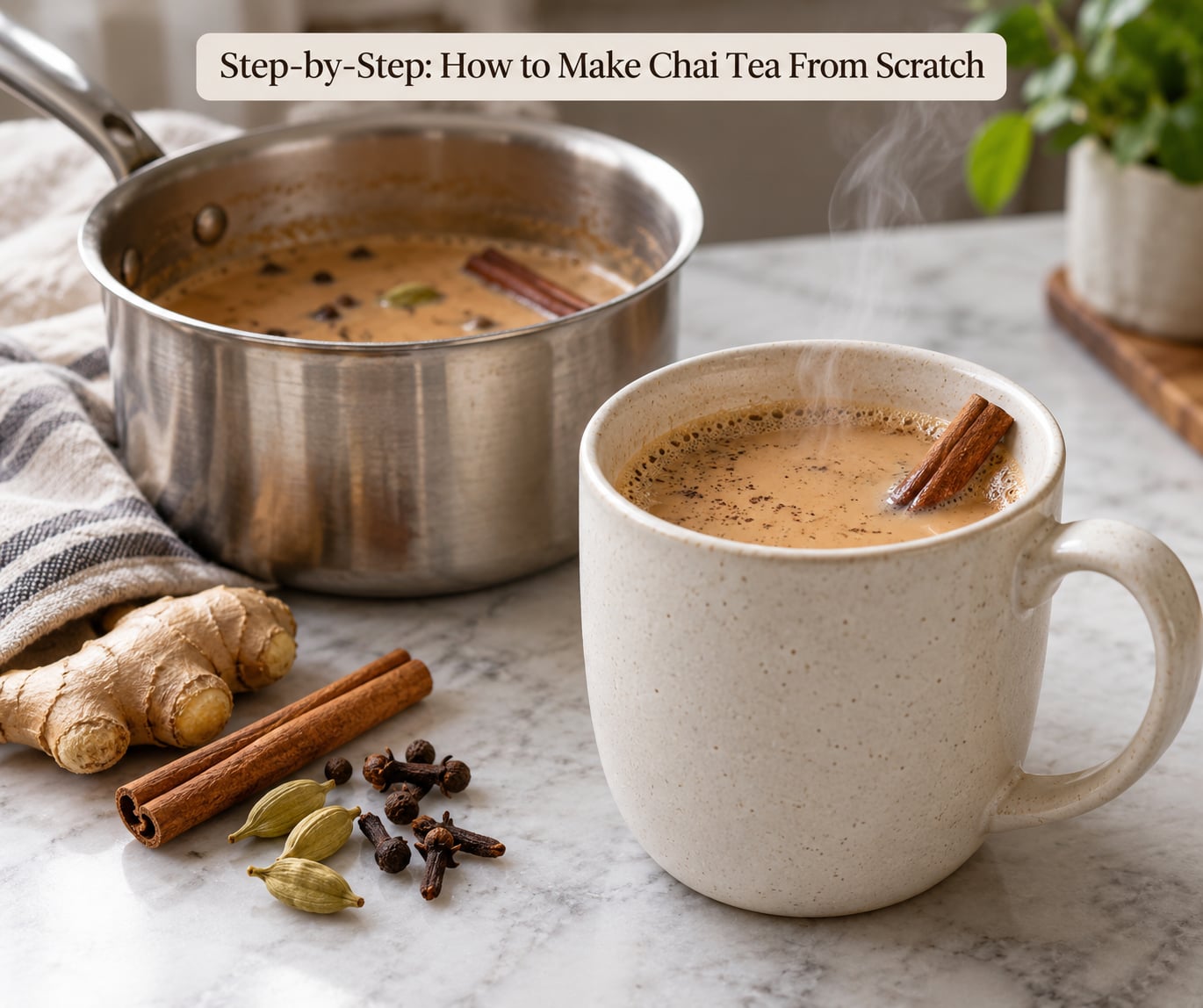
Step 1: Crush the spices (2 minutes)
Crack the cardamom pods with the flat of a knife, crush the cloves, and break the cinnamon stick into smaller pieces. Add the peppercorns and grind everything just until you see broken bits, not powder.
Home cooks who make chai regularly warn against pounding everything into a fine powder. Powders behave like dust in the pot: the drink turns gritty and the flavor flattens. Coarse pieces extract slowly and evenly.
Step 2: Bring the water to a boil (4 to 6 minutes)
Put the water in the saucepan with the crushed spices. Bring it to a full boil over medium-high heat, then cover.
This is the step beginners skip, and it is why their chai tastes thin. A rolling boil for a few minutes pulls the spice oils out of the seeds and bark before the tea goes anywhere near the pot.
Step 3: Simmer the spices (10 to 15 minutes)
Drop the heat to its lowest setting so the surface barely shivers. Simmer covered for 10 minutes for a lighter cup, up to 15 for a stronger one.
You should see tiny bubbles around the edges, hear a soft hiss rather than a roar, and smell cinnamon and cardamom filling the room. If you hear loud bubbling, the heat is too high.
Step 4: Add the tea and steep (3 to 5 minutes)
Turn off the heat completely. Add the loose tea or the tea bags, stir once, and let it sit 3 to 5 minutes with the lid on.
This is the difference between smooth chai and bitter chai. Tea that simmers at a boil for 20 minutes extracts tannin and nothing pleasant. Off the heat, it keeps steeping gently while the spices do their work.
Step 5: Strain (1 minute)
Strain the liquid through a fine mesh sieve or muslin bag into a jug or a second saucepan. Press on the spent leaves and spice bits to squeeze out what is left, then toss them.
Do not skip the second pass if your chai looks speckled. Fine grit settles at the bottom of the cup and the whole drink reads as bitter, when the flavor is actually sediment.
Step 6: Finish with milk and sweetener (3 to 4 minutes)
Put the strained chai back in the saucepan over medium-low heat. Pour in the milk and add 2 teaspoons of your sweetener. Warm it until you see steam and the first small wisps of foam at the edge, about 2 minutes, then taste.
Stop there. Milk that boils separates into curds and whey, and there is no fixing it afterward. Sweetener added now dissolves into the finished drink instead of scorching in the pan, so you can adjust with a teaspoon instead of guessing.
Step 7: Pour and serve (immediately)
Pour through a small additional strainer if any leaf escaped. Sip it as soon as it is drinkable and taste again once it is warm rather than hot; warmth changes sweetness perception, and you usually want less sugar than you thought.
How to Make Chai Tea From Scratch: Choose Your Tea
Black tea is the only traditional base, and the strength matters more than the origin. You want something that stands up to milk and spice without turning into tannic soup.
- CTC Assam — a strong, malty black tea that brews fast and takes spice well. This is what most Indian homes reach for, and it is my first pick for a one-cup-per-person pot.
- CTC or strong blend black tea — rolled into pellets rather than leaf, so it infuses quickly and evenly. Slightly more astringent than leaf tea, so pull it a minute earlier.
- Standard leaf Assam — softer and more floral. Give it the full 5 minutes.
- Strong tea bags — an everyday convenience black tea, or three tea bags in place of 2 teaspoons of loose leaf.
Brew time and leaf format change the flavor more than most people expect. Fast-rolled CTC tea and tea bags need roughly 3 minutes. Leaf tea needs 4 to 5. Double the leaf, and the brew gets tannic; double the steep time, and it gets darker but not much stronger.
All true black tea contains caffeine, and a cup of homemade chai built on two teaspoons of CTC leaf typically lands around 40 to 60 mg, comparable to a cup of tea brewed normally. If you would rather skip caffeine, rooibos red tea and a small amount of vanilla stand in for the black leaf and taste sweet without being sweet about it. Rooibos takes to spice in its own way, and how to make rooibos tea taste better: 8 easy brewing fixes covers the temperature and steep-time tricks that keep it from turning flat. If caffeine is a concern for you, if you are pregnant, or you are managing a medical condition, ask your doctor about how much is right for you, or use the rooibos version.
How to Make Chai Tea From Scratch: Build the Spice Base
Cardamom, ginger, cinnamon and cloves are the four that everyone recognizes. Black pepper is the one people leave out and then miss. Each spice has a distinct job, and knowing which job it does is what lets you adjust the blend later.
- Cardamom — floral, citrusy, mildly sweet. It is the loudest spice in the cup, so measure the pods.
- Ginger — fresh heat that lifts rather than weighs down. Dried ground ginger tastes dusty and cannot replace fresh sliced root.
- Cinnamon — sweetness and warmth. One stick is right for two cups; a teaspoon of ground cinnamon leaves a powdery sediment.
- Cloves — powerful and slightly numbing. Five per two cups is plenty.
- Black pepper — a warm, peppery finish that makes the whole thing taste less sweet.
- Star anise and fennel — licorice notes, optional, best for people who find plain masala chai too blunt.
Whole or ground is the real decision. Ground spices work and save time, and many excellent recipes use a teaspoon of pre-ground chai masala. The trade-off is control: ground spice releases everything at once, so timing matters far more.
Stage the blend if you have five extra minutes. Add the firm spices first, the peppercorns and cloves midway through the simmer, and the cardamom with the tea. People who cook chai regularly describe crushing in stages as the difference between a layered cup and a one-note cup, because the spices do not cook at the same rate.
Make your own dry mix and it gets easier from there. Combine equal parts by volume of cardamom seeds, cinnamon, cloves, ginger, black pepper and a pinch of fennel, keep it airtight, and use 2 teaspoons per two cups of water.
How to Make Chai Tea From Scratch: Simmer and Finish the Drink
The last third of the method is where most recipes go wrong. Everything after the strain is about heat management and about knowing which liquid you started with.
Brewed in water or brewed in milk?
| Method | What you do | Result | Best for |
|---|---|---|---|
| Water base, milk added at the end | Simmer water with spices and tea, strain, then warm with milk | Clear, layered spice flavor; lighter body; no curdling risk | Beginners, concentrate batches, iced chai |
| Milk base | Add milk to the pan with the water and spices and simmer it all together | Rounder, creamier, more cafe-like; deeper color; milk can catch or split if it boils | Rich, sweet, dessert-leaning chai served in a mug |
| Water only | Simmer water with spices and tea, strain, add sweetener | Spiced tea rather than chai; lighter and faster to brew | Caffeine-sensitive drinkers, no-milk diets |
Start with the water base. It gives you more control, because the milk and sugar are the last two variables you can still change.
Choosing a milk
- Whole milk gives the most flavor and the creamiest body. Second-percent works; skim is thinner and needs more sweetener.
- Oat milk is the closest plant-based match because its protein content behaves like dairy and it does not split as readily.
- Soy milk heats well and adds little sweetness of its own.
- Almond milk is light and slightly nutty; many people find it too thin for chai, so use more of it or add a scoop of cashew spread.
- Coconut milk makes a dessert-style cup. Use the full-fat kind from a can, and cut the sugar.
To avoid a grainy or curdled finish, keep the milk at a simmer and not above it. Stir from the bottom every thirty seconds so the protein does not settle, and pull the pot off the heat as soon as it looks drinkable. If you have already seen the pot start separating, take it off the heat immediately, whisk hard, and add a splash of cold milk; it often pulls back together.
Sweetener choices
Sugar, honey, jaggery, maple syrup, stevia and monk fruit all work. Honey and jaggery round out the spice with a caramel depth, maple adds a woodier note, and zero-calorie sweeteners leave you wanting more. Add two teaspoons for two cups, taste the hot chai, then add a teaspoon at a time.
Serving
Fresh chai is at its best in the first hour. For iced chai, let a double-strength batch cool to room temperature, refrigerate it, and pour it over ice with milk at roughly a two to one ratio, concentrate to milk. Warm a mug in the oven at low heat for ten minutes before straining hot chai into it; a cold mug drops the temperature of the drink noticeably.
Common Mistakes and Easy Fixes
Almost every bad cup traces back to one of six things: heat, timing, dilution, spice grind, sugar or strength. Work down the list and the fix is usually obvious.
- Chai tastes weak or watery. You did not simmer the water long enough. Boil the water, then hold the spices at a low simmer for the full 10 to 15 minutes. If the spices were added and you went straight to the tea, that stage was skipped.
- Chai tastes bitter or astringent. The tea steeped too long or too hot. Pull it at 3 to 5 minutes, add it after the heat is off, and drop to one teaspoon of leaf per cup. Tannin bitterness is a timing problem, not a quantity problem.
- The spices taste dusty or the cup feels gritty. They were ground too finely or the brew was not strained finely enough. Crush only until pieces are broken, then pass the strained chai through a fine mesh sieve.
- The chai is curdled, scalded or has a skin. The milk boiled. Bring milk to a heat below a simmer and take the pot off while it still looks drinkable. Skim any skin, and for future batches add milk last over low heat.
- It is cloyingly sweet and you cannot taste the tea. You sweetened too early or too heavily. Add sugar after the tea and milk are in, start at half the recipe amount, and taste while hot.
- Cardamom or clove overwhelms everything. Count your pods and cloves. Three to four pods and four or five cloves for two cups is the ceiling, and stage the cardamom in if it is the spice you like least.
- The process drags past 25 minutes. You are making a concentrate. Simmer the water and spices longer, steep the tea separately in a mug for 5 minutes, and combine. That is the same result in about 15 minutes.
- The tea is weak even though it steeped. Your leaf is too delicate or too old. Use Assam or CTC, or bump the amount by half a teaspoon per cup.
A few habits make repeat batches consistent: weigh your spices once into a jar, measure tea by spoon rather than eye, and always taste before sweetening. One side note on kitchen waste — freezing onion skins and stems to boil down later follows the same reduce-don-toss logic as making vegetable broth from kitchen scraps, and spent chai leaves make a decent second, weaker brew.
Leftover chai keeps well because of the sugar and milk, but refrigerate it in a sealed container within about two hours and use it within four or five days. Freeze it in ice cube trays for longer storage, or reduce a batch until it is syrupy and it keeps a few months in the freezer. Reheat gently, stirring, and never boil. If it smells off or the texture has turned gummy, toss it.
Frequently Asked Questions
Do I need loose-leaf tea to make chai at home?
No. Strong tea bags work fine for a single cup, and a batch concentrate can be brewed from loose leaf and kept for a week. Loose Assam or CTC simply gives you more control over strength and steeping time. If you start with tea bags, use three in place of 2 teaspoons of leaf and pull them at four minutes so the brew stays smooth.
How long should chai tea simmer?
Simmer the crushed spices in water for 10 to 15 minutes after a full boil, then add the tea off the heat for 3 to 5 minutes. Add the milk last and warm it for no more than 2 minutes. Total time from cold water to a poured cup is roughly 25 minutes. The spices take the longest, and the tea takes the least.
How can I make chai tea without milk?
Skip the milk entirely and sweeten the strained brew with sugar, honey or maple while it is hot so it dissolves. Black tea brewed this way is lighter and less creamy, and the cardamom and cinnamon read more clearly than they do in a dairy version. Add a splash of oat milk at the end if you want body without dairy.
How do I keep homemade chai from tasting too sweet?
Sweeten after the tea and milk are combined, start with half the sugar the recipe lists, and taste while the chai is hot. Warm liquid tastes sweeter than the same chai at drinking temperature, so it often needs less sugar than you think. Cutting the sugar is easier to do gradually than fixing an over-sweetened pot, and honey or maple carry less obvious sweetness than sugar.
Can I make chai tea ahead of time?
Yes, and a concentrate is the easiest way to do it. Make a batch with no milk, using twice the tea and spices for the volume you want, then refrigerate it covered and use it within four or five days. Pour it over ice with milk at about two parts concentrate to one part milk, or warm it gently. Freezing it in ice cube trays stretches that to a couple of months.
How do I make a larger batch of chai for guests?
Scale the recipe by volume rather than by doubling the spices. For eight cups of finished chai, use 8 cups of water, 12 to 16 cardamom pods, 3 cinnamon sticks, 16 to 20 cloves, 4 tablespoons of black tea and 2 cups of milk. Simmer the water and spices for the same 10 to 15 minutes, since time matters more than quantity, then steep the tea and add milk off the boil.
Conclusion: Start With a Simple Basic Chai
If you only do one thing this week, simmer two cups of water with three crushed cardamom pods, one cinnamon stick, five cloves, a thumb of ginger and four peppercorns for ten minutes, add two teaspoons of strong black tea off the heat for four minutes, then strain and finish with milk and a teaspoon of sugar. Adjust from there.
Once the base works, the fun part is changing one variable at a time: more ginger in winter, a drop of vanilla, oat milk instead of dairy, or a double-strength concentrate for iced chai. Get the technique right and how to make chai tea from scratch stops being a recipe and turns into a cup you build yourself.
Two more kitchen reads worth your time: how to make vegetable broth from kitchen scraps for the same reduce-don-toss thinking, and how to make steel cut oats faster when you want a pot that mostly cooks itself.