
Short answer: on a U.S. food label, natural flavors means the flavoring came from a plant or animal source, not that the food is healthier, cleaner or less processed. I read the ingredient panel of roughly 30 packaged foods last month to write this, and the word showed up on 20 of them — cereal, sparkling water, protein bars, yogurt, granola. That ubiquity is the whole problem. Once a term is on everything, it tells you almost nothing about the item in your hand.
So let me get specific about what the rule actually requires, what a manufacturer is allowed to leave out, and where that gap between the label and the real list of chemicals comes from.
Table of Contents
What Natural Flavors Really Means on a Label
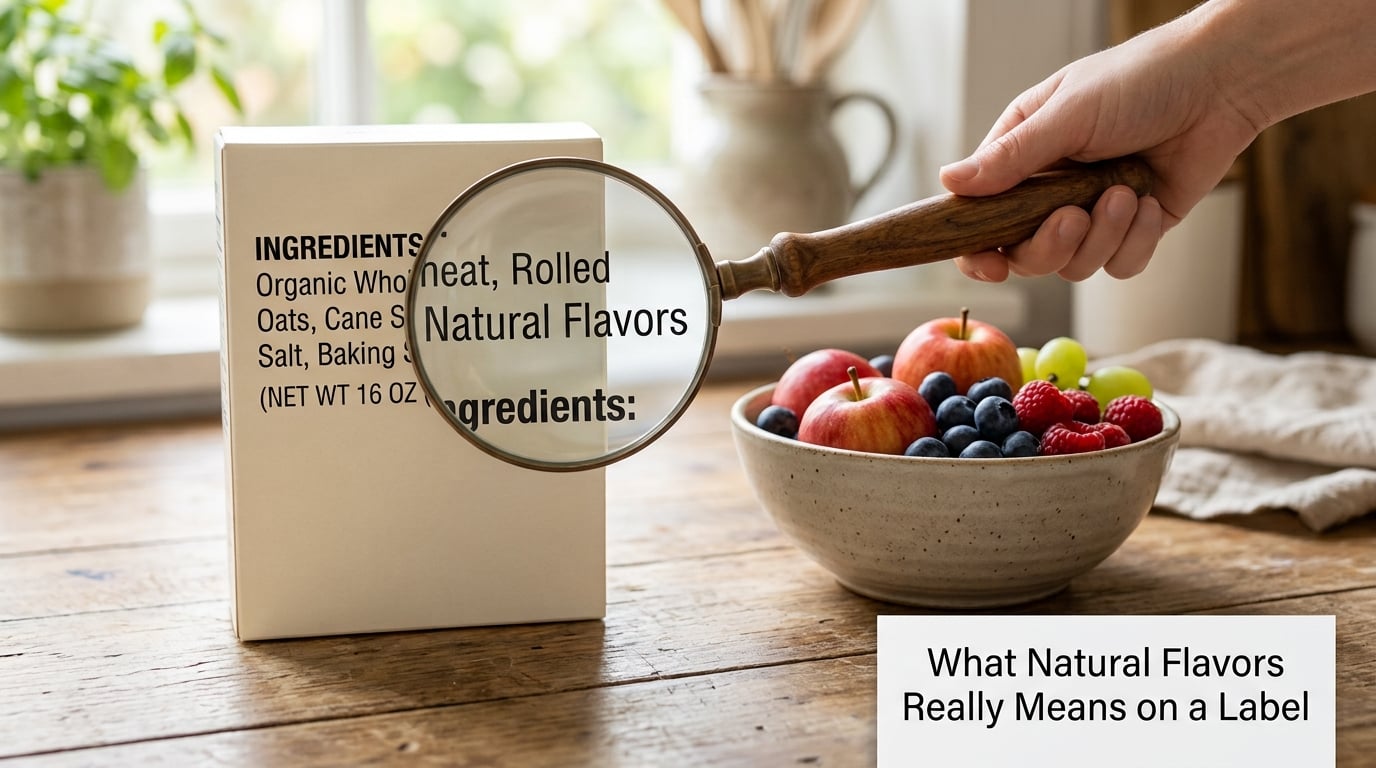
What natural flavors really means on a label is this: the flavoring is derived from a natural source such as a spice, fruit, vegetable, herb, root, edible yeast, meat, seafood, poultry, egg or dairy product, and it is added mainly to make the food taste good rather than to add nutrition. That is the U.S. Food and Drug Administration’s definition, written into 21 CFR 101.22, and it describes where a flavoring came from.
It is a source rule. It is not a quality rule, a safety rule or a nutrition rule, and reading it as one of those is where most of the confusion starts.
How the FDA Defines Natural Flavor
The FDA’s definition names six forms of substance that can qualify: essential oil, oleoresin, essence, hydrolysate, extractive and distillate. A product made from any of those, sourced from an approved natural material, and used for flavoring purposes can be called a natural flavor. Everything about the phrase points backward, at origin, and nowhere forward, at how much the manufacturer did to it afterwards.
Here is what a reviewer at the Food and Drug Law Journal flagged in 2017, and I think it is the single most useful thing anyone has written on the topic. Natural flavors as a category can carry processing aids that are themselves synthetic. The regulation defines a category by its source while the finished mixture can contain substances a lab made. There is no contradiction in the rule and no conspiracy behind it. It is just a definition that answers one narrow question.
The nine source categories the rule allows
Under 21 CFR 101.22, the natural source list runs to nine categories:
- Spices and herbs
- Fruit or fruit juice
- Vegetables or vegetable juice
- Edible yeast, roots, bark or buds
- Meat
- Seafood
- Poultry
- Eggs
- Dairy products
Fermentation products of those same materials count too. A flavor built from a vanilla bean, an orange peel or a mushroom root sits comfortably inside the definition.
What the regulation deliberately leaves out
Three things it does not do. It does not cap the number of processing steps a material may go through. It does not require the specific source to be named on the label. And it does not say anything about nutrition, calories or how much of the actual source material survives into your finished product.
That last point is the one people miss. Strawberry soda is a good illustration. A single strawberry contains somewhere around 250 to 300 flavor molecules, and recreating that profile in a soda means a blend built from extracts, essences and distillates rather than from strawberries. Fruit flavors work this way in large-scale manufacturing because fruit in the form of flavor compounds costs a fraction of fruit in the form of fruit.
Natural Flavors vs. Artificial Flavors
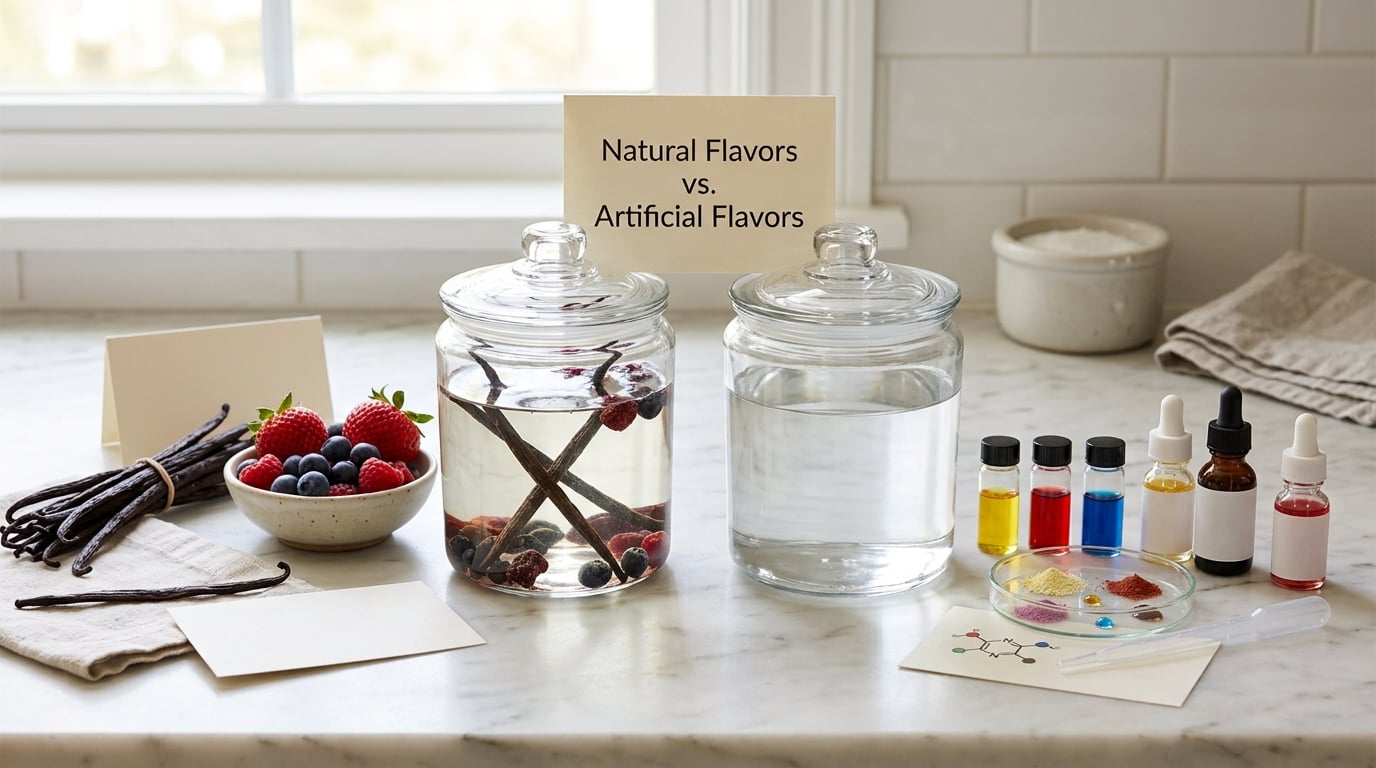
The distinction is not natural versus chemical. Both sides are chemicals. The line is where the starting material came from: a plant or an animal, or a petrochemical starting point in a lab.
| What the label says | What it means under FDA rules | What it does not tell you |
|---|---|---|
| Natural flavor / natural flavoring | Flavoring from an approved natural source, added mainly for taste | The specific source, the number of substances, how it was processed, or anything nutritional |
| Artificial flavor | Flavoring whose flavor simulates a food source, where none of the flavoring used is natural flavor derived from that same food | That it is chemically different in a way that matters to you |
| Made with natural flavors | A front-of-package claim that at least part of the flavoring is natural, while the rest may not be | That the product contains no artificial flavoring at all |
| No artificial flavors | No artificial flavoring was added, per the manufacturer’s declaration | That the product is minimally processed, whole-food based or healthy |
No artificial flavors and made with natural flavors are different claims
These two front-of-package phrases come up constantly and they are not interchangeable. No artificial flavors is a promise about what was left out. Made with natural flavors describes only a portion of the package and leaves the rest open. A product can carry the second phrase and still contain artificial flavoring alongside the natural part.
A food can also be both naturally and artificially flavored at once, which surprises people. Two different flavor systems in the same product, one from a natural source and one from a lab, is perfectly legal. I see this most on savory items where a yeast extract or protein hydrolysate supplies the savory base and a natural flavor rounds out the top note.
What Natural Flavors Do Not Tell You
Here is the part that turns people off, and I think their frustration is fair. The Environmental Working Group has reported that a single natural flavor mixture can contain more than 100 chemicals, with solvents, emulsifiers, flavor enhancers and preservatives making up somewhere around 80 to 90 percent of the total weight. A 2017 report also found natural flavors to be the fourth most commonly listed ingredient on U.S. food labels.
That is not a scandal, it is just what a concentrate has to be. A flavor has to stay stable, mix evenly into a liquid or a batter, survive heat and hold its shelf life. Carriers such as water, sugar or alcohol do the moving, and the processing aids do the holding. The headline flavor compounds can be a small share of what is in the drum.
It is also true that a natural flavor mixture can contain substances made in a laboratory. Whether that makes it a problem depends entirely on the substance and the amount, not on the word natural sitting in front of it.
Why the label does not name the specific flavor
Two mechanics explain the vagueness. First, flavor blends are proprietary. A flavor house treats the exact recipe as a trade secret, the same way a cereal company keeps its grain ratios private. Second, labeling rules allow a flavoring that is used purely for flavor to be listed by a general term rather than by every component. Manufacturers rely on that allowance, and they lean on it hard.
So when a label says natural flavors instead of natural vanilla flavor, the short version is that the manufacturer chose the broader term. The specificity, when you see it, is a choice the company made about its own marketing.
What stops a common spice from being called a natural flavor
Good question, and one nobody in my reading answered well. Cinnamon bark in a spice jar is an ingredient, full stop. Take that same cinnamon, extract or distill it into a concentrate that carries flavor with none of the fiber, and now it is a natural flavoring substance eligible for listing under the general term. The spice is the starting material. The extract is the flavor.
That is also why someone in an r/explainlikeimfive thread could ask whether a pig’s butthole would count. It is a crude way of pointing at a real feature of the regulation: the animal-derived sources are on the list, and the rule asks about origin, not about which part of the animal. This kind of example is exactly why a 2016 FDA proposal would have tightened the definition and never finalized. The broad phrasing survived, and shoppers are still puzzling over it.
How to Read the Ingredient List
Four steps, in order, and none of them require any special knowledge.
- Read the list from the top and find whole foods. Ingredients are listed by weight, so the first few tell you what the product mostly is. A blend of oats, cocoa and dried fruit up top means something different from a blend of sugar and natural flavors up top.
- Locate every flavor term. Look for natural flavors, natural flavoring, artificial flavor, spices, and the specific version such as natural vanilla flavor or natural strawberry flavor. Note whether the label names the source or hides it.
- Check the nutrition facts panel. The ingredient list tells you what went in; the panel tells you what stayed. Sugar, sodium and calories are where a flavored product usually gives itself away.
- Look for certification marks rather than front-of-package adjectives. A USDA Organic seal or a Non-GMO Project Verified mark is a third-party determination. Natural, clean, simple and wholesome are marketing copy with no defined standard attached.
If you follow a diet or avoid an allergen
A natural flavor blend can carry dairy, egg, soy, wheat or peanut components, and most labels will not tell you. That matters if you have an allergy rather than a preference, and it is a real safety question.
Your options, roughly in order of effort: call the manufacturer’s consumer line with the lot number from the package in hand and ask whether the flavor system contains your allergen; look for a brand that publishes allergen statements or certifies the product gluten-free, vegan or low-FODMAP; or skip the product and pick one where the flavor comes from a named ingredient you can see. Celery root powder, vanilla extract, cocoa and fruit concentrates are ingredients on a label. A generic natural flavors blend is not.
For anything celiac, a doctor or registered dietitian is the right call before you rely on a label reading. Nobody should be diagnosing a reaction from a word on a package.
How to ask a manufacturer what is in the blend
Be specific and you usually get a useful answer. Give the product name, the flavor and the lot or UPC number, then ask whether the natural flavoring contains milk, egg, soy, wheat, tree nut or peanut components, and whether the flavor system is gluten-free. Some companies publish allergen statements on their site or will email a specification sheet for a specific product. If the flavor is part of a seasoning blend, asking which components are flavoring agents gets you further than asking what is in the natural flavor.
Are Natural Flavors Safe?
Generally yes, at the levels used in food. Flavoring substances go through the FDA’s GRAS process, generally recognized as safe, and the Flavor Extract Manufacturers Association evaluates thousands of them for safety before they reach a product. Substances that are not GRAS must be listed as food additives, with 21 CFR 172.510 holding the natural flavor extracts that qualify for that status.
Safe and healthy are two different questions, and the label only addresses the first. A natural flavor adds no meaningful nutrition, and in one study participants estimated that products labeled natural contained 18 percent fewer calories when the calorie content was identical. That gap is a labeling effect, not a property of the food.
The reason people avoid them anyway is a fair response to the vagueness rather than to a known hazard. When a term is on 20 out of 30 packages I checked and its contents are undisclosed, people reasonably assume there is something to hide. There is a history that reinforces the feeling: castoreum, a secretion once used in perfume, was for decades listed as a natural flavoring ingredient, and it took a law and a rule change to get it off some labels. Regulation in this area moves slowly, and the public is skeptical for good reason.
None of this makes a label-reading approach a substitute for personal medical advice. If you have a diagnosed allergy, an intolerance or any condition where food ingredients matter to you, talk to your doctor or a registered dietitian about the specific product rather than the word natural.
Frequently Asked Questions
Are natural flavors healthier than artificial flavors?
There is no health difference established between them. Both are regulated flavoring substances, and neither adds nutrition. Studies have shown people estimate a natural-labeled product as lower in calories when the calories are identical. Choose based on the whole nutrition facts panel, not the word natural on the front of the box.
Is natural flavor the same as organic or raw?
No. Natural describes the source of a flavoring ingredient. Organic is a USDA certification covering how a crop or livestock product was grown or raised and how the whole product was handled, under 7 CFR Part 205. A natural flavor can appear in a product with no organic certification at all, and a certified organic product still lists natural flavors on its panel.
Are natural flavors gluten-free?
Often, but not always and not provably from the label. A natural flavor can be carried on wheat-derived carriers or hydrolyzed from grain protein, and a generic natural flavors listing does not have to disclose that. If gluten matters to you, look for a certified gluten-free mark or contact the manufacturer with the lot number before relying on the package.
Do natural flavors expire or need special storage?
The flavor compound is not what spoils first in most packaged food. Oils and carriers can go rancid, and moisture plus heat can degrade a blend, but the product’s own best-by date and storage instructions govern. Follow the package. If a food tastes off before the date, the likely cause is the fat in it, not the natural flavoring.
Conclusion
Natural flavors tells you the flavoring started in a plant or an animal, and nothing else. Not how it was processed, not how many substances are in it, not whether it is good for you, and not whether it contains an allergen you care about.
So start with the ingredient list, not the front of the package. Read the first five ingredients, find the flavor terms, check the nutrition facts panel, and treat every unverified adjective as marketing. If a specific allergen or diet is the reason you are reading the label, call the manufacturer with the lot number in hand. That one step resolves more real questions than any amount of label sleuthing.