
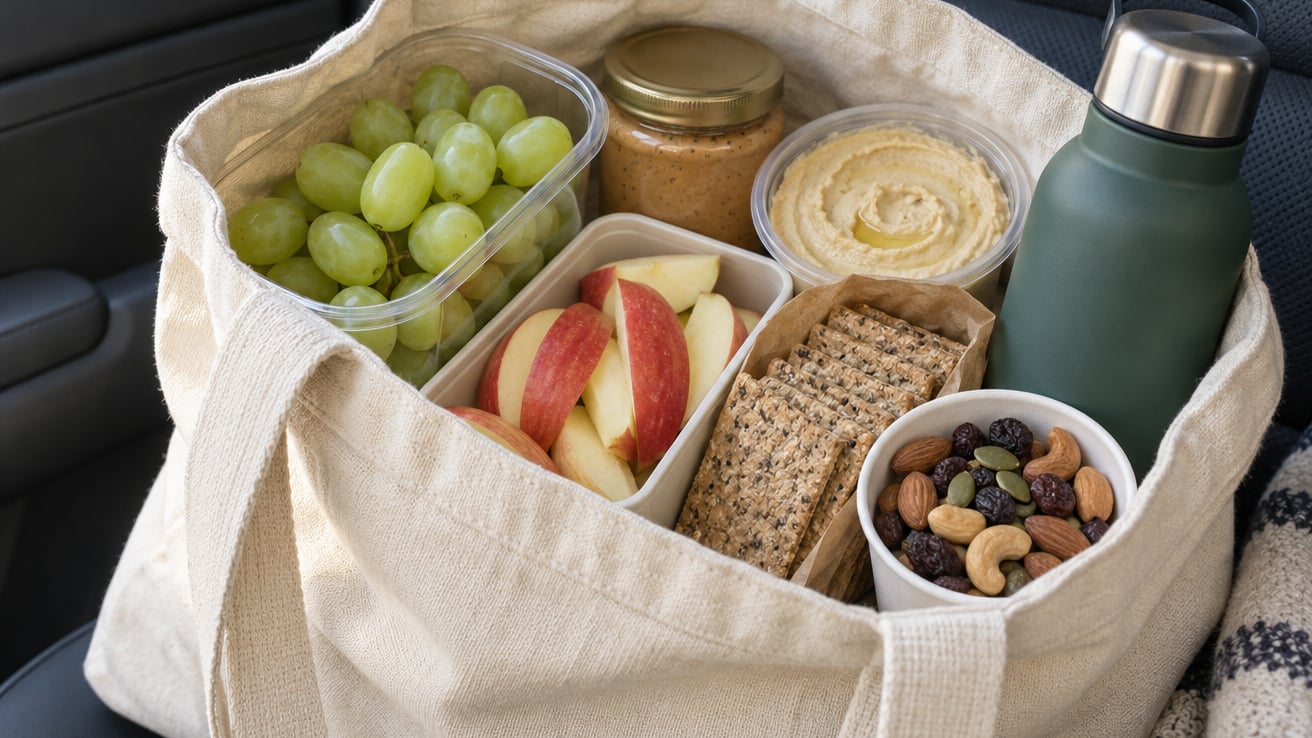
Healthy road trip snacks for kids and adults have to do five things at once: survive hours without a fridge, need no fork or bowl, leave no crumbs, and hold attention longer than a candy bar. Pack the same snack for everyone in the car and you will still be negotiating at the first rest stop.
The list below covers foods that travel well, why each one earns its spot, and how to pack it so a four-year-old and the adult driving can eat the same thing without anyone complaining. Where something melts, browns, or becomes a choking risk, I say so up front.
One rule covers most of the work: if a snack needs refrigeration, a bowl, or a wet wipe before you hand it over, it is not a road trip snack. That rule alone removes a surprising number of ideas from the cooler drawer and puts them on the counter, where they belong.
Table of Contents
- Healthy Road Trip Snacks for Kids and Adults at a Glance
- 1. Fresh Grapes
- 2. Apple Slices with Nut Butter
- 3. Baby Carrots with Hummus
- 4. String Cheese
- 5. Whole-Grain Crackers and Cheese
- 6. Trail Mix with a Twist
- 7. Homemade Energy Bites
- 8. Popcorn
- 9. Bananas
- 10. Rice Cakes with Avocado Mash
- 11. Unsweetened Dried Fruit
- 12. Hard-Boiled Eggs
- 13. Whole-Grain Granola Bars
- 14. Cereal Clusters or Trail Mix Bites
- 15. Frozen Yogurt or Fruit Pops
- How to Pack and Store Road Trip Snacks So Nothing Melts or Spoils
- Frequently Asked Questions
- What are the healthiest snacks to eat on a road trip?
- What are some healthy snacks for a toddler on a long car ride?
- How do I keep snacks from going bad without a cooler?
- What are good no-mess snacks that do not need a fork?
- How many snacks should I pack per person for a long drive?
- What can I make ahead of time for a three-day road trip?
- Conclusion
Healthy Road Trip Snacks for Kids and Adults at a Glance
Every snack below holds up without refrigeration, eats one-handed, and works for more than one age group. The two columns that matter most on a real drive are the last one, where mess and allergy issues get flagged.
| Snack | Best for | Why it travels well | Watch out for |
|---|---|---|---|
| Seedless grapes | All ages over 3 | Firm, no prep, resealable bags | Quarter them for young children; choking hazard whole |
| Apple slices with nut butter | Kids and adults | Dip travels separately, dip prevents mess | Needs a citrus soak or the slices go brown |
| Baby carrots with hummus | Picky eaters, adults | Crunchy, shelf-stable, no cooking | Hummus must be in a sealed cup, not a tub |
| String cheese | School-age kids and adults | Pull-apart, no knife, high protein | Softens in heat, keep in the cooler |
| Whole-grain crackers and cheese | Everyone | Crumbs aside, nothing melts or leaks | Choose crackers with at least 3 g fiber per serving |
| Trail mix | Adults, school-age kids | Shelf-stable, endlessly portionable | Nut-free versions exist; check labels per brand |
| Homemade energy bites | Families, active drivers | Freeze them and pack the night before | Keep chilled in a cooler for dairy-free versions with yogurt |
| Popcorn | Everyone | Light, cheap, eats quietly | Use paper cups or bags, not a bowl |
| Bananas | Kids, commuters | Whole fruit, zero packaging, no utensils | Choose ripeness for the day; they bruise |
| Rice cakes with avocado | Adults, older kids | Savory, quick, keeps energy flat | Make on the stop, never the night before |
| Unsweetened dried fruit | Everyone | Lightweight, no refrigeration, sweet | Sticky, so portion into small cups |
| Hard-boiled eggs | Adults, older kids | Protein that does not need a cooler bag for a few hours | Refrigerate until departure; peel over the bag |
| Whole-grain granola bars | Teens, adults, older kids | Self-contained, fits a pocket, no crumbs if dense | Flaky bars crumble all over the seat |
| Cereal clusters | Families with young kids | Sweet, portionable, freeze well | Watch added sugar in the cereal itself |
| Frozen yogurt or fruit pops | Summer road trips | Act as their own cold pack, cool the car down | Insulate from first mile or they leak |
1. Fresh Grapes
Seedless grapes are the single most reliable road trip snack I know of. They are firm, they need no cutting for older kids and adults, and they come in their own protective skin. A cup per person covers a two-hour drive comfortably.
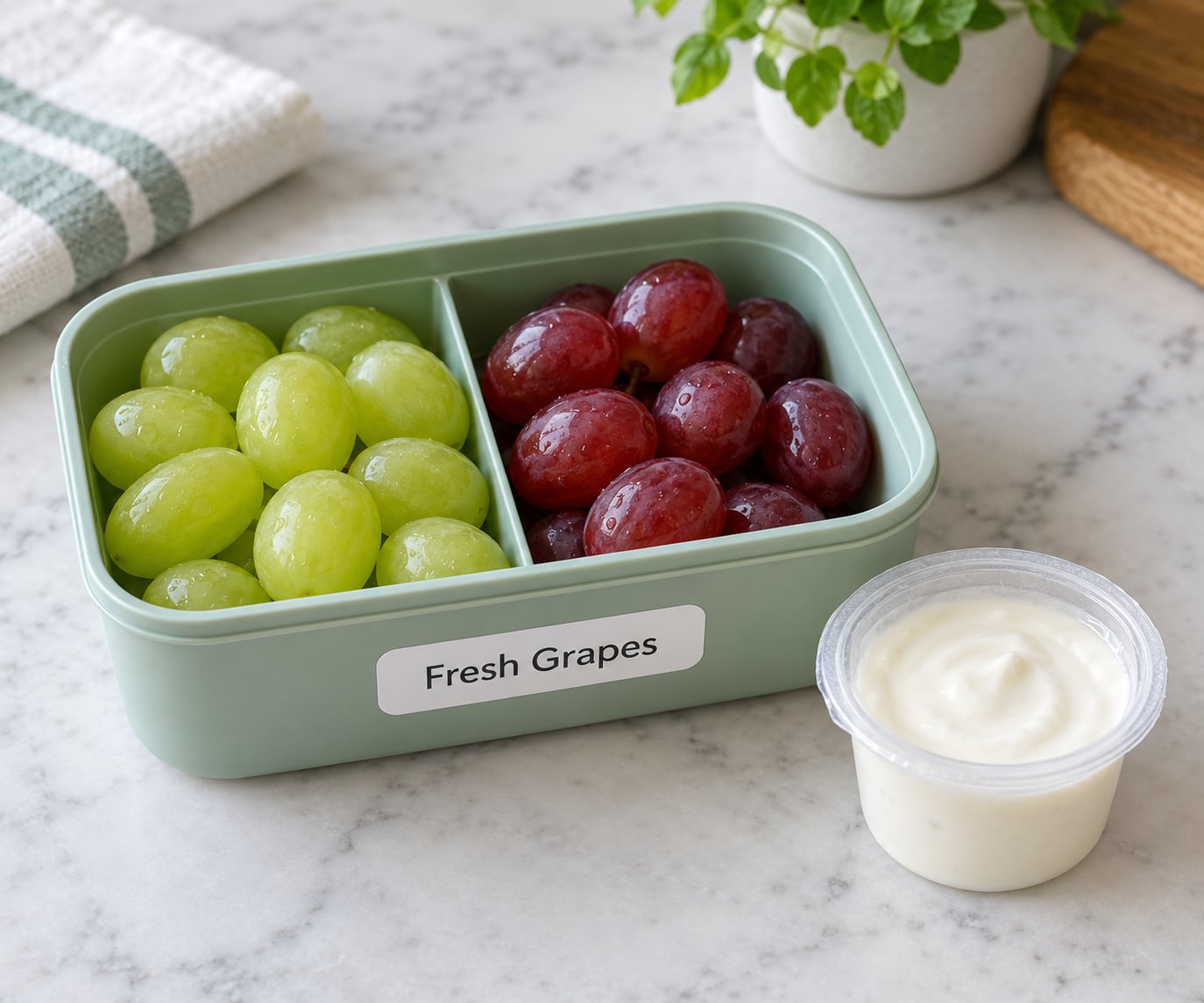
Wash them the night before, dry them thoroughly, and pack them in the fridge overnight. Wet grapes in a closed bag turn into a grape soup by mile forty.
Here is the part parents miss: whole grapes are a leading choking hazard for children under four. Cut them lengthwise into quarters for a toddler or preschooler, and let the older kids and adults eat them whole. That single habit takes the most common worry off the list.
2. Apple Slices with Nut Butter
Apple slices are the best answer to the hangry problem, because you get crunch, sweetness, and something that stays satisfying for more than twenty minutes. Pair them with nut butter and the plate is closer to a real snack than a cookie.
The dip has to travel separately. A tablespoon of peanut butter in a small screw-top container, packed upright in a bag, is the whole system. For anyone avoiding nuts, sunflower seed butter does the same job and travels to school without the nut question attached.
To stop browning, toss the slices in a squeeze of lemon water for ten minutes, drain them, and dry with a paper towel. A wide-mouth jar does the same job if you prefer no lemon taste. Sliced apples are the one item on this list that genuinely needs a plan the night before.
3. Baby Carrots with Hummus
Baby carrots and hummus are a fiber-rich pairing that needs no cooking and no refrigeration, which makes them the default for any trip where the cooler is optional. Plain hummus from the deli section travels fine. Flavored versions with roasted peppers travel better still because the flavor hides the plainness of the carrots.
Pack the hummus in a 2 ounce cup with a snap lid and put it in a zip bag, upright, next to the carrots. A full hummus tub is a spill waiting to happen on the first sharp turn, and a spill in a moving car is worse than a spill anywhere else.
Adults get a bigger portion and some crunch of their own: add snap peas or pepper strips to their cup. The version for a toddler is the same dish, with the carrot coins cut in half.
4. String Cheese
String cheese does three things rare snacks manage: it is protein-forward, it needs no preparation, and kids can pull it apart one-handed while watching out the window. An adult gets the same satisfaction from a stick and a half, which is closer to a real portion than most snack options.
Pack it in a small insulated pouch if you are driving in summer. String cheese softens in a parked car quickly, and soft cheese on a seat is a stain and a smell that lasts the whole trip.
For a toddler, shred it rather than handing over the whole stick, and skip it for children who still choke on other soft foods. Adults watching a blood sugar curve should add something with fiber, like a handful of crackers, to pair with it.
5. Whole-Grain Crackers and Cheese
Crackers and cheese is the most balanced combination on this list, and it works because both halves fix the other’s weakness. Cheese brings protein and fat, crackers bring crunch and carbs, and together they take about an hour to break down instead of twenty minutes.
Read the cracker label and look for whole grain as the first ingredient and at least 3 grams of fiber per serving. Anything labeled multigrain where multigrain is a glaze rather than the first ingredient is mostly flour. Skip crackers that dissolve, because the ones that fall apart in your hand will end up on the floor of the car, not in it.
For sodium, a slice or two of a lower-sodium natural cheese, or a small portion of a sharper cheese cut into sticks, beats a thick slab wrapped in a slice. Portion six crackers and one ounce of cheese per person and pack it in two small containers so nobody is eating an open sleeve over the armrest.
6. Trail Mix with a Twist
The homemade version beats the bagged version for one practical reason: you control the salt, you control the candy, and you can build a nut-free batch in the same bowl. Start with a base of four parts, then add a protein part, a sweet part, and a crunch part. A good ratio is two parts toasted cereal or pretzels, one part nuts or seeds, one part dried fruit, and one part something extra crunchy.
Worth adding: pumpkin seeds, which are nut-free and full of zinc and magnesium, and walnuts for omega-3s. For an adult road trip, a small mix of walnuts, dried mango, and dark chocolate chips with a low added sugar count is genuinely satisfying, not just a kid treat.
Allergy versions work the same way with seed swaps: sunflower or pumpkin seeds instead of nuts, dried cranberries or unsweetened coconut chips instead of peanuts. The catch is cross-contact, so read the label every time rather than assuming the seed version is safe.
Portion into 1/2 cup cups, not a communal bag. Parents on forums who pack mix in one big container report it disappears in twenty minutes; the cup version makes the second snack last until hour three.
7. Homemade Energy Bites
Energy bites are the most make-ahead option on this list and the one that most rewards a quiet night before the drive. The basic formula is one cup rolled oats, half a cup nut butter, a third cup dried fruit, two tablespoons honey or maple syrup, and a tablespoon of chia seeds, mixed and chilled for an hour, then rolled into balls about the size of a walnut.
They survive a car well because they are dense, they do not melt, and they are already portioned. One bite is the serving, which removes the guessing that comes with bars and cookies.
For a trip longer than one day, freeze the batch on a lined tray until solid and move it to a freezer bag. They come out still firm after three days of cooler thawing, and they thaw in your hand in about a minute.
Adults will like these with a swap toward less sweetness, and they travel well enough to double as the lunch protein. If you need a nut-free version, use sunflower seed butter and confirm your oats are processed in a nut-free facility if it matters for your family.
8. Popcorn
Popcorn is the cheapest snack on this list by weight and the one most people never think to pack. A large bag of plain popcorn costs about the same as two gas station snacks and feeds four people for two hours, which quietly changes what a road trip snack budget looks like.
Keep it light. Air-popped or kettle-popped with a small amount of olive oil holds up; anything coated in melted butter or a thick caramel coating turns the seat upholstery into a problem. A light dusting of nutritional yeast or smoked salt gives it flavor without adding sugar.
Portion it into paper cups or folded paper bags before you leave. A bowl of popcorn in a car is a wind tunnel. Bring a small trash bag for the cups, because a paper bag that has held popcorn for four hours deserves a dedicated home.
9. Bananas
Bananas are the most portable carbohydrate on this list, and their main advantage is that the packaging is edible and the peel doubles as a bag. For a kid who is hungry and restless, a banana is a snack that requires no negotiation.
Timing is the whole game. Choose them green for a trip that starts today, yellow-green for tomorrow, and yellow with a few spots for the second day of a longer drive. Overripe bananas are still safe and still good in smoothies, but they do not survive a seat belt.
If you need to slice them the night before, toss the slices in a little lemon water and store them airtight, knowing they soften overnight. Whole bananas need none of that.
One piece of honest advice from the parenting forums: some families simply skip bananas because of the squish factor. If that is your crew, apples or clementines are the substitute, and nothing else on this list is easier.
10. Rice Cakes with Avocado Mash
Rice cakes with avocado is the savory option that keeps energy flat through a long afternoon, which makes it the adult answer to a sugar-crash-heavy snack run. The protein and fat in the avocado slow the carbs in the rice cake, and a savory combination also stays palatable after the third hour when sweets start to feel like too much.
Mash one avocado with a squeeze of lemon and a pinch of salt, spread it on a plain rice cake, and eat it right away. The lemon is not optional if you are packing it for later; it slows the browning that turns the surface grey and unappealing within twenty minutes.
To make it a real meal rather than a snack, add a chopped boiled egg, a few strips of smoked salmon, or a tomato slice. Just make it on the stop, not the night before, and eat it off a folded napkin or a small compostable plate rather than a plate that needs a sink.
11. Unsweetened Dried Fruit
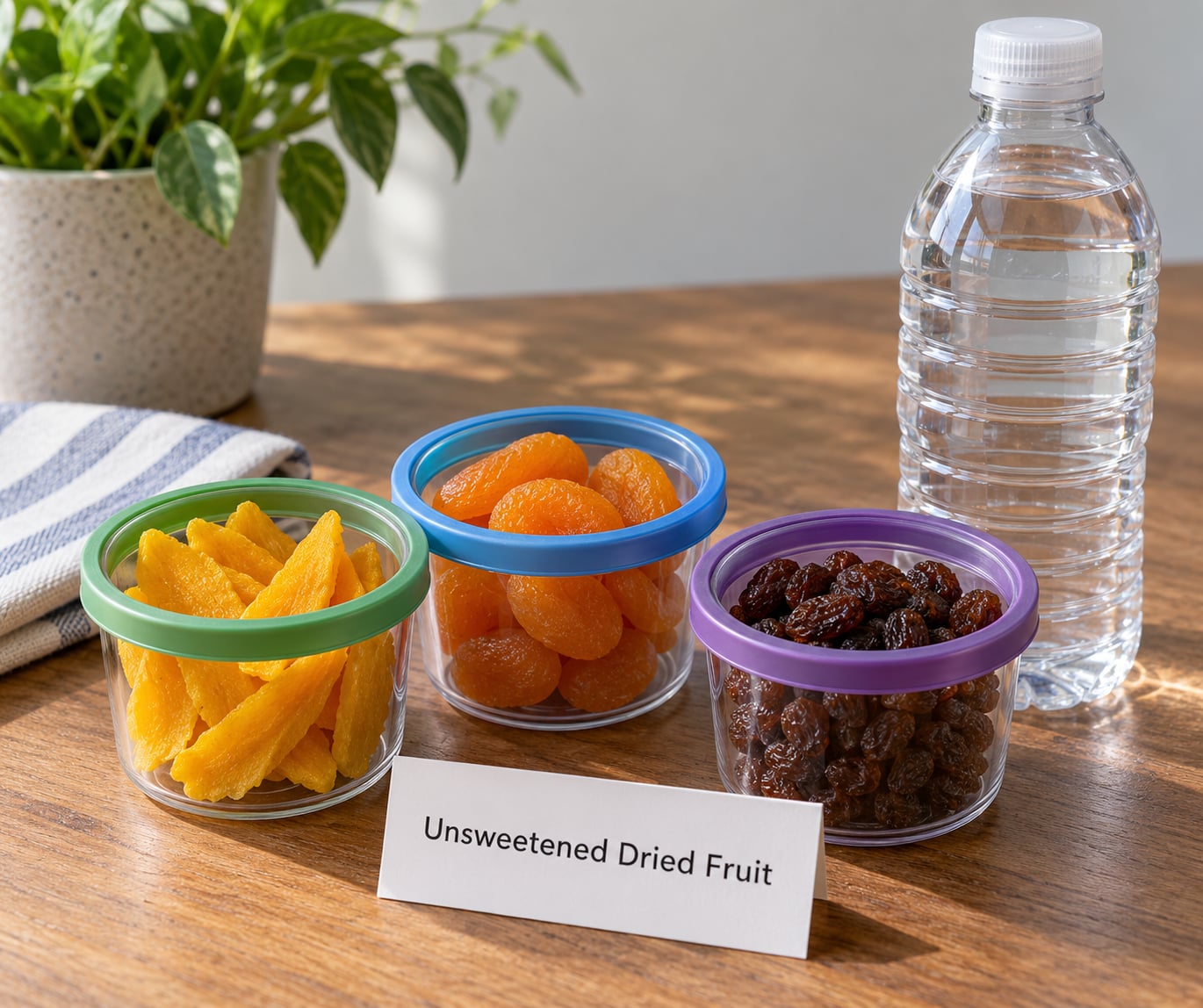
Unsweetened dried fruit gives you concentrated sweetness in a form that fits in a pocket and never needs a cooler. Mango, apricots, and unsweetened raisins are the three that travel best, and they are the base of most trail mixes as well.
When comparing packages, look at the ingredient list rather than the front of the bag. If the only thing listed is fruit, you are fine. If sugar appears in the first three ingredients, you are looking at candy, and the word natural on the front will not change that. Some are also oil-treated, so check for that if anyone in the car is avoiding added oils.
Portion five or six pieces per person into small reusable cups or a tiny zip bag. Dried fruit is easy to overeat because the pieces are small and sweet, and sticky hands are the one mess this list produces. Freeze-dried fruit is the answer to kids who consider raisins a punishment, and it needs no refrigeration.
12. Hard-Boiled Eggs
Hard-boiled eggs are the highest-protein item on this list and one of the few that feels substantial in a way a cracker never does. Six eggs feed two adults and two hungry kids through a morning of driving.
Boil them for ten minutes, then move them straight to ice water so they stop cooking and the yolks stay creamy. Refrigerated in their shells they keep for about a week, so they are easy to make a day or two ahead. Pack them whole and let everyone peel their own, which turns the shells into a small activity instead of a problem.
Food safety note, since a car is a warm place: eggs are perishable. Keep them in a cooler with ice packs at 40 degrees Fahrenheit or below, and follow the two-hour rule below if the cooler is in doubt. Parents describe eggs as messy but grab-and-go, and in practice peeling them over a zip bag makes the mess a non-event.
13. Whole-Grain Granola Bars
A granola bar is a good road trip snack for one reason: it needs nothing, no plate, no napkin, no cooler. It is also the easiest item in the snack aisle to get wrong, so comparing labels matters more than the brand name on the wrapper.
Look for whole grain oats as the first ingredient, at least 3 grams of protein per bar, and under about 8 grams of added sugar. If the bar crumbles when you open it, it will crumble all over the seat, so pick a dense pressed bar over a soft baked one. Our guide to how to tell if a granola bar is actually healthy walks through the label line by line.
For a family, mixed boxes are the answer: nut-free bars for the school-age kid, fruit-forward bars for the picky eater, and a higher-protein bar for the adult driving. Bring one extra bar per person than you think you need, because a dropped bar in a cup holder is gone.
14. Cereal Clusters or Trail Mix Bites
Cereal clusters are the sweet option for families who find granola bars too dense and fruit too boring. Melt a quarter cup of honey with a tablespoon of butter, stir in four cups of whole grain cereal, press it into a muffin tin or a small pan, and let it set. Thirty minutes in the fridge is enough, and it slices into a dozen pieces.
The choice of cereal is where the health lives or dies. Pick a whole grain oat or barley cereal with no more than about 6 grams of added sugar per serving, and check for nuts if anyone in the car reacts to them. Cheerios-style plain oat cereals blend well; anything coated in frosting turns the clusters into a candy.
These are excellent frozen. Lay the finished clusters on a tray, freeze until firm, and store them in a freezer bag. They thaw in about fifteen minutes at car temperature and stay crunchy, which makes them a better three-day trip snack than most things in this list.
15. Frozen Yogurt or Fruit Pops
Frozen treats solve a specific problem: a July road trip where nobody wants food. They also do something practical, since they act as their own cold pack. Pop a couple into the insulated cooler bag and the whole bag stays colder for longer.
Freeze yogurt cups or small silicone molds the night before, at least six hours of solid freezing. Pack them in an insulated bag with a frozen gel pack from the first mile, not the first rest stop, and serve them in a bowl over a napkin if you want to avoid a sticky shirt. Popsicles made from blended fruit and water or coconut milk tend to be more sugar-aware than the ice cream style.
On longer drives, pop one in for the adults on turn-taking duties. For the kids, read the yogurt label before the trip rather than at the gas station, and our store guide to how to pick a healthy yogurt at the store covers what to look for in plain terms.
How to Pack and Store Road Trip Snacks So Nothing Melts or Spoils
The rule that matters most is the two-hour rule. Perishable food, which includes dairy, eggs, cut fruit, and anything with meat, should be eaten or refrigerated within two hours, or within one hour if the temperature is above 90 degrees Fahrenheit. A parked car reaches that range quickly on a summer day, which is why the cooler goes in the shade, not the trunk in the sun.
Keep a cooler at 40 degrees Fahrenheit or below, pack it full, and use ice packs rather than loose ice, which melts into everything else. Put hard items in first, since they tolerate temperature swings better than soft ones. Anything shelf-stable, which is most of this list, goes into the passenger area, not the cooler, so it is within reach and does not take up cold space.
As a packing rule of thumb, plan one snack per person per hour of driving, plus one extra for the second half of the trip when everyone is hungry and out of ideas. Water is not a snack but it is the thing most car runs out of, and thirst reads as hunger to most children.
Skip the smoothie for the car, no matter how much the kids like them. If you want to give them one before you leave, our ideas for smoothies kids actually drink are worth making at home, where the fiber stays in and the cup does not end up in a seat well. Bring a bag of dry extras for the adults, who are the ones who will need it at hour six.
Frequently Asked Questions
What are the healthiest snacks to eat on a road trip?
The healthiest pick is whichever one combines protein, healthy fat, or fiber and holds up unrefrigerated for the whole drive. Nuts, seeds, nut butter with fruit, plain yogurt kept cold, hard-boiled eggs, whole fruit, and whole-grain crackers all fit that description. Candy and crackers made mainly of refined flour do not, whatever the package claims.
What are some healthy snacks for a toddler on a long car ride?
For toddlers, choose soft foods with a low choking risk, cut to the right size. Sliced banana, quartered seedless grapes, soft cooked or canned vegetables, yogurt on a spoon rather than in a pouch for a seated child, and homemade cheerios all work. Never hand over whole nuts, whole grapes, or raw carrot sticks, and keep an adult watching while the car is moving.
How do I keep snacks from going bad without a cooler?
Choose foods that are shelf-stable by nature, such as nuts, seeds, dried fruit, whole fruit with skin, crackers, granola bars, popcorn, and unopened packaged items. For anything perishable, including dairy, eggs, and cut fruit, use an insulated cooler holding ice packs at 40 degrees Fahrenheit or below, keep it out of direct sun, and follow the two-hour rule above.
What are good no-mess snacks that do not need a fork?
Skip anything that needs a bowl, fork, or wet wipe. Good choices include seedless grapes cut lengthwise, whole bananas, string cheese, snack cups of trail mix, dry cereal, plain yogurt eaten from a sealed cup, pretzels, whole-grain crackers, and freeze-dried fruit. Portion sticky items such as dried fruit and nut butter into small sealed containers so residue stays inside them.
How many snacks should I pack per person for a long drive?
A practical rule of thumb is one snack per person per hour of driving, plus one extra, and it scales with the kids you have. For a six-hour drive with two adults and two children, that means about eighteen snacks in total. Pack half in the cabin for easy reach and half in the cooler, and bring more water than you think the trip requires.
What can I make ahead of time for a three-day road trip?
Energy bites, trail mix, cereal clusters, and roasted chickpeas are the make-ahead staples, and all four freeze well. Make the bites and clusters a week ahead, freeze them on a tray until solid, then move them to freezer bags. They thaw in a car within about a minute and keep for the length of a multi-day trip inside a cooler.
Conclusion
Start with four things and build around them: one fruit, one crunchy whole-grain item, one protein, and one thing that is purely a treat. Load those into two containers, one in the cabin and one in the cooler, and the rest of the trip takes care of itself.
Pick snacks that the whole car can share, and the packing job gets much easier.