
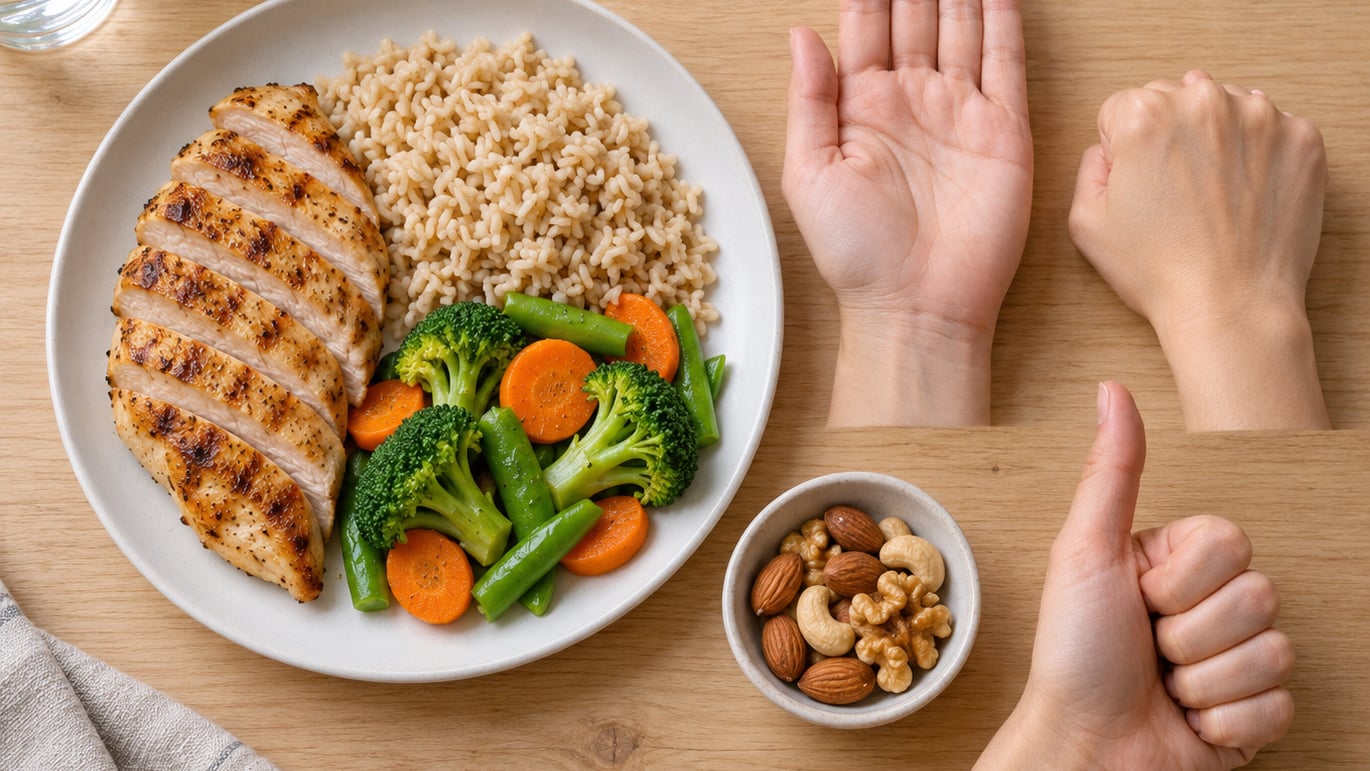
You can control portion sizes without measuring by using your hands, your plate and a few familiar objects as size references. A fist is roughly a cup, a palm is about three ounces of protein, and a thumb is about a tablespoon of fat. Nothing needs to be weighed, and no special equipment has to be bought.
The catch is that eyeballing drifts. Start smaller than usual, eat slowly, notice when you feel satisfied, and adjust from there. Most people get better at estimating within a couple of weeks of paying attention.
Table of Contents
- How to Control Portion Sizes Without Measuring: What You Need
- How to Control Portion Sizes Without Measuring: Step-by-Step
- Use Your Hands: How to Control Portion Sizes Without Measuring
- Divide Meals Into Visual Food Groups
- Control Portions of Calorie-Dense Extras
- Pause Before Eating and Tune the Portion to Your Hunger
- Use Containers and Packaging to Prevent Guesswork
- Make Portion Control Flexible Across Daily Foods
- Eating Out, Takeout and Buffets Without a Single Anchor
- Common Mistakes When Portioning Without Measuring
- Frequently Asked Questions
- Can hands really measure food portions?
- How do I control portions when there is extra food from dinner?
- How can I estimate portions at restaurants or while eating out?
- Is portion control the same as eating less food?
- How do I control portions of calorie-dense foods without weighing them?
- When should I ask a doctor or registered dietitian for help with portions?
- Conclusion
How to Control Portion Sizes Without Measuring: What You Need
No equipment. That is the whole point.
What you need is already in your kitchen and attached to your body: your hands, one familiar plate and bowl, the packaging food came in, and enough attention to notice hunger and fullness. The cues themselves are rough, so treat them as a starting point rather than a rule.
Serving size is a number, portion size is what is on your plate
A serving size is the amount a nutrition label or dietary guideline describes, such as one cup of rice or three ounces of chicken. A portion size is the amount you actually put on your plate, which may be two servings or half of one.
Hand and object anchors sit somewhere in between. They are estimates of a serving, not precise measures, and that is exactly why they work in real kitchens.
The cues you already have
| Cue | What it approximates | Use it for |
|---|---|---|
| Closed fist | About 1 cup | Rice, pasta, potatoes, oatmeal, cereal |
| Open palm, no fingers | About 3 to 4 oz protein | Chicken, fish, beef, tofu, beans |
| Cupped handful | About 1 oz or half a cup | Fruit, vegetables, nuts, cheese, granola |
| Thumb (whole) | About 1 tbsp fat | Oil, butter, peanut butter, avocado, cream cheese |
| Deck of cards | About 3 oz protein | Same as a palm, useful when eating out |
| Baseball | About 1 cup | Same as a fist, and visible across a room |
| Tennis ball | About half a cup | Berries, chopped vegetables, pasta |
| Pair of dice | About 1 tbsp | Nuts, cheese, dressings, spreads |
| Smartphone | About the size of a deck of cards | Steak, fish fillet, sliced cheese |
Hand sizes differ between people, so your anchors will not match a chart printed for someone else. That is not a flaw. The anchors only have to be consistent for you, and you are the only person eating off your hands.
How to Control Portion Sizes Without Measuring: Step-by-Step
Here is the sequence that works best: build the portion from visual cues, control the extras, eat with attention, and adjust based on how the meal actually went. Work through it once and it becomes automatic.
Use Your Hands: How to Control Portion Sizes Without Measuring
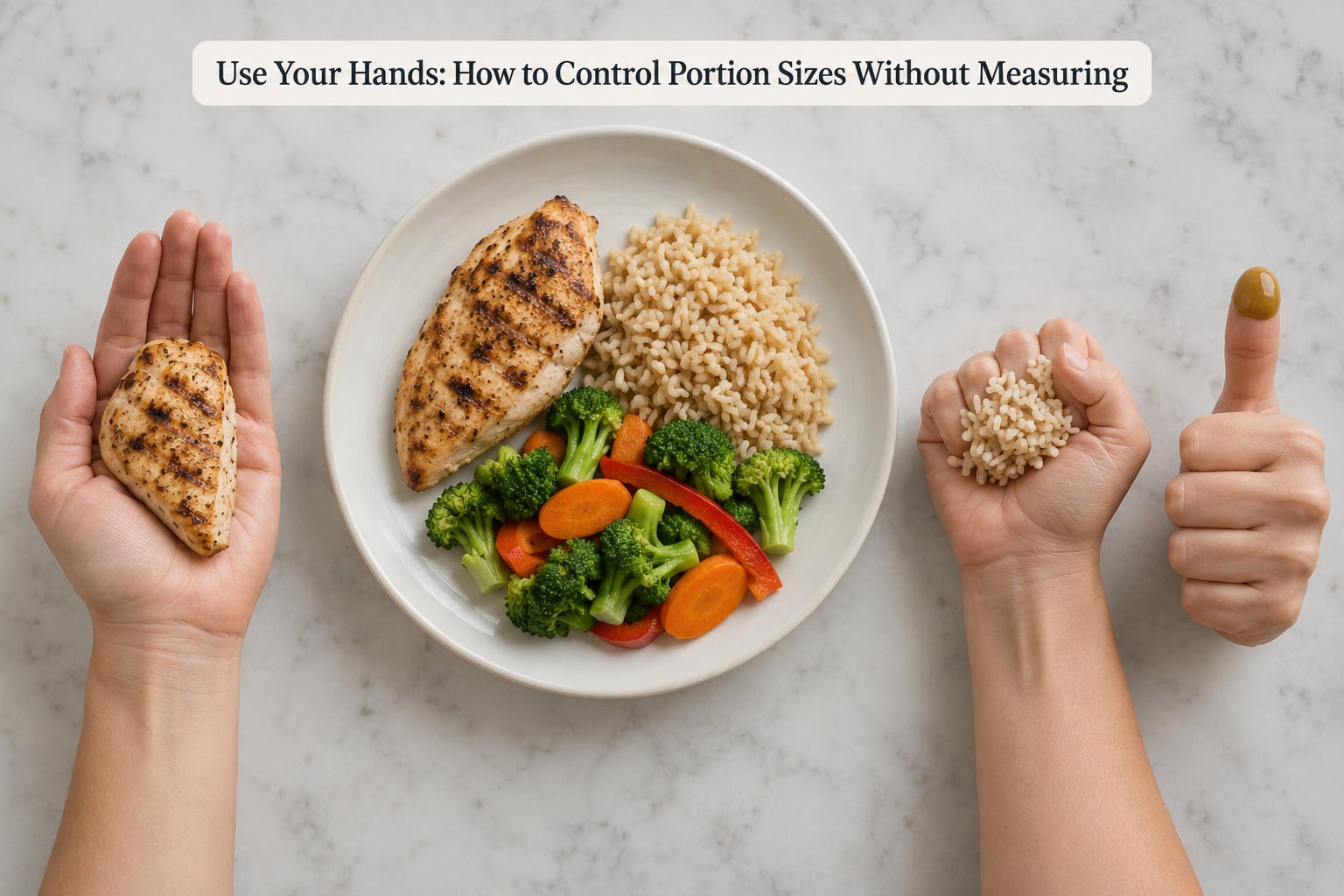
To estimate a portion without a scale, compare the food to one consistent part of your hand rather than to an image on a screen. Protein is the easiest anchor to learn because a palm-size piece of cooked meat looks the same every time.
For grains and starches, a fist of rice or pasta is roughly one cup. For vegetables and fruit, a cupped handful is about half a cup. For fats, a whole thumb is about a tablespoon, which is the difference between a drizzle and a pour.
To learn what four ounces of chicken looks like without measuring, cook one portion on a scale, weigh it, then hold a piece of that size in your palm. Do the same with rice in a mug, and with nut butter on a spoon. This takes ten minutes and saves you guessing forever.
Divide Meals Into Visual Food Groups
Divide your plate rather than counting items: fill part of it with vegetables or fruit, part with a protein food, and part with grains or another carbohydrate. On a standard dinner plate, half for non-starchy vegetables, a quarter for protein and a quarter for starch is a workable default, with fats added in thumb-sized amounts.
This works because it removes the weighing step entirely. You are looking at a plate and making three decisions instead of weighing four foods, and most meals fail at portioning because the decisions are too many.
Adjust the ratios rather than abandoning them. On a high-activity day or after a workout, move some space from vegetables to the carbohydrate quarter. Eating a lower-carbohydrate plate usually means taking a larger share of the vegetable section and keeping the protein steady.
Control Portions of Calorie-Dense Extras
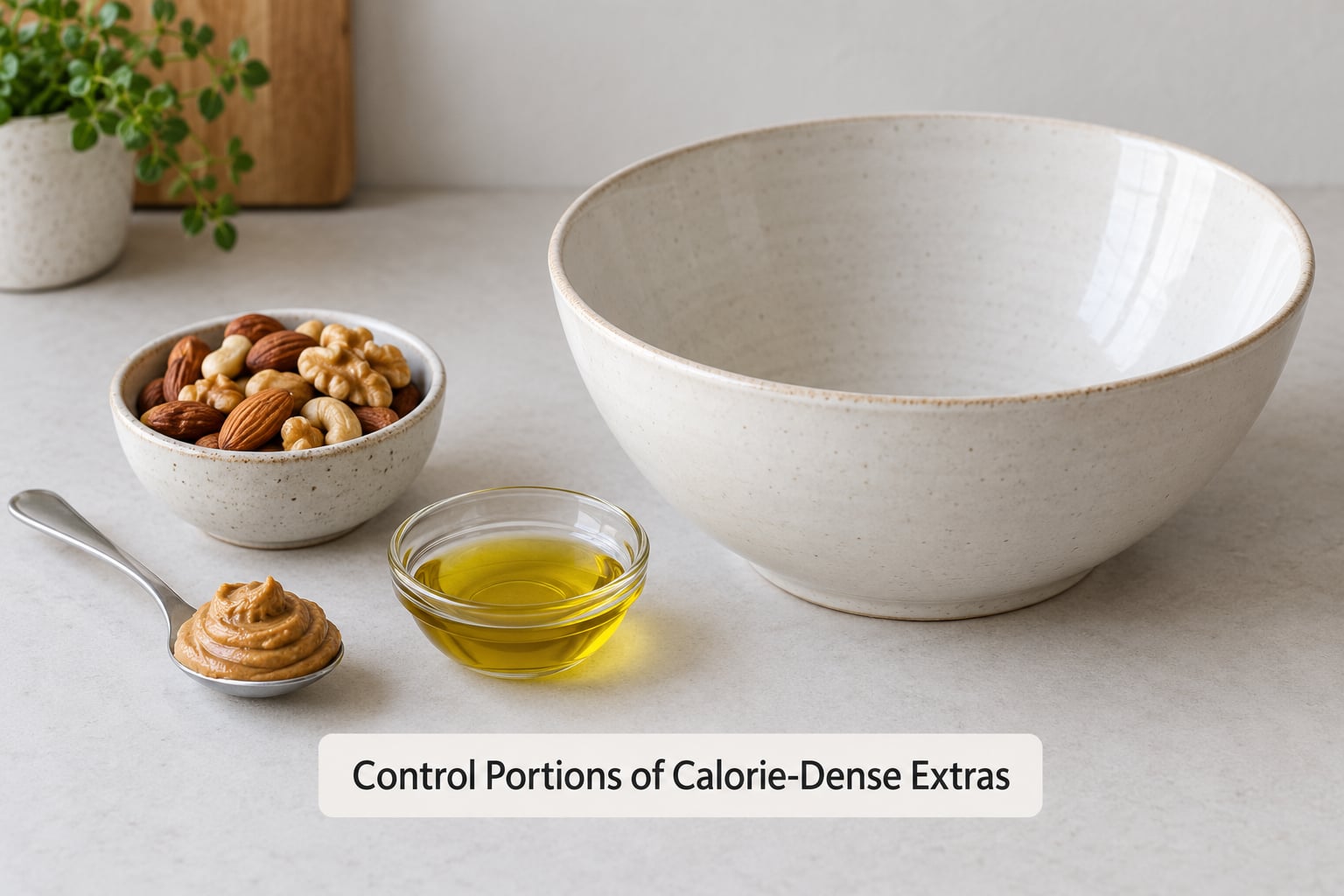
Nuts, oils, nut butters, cheese, dressings, dried fruit and granola are the foods most often overestimated by eyeball. People are usually accurate on meat and wildly optimistic about a pour of olive oil or a “small” handful of trail mix.
Keep the fix simple: put extras in a small bowl, and put that bowl away. A pinch that is a quarter teaspoon looks like a quarter teaspoon; a drizzle that is a tablespoon only looks like a tablespoon because it came out of a bottle with a narrow spout.
Use the thumb as your guide. One whole thumb of dressing or nut butter, one thumb of cheese, a dice-sized scoop of nuts, a dice-sized scoop of nut butter. Repeatable is the point, not precise.
Pause Before Eating and Tune the Portion to Your Hunger
Before starting, ask how hungry you actually are on a scale of one to ten, and check in with your stomach rather than your appetite. Most people serve themselves a ten when they are really a six.
Serve the smaller amount first. Eat the whole plate slowly, without a phone or television, then wait ten minutes before deciding whether to add more. Fullness signals arrive with a delay, and most of the time the portion you started with was enough.
Set your fork down between bites and take fewer, bigger bites instead of many small ones. People routinely finish a meal they would have found too large if they had been served the same portion on a smaller plate and eaten without distraction.
A glass of water before the meal helps some people, mostly because it takes a few minutes and gives the pause a job. It is not a rule, and it does not work for everyone.
Use Containers and Packaging to Prevent Guesswork
Use packaging information when it is there. The serving size printed on a yogurt tub, a cereal box or a bag of rice is a free, exact anchor that most people walk straight past.
Transfer what you plan to eat into a smaller bowl and put the rest away. Eating from the bag or the carton is where portion control quietly ends, because there is no portion boundary to reach.
For leftovers, divide the whole container into equal-looking parts and keep only the parts you will eat this sitting. A family dinner where nobody finishes the serving dish is a bigger problem than the size of the serving dish.
If you want to bring in meals that are naturally portion-controlled, adding fiber without bloating is easier when the vegetables are measured against a cupped handful you have decided on once, rather than an amount that drifts meal to meal.
Make Portion Control Flexible Across Daily Foods
Anchor the everyday foods once and stop thinking about them. Here is the table I keep in mind:
| Food | Anchor | About |
|---|---|---|
| Oatmeal, cooked | Closed fist | 1 cup |
| Cereal | Cupped handful | Half a cup to 1 cup |
| Rice or pasta | Closed fist | 1 cup |
| Potato | Fist, or one palm-sized piece | 1 cup or a medium potato |
| Chicken, fish, tofu | Open palm | 3 to 4 oz |
| Steak | Size of a smartphone | 3 to 4 oz |
| Beans | Cupped handful | Half a cup |
| Leafy greens | Two fists, loosely packed | 2 cups |
| Other vegetables | Cupped handful or tennis ball | Half a cup |
| Whole fruit | One piece, or a cupped handful of slices | 1 serving |
| Nuts | Pair of dice | 1 tbsp |
| Cheese | Pair of dice | 1 tbsp |
| Olive oil, butter | Whole thumb | 1 tbsp |
| Granola | Cupped handful | Half a cup |
These are guides, not rules. Cultural patterns matter, and a plate built around rice, tortillas or noodles is a perfectly good plate as long as you can see the protein and vegetables on it.
Families need a version that is not about discipline. Serve kids on a smaller plate so leftovers stay small, and if the food you want them to eat is vegetables, the volume problem usually disappears on its own. For ideas on making vegetables the easy part of a meal, see how to add greens to food without tasting them.
Eating Out, Takeout and Buffets Without a Single Anchor
At a restaurant you cannot use your hands, so use other cues. Half a plate is half a plate no matter how large the plate is, which is why the fish and vegetables often end up as the safest order.
- Ask for half. Most places will happily plate half a portion, and half the restaurant serving is usually a normal serving.
- Order one thing to share. Put the rest in a box before the meal starts rather than after it is finished.
- Choose the side you can see. A side salad or a vegetable is easier to portion than a bowl of pasta.
- At a buffet, go once. Use the plate method, pick a small plate first, and sit away from the tray line.
- Fries and chips. Order the small size, or take half back in the box. A restaurant fry portion is close to three fists.
- Pizza. One slice of a medium pie is about a palm-sized piece. Two is a decision, not an accident.
Travel brings its own version of the problem. You lose the scale, the familiar bowl and often the routine, and portion creep is the reason people stall after the second week away rather than the first.
Pick two anchors before you leave and use only those. Most travelers eat more from mindless snacking than from any single large meal.
Common Mistakes When Portioning Without Measuring
Most people who abandon measuring do not fail because estimation is impossible. They fail on the same five things.
1. Treating hand portions as exact. A palm is a rough anchor that runs within a wide range, and it drifts further the looser you are about it. Fix it by calibrating with a real scale for one to two weeks: cook a portion, weigh it once, hold it, and remember the feel. Then put the scale away and use the eye you trained.
2. Serving more on a larger plate. This is the single most common mistake and it has nothing to do with discipline. A bigger plate makes the same amount of food look smaller, and most people eat more when offered more. Fix it by moving to a smaller dinner plate and a smaller bowl for snacks.
3. Measuring only the vegetables. Portioning your salad and then pouring pasta, oil and dressing leaves the actual problem untouched. Fix it by applying anchors to every part of the plate, especially the oils, sauces, nuts and cheese, which are the easiest to overpour and the most calorie-dense.
4. Forgetting drinks, sauces and second servings. A glass of juice, a latte and a tablespoon of butter are all part of the meal. So is going back for more because the plate looked empty rather than because you were still hungry. Fix it by deciding the portion before cooking and closing the container.
5. Turning portion control into restriction. Fixed rules, guilt and perfection are how this becomes miserable and then stops working. Members of an eating disorder support community describe measuring as a trigger for some people, which is a real reason to set the scale down permanently and keep the method relaxed.
Estimate what is on your plate, notice whether you were satisfied, and adjust. If calorie tracking has become stressful rather than useful, cutting back on sugar gradually is a good example of the same idea: a small repeatable change instead of a rule you keep breaking.
Some situations still call for actual measurement. If you are tracking macros for a specific target, working through medical nutrition therapy, or adjusting insulin or medication alongside food, your clinician needs real numbers rather than a fist. Portion anchors are also worth relearning after bariatric surgery, since stomach capacity changes and the old anchors no longer mean what they used to.
Frequently Asked Questions
Can hands really measure food portions?
They are estimates, not measurements. Because your hand scales roughly with your body, the same gesture always gives you a similar amount, which is what makes it useful day to day. Within-person consistency is the whole trick, not cross-person precision. If you want a firmer number for a specific goal, weigh a portion once to learn what your palm means for you.
How do I control portions when there is extra food from dinner?
Split the leftover food into equal-looking parts and keep only what you will eat this sitting, with the rest in the fridge. Most portion creep happens at the counter, not at the table, where the container is still in reach. Serving kids on a smaller plate is the easiest version of this, since their leftovers then stay small.
How can I estimate portions at restaurants or while eating out?
Use the plate instead of your hands, since plates and cutlery are the only consistent references there. Ask for half of the main portion, order one item to share and box the rest before the meal starts, and pick the side you can see in quantity rather than a bowl of pasta or rice. At a buffet, take a small plate and go once.
Is portion control the same as eating less food?
No. Portion control is about how much you serve at a sitting, which can mean less, more or the same as before. Someone who had been over-serving pasta at dinner may end up with a smaller portion, while someone under-eating for years may end up with a larger one. The aim is a satisfying amount that you can repeat, not a smaller number on every meal.
How do I control portions of calorie-dense foods without weighing them?
Put them in a small bowl and put the bowl away, so you are not estimating from the original container. Use a thumb for oils, butter and nut butter, a pair of dice for nuts and cheese, and a cupped handful for granola or dried fruit. Avoid pouring straight from the bottle, since a pour reads as a drizzle but lands closer to three tablespoons.
When should I ask a doctor or registered dietitian for help with portions?
Ask if you are managing diabetes, kidney disease, heart conditions, a history of disordered eating, or any medication that has to be adjusted alongside food, since those need real numbers rather than estimates. A registered dietitian is also worth booking if weight changes are unexplained, or if portion anxiety has started affecting how you eat or how you feel about food.
Conclusion
Start with one meal tonight. Serve less than usual, built from one palm of protein, one fist of starch and two fists of vegetables, with a thumb-sized amount of oil or sauce. Eat without a screen, wait ten minutes, and add a little more only if you are still genuinely hungry.
Repeat that for a week before adding anything else. Once one meal feels repeatable, the rest of the day follows the same anchors, and controlling portion sizes without measuring stops being a technique you have to remember and starts being something you just do.