
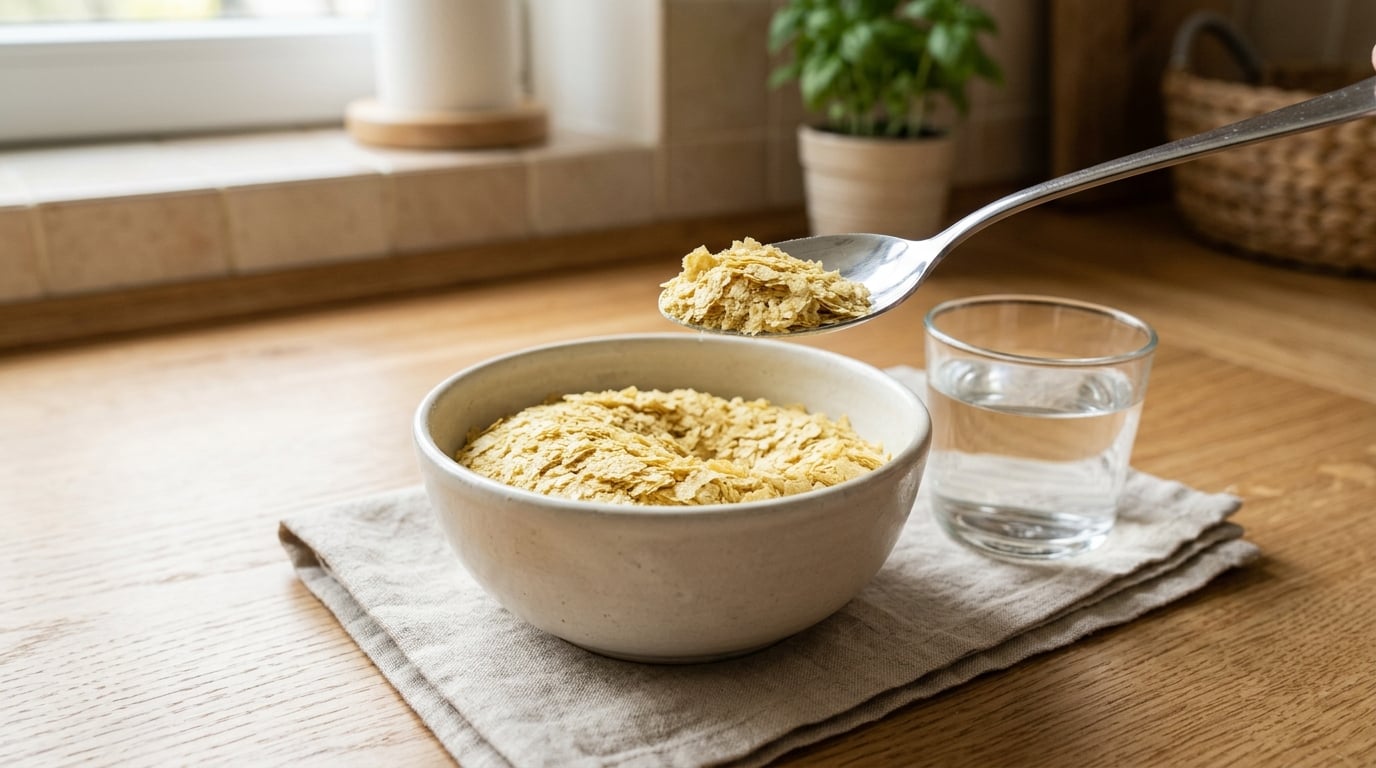
Nutritional yeast tastes cheesy because it is full of free glutamic acid, the same savory compound that gives ripe cheese its depth, and because drying it creates roasted, nutty aromas that read as cheese flavor. Add the natural nucleotides in yeast and you get an amplified umami hit that is genuinely dairy-free.
That is the short version of why nutritional yeast tastes cheesy. It has nothing to do with imitation and everything to do with chemistry that happens twice: once in the fermenting tank, once in the drying drum. Below is what those compounds are, why rehydrating the flakes changes everything, and what to do when the flavor comes out dusty instead of savory.
Table of Contents
- Why Does Nutritional Yeast Taste Cheesy?
- What Gives Nutritional Yeast Its Cheesy Flavor?
- How Yeast Fermentation Creates Savory Aromas
- Does Processing Change the Cheesy Taste?
- Why Some Brands Taste More Cheesy Than Others
- How to Make Nutritional Yeast Taste More Like Cheese
- Frequently Asked Questions
- Is nutritional yeast supposed to taste cheesy?
- Does nutritional yeast contain glutamate or dairy?
- Why does dry nutritional yeast taste less cheesy?
- What happens if you use too much nutritional yeast?
- How do you store nutritional yeast and tell if it has gone bad?
- Why does my nutritional yeast taste bitter or like cardboard?
- Start With Water, Not More Yeast
Why Does Nutritional Yeast Taste Cheesy?
First, the perception is real and shared. Second, there is no dairy involved. Nutritional yeast is deactivated Saccharomyces cerevisiae, the same species of yeast used for bread and beer, grown on cane or beet molasses and then killed with heat and dried.
What survives that process is a concentrated pile of flavor compounds. Aged cheddar and parmesan draw much of their savoriness from free glutamic acid released when milk proteins break down over months. Yeast makes the same amino acid available in a matter of hours of fermentation, and it keeps a high concentration of it after drying.
Cheese taste is not a single molecule, though. It is a signal your tongue builds from glutamates, nucleotides, roasted notes and a bit of saltiness. Yeast happens to hit most of those notes at once, which is why a spoonful in dry popcorn reads as parmesan and a spoonful in a cake batter reads as yeast.
Users on Reddit r/vegan describe the split neatly: it smells like cheese, but for a lot of people the first taste is nuts. That gap is not a mistake in the yeast. It means the aroma reaches you through your nose while the savory signal has not been unlocked yet, which takes water and heat.
What Gives Nutritional Yeast Its Cheesy Flavor?
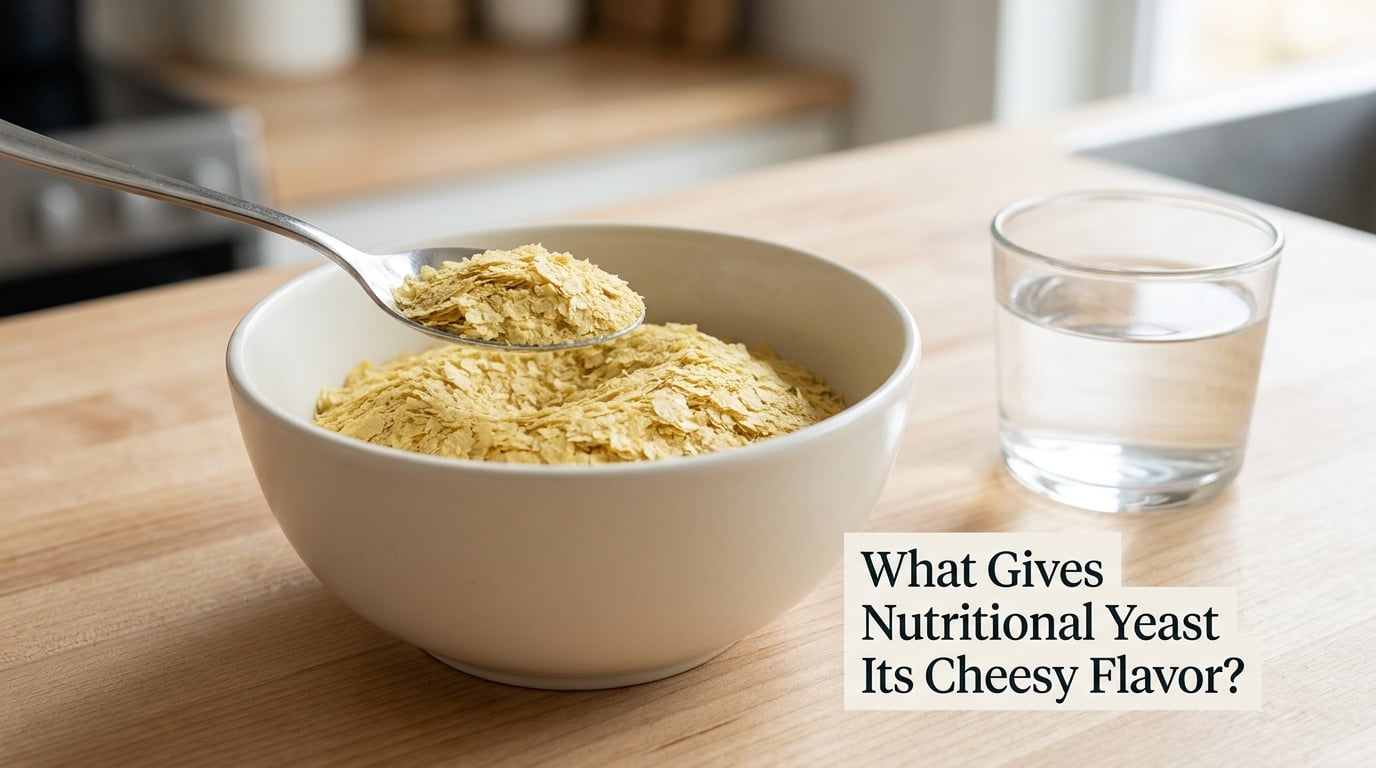
Umami is the fifth basic taste, and it has two triggers: free glutamate on its own, and glutamate paired with 5-prime nucleotides. Nutritional yeast is rich in both halves of that pair, which is the single biggest reason it can pass for cheese.
Free glutamic acid is the biggest driver
Food-science writing on the ingredient puts free glutamic acid in nutritional yeast at roughly 1,350 to 2,240 mg per 100 g, and one detailed analysis lands near 1,700 mg per 100 g. For scale, a tablespoon of the powder weighs about 5 g, so a single spoonful delivers somewhere around 85 to 110 mg of free glutamate.
Nothing else in a typical pantry hits that number cheaply. Parmesan is the famous exception, and parmesan is exactly the flavor most cooks are chasing when they reach for the tub.
Nucleotides multiply the savory signal
Yeast also carries inosine monophosphate and guanylate, the two nucleotides that appear in the flavor industry as disodium inosinate and disodium guanylate. On their own they taste faint. Alongside free glutamate they act as amplifiers, and the perceived savoriness rises far more than the ingredients suggest, which is why food scientists call it synergy rather than addition.
Roasted notes come from the Maillard reaction
Heat-inactivating wet yeast means holding protein and sugar at high temperature, and that is the Maillard reaction in full swing. It produces the roasted, bread-crumb, faintly nutty compounds that sit under the savory layer. Those are the same family of reactions that make seared beef and baked bread taste the way they do.
This is also why toasted nutritional yeast works so well as a garnish. Push the browning further and you get more of those volatiles every time.
Sulfur compounds and the nutty note
A small share of sulfur-containing compounds adds the faint eggy or porcini quality that a lot of people describe as the back edge of the flavor. Layer that on top of roast and glutamate and the profile is strikingly close to a hard, aged cheese.
| Flavor driver | Where it comes from | What it adds |
|---|---|---|
| Free glutamic acid | Amino acid released from yeast protein during fermentation and drying | Base savory depth, the backbone of the cheese illusion |
| 5-prime nucleotides (IMP, GMP) | Ribonucleotides present in the yeast cell | Amplifies the glutamate into something closer to aged cheese |
| Maillard products | Protein and sugar reacting during heat inactivation and drying | Roasted, bread-like, nutty warmth |
| Sulfur volatiles | Fermentation by-products | Eggy, mushroomy, parmesan-rind edge notes |
| Added salt or MSG | Seasoning blended into some brands | Salinity that mimics cheese and pushes the flavor louder |
How Yeast Fermentation Creates Savory Aromas
Yeast does not just grow in a sugar solution, it eats and metabolizes. As the culture ferments, the cells break down their own proteins and take up amino acids from the molasses, and as they multiply and die off they release more of both into the medium.
By the time the slurry reaches the dryer, much of the yeast’s nitrogen is sitting outside the proteins as free amino acids, including a large share of glutamate. That is why the finished flakes behave like a seasoning rather than like a mushroom, even though both are dried fungal foods.
Why the flavor jumps when you mix it with warm liquid
Dry flakes are a bad delivery system for flavor. Their compounds are locked in a rigid, low-moisture structure, and your tongue simply cannot get to them fast enough. Add warm water, stock or milk substitute and the cells swell, the matrix loosens, and the glutamates and nucleotides disperse into solution where the umami receptors can reach them.
Heat does the rest. Somewhere around 140 to 160 degrees Fahrenheit, the last locked aroma compounds come free, which is why a nooch-based sauce tastes stronger than the same amount stirred into cold water. Room-temperature butter also works, just more gently, because fat carries the fat-soluble roast notes.
Stir it in gradually rather than dumping it in. Most of the so-called yeasty aftertaste people complain about is a concentration problem, not a chemistry problem.
Does Processing Change the Cheesy Taste?
Yes, and mostly through moisture and particle size. The compounds are the same in every form; what changes is how fast your tongue can reach them.
Flakes, powder and granules are not interchangeable
Flakes dissolve slowly and land in one spot, which makes them a garnish rather than a sauce ingredient. Powder disperses instantly and works in anything wet, and finer powder reaches the palate faster because the particles are smaller, in the range of tens of microns against the several-hundred-micron size of intact dried cells.
Granules sit between the two. They soften in a sauce without vanishing and they hold a light texture in a crumb coating, which is why bakers and air-fryer cooks reach for them.
Unblended powder also has a downside worth knowing: it stays powdery on the palate, and that dusty film reads as yeast rather than cheese. Blending it into fat, or blooming it in warm liquid first, removes the problem.
Fortified and unfortified taste the same
Fortified versions have B vitamins added, including a large dose of B12, roughly 733 percent of the daily value in a 10 g serving. That fortification is what makes the ingredient useful as a nutrient source and not just a flavoring.
It changes nothing about the taste, which answers the question that comes up constantly in plant-based cooking communities. If a pink-tub version tastes blander than a fortified one, the difference is the brand and the age of the tub, not the vitamins.
Why Some Brands Taste More Cheesy Than Others
Most of the variation comes from three variables: the strain and what it was grown on, how hard it was dried, and how fresh it is when you open it. A brand that salts its yeast will always taste more cheese-like than one that does not, and nothing about the label is deceiving you about that.
Why it can taste bitter or like cardboard
Bitterness is a real and common reaction, and it is not a defect. Bitter taste is detected by TAS2R receptors, and people differ substantially in how many and how sensitive those receptors are. Some palates register the yeast’s bitter compounds clearly while barely registering the glutamate, which is the whole point of the ingredient.
Aged, air-exposed yeast adds to the same effect. Oxidation of the unsaturated fat in the cell membranes produces cardboard-like notes, and more roasting pushes those compounds further. Toasting too hard, storing it warm, or leaving the jar open on the counter are the three ways to make a good product taste tired.
Freshness and moisture decide how loud the flavor is
Dried yeast is stable because its water activity sits low, around 0.2. The moment a jar takes on humidity, the structure softens, the aroma compounds escape, and what is left tastes flat. That is the main reason a shaker that has been open for months seems to have lost its punch.
A tight resealable bag, a glass jar with a rubber gasket, or a freezer bag all solve it. Sealed and cool, the flake form keeps around two years. Scent is the quickest check: a faint buttery, nutty aroma means it is fine, while a stale, dull smell or visible clumping means it has absorbed too much water.
Worth knowing for the sustainability-minded: life cycle analyses put yeast at roughly 0.9 kg of carbon dioxide equivalent, against something like 27 kg for cheddar. Not the main reason to cook with it, but not nothing.
How to Make Nutritional Yeast Taste More Like Cheese
The goal is to get the savory compounds into solution and then give them fat and salt to sit in. Everything below follows from that one idea.
Pairings that push the flavor toward parmesan
- Fat first. Mix the flakes into softened butter, olive oil or cream before anything else. Fat carries the roast compounds and takes the edge off any bitterness.
- Acid to lift it. A squeeze of lemon, a splash of pickle brine, or a spoon of sauerkraut juice brightens the glutamate the way acid does in a real cheese sauce.
- Salt in layers. Season the dish first, then taste, then decide whether the yeast needs more. Salt amplifies umami, so a pinch often beats doubling the yeast.
- Warm liquid, then heat. Bloom the powder in warm stock, cashew cream or plant milk for a few minutes before it goes into the pan. You will notice the difference in a cold sauce.
- Toast it. A dry skillet for a minute before adding fat deepens the nutty roast notes. Watch it, though, because the line between toasted and scorched is thin.
- Mushrooms and tomato. Dried porcins, shiitake and tomato paste bring their own glutamates, and the stacking effect is immediate.
- Start small, taste, adjust. A teaspoon per serving is plenty for most dishes. A common mistake is doubling up to chase a cheeseiness that was never going to arrive, and the result is powdery rather than savory.
Sauces and casseroles
A vegan cheese sauce gets its body from blended cashews or white beans and its flavor from the yeast, so give the sauce both. Toast the flour in the pan, add warm stock, whisk smooth, then stir in a tablespoon of powder off the heat. Cheese sauce seasoned with yeast scorches easily, and the last minute of heat is where the aromatics finish, not where they start.
For a macaroni-style bake, mix the powder with a little mustard powder and salt before folding it into the sauce, then keep the top under a layer of crumbs or a little melted vegan cheese. Surface browning is where the Maillard note does the most work.
Popcorn and other dry applications
Dry applications are the one place the powderiness bites. A light coating of melted butter or oil first, then the flakes, gives each kernel a surface the yeast can stick to. The same logic applies to roasted potatoes, kale chips and any crumb coating.
Freshly grated-style flake forms and a mason jar shaker also work better here than fine powder, since powder falls through your fingers and never lands evenly. If you do use powder on popcorn, mist the bowl very lightly first so it clings instead of dusting the bottom of the bag.
Frequently Asked Questions
Is nutritional yeast supposed to taste cheesy?
Yes. The savory, cheese-adjacent taste is a natural result of the compounds in deactivated Saccharomyces cerevisiae, not an added imitation ingredient. Yeast is rich in free glutamic acid, the same amino acid that builds up in aged cheese, and it carries 5-prime nucleotides that amplify that savory signal. A well-stored, well-cooked jar should read as nutty and parmesan-like rather than yeasty.
Does nutritional yeast contain glutamate or dairy?
It contains plenty of glutamate. Analyses put free glutamic acid at roughly 1,350 to 2,240 mg per 100 g, with one detailed study landing near 1,700 mg per 100 g, which is a very high concentration for a pantry seasoning. It contains no dairy at all, because it is grown on molasses and then heat-inactivated. It is also gluten free, since the protein comes from yeast rather than grain.
Why does dry nutritional yeast taste less cheesy?
Dry flakes and powder trap their flavor compounds in a rigid low-moisture structure that your tongue cannot reach quickly. Adding warm liquid swells the cells and releases the glutamates and nucleotides into solution, where umami receptors can detect them. Heat helps too, so a yeast stirred into a warm sauce tastes noticeably stronger than the same amount added to something cold. Blooming the powder in warm stock first solves most of the problem.
What happens if you use too much nutritional yeast?
The dish turns powdery and dust-textured, and the flavor shifts from savory to yeasty. Dry yeast is extremely concentrated, so two tablespoons is a lot of powder to add to a small dish, and doubling up to chase a stronger cheese flavor usually backfires. Start with about a teaspoon per serving, taste, and adjust from there. Fat, acid and salt will get you further than more yeast will.
How do you store nutritional yeast and tell if it has gone bad?
Keep it sealed, cool and dry. A resealable bag, a jar with a tight gasket, or a freezer bag all work, and sealed flake form holds around two years. Humidity is the enemy, so never leave the container open near the stove. Check the smell first: a faint buttery, nutty aroma means it is fine, while a stale, dull scent or clumping means it has absorbed moisture and lost its aroma.
Why does my nutritional yeast taste bitter or like cardboard?
Both usually point to a couple of things. Bitter taste is partly genetic, since people differ in their TAS2R bitter receptors and some palates register the yeast’s bitter compounds far more strongly than the savory ones. Cardboard notes come from oxidation of the unsaturated fats in the yeast cell membranes, which happens with age, heat and humidity. A stale, open jar or a batch you toasted too hard will do it, and a fresher one fixes it.
Start With Water, Not More Yeast
If you take one practical thing from why nutritional yeast tastes cheesy, take this: the flavor is there, but it is locked in the flakes. Warm liquid, a little fat and a modest pinch of salt release it, and suddenly the same spoonful tastes like parmesan instead of powder.
For anyone who has given up on it because of a dusty first taste, that is usually the whole problem. Store it sealed, keep it out of humidity, and bloom it in warm stock next time. Updated for 2026, this is still the fastest route from dusty to savory.