
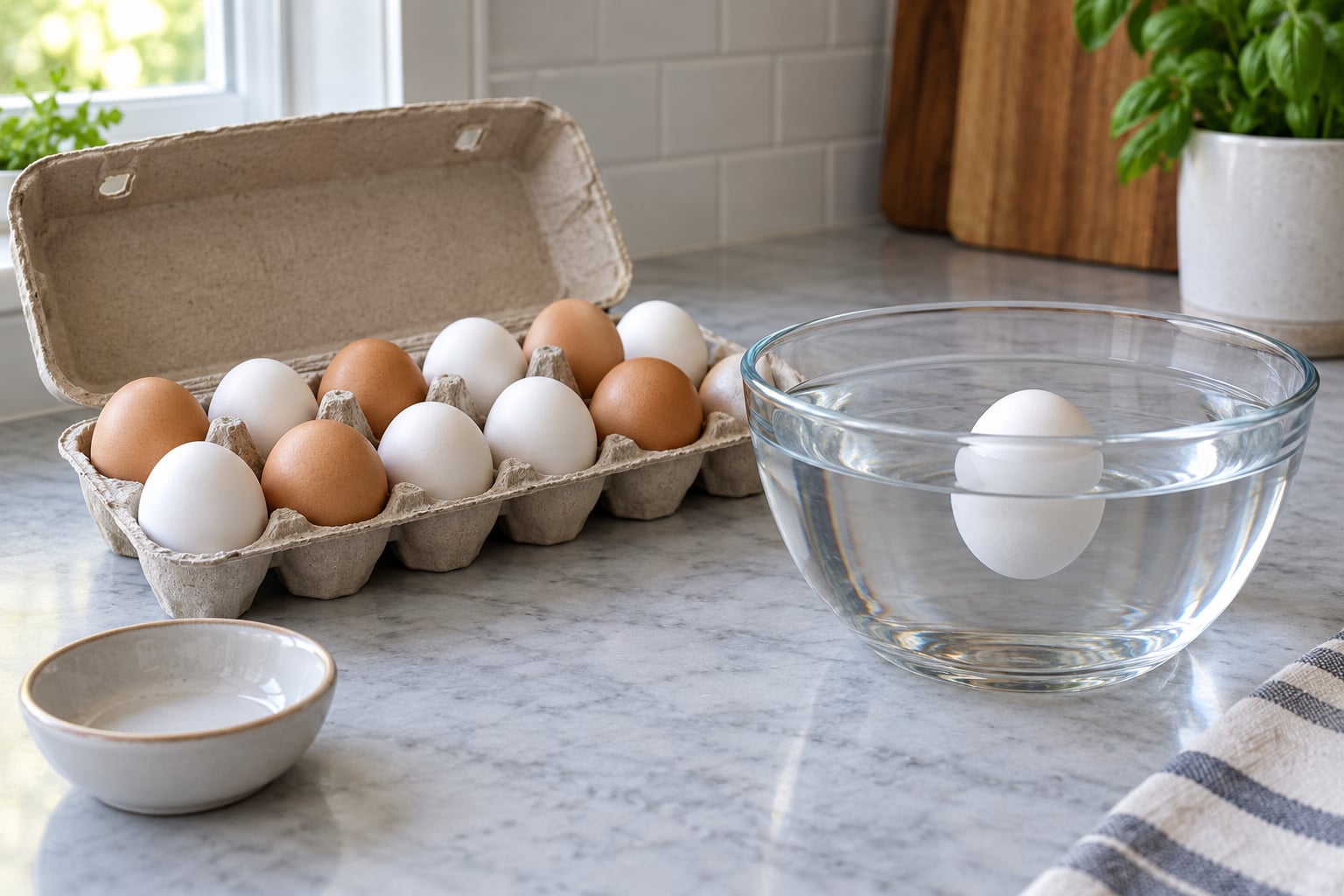
Most eggs are fine, and most of the bad ones announce themselves in one of two ways: a strange smell or a texture you cannot ignore. If you know how to tell if eggs are still good, you can sort a carton in about five minutes and stop throwing away good food. Start with the packaging, then the float test, and let your nose make the final call.
Two things are worth saying up front. A sell-by date is a quality marker rather than a safety deadline, and the float test tells you how old an egg is, not whether bacteria are present. Neither one decides the question on its own, which is why the process below moves from packaging to water to smell.
Table of Contents
What You Need
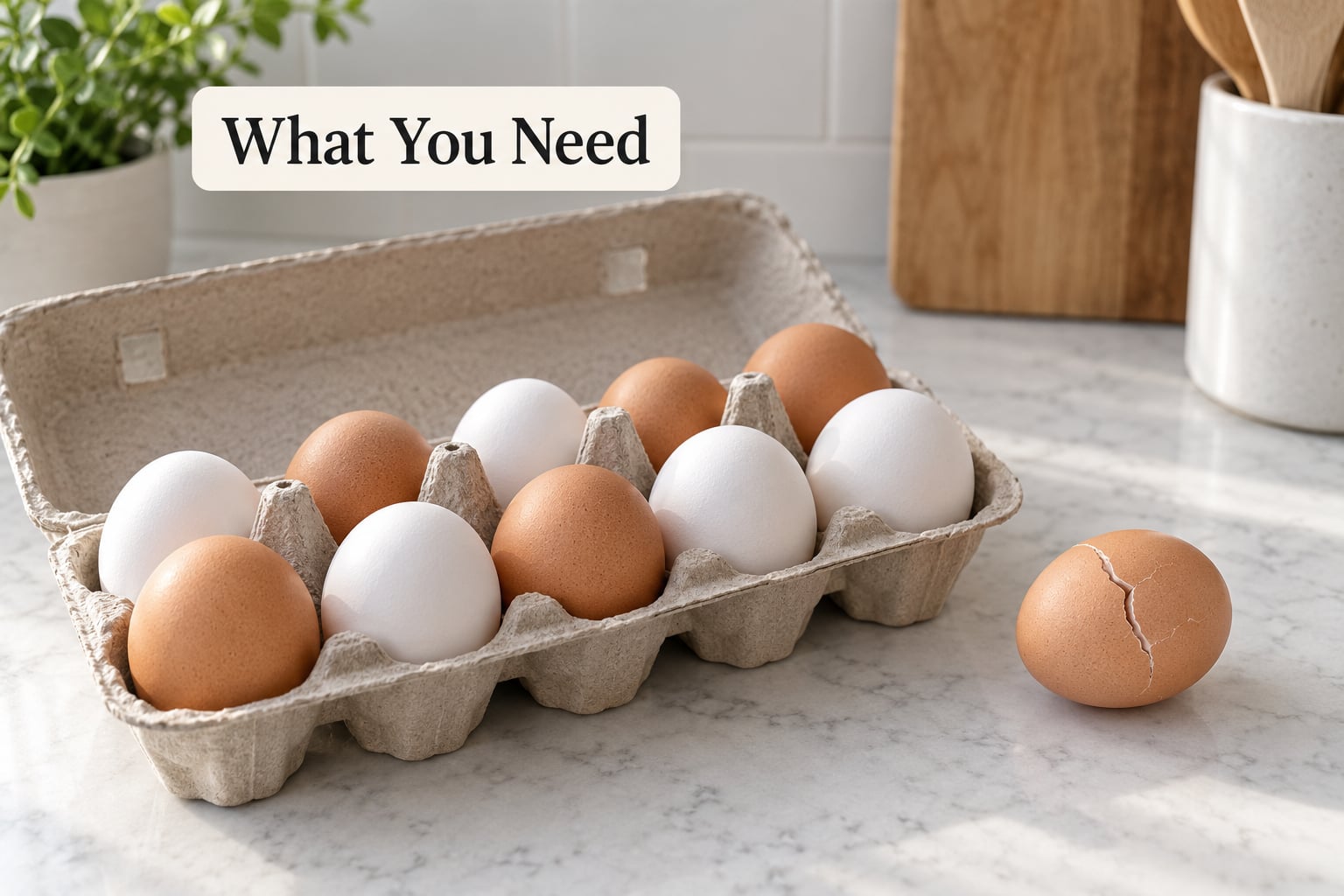
Eggs in their original carton are by far the easiest to evaluate, because the carton tells you how they were handled and when they arrived. Loose eggs on a counter give you almost nothing to work with.
For the checks themselves you want:
- The original cardboard carton, if you still have it
- A bowl or glass of cool water, deep enough for an egg to sink or float freely
- Clean, dry hands
- A small cup or bowl per egg, so one bad egg cannot spoil a whole batch
- A way to dispose of a bad egg without smelling it up close, which means flushing it or wrapping it and putting it outside
Cracked, cooked and frozen eggs each need a different check. A raw shell egg gets the float test and a crack-into-a-cup inspection. A hard-boiled egg gets cracked and smelled, because the water test tells you nothing useful once the egg has been cooked. Frozen eggs are judged after thawing in the refrigerator, never by appearance in the freezer.
Step-by-Step: How to Tell If Eggs Are Still Good
Work through these in order. Each step is cheaper than the one after it, and the earlier steps rule out whole batches at once.
Step 1: Check the Shell and Egg Packaging
Keep the carton open on the counter and look through every egg before touching any of them. Cracks, leaks, moisture or a chalky or slimy shell all mean the egg has lost its protective barrier, and bacteria from the surface can reach the inside.
Check for hairline cracks too, not just the obvious splits. Hold each egg up to the light and look for a thin line that lets light through, or run a clean dry finger over the shell to feel for a groove. An egg with any crack goes out, no further discussion. Discard it without tasting it, and check the others in the carton for the same damage, since cracks tend to arrive in batches.
Eggs that were sitting in condensation or have a damp, sticky patch on the shell have been out of the cold chain or sat in spilled liquid. Treat those separately and use them first.
Step 2: Read the Date on the Carton
In the United States, the number stamped on a carton is usually a Julian date, meaning the day of the year the eggs were packed, counted from January 1. The sell-by, best-by or use-by date printed below it is calculated from that day and is a quality marker, not a cutoff where an egg becomes dangerous.
That distinction matters because storage conditions decide how long an egg really lasts, and the printing cannot account for a fridge that runs warm or a carton that sat on a porch for a morning. An egg well past its date can still sink and still be fine. An egg two days past its date can also be spoiled if it spent that time somewhere warm.
Agency guidance varies by egg type and jurisdiction, and other countries use entirely different date formats. If the label says something other than a date, such as a packing code, rely on your own storage history instead.
The same caution applies to the front of the carton. Marketing language is regulated loosely and printed loosely too, so read the date line rather than the headline. Our guide to how to tell if honey is real covers the same idea for another pantry staple: a printed claim is a starting point, not proof.
Step 3: Use the Float Test
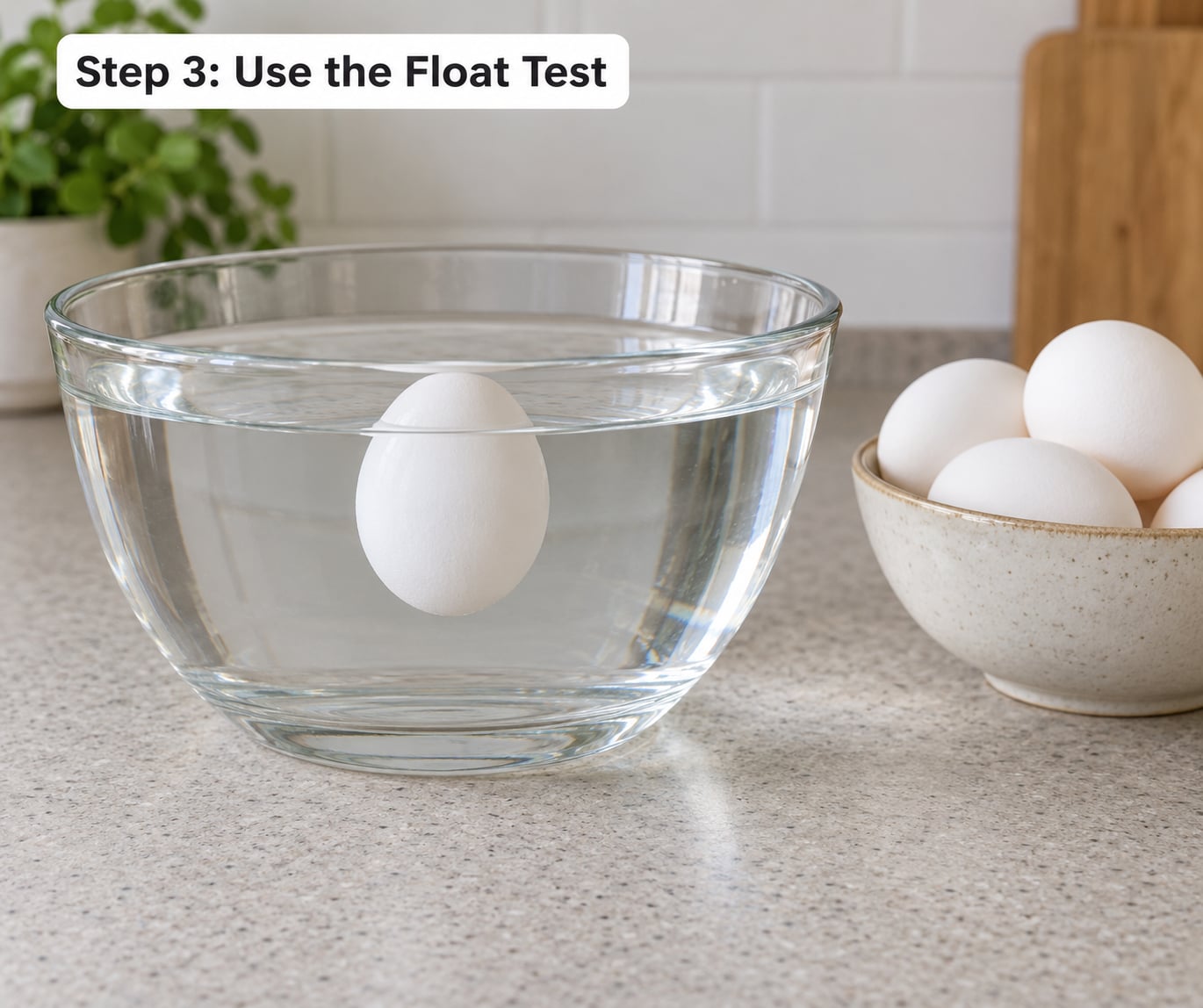
The float test is a freshness check, and it takes about ten seconds per egg.
- Fill a bowl or glass with cool water, deep enough that the egg will not touch the sides when it sinks.
- Place one uncracked egg in gently and let go of it. Dropping an egg can introduce air bubbles that give you a false reading.
- Watch where it settles and how it sits.
| What you see | What it means | Next step |
|---|---|---|
| Sinks and lies flat on the bottom | Very fresh, air cell is small | Use for anything, especially baking and soft-cooked eggs |
| Sinks but stands upright on the bottom | Older, still within normal range | Use first, but crack it into its own cup first |
| Floats to the top or hangs in the water | Old, large air cell | Smell it. If the odor is clean it is usually still usable for baking |
The reason is simple physics, and it is worth knowing because it explains the test’s limits. Eggshells are covered with thousands of tiny pores. As an egg ages, moisture and carbon dioxide escape through those pores, and the air cell between the two shell membranes grows to fill the space. A bigger air pocket means more buoyancy, so an old egg floats. The test measures age. It says nothing about Salmonella or any other bacterial contamination, which is why a sinking egg still needs a smell check and a cracked egg still needs cooking.
Two exceptions catch people out. Small eggs from quail or Silkie bantams can float while genuinely fresh, and keepers report this often enough that they stop discarding small eggs on float alone. And a hairline-cracked egg can sink flat and still be bad, because the crack let bacteria in from the outside. Cracked eggs never get the benefit of the doubt.
Step 4: Inspect and Smell Raw Eggs
Crack each egg into its own cup or small bowl, never straight into the batter or the frying pan. This is the most repeated piece of advice across chicken-keeping forums and cooking threads, and it exists for a plain reason: one bad egg contaminates everything it touches.
Smell the raw egg before you look at anything else. A good egg has no odor or a very faint, neutral one. A spoiled egg smells strongly sulfurous, sour or rotten, and there is no halfway version of that smell. You will not need to think about it.
Then look at what you cracked:
- A watery, thin white that spreads flat instead of holding itself together
- A yolk that spreads out of shape or sits dull and fragile in the center
- A grey or greenish tint on the white, or pinkish, orange or green coloring in the yolk
- A slimy or chalky-feeling shell when you held it
One clarification worth keeping: a grey-green ring around the yolk of a hard-boiled egg is not spoilage. It is an iron and sulfur reaction from overcooking, and it tastes fine.
Afterwards, wash your hands and any bowl, spoon or counter the egg touched, with hot soapy water. Scrub the discard container too, and wash it separately from your dishes.
Step 5: Account for Storage and Cooking
The last question is not about the egg, it is about the last few weeks of its life. Eggs that sat on a counter overnight, in a car, or on a picnic table go into a different category than eggs that never left the fridge. USDA FSIS guidance is two hours at room temperature, cut to one hour when the air is above 90F. If eggs exceeded that, the usual advice is to discard them rather than test them.
Eggs cracked into a bowl and stored covered in the fridge are also a separate case. USDA FSIS gives raw shell eggs three to five weeks in the refrigerator at or below 40F, hard-coiled eggs one week, and separated raw whites two to four days. Frozen raw whites keep for up to 12 months. Whole eggs in the shell do not freeze well, because the expanding contents crack the shell, and yolks do not freeze on their own.
Cooking starts a new and shorter clock. Cook eggs until the whites and yolks are firm, and bring the center to 160F if you are using a thermometer. Appearance alone is not proof of safety, and heating kills many bacteria but not all of them.
If you are pregnant, over 65, or managing an immune condition, skip the sniff-test approach. Discard any egg you cannot confirm by its date and unbroken storage history. That advice applies to food in general, and eggs are not an exception. When sources disagree about what is safe, our piece on telling good nutrition advice from hype explains which ones deserve your time.
Common Mistakes
Five errors cause most of the worry, and most of the waste:
Assuming the date is a safety line. A sell-by or best-by date describes quality. Two eggs printed on the same day can differ by weeks of real freshness depending on the cold chain between the plant and your fridge.
Cracking questionable eggs straight into the dish. One off egg ruins the whole batch and the bowl it landed in. Crack into individual cups first, and only combine eggs that smell and look right.
Trusting smell on its own. Odor is the strongest signal you have at home, but in the earliest stages of spoilage it can be faint, and some people cannot detect sulfur compounds well. Use odor alongside the other checks rather than as the only one.
Tossing the yolk and keeping the white. Both parts come from the same egg and the same exposure. If the egg is bad, neither part is.
Treating the float test as a laboratory test. It measures age, not bacteria. An egg that sinks can still be contaminated, which is why cooking and the crack-and-smell check stay in the process.
Safety Tips for Storing Eggs Safely
- Refrigerate eggs promptly, in the original carton, and keep them at or below 40F.
- Store them on an inside shelf rather than the door. The door warms up every time it opens, and that temperature swing is worse than the shelf position most people assume is wrong.
- Do not wash the shells before storing. Washing removes the natural cuticle, or bloom, that blocks bacteria, and rinsing with cold water can push bacteria through the shell pores. Washed commercial eggs need refrigeration for exactly that reason.
- Keep eggs away from strong smells in the fridge, and put the oldest eggs at the front of the carton.
- Mark your own cartons in marker with the purchase date. For a backyard flock, mark each collection date instead, since that is the only accurate clock you will have.
- Cook until the whites and yolks are firm, and eat them within two hours of cooking, or return them to the fridge.
What you do at the shelf matters as much as the fridge itself. It also helps to read what a package claims before it reaches your cart, and our guide to telling whether a granola bar is actually healthy walks through why front-of-pack phrases deserve a second look.
Frequently Asked Questions
Can you eat eggs after the sell-by date?
Usually yes, if they were stored cold the whole time. A sell-by date marks quality rather than safety, so an egg a week or two past that date that still sinks and smells clean is generally fine. Judge the egg, not the label. Discard it if it has a crack, floats and smells off, or sat on a counter for more than two hours. For pregnant, elderly or immunocompromised readers, the date itself is the safer yardstick.
Are eggs still good if they float in water?
A floating egg is old, not automatically spoiled. The air cell has grown enough to lift it, and an old egg can still be perfectly edible for baking or hard-boiling. Crack it into its own cup and smell it. Clean smell and normal texture means it is fine to use; any sulfur or sour odor means discard it. One exception: small quail or Silkie eggs can float while still fresh.
How can you tell whether hard-boiled eggs are still good?
Crack and smell them. Hard-coiled eggs in the refrigerator keep about one week under USDA FSIS guidance, and cooking starts a shorter clock than the three to five weeks given to raw shell eggs. Peel or unpeeled, the smell test works the same way. A sulfur odor, a slimy surface or grey-green fluid means it is out. A grey-green ring around the yolk is just overcooking and is harmless.
Is it safe to wash eggs before storing them?
For store-bought eggs, no. Commercial eggs are already washed and refrigerated, and washing them at home removes the cuticle that protects the shell. For unwashed farm or backyard eggs, wash them in water warmer than the egg, dry them fully, and refrigerate them, otherwise the cold water opens the shell pores and draws bacteria inside. Washing and storing in the carton together is the worst option.
Can frozen eggs be used after thawing?
Yes, as long as they were frozen safely. Raw whites freeze well and keep for up to 12 months under USDA FSIS guidance. Whole eggs in the shell are not recommended, since the contents expand and crack the shell, and yolks freeze poorly on their own because of the yolk’s high fat content. Thaw in the refrigerator, not on the counter, and use the thawed egg within a couple of days.
What should you do after finding a spoiled egg?
Discard it immediately without smelling it again. Flush it down the toilet or wrap it and put it in an outdoor bin. Then check the whole carton, since spoilage and cracks tend to travel together, and wash your hands, bowls, utensils and any counter surface the egg touched with hot soapy water. If several eggs from the same carton show odd smells or textures, discard the carton rather than working through it one egg at a time.
Conclusion
Start with the carton and the storage history, since those two facts rule out most problems before you touch a bowl of water. Throw away anything cracked, wet or foul-smelling, and use the float test as a supporting check on age rather than a guarantee of safety. When in doubt, crack each egg into its own cup, smell it, and cook it until firm.