
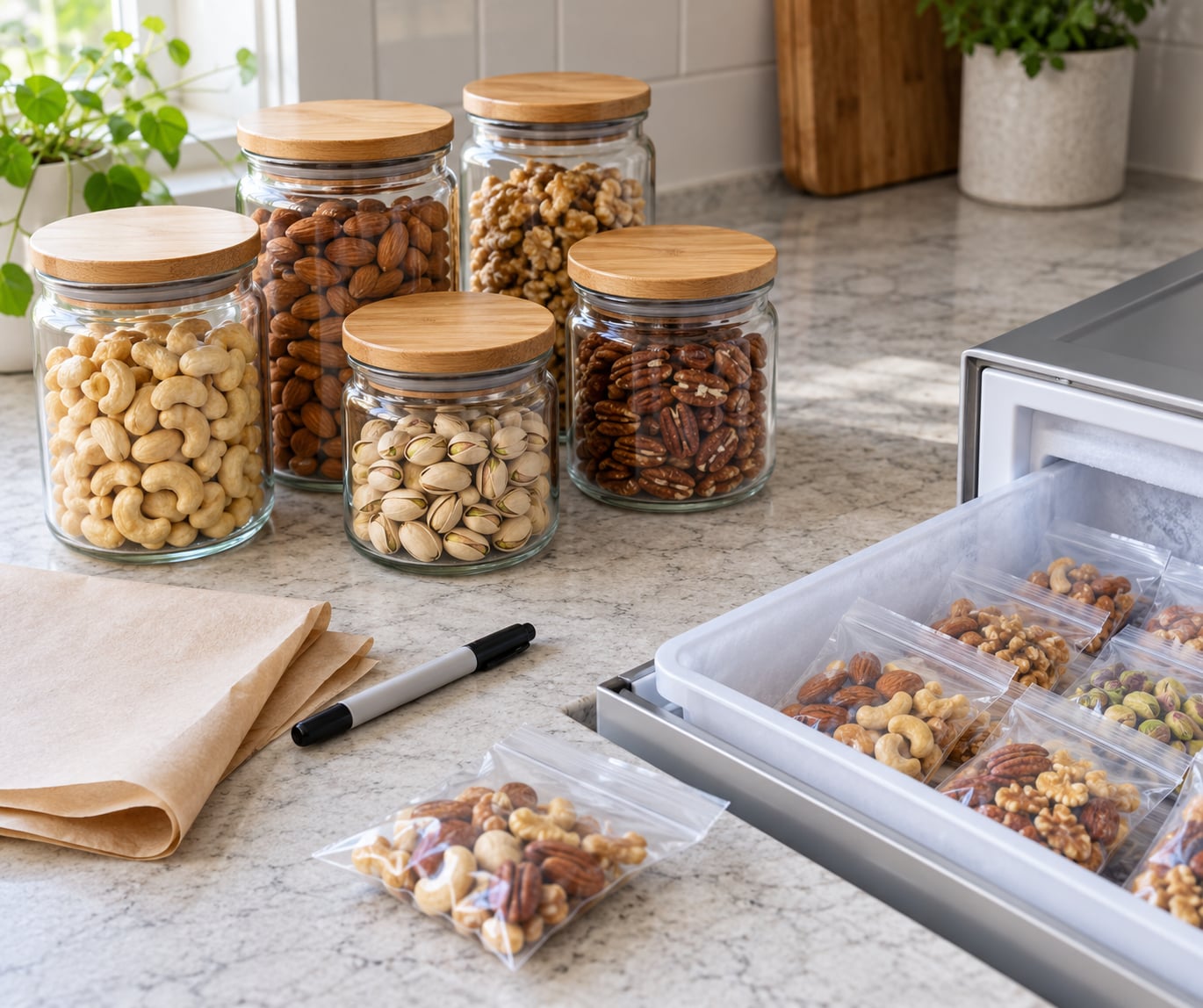
Nuts go rancid because the oils inside them oxidise once air, heat and light reach the surface, and no clever pantry arrangement changes that chemistry. To store nuts so they do not go rancid, keep them whole and raw, sealed airtight, in the freezer for anything beyond a few weeks, and let frozen containers sit at room temperature before you open them.
The whole method takes about ten minutes per batch. If you only want the short version: a cool dark pantry buys you two to four weeks, a refrigerator buys you three to six months, and a freezer at 0°F (minus 18°C) buys you a year or more.
Table of Contents
- What You Need
- Step-by-Step
- Step 1: Buy fresh nuts and check the package
- Step 2: Keep nuts whole as long as you can
- Step 3: Portion before the container goes back in storage
- Step 4: Refrigerate for a medium-term stash
- Step 5: Freeze for anything longer than a few months
- Step 6: Thaw sealed and slowly
- Step 7: Check freshness before serving
- Common Mistakes
- Frequently Asked Questions
- Should I refrigerate nuts to keep them from going rancid?
- How long do nuts stay fresh when stored in the pantry?
- What is the best container for storing nuts long term?
- Can I freeze nuts, and how long will they stay fresh?
- How can I tell whether nuts have already gone rancid?
- Do I need to refrigerate nuts after opening the package?
- Start With the Freezer
What You Need
You do not need anything expensive. You need containers that stop air and moisture from moving in and out, and somewhere cold.
- Airtight glass or plastic containers. Wide-mouth mason jars with a silicone gasket lid are the easiest to clean and easy to see through. Clear plastic screw-top containers work too, as long as the seal is tight.
- Freezer bags or small freezer-safe portions. Quart and gallon freezer bags handle bulk bags from big-box nut aisles. For a vacuum sealer, plain bags are fine.
- Original nitrogen-flushed packaging. If a bag says it was flushed with nitrogen, treat that bag as your storage container. It is already barrier packaging.
- Parchment paper or clean paper. Useful for spreading nuts out before freezing so they do not clump into one solid block.
- A cool, dark pantry or a refrigerator. For short-term storage, the back of a cupboard away from the stove beats a shelf near the oven.
- A marker or masking tape. Date every container. Rotation only works if you know what is oldest.
- Bay leaves or whole cloves. Optional, but worth keeping on hand if moths or weevils are a problem in your pantry.
If you store seeds alongside nuts, our guide to how to store chia seeds so they stay fresh covers the same airtight, cool and dark principles.
Step-by-Step
Step 1: Buy fresh nuts and check the package
Smell the bag before you buy it. Fresh nuts smell nutty and mild; anything with a stale, crayon-like or faintly oily smell is already partway to rancid. Buy smaller bags more often rather than one huge bag you will not finish, and prefer nitrogen-flushed packaging when the shelf offers a choice.
How you know it worked: the nuts smell clean and you can taste one straight from the bag and it tastes like a nut, not like nothing.
Step 2: Keep nuts whole as long as you can
Chopping or grinding cracks the cell walls and exposes far more oil surface to air. Whole raw nuts keep noticeably longer than chopped, and raw nuts keep longer than roasted or salted ones. Chop half a jar for baking and freeze the rest in whole pieces instead.
How you know it worked: the jar in your pantry holds whole nuts only, and chopped amounts live in the freezer in small bags.
Step 3: Portion before the container goes back in storage
Decide how much you actually eat in a sitting, then portion accordingly. A small jar on the counter is the only thing that gets opened daily; the rest of the bag goes straight into the freezer. This is the single change that fixes the “I open the big bag every day and it never lasts” problem.
If you like the idea of prepping nuts ahead, our guide to soaking nuts and seeds covers the soak-and-drain routine before they go into the freezer.
Step 4: Refrigerate for a medium-term stash
Move the airtight container to the refrigerator at or below 40°F (4°C). Cold slows the oxidation reaction, and the door seals out both humidity and the smells of whatever else is in there. Keep nuts on an upper or middle shelf rather than the crisper, which is the warmest and most humid spot.
How you know it worked: three months in, the walnuts still taste like walnuts when you nibble one.
Step 5: Freeze for anything longer than a few months
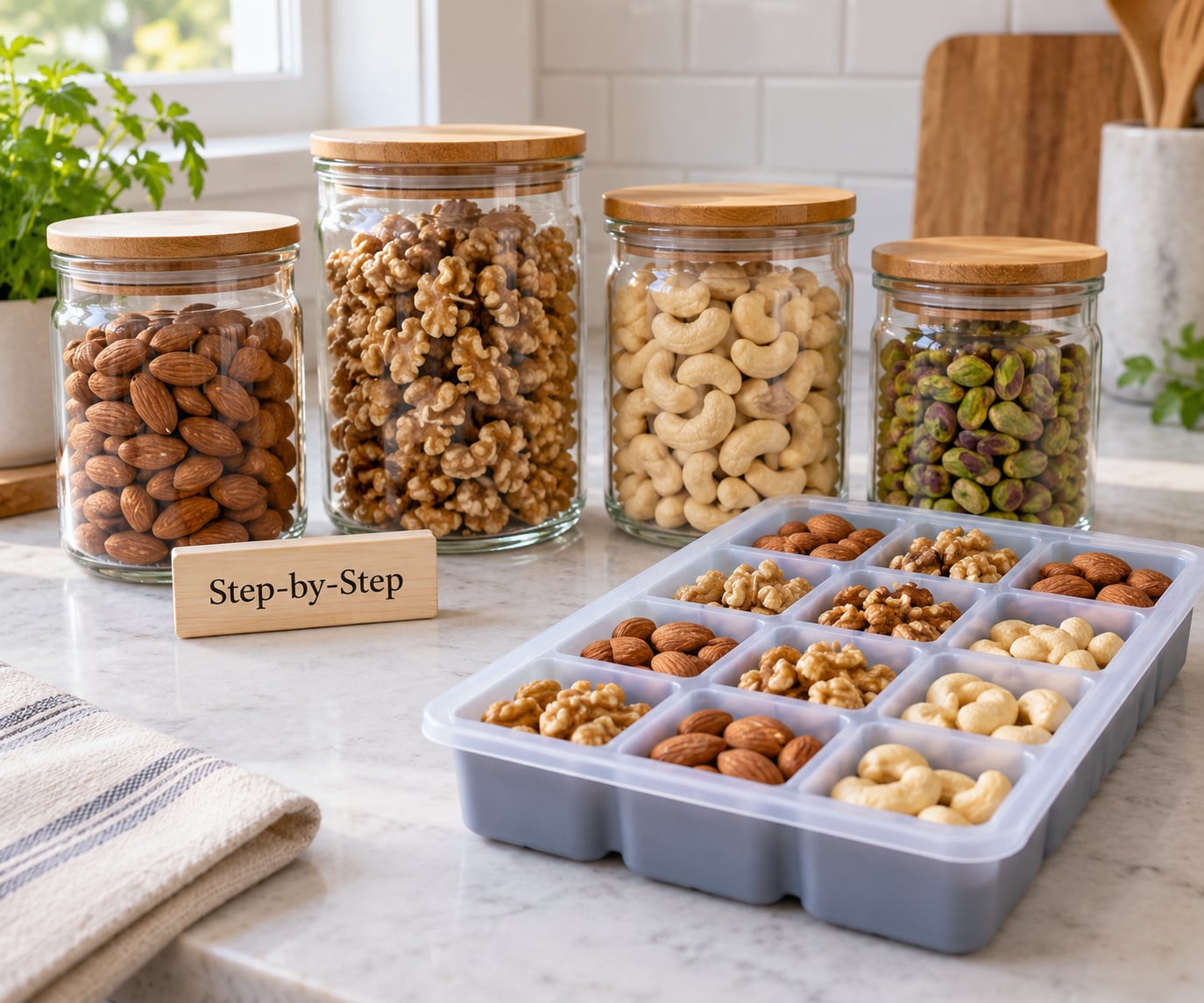
Spread the nuts in a single layer on a lined baking sheet, freeze for an hour or two until solid, then transfer them to freezer bags or containers. Freezing in a single layer first stops them freezing into one frozen brick, which is why people think frozen nuts clump and turn soggy. Squeeze most of the air out of each bag and label it with the nut type and date.
How you know it worked: the bag is firm, flat and hard, with almost no loose air left inside.
Step 6: Thaw sealed and slowly
Move the container from the freezer to the counter and leave it closed for 15 to 20 minutes, until it feels close to room temperature. Only then open it. Cold air meeting warm humid kitchen air inside an open container is what creates condensation, and damp nuts go soft and can pick up off-flavours fast.
Step 7: Check freshness before serving
Taste one nut before you pour a bowl for guests. Bitter, metallic, stale or musty means rancid, and no amount of toasting will hide it. Smell the container too, since the paint-and-nail-polish note usually shows up in the nose before the tongue. If in doubt, discard. Rancid nuts are not worth a health risk or an awkward flavor in a salad.
Common Mistakes
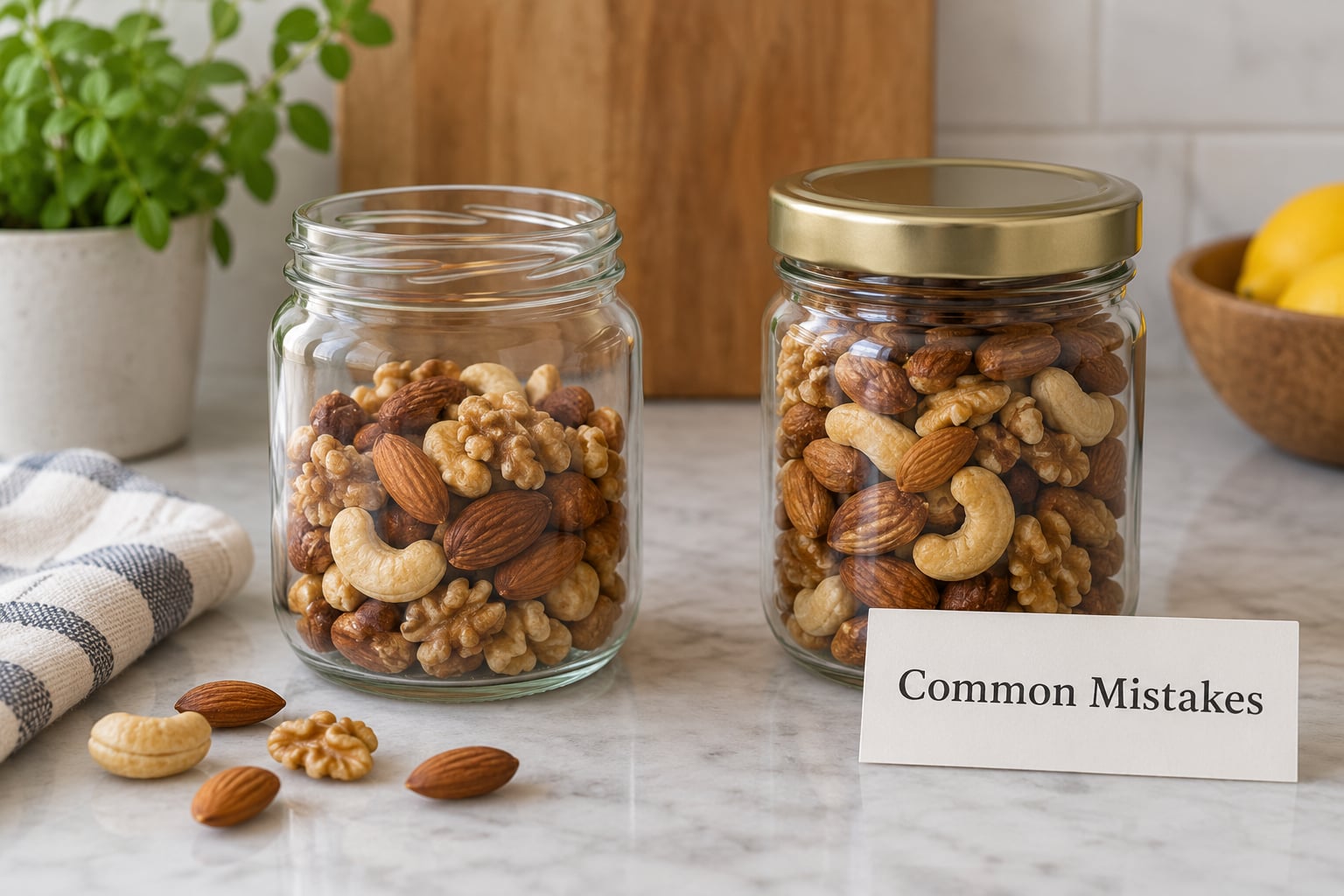
Almost every case of “my nuts went rancid” traces back to one of these.
Leaving nuts in the original bag. A bulk bag has a small opening, so every scoop lets oxygen in and pushes moisture out. Fix: decant into a container with a gasket lid, or use a bag clip that makes an almost airtight seal.
Opening the same big container daily. Repeated exposure is the same problem, just slower. Fix: keep a small working jar in front and the bulk portion cold in the back.
Storing them near the stove or in a warm cupboard. Heat accelerates oxidation faster than anything else you will change. Fix: pick the coolest, darkest cabinet in the kitchen, ideally one that does not share a wall with the oven.
Assuming refrigeration is always necessary. Cold is helpful, but a sealed container in a cool cupboard keeps nuts perfectly fine for a few weeks, and chilled storage is worth the hassle for nuts you will not touch for months. Fix: match the method to the timeline instead of cold-storing everything by reflex.
Freezing a large warm batch all at once. A warm mass takes a long time to reach freezer temperature, and the slow cool-down creates condensation inside the bag. Fix: spread on a sheet, pre-freeze, then bag in single-use portions.
Using a container with a weak seal or a damaged lid. A gasket that has hardened, or a lid with a warped rim, is not holding air out. Fix: test the seal by filling the container with water, snapping the lid on and tipping it over the sink.
Ignoring pests entirely. Moths and weevils get into bulk bags and ruined ones before anyone smells rancidity. Fix: toss a couple of dried bay leaves or a few clove buds into the container. Store in-shell nuts longer if you have them, since the shell is a barrier bugs cannot easily get through.
Two more habits pay off over time. Date every container and use the oldest first, so nothing sits for a year because it fell behind the newer bag. And keep nuts away from strong-smelling foods like onions, garlic, spices and coffee, which nuts absorb readily through the same porous surface that lets oxygen in.
Same thinking applies to everything perishable in the fridge. Our guide to storing fresh ginger so it lasts uses the same airtight-and-cold approach.
Frequently Asked Questions
Should I refrigerate nuts to keep them from going rancid?
Refrigeration helps a lot, but it is not required for short-term storage. In an airtight container in a cool dark cupboard, most nuts stay good for two to four weeks. If you will not use them for a few months, move them to the refrigerator, which slows oxidation and buys you roughly three to six months. Keep them out of the crisper drawer, since that is the warmest and most humid part of the fridge.
How long do nuts stay fresh when stored in the pantry?
Expect two to four weeks in a sealed container in a cool, dark pantry, and less if your kitchen is warm or humid. Raw whole nuts hold up better than roasted, salted or chopped ones, and walnuts and pecans turn first because their oils oxidise quickly. If a bag was going to sit for more than a month, the freezer is the better home for it from the start.
What is the best container for storing nuts long term?
For long-term storage, an airtight glass jar or a freezer bag that squeezes out most of the air works well. Wide-mouth mason jars with silicone gasket lids are easy to clean and easy to see through. A vacuum sealer is a bonus, not a requirement, and double-bagging works when you do not have one. Avoid containers with loose or damaged lids, since a broken seal defeats the whole point.
Can I freeze nuts, and how long will they stay fresh?
Yes, and the freezer is the best method by a wide margin. Freeze them at 0°F (minus 18°C) and they stay good for a year or more, often considerably longer. Spread them on a lined tray first so they freeze individually rather than in one block, then bag them in single-use portions. Let the sealed container reach room temperature before opening it, or condensation will make the nuts damp.
How can I tell whether nuts have already gone rancid?
Smell them first. Rancid nuts give off a stale, oily, crayon-like or nail-polish scent. The taste follows: bitter, metallic or simply flat and stale, with no nut flavor. Soggy or rubbery texture is another sign. There is no way to make rancid nuts safe again, so discard them, and compost or bin them rather than serving them to guests.
Do I need to refrigerate nuts after opening the package?
Only if the bag does not reseal properly. A screw-top or clipped bag that is truly airtight can stay in a cool dark cupboard for a few weeks. Once you have decanted the nuts into a container or the original bag has been opened wide and repeatedly, move the rest to the refrigerator or freezer. Larger bags and anyone living in a warm or humid climate should skip the pantry entirely.
Start With the Freezer
If you do one thing this week, move your bulk nuts into freezer bags today. Portion them, squeeze the air out, label the date, and let each container warm up closed before opening it. That single habit solves most rancid-nuts problems people describe, and it takes ten minutes.