
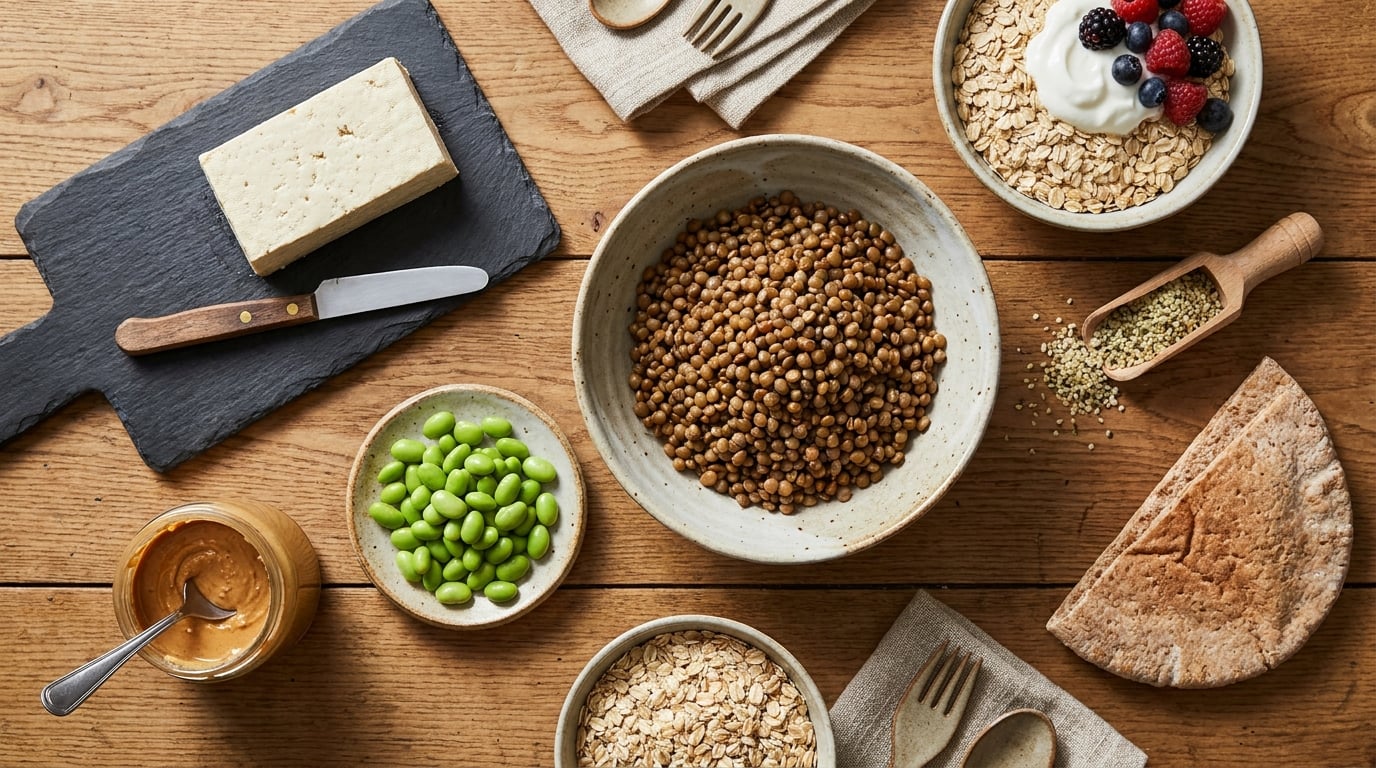
You can hit your protein target on a vegetarian diet without protein powder, and the method is simpler than most guides make it sound. Work out your daily gram range, then attach one dense protein source to every meal and snack until the total adds up. No scoop, no shaker, no chalky aftertaste.
The whole thing comes down to a per-meal number. Most adults land near 20 to 40 g of protein at a meal, spread across three or four eating occasions, and whole foods get you there without much fuss. This guide covers the foods, the realistic portions, and a daily structure you can repeat on a weeknight.
Table of Contents
- What You Need
- Step-by-Step: How to Eat Enough Protein Without Powder
- Common Mistakes
- Frequently Asked Questions
- How much protein do I need on a vegetarian diet?
- What are the best vegetarian protein sources without powder?
- Do I need to combine plant proteins at every meal?
- Are nuts and seeds enough to meet protein needs?
- Can a vegetarian diet provide enough protein for muscle growth?
- How can I eat more protein if vegetarian meals make me feel full?
- Conclusion
What You Need
No equipment and no supplements. You need a kitchen, a pot that holds lentils, a board, and about an hour a week. The shopping list is short and mostly shelf-stable, which matters when you are trying to keep food cost down.
The protein in a vegetarian diet comes from a short list of groups:
- Soy — tofu, tempeh, edamame, soy milk, soy yogurt, textured soy protein
- Legumes — lentils, chickpeas, black beans, cannellini beans, split peas, peas
- Gluten protein — seitan, which is made from washed wheat flour and is the densest everyday protein in most supermarkets
- Dairy and eggs — Greek yogurt, cottage cheese, milk, cheese, eggs, if you eat them
- Nuts and seeds — peanut butter, almond butter, pumpkin seeds, hemp seeds, chia, flax
- Grains — oats, quinoa, whole wheat bread, legume-based pasta, sprouted bread
- Vegetables — peas, spinach, kale, broccoli, potatoes, all lower-protein but valuable for volume and fibre
Your own number depends on body size, age, activity, pregnancy and health status, so treat the ranges below as a starting point rather than a prescription. A registered dietitian can set a target for your own situation, particularly if you are training hard, over 50, pregnant or breastfeeding.
Grams of protein per realistic serving
These are typical values for the portion you would actually put on a plate. Brands and preparation change them, so check the label if a number matters to you.
| Food | Realistic serving | Protein |
|---|---|---|
| Seitan | 100 g | about 25 g |
| Cottage cheese | 200 g | about 22 g |
| Firm tofu | 200 g | about 20 to 25 g |
| Tempeh | 100 g | about 20 g |
| Greek yogurt | 200 g | about 18 g |
| Lentils, cooked | 1 cup | about 18 g |
| Shelled edamame | 1 cup | about 18 g |
| Chickpeas, cooked | 1 cup | about 15 g |
| Black beans, cooked | 1 cup | about 15 g |
| Cannellini beans, cooked | 1 cup | about 15 g |
| Legume pasta | 1 cup cooked | about 13 g |
| Eggs | 2 large | about 12 g |
| Rolled oats | 1 cup dry | about 10 g |
| Hemp seeds | 3 tbsp | about 10 g |
| Pumpkin seeds | 30 g | about 9 g |
| Peanut butter | 2 tbsp | about 7 to 8 g |
| Almond butter | 2 tbsp | about 7 g |
| Soy milk | 1 cup | about 7 to 8 g |
| Pea milk | 1 cup | about 8 g |
| Soy yogurt | 200 g | about 8 to 10 g |
| Frozen peas | 1 cup | about 8 g |
| Quinoa, cooked | 1 cup | about 8 g |
| Whole wheat bread | 2 slices | about 8 g |
| Sprouted bread | 2 slices | about 8 g |
| Nutritional yeast | 2 tbsp | about 5 g |
| Chia or ground flax | 2 tbsp | about 5 g |
| Spinach, cooked | 1 cup | about 6 g |
Step-by-Step: How to Eat Enough Protein Without Powder
1. Estimate your daily protein range
The standard reference point for adults is 0.8 g of protein per kilogram of body weight per day. For a 70 kg person that is about 56 g, and for a 62 kg person about 50 g. Training changes the number: ranges commonly used for strength and endurance athletes sit between 1.2 and 2.0 g/kg, which for a 70 kg lifter means roughly 84 to 140 g.
How to tell it worked: your daily total sits near a number rather than a vague intention. If you are over 50, pregnant or managing a health condition, ask a registered dietitian rather than borrowing someone else’s target.
2. Add a protein anchor to every main meal
An anchor is one clearly protein-led food that you build the rest of the dish around. Beans, lentils, chickpeas, tofu, tempeh, seitan, eggs, Greek yogurt or cottage cheese all qualify. Everything else on the plate — grains, vegetables, fats — fills out the meal but does not carry the protein load.
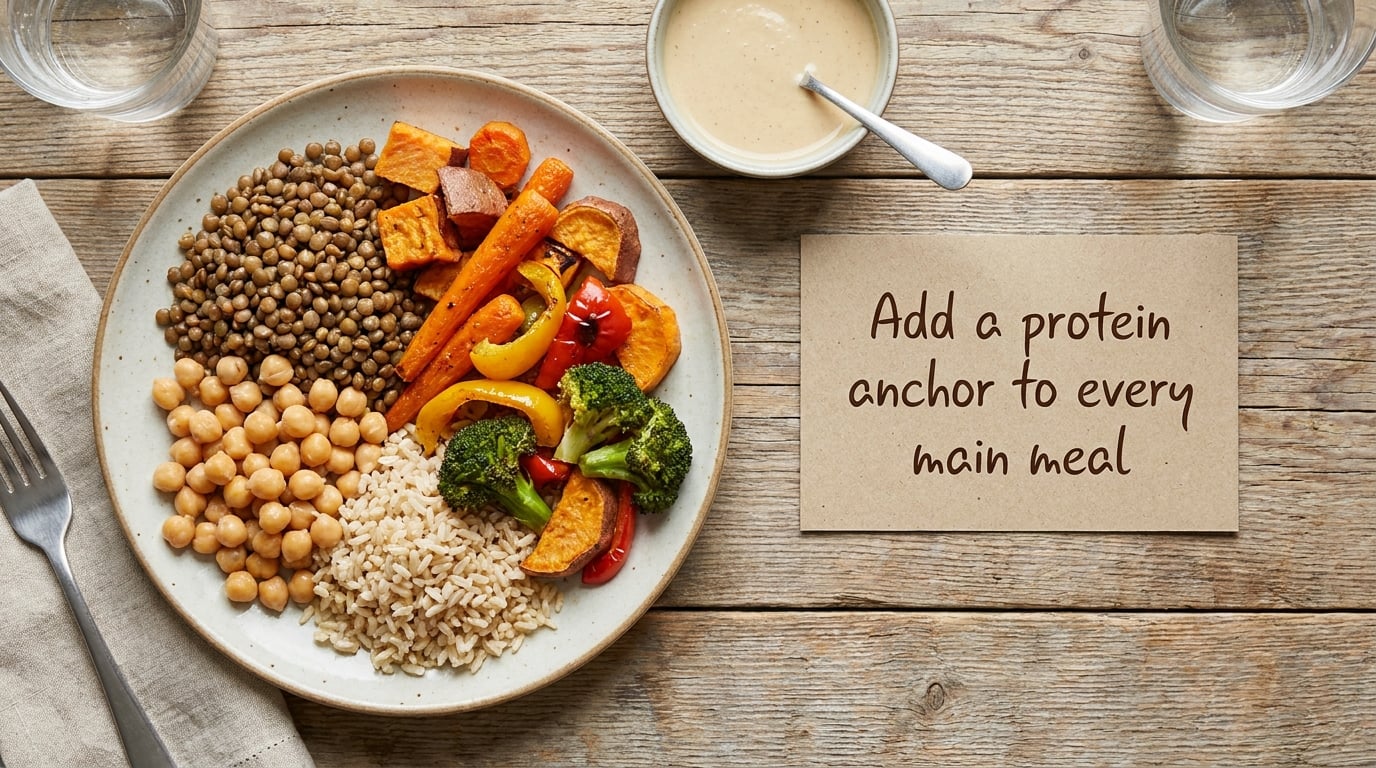
So instead of a plate of rice and salad, you make rice and salad plus a cup of lentils. Instead of pasta with tomato, you make legume pasta with a cup of white beans stirred through. The structure is identical; the protein number is not.
3. Spread protein across the day instead of one big serving
Most people try to cover the whole day’s target at dinner and then wonder why they feel full and still short. Splitting it is far easier. A day built around 25 to 30 g per occasion looks like this:
- Breakfast, about 28 g — 1 cup dry rolled oats with 200 g Greek yogurt, 2 tbsp peanut butter and a spoon of hemp seeds
- Lunch, about 30 g — 200 g firm tofu scrambled with 2 tbsp nutritional yeast, plus 1 cup cooked lentils and 1 cup quinoa
- Snack, about 14 g — 200 g soy yogurt with 30 g pumpkin seeds, or a cup of shelled edamame
- Dinner, about 32 g — 100 g seitan strips in a chickpea curry with brown rice, finished with tahini
That lands near 104 g across the day with nothing scooped into a glass. How to tell it worked: you can name the source for each meal without guessing, and no single meal felt like an obligation.
4. Pair plant proteins for more variety
Plants are not missing a building block you cannot replace. Legumes are relatively low in one amino acid and grains are relatively low in another, so eating both across the day covers the full set. Think beans with rice, hummus with whole wheat pita, lentil soup with a slice of sourdough, or black bean tacos on corn tortillas.
The per-day unit is what matters, not the per-meal one. Try pairing at least two plant protein sources somewhere in each day and you have already done more than enough. So do not treat a bowl of plain rice as a protein meal.
5. Use easy protein swaps for busy days
Low effort is the part most food lists ignore, and it is where people give up. Keep canned and shelf-stable options on hand so there is always something between cooking sessions:
- Swap chicken for 200 g of firm tofu in a stir-fry, or tempeh if you want more texture and fibre
- Swap ground meat for 1 cup of cooked lentils in a Bolognese or taco filling
- Throw a cup of shelled edamame into a salad or a soup for a silent 18 g
- Drain a can of cannellini or black beans and add them to a soup, a stew or a plate of grains
- Use eggs or Greek yogurt where you eat them, and tofu, soy yogurt or seitan where you do not
Roasted chickpeas and shelled edamame straight from the fridge get named repeatedly in vegetarian forums as the bridge between a cooking session and the next meal, and that is the gap this step is designed to close.
6. Plan meals before you get hungry
One batch-cook session covers most of the week. Cook a big pot of lentils and a pot of quinoa on a Sunday, roast a tray of tofu or tempeh, boil eggs if you eat them, and wash the vegetables. Portion everything into containers you can grab without thinking.
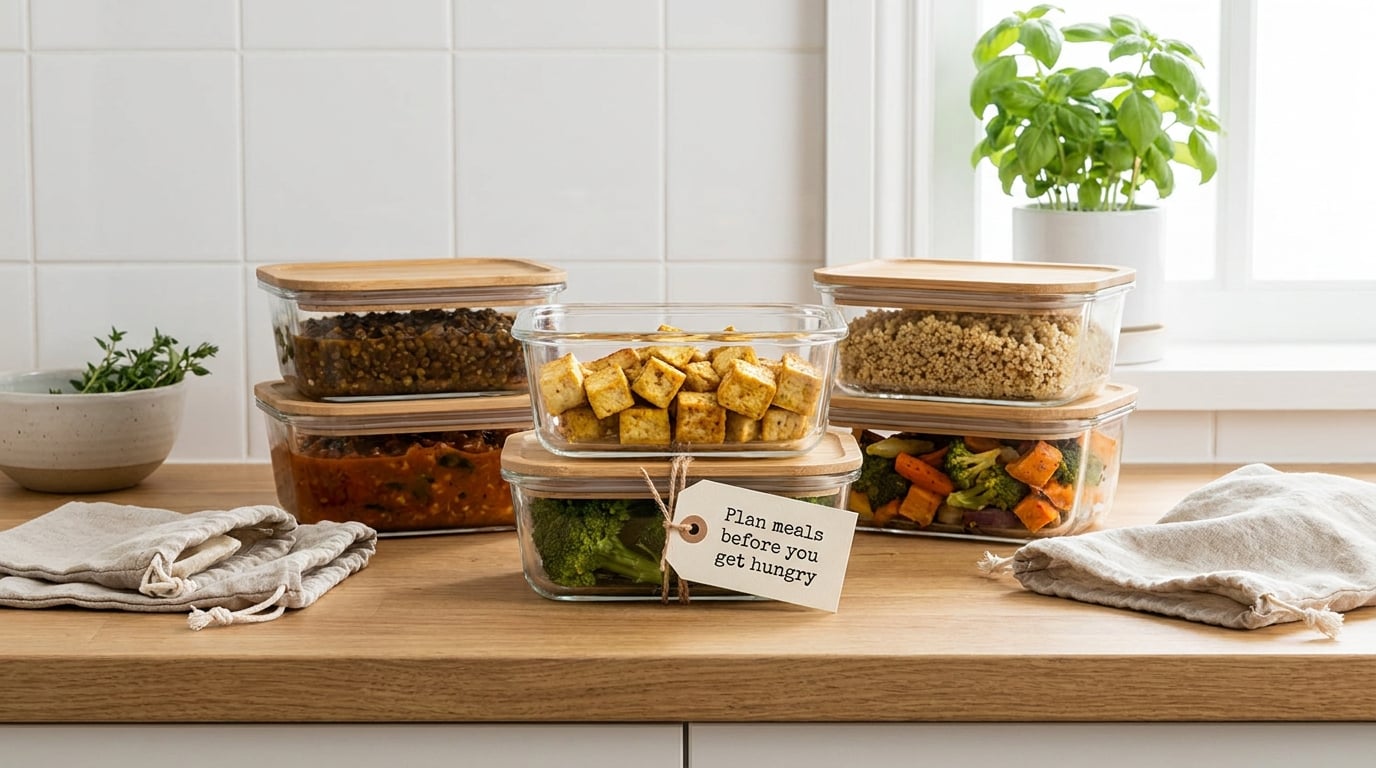
Then pick two protein sources for the week and one backup meal that needs no cooking at all — cottage cheese with fruit, soy yogurt with seeds, or whole-grain toast with peanut butter. Consistency is doing the work here, not perfection. How to tell it worked: you went three days without standing at the fridge deciding.
Common Mistakes
Relying on vegetables for the bulk of your protein
Spinach, broccoli and peppers are nutritious, but they carry a few grams per serving at most. Correction: build the plate around the protein anchor first, then add vegetables for volume and fibre. Tip: frozen peas are the exception worth keeping in the freezer, at roughly 8 g a cup.
Choosing portions that look healthy but measure small
A spoonful of beans is not a serving of beans. Correction: commit to real volumes — a cup of cooked lentils, 200 g of tofu, 100 g of seitan. Tip: measure once with a kitchen scale so your eye learns what 200 g looks like.
Skipping meals and then overeating at night
Missing a protein anchor at lunch guarantees a large deficit by evening, and no amount of food at 9 p.m. fixes a day that started empty. Correction: protect three eating occasions before you protect calories. Tip: if you compress your eating window, raise the protein density of each meal rather than skipping further.
Treating nuts and seeds as a meal anchor
Two tablespoons of peanut butter is about 7 g, which is a top-up rather than a foundation. Correction: pair them with something protein-dense, such as yogurt or a legume-based pasta. Tip: keep a jar of nut butter for closing gaps, not for replacing a meal.
Expecting one food to do everything
No single vegetarian food delivers a full day’s target in a portion anyone would actually eat. Correction: aim for two or three anchors across the day. Tip: rotate them so your amino acid intake stays wide and you do not get bored of the same dinner three nights running.
Ignoring under-eating signals
Constant hunger, low energy, slow recovery from training and hair shedding are all worth taking seriously. Correction: check your totals for a week before assuming nothing is wrong. Tip: speak to a doctor or registered dietitian if any of these show up, since they can have causes unrelated to protein.
Frequently Asked Questions
How much protein do I need on a vegetarian diet?
Most adults need about 0.8 g per kilogram of body weight daily, which is roughly 56 g for a 70 kg person. People who train for strength or endurance are usually advised 1.2 to 2.0 g/kg, so 84 to 140 g at that same weight. Vegetarian diets can reach either range with whole foods. A registered dietitian can set a target for your body, age and health status.
What are the best vegetarian protein sources without powder?
The densest everyday options are seitan at about 25 g per 100 g, cottage cheese around 22 g per 200 g, firm tofu at 20 to 25 g per 200 g, tempeh near 20 g per 100 g, and a cup of cooked lentils or shelled edamame at roughly 18 g each. Greek yogurt, chickpeas, canned beans, soy milk and nut butters fill in around 7 to 10 g per serving. Rotating two or three keeps the variety wide.
Do I need to combine plant proteins at every meal?
No. The older advice to combine proteins within a single meal applies to a narrow eating window. Across a full day of varied eating, legumes and grains appear together often enough that you get all nine essential amino acids without planning each plate. If you do eat them in the same meal, such as beans with rice or hummus with pita, you are simply adding margin. Aim for a varied day rather than a perfect plate.
Are nuts and seeds enough to meet protein needs?
On their own, no. Two tablespoons of peanut butter gives roughly 7 g and three tablespoons of hemp seeds about 10 g, so a handful will not cover a meal on its own. They are excellent top-ups, and pumpkin seeds, hemp, chia and flax also bring magnesium, iron and fibre. Use them to close gaps around anchors like yogurt, tofu, lentils and eggs, not as the main event.
Can a vegetarian diet provide enough protein for muscle growth?
It can, though it takes more deliberate planning than an omnivorous diet. Lifters commonly use ranges of 1.6 to 2.2 g per kilogram of body weight, so a 70 kg person would target roughly 112 to 154 g. That is reachable with seitan, soy, dairy and eggs where eaten, plus a consistent protein anchor at every meal. Anyone with a specific training goal should get individual advice from a registered dietitian.
How can I eat more protein if vegetarian meals make me feel full?
Make the protein source the volume, not the side dish. Fibrous vegetables, whole grains and nuts fill you up quickly, so swap some of them for higher-protein, lower-fibre options like cottage cheese, seitan, eggs, edamame or Greek yogurt. Choose tender tofu over very firm, and eat protein before the carbohydrate rather than last. Starting meals with the protein anchor often solves the problem on its own.
Conclusion
Start with the next three meals. Pick one protein anchor for each — Greek yogurt, tofu, lentils, seitan, eggs, whatever you will actually eat — and add one complementary food such as a grain, nuts or seeds. Then keep one no-cook meal ready for the days when nothing goes to plan.
A varied vegetarian diet meets a protein target without powder for most people, and it comes with fibre, iron and magnesium alongside. If your target is high, or you are training, pregnant, over 50 or managing a health condition, take your number to a registered dietitian rather than guessing. This is general information, not medical advice.
Updated for 2026.