
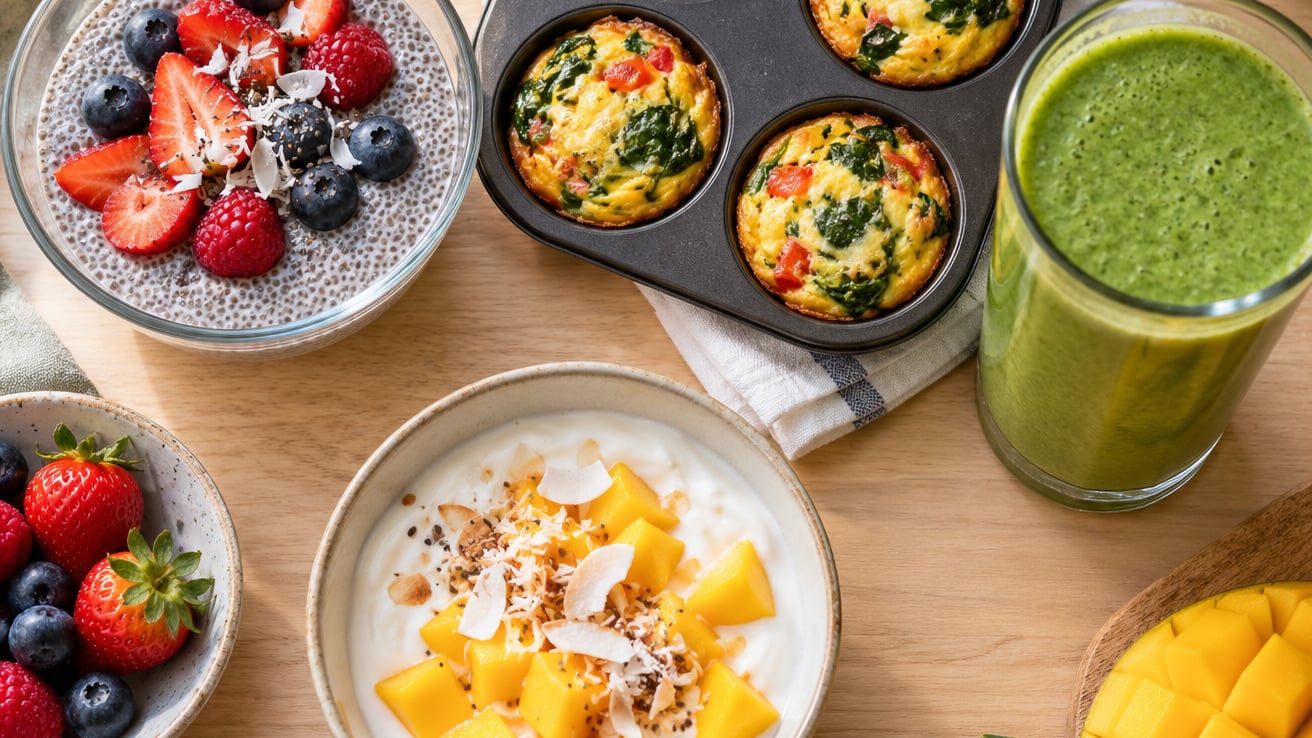
A grain-free breakfast is any morning meal built without wheat, rice, oats, barley, corn, millet, quinoa or buckwheat. Instead of starchy cereals and bread, you build it from eggs, yogurt, vegetables, fruit, nuts and seeds, which is why these healthy grain free breakfast ideas tend to hold you until lunch. Most take five to fifteen minutes, and every one below lists its prep time and a rough protein figure so you can pick by appetite and schedule.
Two things get skipped in most grain-free roundups. The first is non-egg breakfasts, even though egg fatigue is the most common complaint from readers on gluten-free forums. The second is what to do when a grain-free morning turns into leftovers at 2pm, so every idea here names its fiber and protein numbers and says whether it travels, freezes or reheats.
One note before you start. Whole grains are a solid part of many healthy diets, and going grain-free is not automatically better for you. If you have celiac disease, wheat allergy, IBS, PCOS or insulin resistance, or you are working around a diagnosed condition, talk it through with your doctor or a registered dietitian first. The recipes below are general food information, not medical advice.
Table of Contents
- Healthy Grain Free Breakfast Ideas at a Glance
- 1. Berry Chia Pudding with Almond Milk
- 2. Coconut Yogurt with Tropical Fruit
- 3. Egg Muffins with Spinach and Feta
- 4. Sweet Potato Breakfast Hash
- 5. Coconut Flour Pancakes with Berries
- 6. Avocado and Egg Toast, But Grain-Free
- 7. Green Smoothie with Greek Yogurt
- 8. Nut Butter and Fruit Stuffed Apples
- 9. Savory Breakfast Lettuce Cups
- 10. Overnight Coconut Chia Parfait
- 11. Breakfast Cauliflower Rice Bowl
- 12. Frozen Banana Oat-Free Smoothie Bites
- Where These Ideas Leave Gaps
- Frequently Asked Questions
- Conclusion
Healthy Grain Free Breakfast Ideas at a Glance
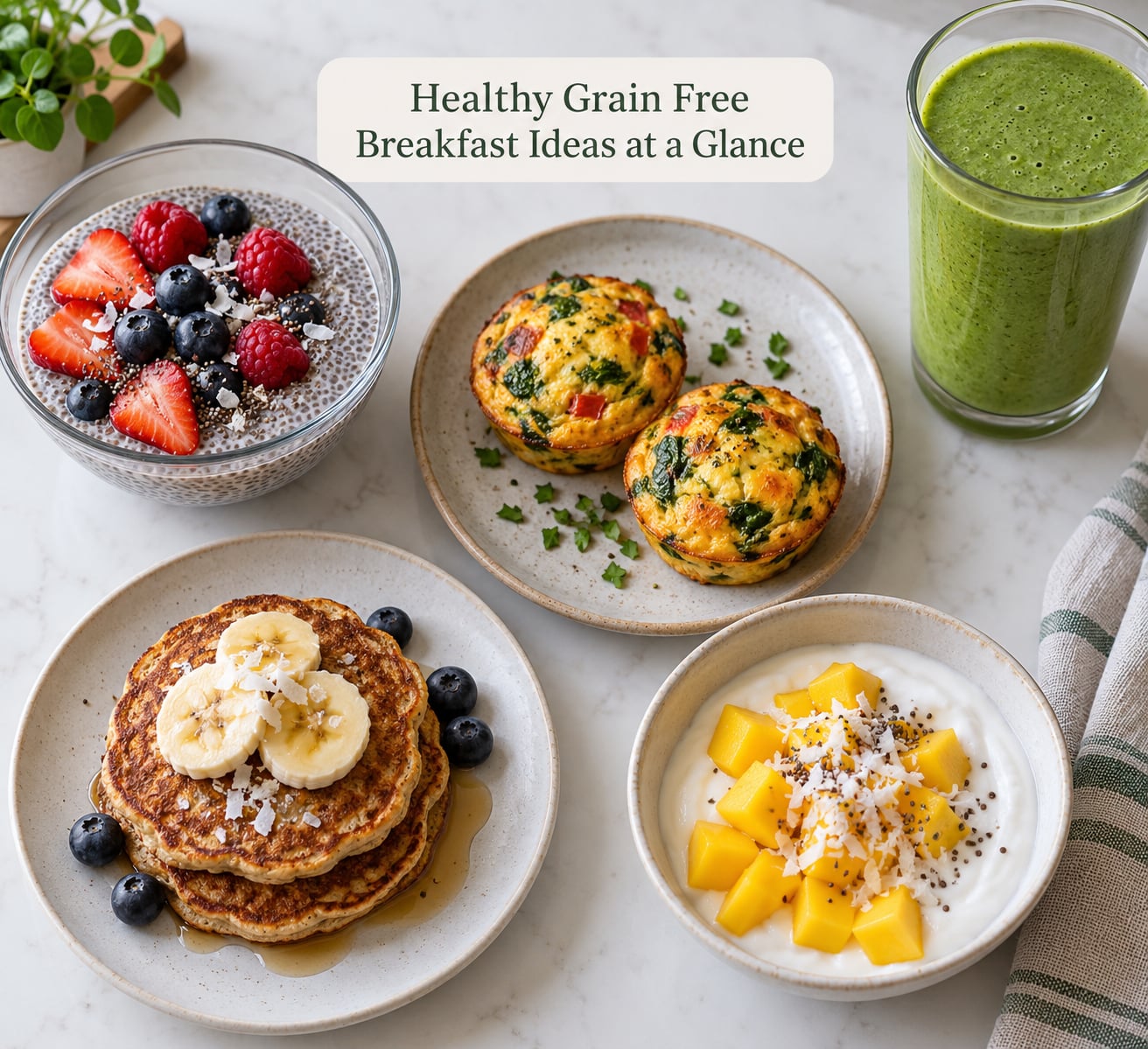
Macros below are per serving and approximate, based on typical ingredient amounts. Brands vary a lot, so treat them as a guide for comparing ideas rather than a nutrition label.
| Breakfast | Best time | Protein | Fiber | Meal prep | Travels well |
|---|---|---|---|---|---|
| 1. Berry chia pudding | Night before, 5 min | ~10 g | ~11 g | Yes | Spoon-in-jar only |
| 2. Coconut yogurt with tropical fruit | Any morning, 3 min | ~14 g | ~5 g | No, assemble fresh | Yes, in a cup |
| 3. Spinach and feta egg muffins | Batch Sunday, 25 min | ~18 g | ~1 g | Yes | Yes, cold or warm |
| 4. Sweet potato breakfast hash | Weekend, 30 min | ~16 g | ~6 g | Yes | Only in a sealed bowl |
| 5. Coconut flour pancakes | Weekend morning, 20 min | ~12 g | ~4 g | Batter freezes | Poor, eat at home |
| 6. Avocado and egg, no toast | Commute morning, 8 min | ~20 g | ~7 g | Partial | Yes |
| 7. Green smoothie with yogurt | Commute morning, 5 min | ~22 g | ~6 g | No, blend to order | Yes, in a sealed bottle |
| 8. Nut butter stuffed apples | Any morning, 10 min | ~8 g | ~6 g | Partly, bake ahead | Poor, gets watery |
| 9. Savory lettuce cups | Quick morning, 10 min | ~15 g | ~4 g | Filling only | Fill at the table |
| 10. Overnight chia parfait | Night before, 10 min | ~16 g | ~12 g | Yes | Layer in a jar |
| 11. Cauliflower rice bowl | Batch cook, 20 min | ~19 g | ~5 g | Yes | Yes, microwave at work |
| 12. Frozen smoothie bites | Freezer stock, 10 min | ~5 g | ~3 g | Yes | Yes, insulated bag |
1. Berry Chia Pudding with Almond Milk
This is the workhorse make-ahead breakfast. Stir three tablespoons of chia seeds into one cup of unsweetened almond milk, add a spoon of maple or monk fruit sweetener, and refrigerate overnight. The seeds swell into a loose, spoonable pudding that tastes a bit thick in the morning, which is exactly right.
Prep takes five minutes the night before and almost none in the morning. One serving lands near 10 grams of protein and about 11 grams of fiber, mostly from the seeds, so it is the most filling bowl on this list. Users on r/glutenfreecall chia pudding a repeat-make favorite for the same reason: you make it once and eat for three days.
Sweetness is the one thing worth adjusting. Ripe berries stirred in at the end release their own juice, so you can often halve the sweetener. Add a tablespoon of ground flaxseed if you want more fiber and less of a pudding texture, and a scoop of protein powder if you are training or you get hungry before ten.
How to make berry chia pudding filling and balanced
Two habits fix most watery chia bowls. Refrigerate at least four hours, and stir again right before eating because the seeds settle. For staying power, pair the pudding with a protein source rather than fruit alone: a spoon of almond butter, a dollop of Greek yogurt, or a handful of chopped walnuts all turn it into a meal instead of a snack.
Watch the ratio when you swap liquids. Almond, coconut and oat milks all set a loose chia mix, but oat milk is a grain, so it does not belong on a grain-free list. Use a 1:3 seed-to-liquid ratio at the start and go thicker with 1:2 if you want something you can scoop with a spoon.
2. Coconut Yogurt with Tropical Fruit
Three minutes, no heat, nothing to wash up. Scoop full-fat coconut yogurt into a bowl, pile on mango, pineapple and kiwi, then finish with chia or hemp seeds, shredded coconut and a small spoon of maple syrup. The fruit does most of the sweetening, so a modest drizzle is usually enough.
Full-fat coconut yogurt is the version worth buying. The low-fat versions are thinner and the protein drops noticeably, which makes the bowl less satisfying by mid-morning. Check the label for added sugar and pick the plain one, then sweeten it yourself. Thick, unsweetened Greek yogurt works too if dairy is fine for you and you want more protein per bite.
Swap the toppings with the season and you stop repeating yourself. In cooler months use baked apple, cinnamon and walnuts. In summer, a thick mango and passion fruit blend turns it into a smoothie bowl, and toasted pumpkin seeds add enough crunch that you can skip the granola entirely.
3. Egg Muffins with Spinach and Feta
Whisk eight eggs with a splash of milk, then fold through a cup of chopped spinach, a third cup of crumbled feta, dried oregano and black pepper. Pour into a greased 12-cup muffin tin and bake at 350°F for 18 to 22 minutes, until the centers are just set. Two of these is a breakfast.
Each muffin holds roughly 18 grams of protein, which makes this the highest protein-per-minute option here. It is also the most meal-prep friendly: a full tin freezes for up to two months, and a cooked muffin reheats in 30 seconds. Reheat until the center reaches 160°F, which is the same temperature you would use for any egg dish.
Storage matters more than most recipes admit. Refrigerate cooked egg muffins in a sealed container and eat them within four days, or freeze them on a tray first so they do not stick together. If they are for someone with celiac disease, use a dedicated pan and utensils, since egg is a common hidden carrier for cross-contamination in shared kitchens.
4. Sweet Potato Breakfast Hash
Roast a medium sweet potato in small cubes at 425°F for about 20 minutes, then transfer it to a hot skillet with olive oil, greens and a pinch of salt. Press it down, leave it five minutes without touching it, and you get a crust instead of a pile. Top with two fried or poached eggs, sliced avocado and salsa.
The soggy hash problem is entirely about moisture. Roast the potato separately rather than steaming it, use a cast iron or stainless pan with a little oil, and do not stir until a golden layer has formed. Wringing the shredded potato in a towel first helps, but small roasted cubes need far less work than shredded ones.
Cook the eggs any way you like, just to a firm white and a yolk you prefer. Some mornings I scramble them into the hash at the end, some mornings I leave them on top. The whole plate lands near 16 grams of protein and 6 grams of fiber and reheat well in a skillet or microwave.
5. Coconut Flour Pancakes with Berries
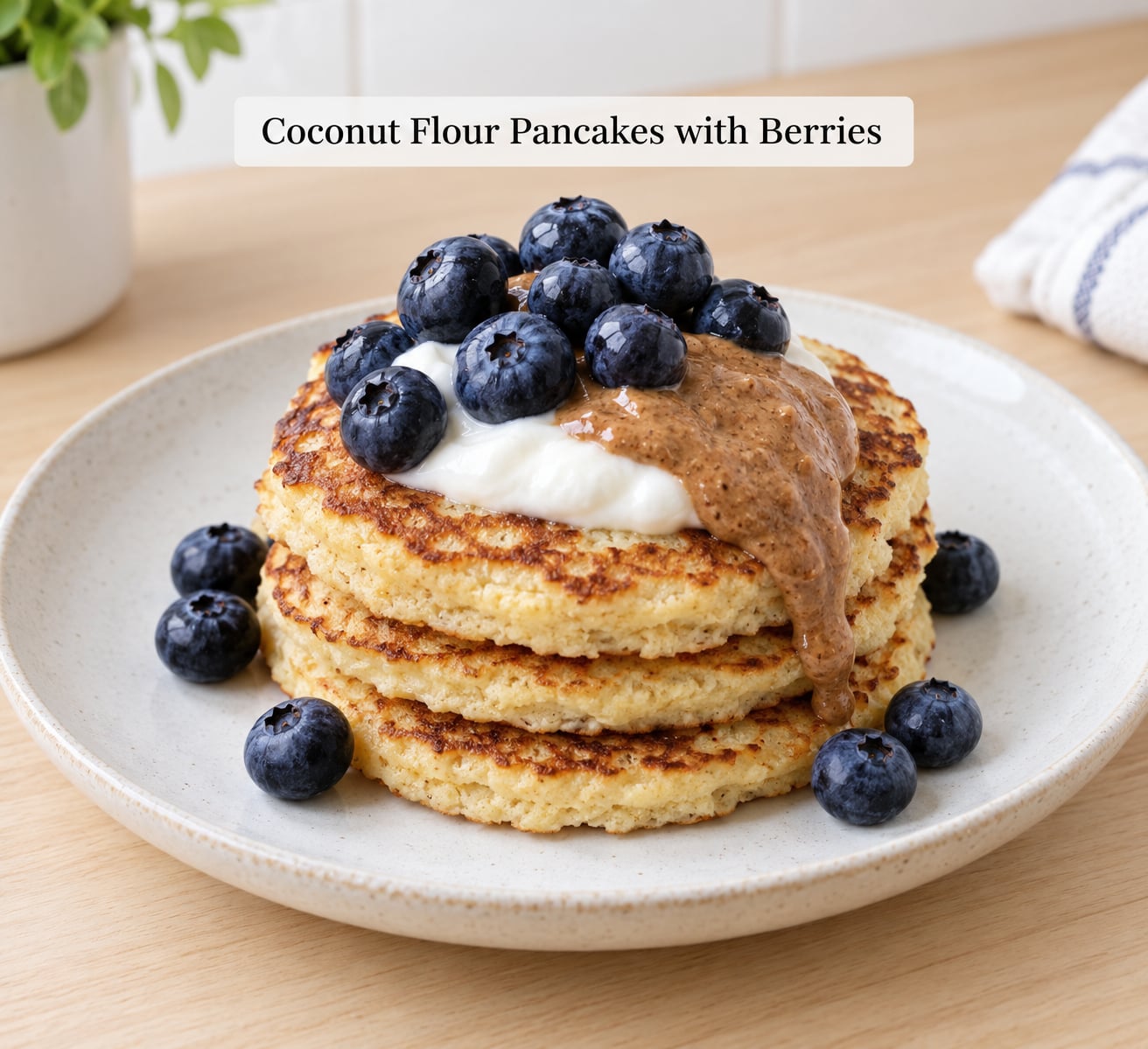
Coconut flour pancakes get dry, and the fix is not more liquid in the batter. Use one third cup of coconut flour per egg plus two tablespoons of almond or oat-style yogurt alternative, rest the batter for ten minutes so the flour hydrates, and cook on medium-low heat only.
Coconut flour is four times thirstier than wheat flour by weight, so it needs eggs to bind and a source of fat for browning. One egg plus one third cup flour makes two small pancakes. Skip the flour entirely if you want a faster version: a banana, two eggs and a spoon of almond butter blend into a three-ingredient pancake that needs no flour at all.
For a balanced plate, top with plain yogurt, a thin layer of nut butter and a handful of fresh berries. Berries and yogurt bring the plate back to roughly 12 grams of protein and 4 grams of fiber, and they take the edge off how sweet the batter tastes on its own.
6. Avocado and Egg Toast, But Grain-Free
Most grain-free versions of this one fall apart, so keep it simple. Mash half an avocado onto a small flour-free corn tortilla or a thick slice of roasted sweet potato, add softly scrambled eggs, thin tomato slices, a pinch of chili flakes and a squeeze of lime. Everything is soft, so nothing needs a fork beyond the first bite.
The tortilla is a swap, not a rule. If corn is not part of your definition of grain free, a large crisp lettuce leaf or two thick slices of cucumber work just as well, and cucumber holds its crunch better. Roasted sweet potato slices are the warmest option and the most filling at about 7 grams of fiber with the avocado.
This is the 8-minute breakfast for people who want a savory plate they can eat off a plate rather than out of a container. Assemble the avocado and eggs in the morning, hold the sliced tomato separate in a small dish so it does not water the avocado, and the whole thing still holds up to a drive across town.
7. Green Smoothie with Greek Yogurt
Blend a frozen banana, a packed cup of spinach, a half cup of berries, three quarters of a cup of Greek yogurt, a tablespoon of chia or hemp seeds and enough water or unsweetened almond milk to reach drinkable thickness. Around 22 grams of protein, six of fiber, and it takes about the same time as boiling an egg.
Texture problems in a green smoothie usually come from the greens, not the fruit. If it tastes like grass, the spinach was probably too tender or too small an amount, so blend the liquid and fruit first, add spinach, then drop the yogurt in last. A tablespoon of nut butter also rounds out a thin blend and adds staying power.
Balanced beats sweet here. A fully ripe banana plus berries is enough, and you do not need juice or syrup, which is where most homemade smoothies quietly pick up 15 grams of sugar. If you are making one for a child, the same formula works with more fruit and a smaller handful of spinach, and there are more ideas in our guide to smoothies kids actually drink.
How to blend a grain free smoothie that keeps you full
Order of ingredients decides almost everything. Liquid first, then frozen fruit, then greens, then protein, then fat. This gives the blender something to grab the greens and stops powder from sticking to the walls.
For a filling breakfast rather than a drink, aim for at least 20 grams of protein. Greek yogurt, cottage cheese, silken tofu and a scoop of protein powder all get you there, and adding a tablespoon of flaxseed or chia seeds brings fiber to about six grams. Blend it thick enough to eat with a spoon and it stops reading as a snack.
8. Nut Butter and Fruit Stuffed Apples
Core an apple, leave the base intact so it holds, and fill the hollow with two tablespoons of almond or peanut butter. Add a spoonful of raisins or chopped dried dates, a dusting of cinnamon and a tablespoon of pumpkin seeds. Bake at 375°F for 18 to 20 minutes until the apple softens and the filling softens with it.
Eaten raw, this is a five-minute job. Baked, it tastes like dessert and warms you up in February, and the softened apple flesh is easier to digest than a raw one if your stomach is not cooperating. Skip the raisins if you are watching sugar, since a small handful of fresh chopped apple inside the same apple works fine.
One apple with nut butter lands near 8 grams of protein and 6 grams of fiber, which is a decent light start but a small one if you are running to a workout. For that, double the filling or serve it alongside a boiled egg. These travel badly once cut, so this is a sit-down breakfast or a quick stop, not a commute meal.
9. Savory Breakfast Lettuce Cups
Separate the leaves from a head of romaine or butter lettuce, rinse them and dry them thoroughly. Fill each cup with scrambled egg or crumbled tofu, then add diced avocado, cherry tomato, cucumber and a scattering of fresh herbs. A pinch of salt and a squeeze of lime is the whole dressing.
For tofu, press half a block for 10 minutes, crumble it into a hot pan with turmeric, cumin and black pepper, and cook until the moisture cooks off. The seasoning does the work, and the texture is closer to scrambled egg than most people expect on the first try.
Dry leaves are the whole trick. Wet lettuce dilutes anything you put in it, so spin or pat the cups dry after washing and fill them at the table rather than packing them assembled. Each cup is light at about 15 grams of protein with the egg, which makes this a good option when a heavy savory breakfast feels wrong.
10. Overnight Coconut Chia Parfait
Layer it in a glass jar: coconut chia pudding on the bottom, plain yogurt in the middle, berries and chopped nuts on top. The layers matter more than they sound, because the yogurt sits at eye level and keeps the pudding from sliding to the bottom of the jar by lunchtime.
Make the pudding the night before with a cup of coconut milk, three tablespoons of chia and a sweetener, then layer in the morning. You are looking at about 16 grams of protein and 12 grams of fiber per jar, the highest fiber count on this list, and the nuts add the crunch that plain yogurt does not have on its own.
Toasted or raw nuts both work, and a spoon of pumpkin seeds makes it nut-free without much fuss. This is the best of the twelve for a workday, since it eats from a jar at your desk and survives a bag with an ice pack. Keep it cold all morning and the layers stay distinct.
11. Breakfast Cauliflower Rice Bowl
Brown a cup of frozen cauliflower rice in a hot, lightly oiled pan for 6 to 8 minutes until it looks dry and a little crisp. Push it to one side, add two scrambled eggs or a half block of pressed tofu, and finish with wilted spinach, sliced avocado and salsa.
Watery cauliflower rice is the only real risk. Use a hot pan rather than a low one, do not crowd it, and let it sit undisturbed for a couple of minutes at the end so it crisps instead of steams. Patting it dry with a paper towel after thawing helps more than any other step.
With egg this bowl runs about 19 grams of protein and 5 grams of fiber, and it batches well: cook a double portion of rice, keep it separate from the egg, and assemble two or three mornings’ worth. It reheats in a microwave in about 90 seconds, and salsa on top keeps it from tasting like reheated leftovers.
12. Frozen Banana Oat-Free Smoothie Bites
Blend two frozen bananas, four dates, two tablespoons of almond butter, a tablespoon of cacao powder and a splash of water into a thick paste. Roll it into tablespoon-sized balls, press a few pumpkin seeds into each, and freeze on a lined tray for two hours before moving them to a container.
They keep for about two months frozen and thaw in about 15 minutes on the counter, which is roughly how long it takes to get dressed. Two bites is a small breakfast, around 5 grams of protein and 3 grams of fiber, so pair them with a boiled egg or a handful of walnuts if you are hungry by ten.
This is a nut-free-friendly option if you swap sunflower seed butter for the almond butter, and the dates do all the sweetening so there is no added sugar. They are also the easiest of the twelve to hand to a child who has decided smoothies are not breakfast, which is a recurring problem in our own house.
Where These Ideas Leave Gaps
Two things readers ask about constantly are worth a short note outside the list. The first is protein on a plant-based version of these meals, which is harder to hit with yogurt and eggs removed. This guide to getting more protein in a plant-based breakfast covers the swaps in more detail.
The second is oats. Oats are a grain, and many people who react to them find that even certified gluten-free oats still upset them. If you want the thick, warm breakfast-bowl texture without oats, coconut chia pudding and the parfait above get you most of the way, and you can add a scoop of maca powder for the earthiness that normally comes from grain.
One label habit worth building for anyone eating this way long term: check sauces, dressings, granola bars and protein powders for malt, brewer’s yeast, wheat starch and soy sauce, which all bring grain in without tasting like it. Celiac disease also makes shared toasters, fryers and colanders a real risk, not a theoretical one.
Frequently Asked Questions
What can I eat for breakfast without grains?
Eggs, Greek yogurt or cottage cheese with berries and nuts, smoothies with fruit and spinach, chia pudding, avocado with scrambled eggs, cauliflower rice bowls, lettuce cups, stuffed apples and coconut flour pancakes all work. The pattern is protein plus fat plus fiber instead of starch, which is what keeps you full until lunch.
Are eggs and yogurt grain-free breakfasts?
Yes. Eggs and plain yogurt come from animals, not grasses, so neither contains grain. Plain yogurt is the better option because flavored varieties often carry added sugar and thickeners. Check labels anyway, since some flavored yogurts use wheat-based stabilizers or malt flavoring.
Is quinoa or millet allowed on a grain-free diet?
Quinoa, millet, buckwheat and amaranth are seeds, not true grasses, so they are technically grain-free. Most people who remove grains want the lower carbohydrate load those foods bring, so they usually leave them out too. If your reason is celiac disease, the question does not arise, since none of them contain gluten.
What is the best grain-free breakfast when I am sick of eggs?
The chia pudding, the coconut yogurt bowl, the green smoothie, the stuffed apple and the frozen smoothie bites on this list contain no eggs at all. The lettuce cups and cauliflower rice bowl take crumbled tofu instead, and the pancakes work with a banana and two eggs swapped for flax and aquafaba if you are avoiding them completely.
How do I meal prep grain-free breakfasts for the week?
Sunday, bake a tin of egg muffins, blend a jar of chia pudding, cook a double portion of cauliflower rice and freeze a tray of smoothie bites. Store each item separately, keep cooked eggs refrigerated and eat them within four days, and freeze anything you will not reach before Wednesday.
How can I make these breakfasts healthier?
Watch the three easy places sugar sneaks in: flavored yogurt, granola and nut butter. Pick plain versions, skip granola entirely or make a nut-and-seed version, and choose nut butter with only nuts and salt on the label. Adding a vegetable or a full handful of berries usually improves the balance more than anything else you change.
Conclusion
Start with the one that matches your morning rather than the one that sounds healthiest. If you cook nothing on weekdays, the coconut yogurt bowl or the avocado and egg plate take under ten minutes. If Sunday is free, the egg muffins and chia parfait cover half the week on their own, and the frozen bites keep working in the freezer for two months.
Build the rest around protein, fat and fiber, and pick the version that fits the dietary limits you actually have rather than the strictest version you can imagine. If you are managing a diagnosed condition, bring the plan to a registered dietitian before you start, since that is a conversation worth having with someone who knows your history.
Last updated October 2026.