
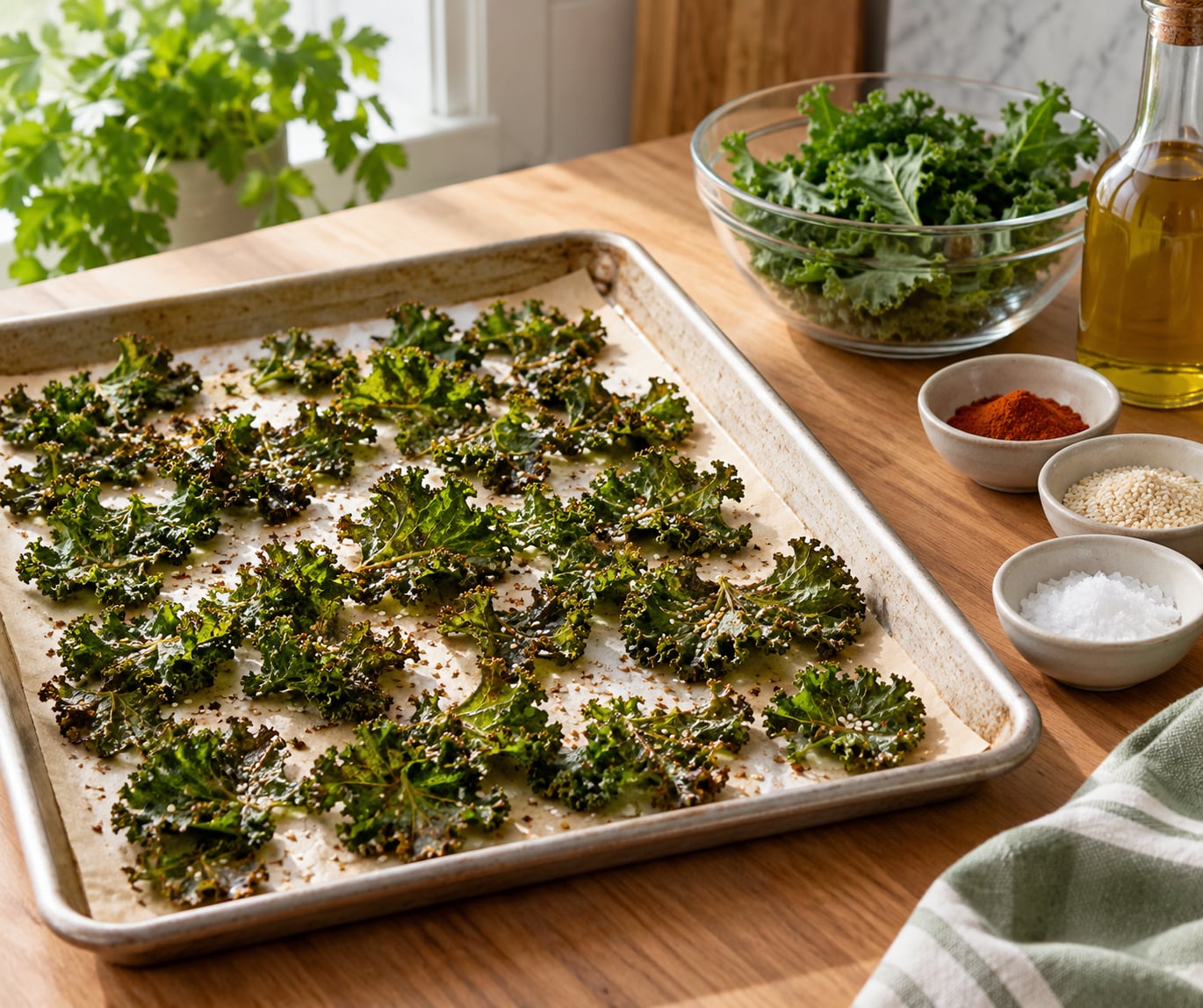
To make kale chips in the oven, tear one bunch of kale into bite-size pieces, toss it with about 2 teaspoons of olive oil and salt, spread it in a single layer on a parchment-lined sheet pan, and bake at 350F (175C) for 10 to 16 minutes until the edges look crisp. Prep takes 10 minutes, the oven does the rest, and no dehydrator is needed.
The whole thing depends on one thing most people skip: getting the leaves properly dry. Wet kale steams inside the oven instead of crisping, and you end up with chewy dark-green flakes instead of chips.
Table of Contents
What You Need
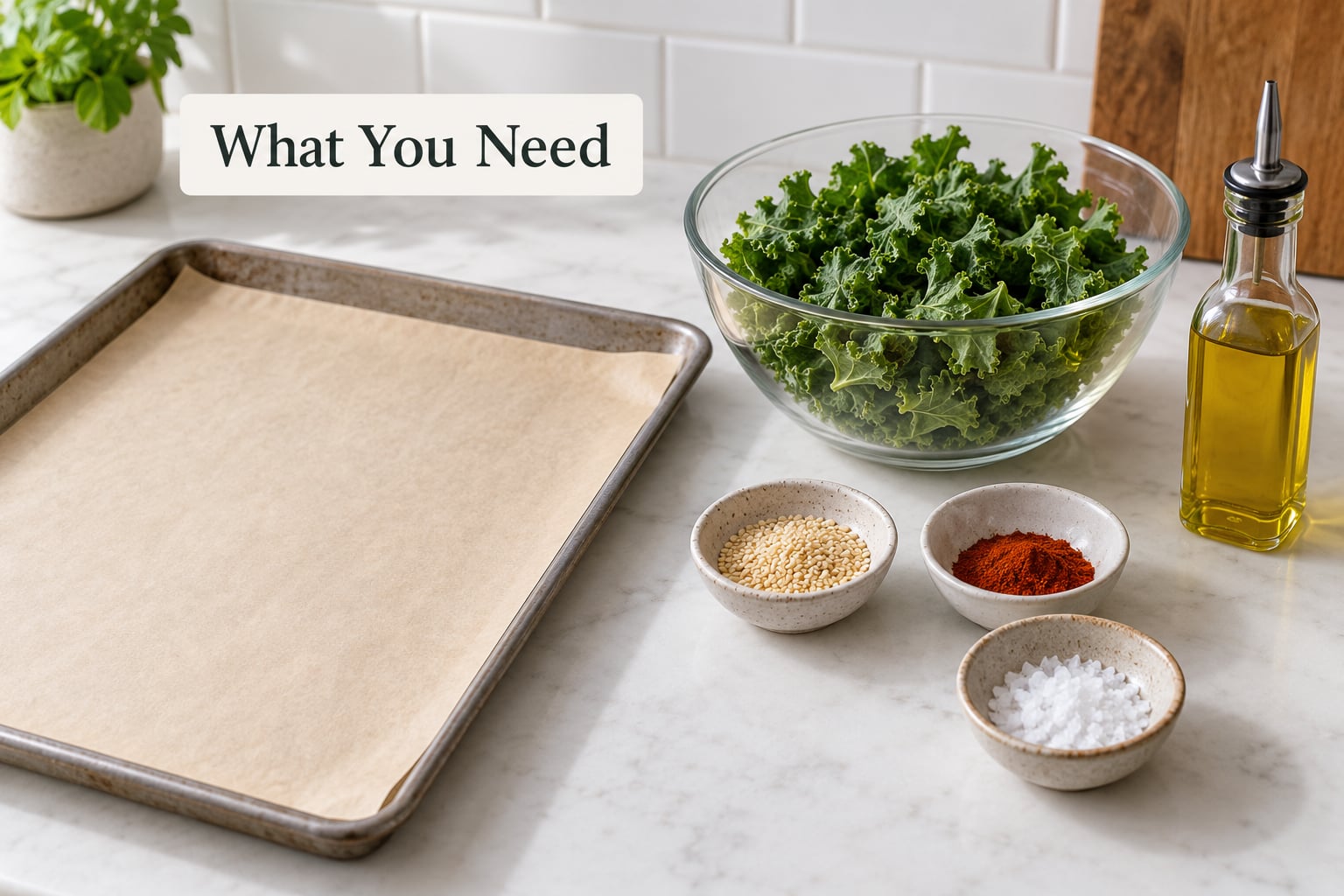
This makes about two servings from one bunch of kale. Kale shrinks by more than half as it bakes, so buy a bigger bunch than feels reasonable.
- 1 bunch kale (about 6 cups packed), stems removed and leaves torn into 2-inch pieces
- 2 teaspoons extra virgin olive oil, plus a little more for the pan
- 1/2 teaspoon kosher salt or flaky sea salt
- 1 teaspoon garlic powder and 1/2 teaspoon smoked paprika for a basic savory version
- Optional: 1/4 cup grated Parmesan, 1 teaspoon nutritional yeast, everything bagel seasoning, or a pinch of chile powder
Tools: two rimmed baking sheets, parchment paper, a salad spinner, and a clean kitchen towel. The spinner is the single most useful tool here. Paper towels alone leave enough surface moisture behind to soften the chips.
Any kale works, but Lacinato (also called dinosaur or Tuscan kale) gives the biggest, crunchiest chips with the mildest flavor. Curly kale crisps fine too and holds seasoning well. Bagged baby kale is the easiest option since it arrives pre-washed and already dry, which is why so many home cooks reach for it.
If you buy a whole bunch and only use part of it, keep the rest in the fridge rather than freezing it for chips. Our guide to freezing spinach and kale for smoothies covers the part that goes into the blender instead.
Step-by-Step: How to Make Kale Chips in the Oven
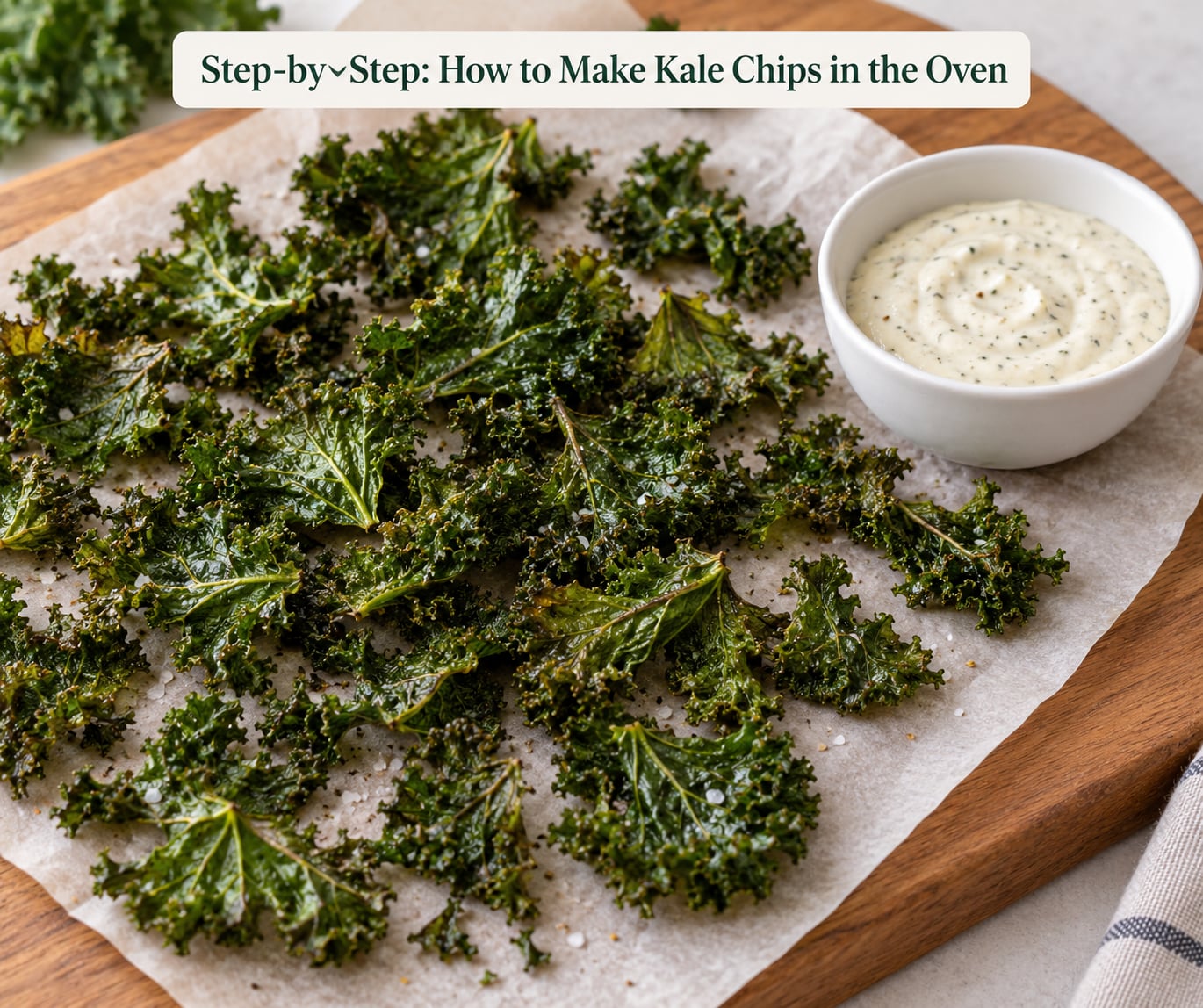
Step 1: Wash and Dry the Kale Thoroughly
Hold the stem end of each leaf and pull the leaves off in an upward strip, then slice the thick rib out of any big pieces. Cut or tear everything into pieces roughly 2 inches wide, and try to keep sizes similar so they finish at the same time.
Rinse the pieces in a bowl of cold water, lift them out, and spin them in a salad spinner for several full cycles. Keep spinning until the water in the bowl runs clear and the leaves feel almost papery rather than cool and damp.
Now the less glamorous part that decides the batch: lay the kale on a clean towel, roll it up, and press firmly to wick out what the spinner missed. Spread it back out on the towel for a few minutes before you season it.
Step 2: Season the Kale Before Baking
Put the dried kale in a large bowl, drizzle the olive oil over it, and toss with your fingers until every piece looks lightly glossy. Then add the salt, garlic powder and paprika, tossing again so the seasoning spreads evenly.
Work with your hands rather than a spoon. Massage each piece for a few seconds so the oil coats both sides, and keep the pieces loose. Clumps of kale steam against each other, and seasoning buried inside a clump never reaches the surface where you can taste it.
Go easy on the salt. Kale loses more than half its volume in the oven, so what tastes right in the bowl gets noticeably stronger by the time it comes out.
Step 3: Bake Until the Edges Are Crisp: How Long to Bake Kale Chips
Heat the oven to 350F (175C) and line two rimmed baking sheets with parchment. Arrange the kale in a single layer with no touching pieces. If everything will not fit, bake in batches rather than piling it up, since crowding traps the steam that would have crisped the leaves.
Bake for 10 to 16 minutes. Small, thin pieces finish in about 10; large, thick pieces take closer to 16. At the halfway mark, swap the two sheets and rotate each one, so the outer edges do not darken before the middle pieces crisp.
You will know they are done when the leaves look shrunken and matte-dark, the edges curl slightly, and the thickest pieces bend without snapping. Take one out and let it cool on the pan for 30 seconds. It should feel rigid and crackle when you press it. If it bends like a cooked green bean, give it another 2 to 3 minutes.
Different recipes online disagree about temperature because they are describing different jobs. This table covers the main ones:
| Temperature | Bake time | Best for |
|---|---|---|
| 170F (75C) | 60 to 90 minutes | The closest oven substitute for a dehydrator. Very slow drying, brightest color, least risk of burning, but it ties up the oven. |
| 300F (150C) | 18 to 22 minutes | Thicker leaves or very humid kitchens. Gentler browning, more even drying, a slower batch. |
| 325F (165C) | 14 to 18 minutes | A forgiving middle ground that works well with Parmesan or nutritional yeast coatings. |
| 350F (175C) | 10 to 16 minutes | The standard method. Fast, crisp, and the easiest to get right on a first try. |
| 400F (200C) | 6 to 8 minutes | Watched closely, for small torn pieces only. The risk here is cooking the kale instead of drying it, which leaves a bitter, sulfurous taste. |
Step 4: Cool and Store the Kale Chips
Slide the pan onto a cooling rack and leave the chips alone for at least 5 minutes. Chips straight out of the oven are still releasing steam, so eating them too early often feels papery even though the batch is fine.
For longer crunch, let them cool completely in the pan or on a rack, uncovered, for 15 to 20 minutes. They get noticeably crisper as they finish drying on the rack.
Store the finished chips in an airtight container with a paper towel tucked inside, somewhere dry and away from the stove. They stay crisp for about 5 to 7 days in the fridge. If they soften, spread them on a baking sheet and re-crisp in a 250F (125C) oven for 5 minutes; most of the time that is enough to bring them back.
Common Mistakes and How to Fix Them
The chips are soggy or leathery. The kale was too wet when it went in, or the pan was crowded. Wet leaves release steam that has nowhere to go, so they cook instead of drying. Spin and towel the kale harder, and always use a single layer.
The small pieces burned while the big ones stayed chewy. Uneven sizes plus one oven means uneven cooking. Tear everything closer to the same size, and take the small edge pieces off the pan a couple of minutes early. Rotating the sheets halfway helps too.
The chips taste bitter or dull green. The temperature was too high for that batch. High heat cooks the leaves and drives off the bright flavor. Drop to 325F, add a few minutes, and accept the color you get.
The seasoning disappeared. It went on before the leaves were dry, or it was applied too early. Salt on damp kale dissolves and runs off the sheet. Season after the kale is dry, and use a light hand on salt in particular.
The chips turned soft a day later. Storage was too moist. Any trapped condensation makes chips limp. Wipe the container with a paper towel before you fill it, keep the towel inside, and skip the fridge if you have a cool, dry cupboard.
The leaves came out tough rather than crunchy. The ribs were left on, or the pieces were baked too long at high heat. Strip every rib and skip any leaf with a thick stem. Batches also tend to get eaten fast, so plan on making a second tray rather than stretching one.
Flavor Ideas and Serving Suggestions
Once you have the basic technique down, the seasoning is where it gets interesting. Because the flavor concentrates as the kale shrinks, change one thing at a time so you know what you like.
- Parmesan and garlic: add 1/4 cup grated Parmesan during the toss and a handful at the end while the chips are still hot. The cheese crisps and hardens into a shell. Best on 325F rather than 350F.
- Everything bagel: 1 tablespoon everything bagel seasoning with a light oil drizzle. This one disappears fast, often before the batch finishes baking.
- Chile and lime: 1 teaspoon mild chile powder, the zest of one lime and a squeeze of juice added after baking. The citrus brightens chips that taste flat.
- Nutritional yeast: 2 tablespoons tossed in with the oil for a cheesy, dairy-free version that browns nicely.
- Oil-free: skip the oil entirely, use salt, pepper and garlic powder, and bake at 300F for 18 to 22 minutes. The texture is lighter and less rich, and it works well for anyone watching fat intake.
- Tahini and lemon: thin a couple of spoonfuls of tahini with lemon juice and water for a drizzle after baking. Our tahini dressing method takes the bitterness out so it works as a dip too.
Kale chips do more than sit in a bowl. Crush them over a salad in place of croutons, scatter a few on soup just before serving, or stand them next to a burger or tuna sandwich. They travel well for lunchboxes, and they turn a bowl of leftovers into something a picky eater will actually pick at.
If you serve them alongside a drink, a bright carrot juice pairs well with the smoky paprika version. We have a blender method in how to make carrot juice with a blender that takes about five minutes.
Frequently Asked Questions
Why are my kale chips not crispy?
Kale chips stay soft when the leaves went into the oven damp or when the pan was crowded. Both trap steam, and steaming leaves can never crisp. Spin the kale until the water runs clear, press it in a towel, and bake a single layer with no touching pieces at 350F for 10 to 16 minutes.
How long should kale chips be in the oven?
At 350F (175C), bake kale chips for 10 to 16 minutes. Small, thin pieces finish around 10 minutes, while thick pieces need closer to 16. Rotate the pans at the halfway mark and pull the pan when the edges curl and the thickest piece snaps instead of bending.
Do kale chips need oil?
Oil helps. A light coat speeds up crisping and carries seasoning, and 2 teaspoons for one large bunch is plenty. You can bake kale chips without oil, though: use salt, pepper and garlic powder instead and bake at a lower 300F for 18 to 22 minutes. The result is lighter and less rich.
How long do kale chips last and how do I keep them crisp?
Stored in an airtight container with a paper towel inside, kale chips stay crisp about 5 to 7 days in the fridge. Let them cool completely on a rack before sealing the container, since chips packed warm will trap steam and go soft. Refresh them at 250F for 5 minutes.
Can I use any kind of kale for chips?
Curly, Lacinato (dinosaur) and Tuscan kale all work, and prewashed baby kale is the most forgiving since it starts dry. Lacinato gives the biggest, mildest chips, while curly kale holds seasoning well and crisps with more bite. Remove every rib, since the stem stays tough no matter how long you bake it.
Does baking kale chips destroy the nutrients?
No. Kale is a cruciferous vegetable, and light oven baking keeps its fiber, vitamin K, vitamin C and much of its folate. Heat does reduce some vitamin C, so very high, long bakes like 400F burn off more than a 350F bake. For the most nutrients, eat the greens fresh and treat the chips as a snack.
Conclusion
Start with the boring step: dry the kale until it feels papery, not cool. Spread it in a single layer on a parchment-lined pan, season lightly, and bake at 350F for 10 to 16 minutes, rotating the pans halfway. Cool the chips fully on a rack before you eat or store them, and re-crisp any that soften at 250F for 5 minutes.
Once that batch works, swap the seasoning and see how far you can push it. Parmesan and garlic, everything bagel, chile and lime and a straight oil-free version all use the same method, so the only variable is what you put on the leaves.